





| Research Article | ||
Open Vet. J.. 2026; 16(3): 1725-1733 Open Veterinary Journal, (2026), Vol. 16(3): 1725-1733 Research Article Anti-Psoriatic activity of Coffee liberica pulp extract on Imiquimod-induced Psoriasis-like dermatitis in Balb/C miceMishalini Vijayakumaran1, Monisha Thanka Velu2, Azrina Zainal Abidin2, Hasnah Bahari3, Fezah Othman4, Goh Khang Wen5,6, Mahardian Rahmadi7,8 and Santhra Segaran Balan2*1School of Graduate Studies, Management and Science University, Shah Alam, Malaysia 2Department of Diagnostic and Allied Health Sciences, Faculty of Health and Life Sciences, Management and Science University, Shah Alam, Malaysia 3Department of Human Anatomy, Faculty of Medicine and Health Sciences, Universiti Putra Malaysia, Serdang, Malaysia 4Department of Biomedical Sciences, Faculty of Medicine and Health Sciences, Universiti Putra Malaysia, Serdang, Malaysia 5Faculty of Business and Communication, INTI International University, Nilai, Malaysia 6Faculty of Mathematics and Natural Sciences, Universitas Negeri Padang, Padang, Indonesia 7Department of Pharmacy Practice, Faculty of Pharmacy, Universitas Airlangga, Surabaya, Indonesia 8Biomedical Pharmacy Research Group, Faculty of Pharmacy, Universitas Airlangga, Surabaya, Indonesia *Corresponding Author: Santhra Segaran Balan. Department of Diagnostic and Allied Health Sciences, Faculty of Health and Life Sciences, Management and Science University, Shah Alam, Malaysia. Email:santhra [at] msu.edu.my Submitted: 12/09/2025 Revised: 30/01/2026 Accepted: 12/02/2026 Published: 31/03/2026 © 2026 Open Veterinary Journal
AbstractBackground: Psoriasis, also known as Psoriasis (Pso), is a persistent skin disorder characterized by erythematous, indurated, scaly, itchy, and often painful plaques. Although conventional medicine has been employed to treat psoriasis, it may cause adverse effects owing to its long-term use. Consequently, alternative medicine has become a popular option to address this issue. Coffee liberica pulp, a commonly overlooked waste product, has been found to have numerous benefits for humans. Aim: This study investigated the effectiveness of Liberia coffee pulp extract using an imiquimod (IMQ)-induced mouse model that replicated several features of psoriasis in humans. Methods: The study involved applying IMQ cream and other topical treatments to the shaved dorsal skin of mice. The psoriasis Area and Severity Index score, body weight, organ weight, expression of interleukins in the skin and serum, and full blood count were measured. Results: The results showed significant changes (p < 0.05) in skin weights in the negative control group compared with other groups. No significant changes in other organ weight were observed in any groups. However, the full blood count revealed significant changes (p < 0.05) in haemoglobin and white blood cell counts. The levels of interleukin 17a, interleukin 22, and interleukin 23 levels showed significant differences (p < 0.05) between the positive and treatment groups. Conclusion: This study found that C. liberica pulp has anti-inflammatory and antioxidant properties that help reduce skin inflammation. These findings suggest that C. liberica is a cost-effective source of natural antioxidants that can be used to alleviate psoriasis. Keywords: Psoriasis, Coffee liberica pulp, Imiquimod, Anti-psoriatic activity, psoriasis Area and Severity Index (PASI) score. IntroductionPsoriasis, commonly referred to as Psoriasis (Pso), is non-contagious, systemic immune-mediated skin disorders. The characteristic symptoms of Pso include the growth of erythematous, indurated, scaly, and itchy skin plaques, often accompanied by pain (Armstrong and Read 2020). The rapid growth of skin cells in Pso is triggered by inflammatory chemicals produced by T-cells, and defective inflammatory responses are essential (Qi et al., 2021). Acute dermatitis presents as a blistered and swollen red rash, whereas chronic dermatitis is characterised by a long-standing, thickened, and scratched area of the skin that is often darker than the surrounding area. Psoriatic scales typically appear as whitish-silver, thick, and red patches with well-defined edges and a scaly appearance. They can also cause itching and discomfort in affected individuals (Raj et al., 2021). Moreover, the presence of plaques can lead to feelings of embarrassment and low self-esteem among affected individuals (Raj et al., 2021). Some potential drawbacks may arise when using certain treatments for psoriasis. For instance, overproduction of skin cells can exacerbate the condition and cause discomfort to patients. Additionally, the use of this treatment may decrease the effectiveness of other medications that the patient may be taking, requiring them to adjust their dosage or switch to a different treatment. Coffee liberica pulp is derived from c. liberica, which is primarily cultivated in the Philippines, Malaysia, and Indonesia. Pumaras et al. (2024) indicated that C. liberica is typically grown in the mountainous regions of West Africa and Southeast Asia. The distinct smell that emanates from beans during roasting, reminiscent of durian, makes C. liberica an acquired taste. As a result, C. liberica beans are known for their strong aroma, which can be quite pungent and may be used by those who are not accustomed to it. Coffee pulp, which is the dried skin of coffee cherries, is a by-product of coffee production and has been found to possess various medicinal properties. Coffee pulp contains bioactive compounds with anti-inflammatory, antioxidant, and antimicrobial properties, making it a promising source for the development of natural products in the pharmaceutical industry. Coffee pulp is a rich source of chlorogenic acid, which has been associated with various health benefits, including reducing the risk of type 2 diabetes and lowering blood pressure. Pulped skins, also known as coffee pulp, were collected after the seeds had been removed from the cherries. These skins are typically discarded during the coffee production process but can potentially be utilised for various applications in the pharmaceutical industry. Coffee liberica has a unique and distinct taste, and its coffee pulp has potential medicinal properties that could be harnessed for various applications in the pharmaceutical industry. Imiquimod cream is often used to treat actinic keratoses on the face or scalp as well as superficial basal cell carcinoma in various areas of the body, including the trunk, neck, arms, hands, legs, and feet. Additionally, it can be effective in treating other skin conditions such as solar lentigines, seborrheic keratoses, and Bowen's disease (Nerurkar et al., 2017). Imiquimod cream functions by increasing immune system activity to treat genital and anal warts. In this study, imiquimod cream was used to induce psoriasis-like dermatitis in a mouse model; and is treat with Coffee liberica pulp extract align with Sustainable Development Goals 3 (Good health well-being) and 12 (Responsible Consumption and Production). Although the anti-inflammatory and antioxidant properties of coffee bioactives have been widely reported, most investigations have centered on coffee beans or green coffee extracts, leaving the potential of coffee pulp, a polyphenol-rich by-product, largely unexplored. This study advances current knowledge by evaluating the protective and immunomodulatory effects of coffee pulp extract in an imiquimod-induced psoriasis model, thereby providing new insights into its role in regulating the IL-23/Th17 cytokine pathway and improving systemic hematological parameters. These findings highlight coffee pulp as a novel, sustainable source of bioactives with therapeutic potential in psoriasis management. Materials and MethodsSample identification and ethanol extraction of Coffee liberica pulp (LCP)Sample LCP (waste product) was obtained from the Federal Agricultural Marketing Authority of Banting, Selangor. Subsequently, the LCP was cleaned under running tap water to remove any external materials. LCP was oven-dried at 60°C for 24 hours. For ethanol extraction, 100 g of LCP was diluted with 900 ml of ethanol in a conical flask. Homogenised LCP with ethanol was filtered using Whatman paper No. 1 after 4 days. The supernatant was kept in a Scott bottle, and the sediment was diluted with 900 ml ethanol for another 4 days. This procedure was repeated for an additional 4 days, and at the end of 12 days. All the supernatants were collected and freeze dry. The sample was kept and stored at −20°C until further use (Balan et al., 2021). Preparation of C. liberica pulp cream (LCPC)A homogenous mixture of the extract and a cream base (sourced from Popoemart, Malaysia) was prepared according to the previously described method (Balan et al., 2024). The cream base used in this process did not contain any fragrance and was composed of purified water, cetearyl alcohol, glycerin, and phenoxyethanol. Table 1 provides the amounts of LC extract and cream base required to produce 1%, 5%, and 10% (w/w) LC cream, respectively. Table 1. The required amounts of LC extract and base cream to prepare 10 g of each cream concentration (1%, 5% and 10%, w/w).
Animal studiesA total of 30 BALB/c mice (20–25 g) were obtained from Universiti Putra Malaysia (UPM), Serdang, Selangor. After a one-week acclimatization period, the animals were randomly assigned to six groups (n=5). The dorsal hair of each mouse was shaved to create a uniform 2 × 4 cm² area for topical application. All animals were maintained under controlled conditions (22°C ± 2°C, 12-hour light/dark cycle) with free access to food and water. BALB/c mice were chosen because they exhibit a well-characterized Th1/Th17 immune response, making them a reliable model for IMQ-induced psoriasis-like dermatitis. This strain provides consistent skin reactions, reproducible inflammatory profiles, and has been widely used.
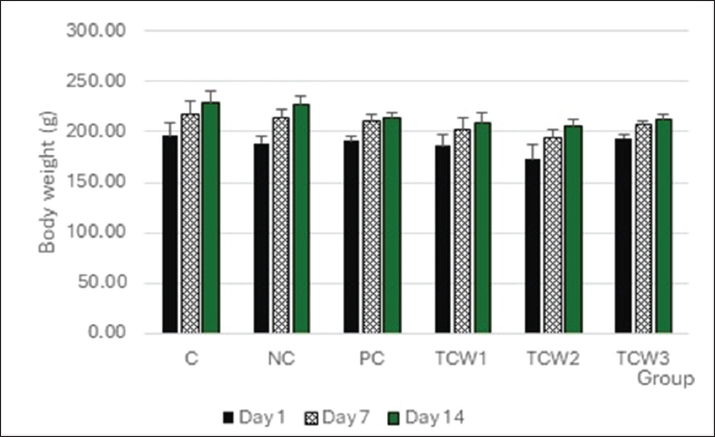
Psoriasis Area and Severity Index (PASI) scoring system, body weight assessment, and organ weight assessmentScoring was performed on a 2 × 4 cm2 area of the dorsal skin that was shaved one day prior to the application of Vaseline and IMQ cream. The PASI score was recorded for erythema, thickness, and scaling of the skin on day 15. The score was assigned on a scale of 0–4 for erythema, thickness, and scaling, with 0 indicating none, 1 indicating slight, 2 indicating moderate, 3 indicating marked, and 4 indicating very marked erythema (Balan et al., 2024). The body weight of the mice was measured on days 1, 7, and 17. During the experimental period, all groups of mice were weighed, and their weights were recorded. After culling all mice, the organs of each mouse’s skin, spleen, kidney, liver, and heart were isolated and weighed. Inflammatory factor determinationBlood samples (3 ml) were collected from the mice via cardiac puncture and transferred into plain tubes. The samples were then centrifuged at 2,500 rpm for 15 minutes to separate the serum, which was stored for subsequent analysis. In addition, the dorsal skin of each mouse was dissected and immediately snap frozen in liquid nitrogen for further examination. The concentrations of key pro-inflammatory cytokines, including IL-17A, IL-22, and IL-23, were quantified using commercially available enzyme-linked immunosorbent assay kits (Sigma-Aldrich, St. Louis, MO, USA), following the manufacturer’s protocols. Statistical analysisData analysis was performed using the Statistical Package for the Social Sciences 25.0 Windows software. The differences between the treatment and control groups were assessed using one-way analysis of variance (ANOVA), followed by a post hoc LSD test. Data are expressed as the mean ± standard error mean (SEM). Ethical approvalAnimal study conducted with approval of Animal Ethic Committee Management and Science University (EA-L3-01-FHLS-2024). Date approval 14 March 2024. ResultsImpact of Coffee liberica pulp on body weight on day 1, 7, and 15As shown in Figure 1, all groups exhibited a gradual increase in body weight from day 1 to day 15. Although minor variations were observed among groups—with TCW3 showing the highest mean body weight and TCW2 the lowest—these differences were not statistically significant (p > 0.05). Overall, the consistent weight gain across all groups indicates normal physiological growth, suggesting that neither imiquimod application nor the treatments produced adverse effects on body weight regulation.
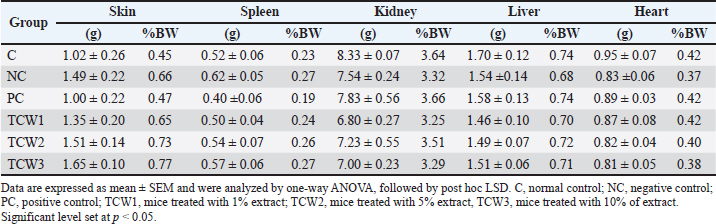
Fig. 1. Body weight of mice at day 1, day 7 and day 14. Data are expressed as mean ± SEM and were analyzed by one-way ANOVA, followed by post hoc LSD. C, normal control; NC, negative control; PC, positive control; TCW1, mice treated with 1% extract; TCW2, mice treated with 5% extract, TCW3, mice treated with 10% of extract. Significant level set at p < 0.05. Impact of Coffee liberica pulp on the weight of organBased on Table 2, the NC group exhibited a significant (p < 0.05) increase in skin weight compared to the control (C), reflecting epidermal thickening and inflammation characteristic of psoriatic lesions. Treatment groups, particularly TCW3, also displayed higher skin weight than control, which may indicate ongoing epidermal remodeling or partial recovery following treatment rather than active hyperproliferation. In contrast, the positive control (PC) group demonstrated near-normal skin weight, signifying effective suppression of inflammation. Splenomegaly observed in the NC group confirms systemic immune activation induced by imiquimod, while both PC and treatment groups showed reduced spleen size, suggesting attenuation of systemic inflammation and restoration of immune homeostasis. Table 2. Impact of Coffee liberica pulp on Balb/C mice organ weight such as skin, spleen, kidney, liver and heart.
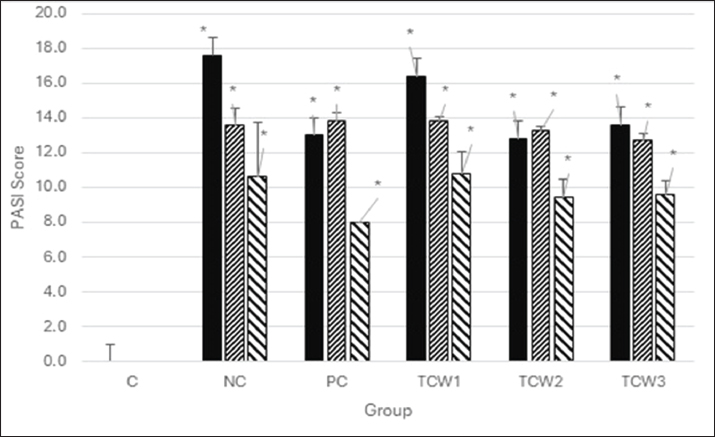
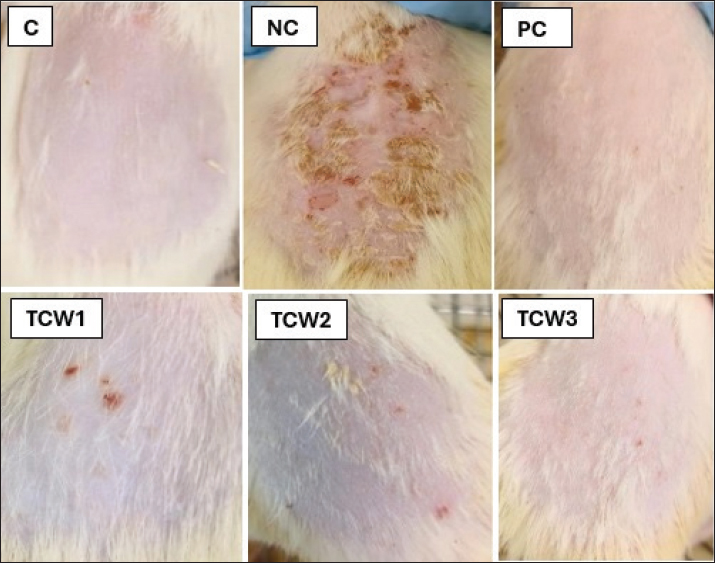
The NC group had reduced kidney weight compared to controls. This may indicate systemic stress or early renal involvement. Kidney weights in all treatment groups improved, particularly TCW2 close to normal. No significant changes in heart weight across all groups. Liver weights across groups remained relatively stable, though NC group and PC group showed minimal changes. Anti-Psoriatic activity of Coffee liberica pulp on Balb/C miceFigure 2 shows the cumulative PASI scores for erythema, thickness, and scaling. PASI score for the control group was negligible for all parameters. For the NC, the PASI score was higher for all the parameters. The PASI score, particularly for erythema, was significantly higher in the NC group than that in the other groups. However, TCW1, TCW2, and TCW3 showed a reduction in the PASI score for all three parameters compared with the NC group. The graph indicates that the treatments (TCW1, TCW2, and TCW3) seem to be effective in lowering PASI scores for erythema, thickness, and scaling compared to the NC. This suggests that these treatments are useful for treating psoriatic symptoms such as dermatitis. Figure 3 shows the phenotypical observations of the dorsal skin in mice with IMQ-induced psoriasis.
Fig. 2. PASI score on IMQ induced mice. Data are expressed as mean ± SEM and were analyzed by one-way ANOVA, followed by post hoc LSD. C, normal control; NC, negative control; PC, positive control; TCW1, mice treated with 1% extract; TCW2, mice treated with 5% extract, TCW3, mice treated with 10% of extract. Significant level set at p < 0.05.
Fig. 3. Observation of Psoriasis Area and Severity Index (PASI) at day 14 from different group of rats. C, normal control; NC, negative control; PC, positive control; TCW1, mice treated with 1% extract; TCW2, mice treated with 5% extract, TCW3, mice treated with 10% of extract. Effect of Coffee liberica pulp on full blood count (FBC)Based on Table 3, the NC group shows a significant (p < 0.05) reduction in hemoglobin and red blood cell (RBC) count compared to the C group, indicating anemia associated with inflammation. PC group showed elevated hemoglobin and RBC, reflecting effective reversal of inflammatory anemia. Among treatment groups, TCW 1 and TCW 3 showed significant (p < 0.05) improvement compared to the NC group, with TCW 1 being most comparable to the PC group. Table 3. Effect of Coffee liberica pulp on Balb/C mice full blood count (FBC).
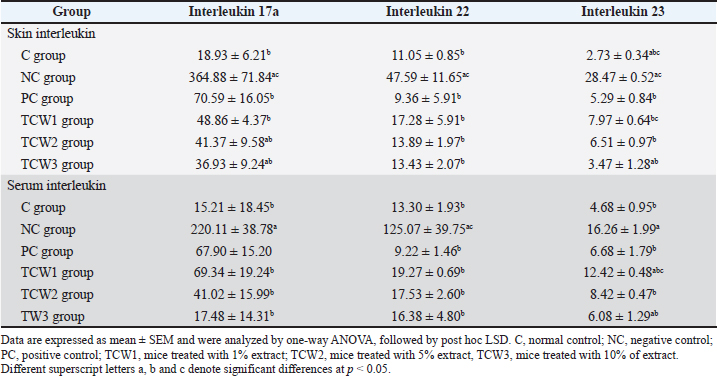
The results also show that there is a marked increase in white blood cell (WBC) was observed in the NC group and neutrophils, indicating systemic inflammation. The PC group showed normalization of WBC and neutrophils. Treatment with TCW, particularly TCW 1 showed significantly (p < 0.05) reduced leukocytosis and neutrophilia. Lymphocyte counts, which were suppressed in the NC group, were restored in the treatment groups, especially TCW 3, suggesting recovery of immune homeostasis. The platelet count increased in the NC group, a common feature in systemic inflammation and the acute phase response. All treatment groups showed a downward trend, with TCW 1 and PC group nearing normal levels. Effect of Coffee liberica pulp on skin and serum interleukin expressionTable 4 show, NC groups show remarkable significant (p < 0.05) increased all interleukins compared to the normal control group (C), reflecting strong activation of the Th17/IL-23 inflammatory axis in skin and serum. The control group showed the lowest expression levels of IL-17A, IL-22, and IL-23 in both skin and serum, confirming physiological baseline immune activity. However, for PC group, it shows that treatment with a standard anti-inflammatory agent significantly suppressed all interleukins compared to NC. The TCW1 group showed a moderate reduction in cytokine levels compared to the NC group. TCW2 exhibited a more pronounced suppression of cytokines, comparable to the positive control, while TCW3 demonstrated the greatest reduction, indicating a dose-dependent anti-inflammatory effect. Table 4. Effect of Coffee liberica pulp on Balb/C mice skin and serum interleukin expression.
DiscussionIn this study, we used C. liberica pulp extracts applied topically to experimental groups to evaluate their potential in either inducing or alleviating psoriasis in a mouse model. Coffee liberica pulp, a coffee-derived product, is rich in nutrients and antioxidants that offer benefits for the skin, scalp, and hair. It can also be used to exfoliate and treat acne, improve blood flow, and balance pH levels (Patay et al., 2016). Therefore, the antioxidative properties of Coffee liberica pulp may help reduce inflammation, making it a potential treatment for psoriasis. IMQ cream plays a key role in activating the IL-23/IL-17 axis in psoriasis and induces dermatitis in mice, serving as a reliable model for analyzing pathogenic mechanisms and IL-23/IL-17 lesions that mimic plaque-type psoriasis. Induction with IMQ cream leads to increased epidermal proliferation, abnormal differentiation, neutrophil accumulation in micro-abscesses, neo angiogenesis, and infiltration of CD4+ T cells, CD11c+ dendritic cells, and plasmacytoid dendritic cells (Zhang et al., 2021). Treatment with coffee pulp extract in mice led to a significant reduction in PASI scores, suggesting its potential anti-inflammatory and antiproliferative effects. The PASI is a widely used tool for assessing psoriasis severity, based on erythema, skin thickness, and scaling. The observed reduction in PASI scores following treatment indicates that coffee pulp extract may effectively ameliorate the pathological features of psoriasis. Previous research has demonstrated that coffee pulp extract contains abundant polyphenols with antioxidant and anti-inflammatory effects. These bioactive compounds can regulate inflammatory pathways, potentially reducing the severity of skin inflammation characteristic of psoriasis. In psoriasis-like mouse models, such as those induced by IMQ, the inflammatory response includes increased redness, scaling, and epidermal thickness, which contributes to higher PASI scores (Burlec et al., 2024). Studies have shown that administering coffee pulp extract can alleviate psoriatic symptoms by inhibiting key inflammatory mediators, which in turn reduces keratinocyte hyperproliferation and leukocyte infiltration, leading to a significant decrease in PASI scores and improvement in disease severity (Burlec et al., 2024). These findings are consistent with previous reports demonstrating the anti-inflammatory and antioxidant properties of coffee-derived polyphenols, which help lower systemic inflammatory markers across various conditions (Liu et al., 2019). In psoriatic models, treatment with coffee pulp extract may also modulate FBC parameters, reflecting its influence on systemic inflammation. Psoriasis often leads to elevated WBC counts, particularly neutrophils and lymphocytes, due to chronic immune activation (Güvenç et al., 2021). The polyphenols present in coffee pulp extract can help normalize WBC levels by suppressing pro-inflammatory cytokines such as IL-17A, IL-23, and IL-6, thereby reducing immune cell recruitment. Moreover, psoriasis is associated with anemia of chronic inflammation, characterized by decreased RBC counts and hemoglobin (Hb) levels. The antioxidant capacity of coffee polyphenols helps counteract oxidative stress, supporting normal erythropoiesis and maintaining stable RBC and Hb levels (Xie et al., 2017). Elevated platelet counts observed in psoriasis are also linked to increased inflammatory cytokines such as IL-6; by reducing cytokine production, coffee pulp extract may normalize platelet activity and restore hematological balance (Xie et al., 2017; Nageen et al., 2022). Psoriasis is a chronic inflammatory skin disorder involving both the immune system and keratinocytes. This condition arises from the disruption of cytokines, especially IL-17a, IL-22, and IL-23, which play significant roles in triggering the inflammatory process. The potential use of coffee pulp extract as a psoriasis treatment might be related to its effects on these interleukins. IL-17a, a crucial cytokine in psoriasis, is primarily produced by the Th17 cells. It promotes keratinocyte proliferation and inflammation, resulting in the formation of characteristic plaques in psoriasis. The anti-inflammatory properties of coffee pulp extract, which are abundant in polyphenols, such as chlorogenic acids, may help decrease IL-17a levels. Studies have demonstrated that the antioxidant and anti-inflammatory actions of these polyphenols can suppress IL-17a expression, thereby reducing the inflammatory response in psoriasis models (Burlec et al., 2024). Furthermore, recent studies have revealed that mice treated with coffee pulp exhibit lower levels of IL-17a in their serum and skin than the negative control group (Nakajima et al., 2011; Chen et al., 2016; Khueangchiangkhwang et al., 2022; Nageen et al., 2022). IL-22 is a critical cytokine in psoriasis as it contributes to the proliferation of keratinocytes and thickening of the epidermis. Inhibition of IL-22 is crucial for managing the hyperplastic response observed in psoriatic lesions. The bioactive compounds found in coffee pulp extract have been shown to modulate IL-22 production, potentially by interfering with the signalling pathways that activate Th17 and Th22 cells, which are the primary producers of IL-22 (Qi et al., 2021). IL-23 is vital for the maintenance and expansion of Th17 cells, making it a key cytokine for sustaining the inflammatory cascade in psoriasis. Coffee pulp extract may exert its therapeutic effects by reducing IL-23 production, thereby limiting the differentiation and proliferation of Th17 cells. This could result in a decrease in IL-17A and IL-22 levels, contributing to a reduction in psoriatic inflammation (Liu et al., 2019; Burlec et al., 2024). Coffee pulp extract demonstrates potential in alleviating psoriasis through its immunomodulatory and anti-inflammatory actions. Its bioactive polyphenols may contribute to the downregulation of key cytokines within the IL-23/Th17 pathway, thereby attenuating inflammation and keratinocyte hyperproliferation. While these findings highlight its therapeutic promise, further studies are warranted to elucidate the precise molecular mechanisms and evaluate its clinical applicability in Psoriasis management (Nakajima et al., 2011; Nadeem et al., 2015; Liu et al., 2019). ConclusionThis study highlights the significant anti-psoriatic properties of C. liberica pulp extract, demonstrating its effectiveness in alleviating psoriasis-like symptoms induced by IMQ in mice. Compared to the application of IMQ cream alone, the extract not only improved PASI scores but also positively influenced body and organ weights, including those of the skin and spleen. These findings suggest that the antioxidant- and nutrient-rich composition of C. liberica pulp renders it a promising natural intervention for psoriasis. Conflict of interestThe authors declare that there are no conflicts of interest. FundingThis work was supported and funded by the Management and Science University (MPG-017-042024) and (SG-007-022020-FHLS). Author contributionsSSB: Conceptualization, methodology, writing, and reviewing the original draft; AZA and HB: Conceptualization, methodology, and writing the original draft; MV and MTV: Experiment conduct, data collection and writing draft; FO and AZA: Writing—review and editing; SSB and HB: visualization; SSB: resources; CKW and MR: data analysis, and review; CKW: Editing and review; SSB: writing, editing, and review; SSB and HB: Conceptualization, methodology, and writing the original draft; FO: Conceptualization, methodology, and writing the original draft. Data availabilityAll the data that support the findings of this study are available in the main text. ReferencesArmstrong, A.W. and Read, C. 2020. Pathophysiology, clinical presentation, and treatment of psoriasis: a review. JAMA 323(19), 1945–1960; doi:10.1001/jama.2020.4006 Balan, S.S., Abidin, A.Z., Perumal, K.V., Shafie, N.H., Abdullah, M.A., Jasni, A.S. and Bahari, H. 2021. Transgenerational evaluation of Elateriospermum tapos extracts on the male offspring of obesity-induced sprague dawley rats. Sains Malays 50, 3045–3057. Balan, S.S., Bahari, H., Arjunaidie, N.A., Noor, S.M., Mahfudh, N. and Othman, F. 2024. Evaluation of antioxidant and anti-psoriatic activities of purple sweet potato (Ipomoea batatas L.) Leaves aqueous extract on imiquimod-induced psoriasis-like Dermatitis. Philippine. J. Sci. 153(6B), 2273–2281. Burlec, A.F., Hăncianu, M., Ivănescu, B., Macovei, I. and Corciovă, A. 2024. Exploring the therapeutic potential of natural compounds in psoriasis and their inclusion in nanotechnological systems. Antioxidants. (Basel. Switzerland). 13(8), 912; doi:10.3390/antiox13080912 Chen, Y.H., Wu, C.S., Chao, Y.H., Lin, C.C., Tsai, H.Y., Li, Y.R., Chen, Y.Z., Tsai, W.H. and Chen, Y.K. 2016. Lactobacillus pentosus GMNL-77 inhibits skin lesions in imiquimod-induced psoriasis-like mice. J. Food Drug Anal. 25(3), 559–566; doi:10.1016/j.jfda.2016.06.003 Güvenç, G., Arslan, G., Karaçay, M., Yöyen Ermiş, D., Özoğlu, E., Oral, B. and Yalçin, M. 2021. Evaluation of some blood parameters in the experimental autoimmune encephalomyelitis mouse model. J. Res. Vet. Med. 40(2), 93–97; doi:10.30782/jrvm.936948 Khueangchiangkhwang, S., Wu, Z., Nagano, I. and Maekawa, Y. 2022. Trichinella pseudospiralis secreted 53 kDa protein ameliorates imiquimod-induced Psoriasis by inhibiting the IL-23/IL 17 axis in mice. Biochem. Biophys. Rep. 33, 101415; doi:10.1016/j.bbrep.2022.101415 Liu, C., Liu, H., Lu, C., Deng, J., Yan, Y., Chen, H., Wang, Y., Liang, C.L., Wei, J., Han, L. and Dai, Z. 2019. Kaempferol attenuates imiquimod-induced Psoriatic skin inflammation in a mouse model. Clin. Exp. Immunol. 198(3), 403–415; doi:10.1111/cei.13363 Nadeem, A., Al-Harbi, N.O., Al-Harbi, M.M., El-Sherbeeny, A.M., Ahmad, S.F., Siddiqui, N., Ansari, M.A., Zoheir, K.M.A., Attia, S.M., Al-Hosaini, K.A. and Al-Sharary, S.D. 2015. Imiquimod-induced Psoriasis-like skin inflammation is suppressed by BET bromodomain inhibitor in mice through RORC/IL-17A pathway modulation. Pharmacol. Res. 99, 248–257; doi:10.1016/j.phrs.2015.06.001 Nageen, S., Shah, R., Sharif, S., Jamgochian, M., Waqas, N. and Rao, B. 2022. Platelet Count, Mean Platelet Volume, and Red Cell Distribution Width as Markers for Psoriasis Severity. J. Drugs. Dermatology. 21(2), 156–161; doi:10.36849/jdd.6127 Nakajima, K., Kanda, T., Takaishi, M., Shiga, T., Miyoshi, K., Nakajima, H., Kamijima, R., Tarutani, M., Benson, J.M., Elloso, M.M., Gutshall, L.L., Naso, M.F., Iwakura, Y., Digiovanni, J. and Sano, S. 2011. Distinct Roles of IL-23 and IL-17 in the Development of Psoriasis-Like Lesions in a Mouse Model. J. Immunol. 186(7), 4481–4489; doi:10.4049/jimmunol.1000148 Nerurkar, L., Mccoll, A., Graham, G. and Cavanagh, J. 2017. The systemic response to topical Aldara treatment is mediated through direct TLR7 stimulation as Imiquimod enters the circulation. Scientific. Rep. 7(1), 1–11. Patay, E.B., Bencsik, T. and Papp, N. 2016. Phytochemical overview and medicinal importance of Coffea species from the past until now. Asian. Pacific. J. Trop. Med. 9(12), 1127–1135. Pumaras, R.O., Badong, D., Cruz, A.M., Coros, K., Infiesto, M.V., Paulino, J.Y. and Mojica, J.J. 2024. Antimicrobial activity of Coffea liberica (Liberian Coffee) in different roasting intensities and varying extract concentrations against Staphylococcus aureus and Escherichia coli. J. Interdiscipl. Perspect. 2(10), 24–31; doi:10.69569/jip.2024.0373 Qi, F., Tan, Y., Yao, A., Yang, X. and He, Y. 2021. Psoriasis to Psoriatic Arthritis: the Application of Proteomics Technologies. Front. Med. 8, 681172; doi:10.3389/fmed.2021.681172 Raj, R., Londhe, N.D. and Sonawane, R. 2021. Automated Psoriasis lesion segmentation from unconstrained environment using residual U-Net with transfer learning. Comput. Methods Programs Biomed. 206, 106123; doi:10.1016/j.cmpb.2021.106123 Xie, X., Zhang, L., Lin, Y., Wang, Y., Liu, W., Li, X. and Li, P. 2017. Imiquimod induced ApoE-deficient mice might be a composite animal model for the study of Psoriasis and dyslipideamia comorbidity. J. Dermatological. Sci. 88(1), 20–28; doi:10.1016/j.jdermsci.2017.05.003 Zhang, B., Lai, R.C., Sim, W.K., Choo, A.B.H., Lane, E.B. and Lim, S.K. 2021. Topical application of mesenchymal stem cell exosomes alleviates the imiquimod induced Psoriasis-like inflammation. Int. J. Mol. Sci. 22(2), 720. | ||


| How to Cite this Article |
| Pubmed Style Vijayakumaran M, Velu MT, Abidin AZ, Bahari H, Othman F, Wen GK, Rahmadi M, Balan SS. Anti-Psoriatic activity of Coffee liberica pulp extract on Imiquimod-induced Psoriasis-like dermatitis in Balb/C mice. Open Vet. J.. 2026; 16(3): 1725-1733. doi:10.5455/OVJ.2026.v16.i3.30 Web Style Vijayakumaran M, Velu MT, Abidin AZ, Bahari H, Othman F, Wen GK, Rahmadi M, Balan SS. Anti-Psoriatic activity of Coffee liberica pulp extract on Imiquimod-induced Psoriasis-like dermatitis in Balb/C mice. https://www.openveterinaryjournal.com/?mno=283305 [Access: March 31, 2026]. doi:10.5455/OVJ.2026.v16.i3.30 AMA (American Medical Association) Style Vijayakumaran M, Velu MT, Abidin AZ, Bahari H, Othman F, Wen GK, Rahmadi M, Balan SS. Anti-Psoriatic activity of Coffee liberica pulp extract on Imiquimod-induced Psoriasis-like dermatitis in Balb/C mice. Open Vet. J.. 2026; 16(3): 1725-1733. doi:10.5455/OVJ.2026.v16.i3.30 Vancouver/ICMJE Style Vijayakumaran M, Velu MT, Abidin AZ, Bahari H, Othman F, Wen GK, Rahmadi M, Balan SS. Anti-Psoriatic activity of Coffee liberica pulp extract on Imiquimod-induced Psoriasis-like dermatitis in Balb/C mice. Open Vet. J.. (2026), [cited March 31, 2026]; 16(3): 1725-1733. doi:10.5455/OVJ.2026.v16.i3.30 Harvard Style Vijayakumaran, M., Velu, . M. T., Abidin, . A. Z., Bahari, . H., Othman, . F., Wen, . G. K., Rahmadi, . M. & Balan, . S. S. (2026) Anti-Psoriatic activity of Coffee liberica pulp extract on Imiquimod-induced Psoriasis-like dermatitis in Balb/C mice. Open Vet. J., 16 (3), 1725-1733. doi:10.5455/OVJ.2026.v16.i3.30 Turabian Style Vijayakumaran, Mishalini, Monisha Thanka Velu, Azrina Zainal Abidin, Hasnah Bahari, Fezah Othman, Goh Khang Wen, Mahardian Rahmadi, and Santhra Segaran Balan. 2026. Anti-Psoriatic activity of Coffee liberica pulp extract on Imiquimod-induced Psoriasis-like dermatitis in Balb/C mice. Open Veterinary Journal, 16 (3), 1725-1733. doi:10.5455/OVJ.2026.v16.i3.30 Chicago Style Vijayakumaran, Mishalini, Monisha Thanka Velu, Azrina Zainal Abidin, Hasnah Bahari, Fezah Othman, Goh Khang Wen, Mahardian Rahmadi, and Santhra Segaran Balan. "Anti-Psoriatic activity of Coffee liberica pulp extract on Imiquimod-induced Psoriasis-like dermatitis in Balb/C mice." Open Veterinary Journal 16 (2026), 1725-1733. doi:10.5455/OVJ.2026.v16.i3.30 MLA (The Modern Language Association) Style Vijayakumaran, Mishalini, Monisha Thanka Velu, Azrina Zainal Abidin, Hasnah Bahari, Fezah Othman, Goh Khang Wen, Mahardian Rahmadi, and Santhra Segaran Balan. "Anti-Psoriatic activity of Coffee liberica pulp extract on Imiquimod-induced Psoriasis-like dermatitis in Balb/C mice." Open Veterinary Journal 16.3 (2026), 1725-1733. Print. doi:10.5455/OVJ.2026.v16.i3.30 APA (American Psychological Association) Style Vijayakumaran, M., Velu, . M. T., Abidin, . A. Z., Bahari, . H., Othman, . F., Wen, . G. K., Rahmadi, . M. & Balan, . S. S. (2026) Anti-Psoriatic activity of Coffee liberica pulp extract on Imiquimod-induced Psoriasis-like dermatitis in Balb/C mice. Open Veterinary Journal, 16 (3), 1725-1733. doi:10.5455/OVJ.2026.v16.i3.30 |


