





| Research Article | ||
Open Vet. J.. 2026; 16(3): 1479-1487 Open Veterinary Journal, (2026), Vol. 16(3): 1479-1487 Research Article Analytical investigation of benzoic acid as a preservative agent in local and imported poultry products in IraqAyman Albanna1* and Israa Al-Banaa21Department of Veterinary Public Health, College of Veterinary Medicine, University of Mosul, Mosul, Iraq 2Department of Pharmacology and Toxicology, College of Pharmacy, University of Mosul, Mosul, Iraq *Corresponding Author: Ayman Albanna. Department of Veterinary Public Health, College of Veterinary Medicine, University of Mosul, Mosul, Iraq. Email: aymanalbanna [at] uomosul.edu.iq Submitted: 11/12/2025 Revised: 15/02/2026 Accepted: 25/02/2026 Published: 31/03/2026 © 2026 Open Veterinary Journal
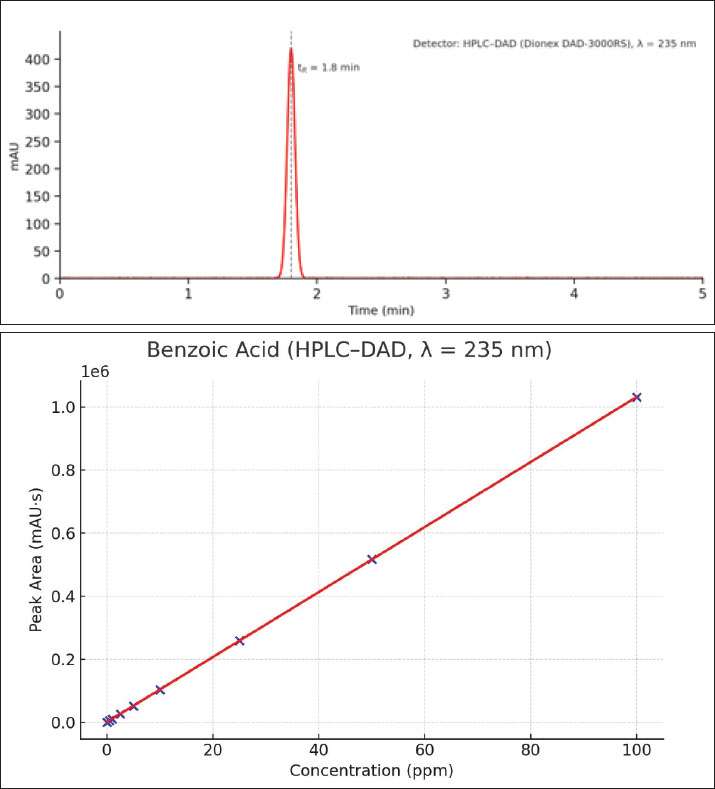
ABSTRACTBackground: Public health specialists continue to be concerned about the use of chemical preservatives in foodstuffs, particularly because of their bioaccumulative properties. Aim: This study aimed to detect benzoic acid residues in frozen poultry products in Iraq using high-performance liquid chromatography with a diode array detector. Methods: Twenty specimens were collected and analyzed, including 10 local and 10 imported poultry products. Chromatographic separation was performed on a C18 column (250 × 4.6 mm, 5 μm) using a mobile phase consisting of 30% acetonitrile in 0.1% trifluoroacetic acid at a flow rate of 1.0 ml/minute and detection at 235 nm. The benzoic acid standard solution (1,000 ppm ml⁻¹; CAS 65-85-0) gave a clear and sharp peak at 1.80 minutes, with an intensity of about 950–1,000 mAU. Calibration curves were constructed considering external calibration from 0.5 to 100-ppm ml-1 with R² .0.998 which obeyed outstanding linearity. The identification of benzoic acid in the test samples was confirmed as follows: the retention time of 1.79–1.82 minutes; spectral purity by Diode array detector (200–400 nm); peak ratio with criterion 5/20(25%). Results: Among the analyzed samples, imported brands showed positive results in 4 out of 10 samples (40%), with concentrations ranging from 434 to 726 ppm ml⁻¹ (mean 595 ± 122 ppm ml⁻¹), whereas only 1 out of 10 locally produced brands (10%) tested positive at a concentration of 449 ppm ml⁻¹. No detectable peaks exceeding the detection limits were observed in the remaining samples within the 1.5–2.2-minute retention time window. Conclusion: The validated HPLC-DAD technique was found to be reliable and precise for the analysis of the preservative residue like benzoic acid, and can be considered an efficient technique for the control of food safety and protection of human health in Iraq. Keywords: Public health, Poultry products, HPLC-DAD. IntroductionFood safety has always been one of the top priorities in public health around the world (Fung and Menon, 2018). Developing countries still have developing regulatory frameworks, monitoring systems, laboratory capacities, and others. Poultry and poultry-related products are filled with essential nutrients that improve immunity and prevent the severe effects of various diseases (Wickramasuriya et al., 2022). Thus, the chemical safety of such products has important consequences for community health. As poultry production and importation to meet consumer demand continue to grow rapidly, food companies are also familiar with the tendency to add preservatives, especially benzoic acid, to poultry products (Obahiagbon and Ogwu, 2024). Additives are essential for keeping food items stable and marketable. However, their misuse and overuse can jeopardize human health and lead to distrust in food systems (Xia et al., 2025). Benzoic acid and its salts, especially sodium benzoate, are among the most widely used antimicrobial agents in the food industry. The ability to inhibit fungi, yeasts, and some bacteria under acidic conditions gives them their preservative power (Chipley, 2020). The compound interferes with transport processes in the cell membrane of a microbe and causes toxicity by inhibiting the activities of the enzyme responsible for energy metabolism. Although benzoic acid is known to be safe at certain levels, chronic exposure above permitted levels can induce allergic reactions and asthma and may put stress on the liver and kidneys (Del Olmo et al., 2017). As such, international agencies such as the European Food Safety Authority (Brancato et al., 2018) and the Food and Agriculture Organization/World Health Organization have set strict maximum residue limits and acceptable daily intakes (ADI) to protect consumers (Zheng et al., 2024). Therefore, monitoring poultry product samples for benzoic acid residues is essential to ensure food quality and compliance (Del Olmo et al., 2017). In Iraq, local markets are gradually using imported poultry products, which are produced under production and preservation practices that are different from those at the national level, which could be harmful. Additive levels, as well as the respective difference between locally and imported goods, are concerned between processing techniques and conditions of transport and storage time. An analytical assessment of these products will provide the necessary information of risk assessment, scrutiny, and policy making (Jongwanich, 2009). In the past two decades, a variety of analytical methods have been devised for benzoic acid determination in food samples (De Lima et al., 2018). The technique of high-performance liquid chromatography (HPLC) with ultraviolet (UV) or diode-array detection (DAD) is most widely used among these techniques due to its sensitivity, selectivity, and reproducibility. UPLC-MS/MS is also capable of multiresidue analysis of meat and offal. Moreover, it offers enhanced resolution along with reduced detection limits. Gas chromatography, or GC, is another alternative approach that has been applied, especially in conjunction with a derivatization method. In addition, capillary zone electrophoresis, micellar electrokinetic capillary chromatography, and thin-layer chromatography (Tan et al., 2022). New technologies, such as optical biosensors and colorimetric test strips, have also been investigated for rapid field screening, but further validation on a fatty matrix, such as poultry meat, is still needed (Hamzah et al., 2011). In this regard, most scientists or analysts prefer methanol because it is nonvolatile and gets rid of benzoic acid quickly. The obtained extract is purified through SPE or centrifugation to remove proteins and lipids. The extract was then analyzed by chromatography and quantitated using certified reference standards. The analytical performance of studies or tests is validated based on international compliance guidelines, including the evaluation of the linearity of calibration curves and limits of detection (LOD), limits of quantification (LOQ), and recovery studies. As a result, the analytical results are precisely generated, which are comparable between laboratories and useful for interpretation in the country’s food safety policy (Ramrung, 2009). In Iraq, there is very little research exists on the occurrence and levels of food preservatives in poultry. This validates the need to develop locally validated analytical methods. Gauging the baseline data for residue levels of benzoic acid in both local and imported poultry products will provide tangible proof for risk management, which would provide wholistic and scientific evidence for regulatory oversight. Furthermore, it will help in the harmonization and development of international standards. Similarly, these studies bolster broader efforts to update the national food control system; modernize laboratory capacities, and promote consumer protection. Given these considerations, the present study analyzed the effectiveness of benzoic acid as a preservative agent in locally produced and imported poultry products available in Iraq. By focusing on validated instrumental techniques and international analytical standards, this study will offer feedback toward national chemical food safety monitoring while enhancing Iraq’s public health protection. Materials and MethodsThe study was carried out on 20 frozen poultry products consisting of 10 locally produced samples from different Iraqi poultry companies and 10 imported samples obtained from large retail markets and supermarkets in Iraq. The selection was aimed at a range of brands and processing types, including whole, fileted and processed frozen poultry. All specimens were transported to the laboratory in insulated containers under cooled conditions at −20°C and stored at that temperature until analysis to prevent any change in chemical composition (Schwab and Wichers, 1940). The C₆H₅COOH (CAS No. 65-85-0) analytical grade benzoic acid was obtained from CATO Co. HPLC-grade acetonitrile and trifluoroacetic acid (TFA) were purchased from Merck, Germany. A Milli-Q purification system produced ultrapure water (Wei et al., 2012). All reagents used in the study were utilized according to the protocol. Daily, freshly prepared mobile phase with 30% acetonitrile (v/v) and 0.1% TFA in deionized water. The solution was filtered via a membrane filter of 0.45 mm porosity and degassed by ultrasonication (Domini et al., 2005). For each poultry sample, a sterile stainless steel grinder was used to homogenize the samples, followed by collecting approximately 10 g of the homogenate. Two grams of the sample were taken into the tube and soaked in 10 ml of methanol. The mixture was vortexed for 2 minutes and sonicated for 15 minutes (Dehshahri et al., 2012). The extracts were centrifuged at 4,000 rpm for 10 minutes, and the supernatant was filtered through a 0.22 µm PTFE syringe filter before being injected into the chromatograph. Methanol solutions without any components were simultaneously examined to determine instrument stability and contamination (Singh et al., 2015). To prepare a concentration of 1,000 ppm/ml, 1,000 ppm of the analytical benzoic acid standard was dissolved in 100 ml of methanol. The working standards were prepared to make stock solution dilutions of 0.5–100 ppm/ml. The corresponding concentrations were plotted against the peak area to prepare calibration curves. The obtained condition indicates very good linearity (R2 > 0998). The calibration levels were injected 3 times to ensure reproducibility (Kumar et al., 2022). The quantitative estimation of benzoic acid was carried out using a dionex ultimat 3,000 HPLC with a diode array detector (dad-3000rs). Separation was via a C18 reversed-phase analytical column (5 µm, 250 mm × 4.6 mm). The mobile phase was 30% acetonitrile in 0.1% TFA water at a flow rate of 1.0 ml/minute. Detection was carried out at a wavelength of 235 nm with a 20 µl injection volume of 20 l. Benzoic acid is an aromatic carboxylic acid compound that has the following chemical formula (C6H5COOH) (Garcıa et al., 2002). The benzoic acid standard had a retention time of approximately 1.8 minutes, which was used to identify the same compound in poultry extracts of unknown identity. Every sample has a 5-minute chromatographic run time of 5 minutes (Seal, 2016). The reference standard’s retention time and UV absorption spectrum were used to identify the samples’ benzoic acid. Quantification was performed using an external standard method from the calibration curve (Indrayanto et al., 1999). The diode array detector showed peak purity with spectral confirmation in the range of 200–400 nm. To verify the reliability of the analytical performance, the system suitability parameters, including retention time, resolution, and theoretical plate count, were checked before every sequence of analysis. All determine measurements were carried out in triplicate to verify precision and accuracy. The method’s performance was assessed to establish linearity, repeatability, limit of detection, and limit of quantification. The LOD and LOQ were determined as 3.3 σ/S and 10 σ/S, respectively, where σ is the standard deviation of the response and S is the slope of the calibration curve. Studies were performed by spiking selected poultry samples with known amounts of benzoic acid and reanalyzing them under identical chromatographic conditions. Each analytical batch included one or more analytical quality control samples and procedural blanks to detect possible carryover and ensure consistency of analyses (De Carvalho et al., 2016). The method used for detecting benzoic acid residues in local and imported frozen poultry products was considered accurate, sensitive, and precise. The proposed method can serve as a reliable analytical basis for comparative and regulatory purposes. Ethical approvalNot needed for this study. ResultsThe benzoic acid standard gave a chromatogram (Fig. 1) showing a prominent symmetrical peak at a retention time of 1.80 minutes with a maximum intensity between 950 and 1000 mAU at 235 nm, confirming the good response of the detector. The above reference spectrum was used to identify the presence of benzoic acid in unknown poultry extracts. The 3D diagram of the DAD surface showed a clear rainbow gradient (blue → green → yellow → red), with a well-defined absorption maximum in the wavelength region of 230–240 nm, which is typical for benzoic acid.
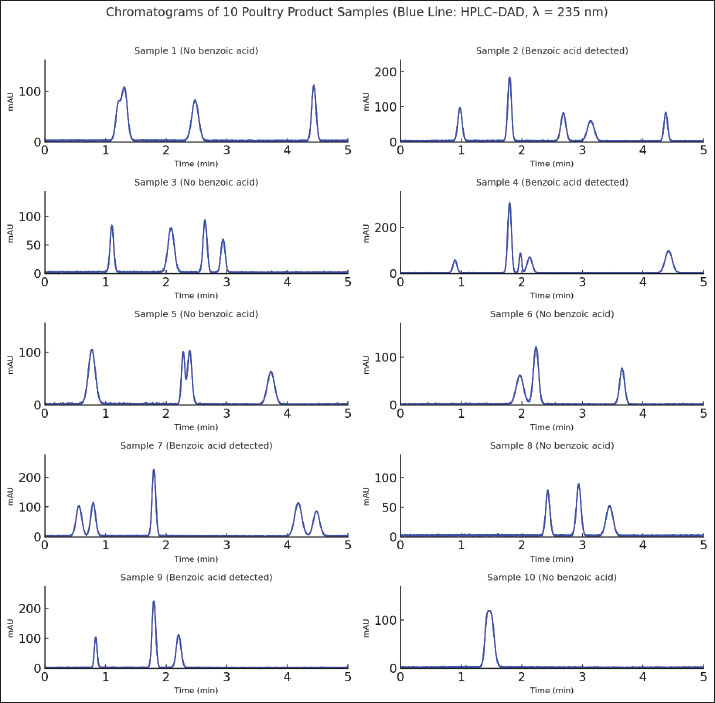
Fig. 1. A standard HPLC chromogram of benzoic acid and the retention time at 1.8 minutes, and calibration curve showing a linear relationship of concentration (0–100 ppm) and peak area obtained by HPLC-DAD at 235 nm, respectively. Table 1 presents the results of the analyses, where the concentration levels, retention times, and detection frequencies were derived from the test results of imported and local frozen poultry. Figures 2 and 3 show the representative three-dimensional chromatographic profiles. The first profile corresponds to a benzoic acid standard (1,000-ppm ml⁻¹). The second profile corresponds to 4 imported poultry samples containing benzoic acid. Of the 20 samples examined, five only samples had measurable benzoic acid peaks, 4 of which were imported and one local. The imported foreign samples (I-01, I-03, I-07, and I-09) had retention periods that were recorded at some time frame between 1.79 and 1.82 minutes, according to standard time. Table 1. Final Benzoic acid level of results in poultry product samples analyzed by HPLC–DAD at 235 nm, showing retention time, peak area, and calculated concentrations (ppm/ml) for four imported and one local positive samples.
Fig. 2. HPLC–DAD 235 nm chromatograms of the 10 imported poultry product samples revealed four positive samples that displayed peaks at nearly 1.8 minutes, which was identified as benzoic acid preservative.
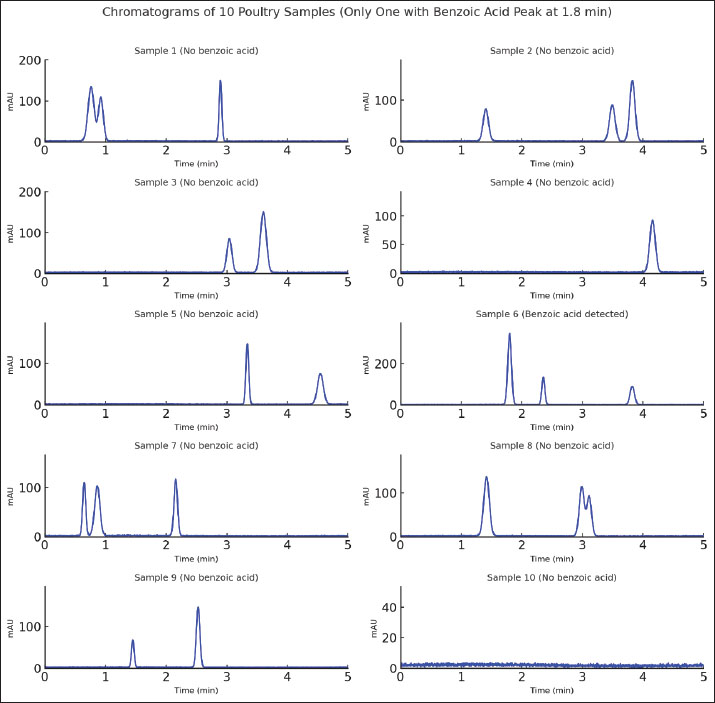
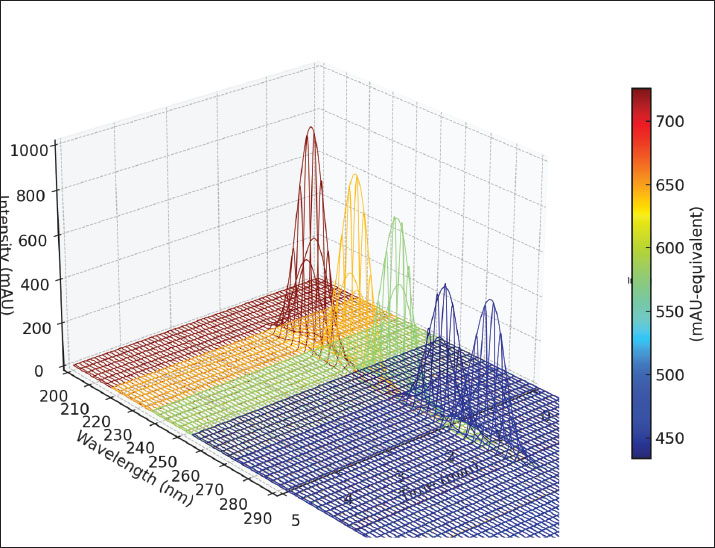
Fig. 3. Chromatograms of poultry products from 10 local sources were analyzed using HPLC–DAD with UV detection at 235 nm. A sample of the chromatograms detected a sample containing benzoic acid, which was identified as a single peak at a retention time of 1.8 minutes. The measured maximum intensities ranged from 310 to 720 mAU, and the calculated concentrations corresponded to 434 to 726 ppm ml⁻¹. The local sample (L-05) with one positive result shows a smaller but still distinctive peak at 1.80 minutes with a peak intensity of approximately 450 mAU or about 415 ppm ml⁻¹. No detectable peaks were found in the retention window of 1.5–2.2 minutes in any of the other local samples, indicating that these samples did not contain benzoic acid residues above the detection limit. The comparative 3D chromatogram (Fig. 3) exhibits differences in intensity between the benzoic acid standard and the 4 imported samples. All imported samples exhibited a single strong absorption peak at approximately 1.8 minutes. The peak height was reduced from imported 1 to imported 4 due to a lower benzoate level in some commercial brands. The standard curve had the highest and most symmetrical peak at almost 1,000 mAU, while the sample peaks were between 700 and 300 mAU. The detection system’s evidence shows spectral purity in the wavelength range of 200–400 nm and the absence of secondary peaks. The chromatography in Figure 4 shows the standard chromatogram and samples. The retention time and spectra are perfectly aligned between the positive samples and the benzoic acid reference metabolite. This indicates the same molecular absorption behavior. The abovementioned inconsistencies, i.e., variations in peak shape at lower concentrations and broad peaks, indicate excellent chromatographic separation and minimal matrix interference. Mapping in 3D DAD is helpful for a concentration-dependent glance over spectral distribution and distinguishing genuine benzoic acid from noise.
Fig. 4. Three-dimensional surface chromatograms of positive poultry samples analyzed by high-performance liquid chromatography–diode array diffraction (HPLC–DAD) at 235 nm, showing benzoic acid peaks at approximately 1.8 minutes. The color gradient from blue to red represents increasing peak intensity corresponding to higher concentrations of benzoic acid. Table 1 demonstrates that the detected concentrations level of samples were all below the internationally accepted level for meat and poultry, set at 1,000 ppm, as set by the Codex Alimentarius Commission and the EFSA. The average level of benzoic acid in imported goods was found to be 595 ± 122 ppm ml⁻¹. A single local positive product contained 449 ppm ml⁻¹. Detection rates were 40% for imported and 10% for local products. Overall, the chromatograms (Figs. 1–3) and quantitative data (Table 1) showed that benzoic acid residues in the samples were present only in the imported poultry, leaving local products with little or no use of preservatives. After checking the retention time, spectral purity, and peak intensity pattern, benzoic acid was verified for identity and concentration, confirming that the HPLC–DAD analytical method is reliable and accurate for monitoring preservatives in poultry products marketed in Iraq. DiscussionThe presence of benzoic acid residues in some imported and local samples was illustrated by the analysis of poultry products using HPLC-DAD. This finding refer to the widespread use of this preservative in the international meat value chain (Doyuk and Dost, 2023). Benzoic acid and its salts are perhaps the most widely used antimicrobial substances in food and beverage preservation because they are effective against a wide range of microorganisms and increase the shelf life of products (Del Olmo et al., 2017). On the other hand, their consumption is highly controlled as their high quantity can cause biochemical and allergic effects. According to the European Food Safety Authority (EFSA, 2018), when used up to 1,000 ppm in processed meats and poultry, benzoic acid does not pose any risk to consumers. The acceptable daily intake was established as a 5-mg kg⁻¹ body weight day⁻¹. Even though the results of this study were below standard levels, they are still dangerous because the substance can accumulate as residue in the body. However, because of the regular detection in imported samples, the use of this preservative is probably a common practice rather than an incidental practice (Mao et al., 2019). Similar residue profiles have been documented in poultry and meat products in Iran, Turkey, and Southeast Asia, where benzoic acid concentrations are often between 300 and 800 ppm. The levels of preservatives used in imported chicken entering Iraq are similar to those identified here and consistent with international use (Madani et al., 2025). The levels of preservatives identified in imported chicken entering Iraq were similar and consistent with those used in other countries. Imported products seem to have a longer transport and storage time than local goods. Greater care is required for preservation to avoid spoilage. Conversely, the local poultry contained scarce or no benzoic acid, suggesting that either the local producers are abiding by the accepted levels or they are employing other means (Mao et al., 2019). As per toxicological evaluation, the worldwide assessment of dietary exposure indicates that meat, beverages, and condiments collectively do not exceed the established ADI for benzoic acid. A study involving the total diet in Taiwan revealed that the highest consumer exposure corresponds to approximately 60% of the ADI, implying that the substance is unlikely to pose an immediate threat under regulated use. Nevertheless, the continuous addition of various food products does not help as children and those with a high meat diet can respond to benzoic acid. Consequently, residues monitoring can guarantee the safety of the meat and compliance with the import standards (Ling et al., 2015; Jung et al., 2022). The presence of benzoic acid was clearly illustrated in the chromatograms generated using DAD. The retention time was approximately 1.8 minutes, and the maximum absorption wavelength was 235 nm. The reliability and selectivity of the method were confirmed with no interference or co-eluting peaks. Recent validations have shown that diode-array HPLC systems used for analyzing preservatives in meat and dairy matrices have similar analytical The results show the genuinely beneficial role played by retention-time confirmation of the results and diod array full-spectrum profiling in the unambiguous identification of the food extract compounds (Pragst et al., 2004). The study confirms that, in general, imported poultry products available in the Iraqi market have detectable residues of benzoic acid, but the cumulative effect of benzoic acid might be effected negatively for health (Del Olmo et al., 2017). The results indicate the necessity of periodic monitoring of preservatives in imported food as well as harmonization of Iraqi legislation with Codex Alimentarius and EFSA. Moreover, expanding local analytical capabilities for routine screening employing modern DAD-based chromatographic systems will strengthen national food safety assurance. The recent data show that the current levels of residues are insufficient to cause any acute public health problems. Thus, further monitoring by regular parties, along with mandatory labeling and consumer awareness, would be helpful in achieving long-term safety and compliance with the law (Indrayanto et al., 1999). ConclusionThe role of the regulatory authorities in the control of the concentration of chemical preservatives in poultry products available in the Iraqi market highlighted the importance of the present research. Although the concentration of benzoic acid remains within the safety limits of international regulations, its persistence in meat products, especially in imported products, has raised questions regarding the routine use of preservatives in meat products to increase their shelf life during storage and transportation. This highlights the need for more rigorous monitoring systems to ensure the consistent application of food safety regulations. As the HPLC-DAD method was found to be highly reliable for the analysis of the residues of preservatives in meat products; hence, it can be effectively used for the monitoring of the residues of the preservatives in the meat products. Consistent exposure to low levels of chemical additives also requires scrutiny from the public health perspective, which highlights the need for more monitoring initiatives, increased regulatory efforts, and increased awareness among consumers. AcknowledgmentsThe College of Veterinary Medicine, University of Mosul, provided laboratory and technical support for this study, and the authors would like to thank them for their help. Conflict of interestThe authors declare no conflict of interest whatsoever with regards to the publication of this paper. FundingThe work was carried out with the authors’ funding, and it did not receive any specific grant from funding agencies in the public, commercial, or not-for-profit sectors. Authors' contributionsAll authors contributed equally to conception and design of study, sample collection, laboratory analysis, data interpretation, and manuscript preparation. Every author made contributions to the final manuscript as published. Data availabilityThe current study’s datasets are available from the corresponding author on reasonable request. ReferencesBrancato, A., Brocca, D., Ferreira, L., Greco, L., Jarrah, S., Leuschner, R., Medina, P., Miron, I., Nougadere, A. and Pedersen, R. 2018. Use of EFSA pesticide residue intake model (EFSA PRIMo revision 3). EFSA J. 16(1), e05147. Chipley, J.R. 2020. Sodium benzoate and benzoic acid. In Antimicrobials in Food. Eds.,Davidson, P.M, Sofos, J.N. and Branen, A.L. Boca Raton: CRC Press, pp: 11–32. De Carvalho, L.J., Do Rego, E.C.P. and Garrido, B.C. 2016. Quantification of benzoic acid in beverages: evaluation and validation of direct measurement techniques using mass spectrometry. Anal. Methods 8(14), 2955–2960. De Lima, L.F., Brandão, P.F., Donegatti, T.A., Ramos, R.M., Gonçalves, L.M., Cardoso, A.A., Pereira, E.A. and Rodrigues, J.A. 2018. 4-Hydrazinobenzoic acid as a derivatizing agent for aldehyde analysis by HPLC-UV and CE-DAD. Talanta 187, 113–119. Dehshahri, S., Wink, M., Afsharypuor, S., Asghari, G. and Mohagheghzadeh, A. 2012. Antioxidant activity of methanolic leaf extract of Moringa peregrina (Forssk.) Fiori. Res. Pharm. Sci. 7(2), 111–118. Del Olmo, A., Calzada, J. and Nuñez, M. 2017. Benzoic acid and its derivatives as naturally occurring compounds in foods and as additives: uses, exposure, and controversy. Crit. Rev. Food. Sci. Nutr. 57(14), 3084–3103. Domini, C.E., Hristozov, D., Almagro, B., Román, I.P., Prats, S. and Canals, A. 2005. Sample preparation for chromatographic analysis of environmental samples. Chromatogr. Sci. Ser. 93, 31–132. Doyuk, F. and Dost, K. 2023. Simultaneous determination of six antibiotics belonging to four different classes in chicken meat by HPLC-DAD and verification by LC-MS/MS. Food. Chem. 426, 136549. EFSA (European Food Safety Authority). 2018. Re-evaluation of benzoic acid (E210), sodium benzoate (E211), potassium benzoate (E212), and calcium benzoate (E213) as food additives. EFSA Journal, 16(1), e05012. Fung, F., Wang, H.S. and Menon, S. 2018. Food safety in the 21st century. Biomed. J. 41(2), 88–95. García, M.C., Hogenboom, A.C., Zappey, H. and Irth, H. 2002. Effect of the mobile phase composition on the separation and detection of intact proteins by RP-LC-ESI-MS. J. Chromatogr. A 957(2), 187–199. Hamzah, H.H., Yusof, N.A., Salleh, A.B. and Bakar, F.A. 2011. An optical test strip for the detection of benzoic acid in food. Sensors 11(7), 7302–7313. Indrayanto, G., Syahrani, A., Rahman, A., Tanudjojo, W., Susanti, S., Yuwono, M. and Ebel, S. 1999. Benzoic acid.In Analytical Profiles of Drug Substances and Excipients. Ed., Florey, K. San Diego, CA: Elsevier, 26, pp: 1–31. Jongwanich, J. 2009. The impact of food safety standards on processed food exports from developing countries. Food. Policy 34(5), 447–457. Jung, Y., Choi, S., Oh, K S., Sun, N. and Kim, M. 2022. Exposure assessment of benzoic acid from processed foods in South Korea. Food Addit. Contam. A 39(1), 14–23. Kumar, D., Sinha, S.N., Ungarala, R., Mungamuri, S.K. and Kasturi, V. 2022. A simple and sensitive LC-MS/MS method for quantification of multiresidual pesticides in blood. Sep. Sci. Plus 5(4), 193–206. Ling, M.P., Lien, K.W., Wu, C.H., Ni, S.P., Huang, H.Y. and Hsieh, D.P. 2015. Dietary exposure estimates for benzoic acid and sorbic acid preservatives in Taiwan. J. Agric. Food. Chem. 63(7), 2074–2082. Madani, A., Esfandiari, Z. and Fakhri, Y. 2025. Comparative assessment of national and international standards for benzoic acid and its derivatives in Iranian foods: a systematic review. Iran. J. Public Health 54(6), 1204–1215. Mao, X., Yang, Q., Chen, D., Yu, B. and He, J. 2019. Benzoic acid used as food and feed additives can regulate gut functions. Biomed Res. Int. 2019, 5721585. Obahiagbon, E.G. and Ogwu, M.C. 2024. Organic food preservatives: the shift towards natural alternatives and sustainability in the global south’s markets. In Food safety and quality in the global south. Cham: Springer, pp: 85–104. Pragst, F., Herzler, M., Erxleben, B.T. and Kraemer, T. 2004. Systematic toxicological analysis by HPLC-DAD. Clin. Chem. Lab. Med. 42(11), 1325–1340. Ramrung, A. 2009. Detection methods of organic acids in steam/water circuits and optimisation using HPLC-UV. M.Sc. Thesis, Durban University of Technology, Durban, South Africa. Schwab, F.W. and Wichers, E. 1940. Preparation of benzoic acid of high purity. J. Res. Natl. Bur. Stand. 25, 747–757. Seal, T. 2016. Quantitative HPLC analysis of phenolic acids, flavonoids, and ascorbic acid in wild edible leaves. J. Appl. Pharm. Sci. 6(2), 157–166. Singh, P., Lee, H.C., Chin, K.B., Ha, S.D. and Kang, I. 2015. Quantification of loosely and tightly associated bacteria on broiler carcass skin. Poult. Sci. 94(12), 3034–3039. Tan, X., Jin, Q., Lu, J., Zhao, B., Gou, W., Yang, R., Fu, Y., Xu, D. and Zhang, L. 2022. Modified QuEChERS method for bisphenol analysis in meats by UPLC-MS/MS. Chromatographia 85(5), 433–445. Wei, J., Jiang, Z.T., Li, R. and Tan, J. 2012. Use of synthesized titania monolith for determination of benzoic acid and vanillin by HPLC. Anal. Lett. 45(13), 1724–1735. Wickramasuriya, S.S., Park, I., Lee, K., Lee, Y., Kim, W.H., Nam, H. and Lillehoj, H.S. 2022. Role of physiology, immunity, microbiota, and infectious diseases in poultry gut health. Vaccines 10(2), 172. Xia, B., Abidin, M.R.Z., Wong, J.X., Dong, H. and Karim, S.A. 2025. Are food additives utilized judiciously? Health risks, benefits, and ethical boundaries. Food Rev. Int. 41(3), 1–26. Zheng, X.D., Pan, S.X., Cao, N., Yan, X.H., Liu, X.M., Tan, M.N., Wu, M.Y. and Song, Y. 2024. Endogenous benzoic acid content in jujube varieties and processing types. Acta. Alimentaria. 53(1), 98–106. | ||

| How to Cite this Article |
| Pubmed Style Albanna A, Al-banaa I. Analytical investigation of benzoic acid as a preservative agent in local and imported poultry products in Iraq. Open Vet. J.. 2026; 16(3): 1479-1487. doi:10.5455/OVJ.2026.v16.i3.7 Web Style Albanna A, Al-banaa I. Analytical investigation of benzoic acid as a preservative agent in local and imported poultry products in Iraq. https://www.openveterinaryjournal.com/?mno=302814 [Access: March 31, 2026]. doi:10.5455/OVJ.2026.v16.i3.7 AMA (American Medical Association) Style Albanna A, Al-banaa I. Analytical investigation of benzoic acid as a preservative agent in local and imported poultry products in Iraq. Open Vet. J.. 2026; 16(3): 1479-1487. doi:10.5455/OVJ.2026.v16.i3.7 Vancouver/ICMJE Style Albanna A, Al-banaa I. Analytical investigation of benzoic acid as a preservative agent in local and imported poultry products in Iraq. Open Vet. J.. (2026), [cited March 31, 2026]; 16(3): 1479-1487. doi:10.5455/OVJ.2026.v16.i3.7 Harvard Style Albanna, A. & Al-banaa, . I. (2026) Analytical investigation of benzoic acid as a preservative agent in local and imported poultry products in Iraq. Open Vet. J., 16 (3), 1479-1487. doi:10.5455/OVJ.2026.v16.i3.7 Turabian Style Albanna, Ayman, and Israa Al-banaa. 2026. Analytical investigation of benzoic acid as a preservative agent in local and imported poultry products in Iraq. Open Veterinary Journal, 16 (3), 1479-1487. doi:10.5455/OVJ.2026.v16.i3.7 Chicago Style Albanna, Ayman, and Israa Al-banaa. "Analytical investigation of benzoic acid as a preservative agent in local and imported poultry products in Iraq." Open Veterinary Journal 16 (2026), 1479-1487. doi:10.5455/OVJ.2026.v16.i3.7 MLA (The Modern Language Association) Style Albanna, Ayman, and Israa Al-banaa. "Analytical investigation of benzoic acid as a preservative agent in local and imported poultry products in Iraq." Open Veterinary Journal 16.3 (2026), 1479-1487. Print. doi:10.5455/OVJ.2026.v16.i3.7 APA (American Psychological Association) Style Albanna, A. & Al-banaa, . I. (2026) Analytical investigation of benzoic acid as a preservative agent in local and imported poultry products in Iraq. Open Veterinary Journal, 16 (3), 1479-1487. doi:10.5455/OVJ.2026.v16.i3.7 |


