





| Short Communication | ||
Open Vet. J.. 2025; 15(6): 2889-2894 Open Veterinary Journal, (2025), Vol. 15(6): 2889-2894 Short Communication Keratometry, biometry, and intraocular lens power calculation in Bornean sun bears (Helarctos malayanus euryspilus)Yong Zheng Wai1, Boon Nie Yeoh2*, Wai Seng Chiang1, Muhammad Hazim bin Sharum1, Nurhayati Abdul Kadir1, Nur Hafizah binti Mat Jalil1, Jessie Si Wai Ho3, Nur Nabila Sarkawi4, Siew Te Wong2 and Nadzariah Cheng binti Abdullah51Hospital Duchess of Kent, Sandakan, Malaysia 2Bornean Sun Bear Conservation Centre, Sandakan, Malaysia 3Jesselton Animal Clinic, Kota Kinabalu, Malaysia 4Sabah Wildlife Department, Kota Kinabalu, Malaysia 5Animed Veterinary Center, Cheras, Malaysia *Corresponding Author: Boon Nie Yeoh. Bornean Sun Bear Conservation Centre, Sandakan, Malaysia. Email: vet.bsbcc [at] gmail.com Submitted: 15/02/2025 Revised: 14/05/2025 Accepted: 23/05/2025 Published: 30/06/2025 © 2025 Open Veterinary Journal
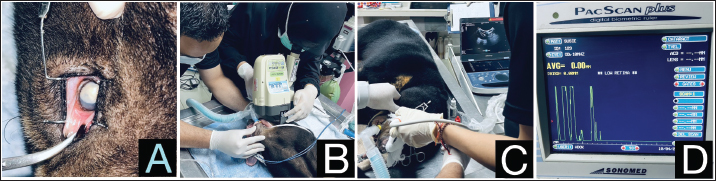
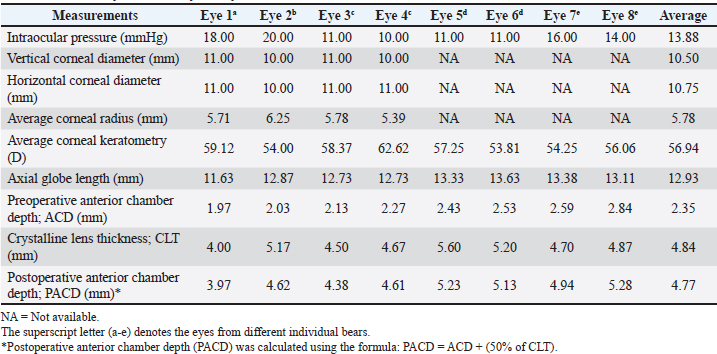
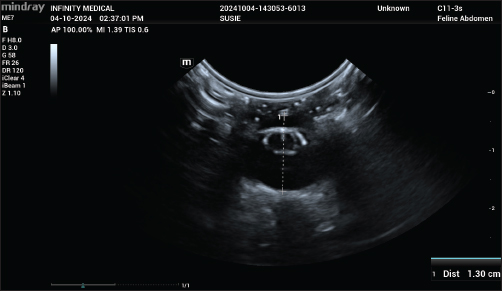
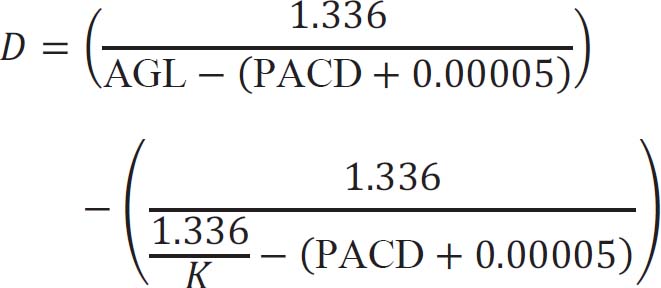
AbstractBackground: Cataracts are a common ocular condition that affects captive sun bears, yet there is a lack of detailed case reports and ocular studies of this species. Aim: The examinations aim to calculate the intraocular lens (IOL) power required to achieve emmetropia following cataract surgery. Methods: Five Bornean sun bears diagnosed with cataracts at the Bornean Sun Bear Conservation Centre in Malaysia underwent ocular examination under general anesthesia. Keratometry and biometry data, including anterior chamber depth, crystalline lens thickness, and axial globe length, were collected using an automated keratometer and B-mode ultrasound. The Retzlaff, Binkhorst, Colenbrander, and Fyodorov formulas were used to estimate the required IOL power. Results: The mean corneal keratometric power was 56.94 D, the mean axial globe length was 12.93 mm, and the mean calculated postoperative anterior chamber depth was 4.77 mm. The mean calculated IOL power was +92.96 D. Conclusion: Aphakic cataract surgery were decided following these findings showing no available commercial IOL implants for this species. These findings provide valuable baseline data for optimizing cataract surgery in Bornean sun bears. Keywords: Biometry, Cataract, Intraocular lens power, Keratometry, Sun bear. IntroductionOnly a few scientific articles are reported on ocular pathology among Ursidae (Dombrowski et al., 2016; Sakai et al., 2017). Cataract is a disease that can cause blindness. Hartley reported that 28% of 135 bears comprising the Asiatic black bear (Ursus thibetanus), Malayan sun bear (Helarctos malayanus), Eurasian brown bear (Ursus arctos arctos), and Tibetan brown bear (Ursus arctos pruinosus) had cataracts (Hartley and Oliveira, 2022). Only two papers have described cataract removal in bears, but neither has a bear received an intraocular lens (Uhl et al., 2019; Maehara et al., 2020). To calculate the appropriate intraocular lens (IOL) power for bears, knowledge of the ocular anatomy, keratometry, and biometry specific to each bear species is essential. Although the post-mortem morphology of the Asiatic black bear’s eyes has been reported, with measurements of anterior chamber depth (ACD) and axial globe length (AGL) obtained after euthanasia (Paszta et al., 2022), in vivo data on ACD, AGL, and keratometry in bears have not been published. Studies on other species do exist on biometry, keratometry, and IOL power estimation. These reports investigated cats, dogs, horses, orangutans (Pongo pygmaeus), tigers (Panthera tigris), and bald eagles (Haliaeetus leucocephalus) (Mirshahi et al., 2014; Kuhn et al., 2015; Chiwitt et al., 2017; Meister et al., 2018; Sritrakoon et al., 2021; Owens et al., 2022). However, to the best of the authors’ knowledge, this information has not been published for bears. The Malayan sun bear is the smallest species in the Ursidae family, and it is native to mainland Southeast Asia and the island of Sumatra (Crudge et al., 2019). The Bornean sun bear, a subspecies found exclusively in Borneo, is characterized by a smaller body size than the Malayan sun bear (Meijaard, 2004). At the Bornean Sun Bear Conservation Centre in Sandakan, Sabah, Malaysia, we examined five Bornean sun bears (Helarctos malayanus euryspilus), aged between 16 and 23 years, all of whom were diagnosed with cataracts. These bears were rescued from illegal captivity in different locations across Sabah between 2008 and 2013. Materials and MethodsThis study complies with the ethical requirements of the Sabah Wildlife Department, including the provision of diagnosis and treatment for rescued Bornean sun bears. General anesthesia was induced with tiletamine- zolazepam (Zoletil; Virbac, Carros, France) at 3 mg/ kg and xylazine (Ilium Xylazil; Troy Laboratories, Glendenning, Australia) at 1 mg/kg. Each bear was then intubated, and general anesthesia was maintained with isoflurane (Isorane; Piramal Pharma, Sangareddy, India). Anesthetic depth and vital signs were closely monitored using an electronic blood pressure machine, electrocardiogram, and pulse oximetry. A warming blanket was used to maintain body temperature throughout the procedure. Once the examination was complete, anesthesia was reversed with intramuscular yohimbine (0.15 mg/kg (Yohimbe; Equimed USA, Miami, USA), and the bears were monitored until full recovery in their respective cages. Once the bears had been intubated and positioned, topical proparacaine hydrochloride (Alcaine; Alcon Laboratories, Ft. Worth, TX, USA) was applied to each eye for local anesthesia. Only eyes without existing ocular pathology or prior ocular surgery were included in the study; two eyes from the five studied sun bears were excluded. One bear had an eye with a history of cataract extraction and another bear had an anteriorly luxated crystalline lens (Fig. 1A). The ophthalmic assessment began with intraocular pressure measurements using a rebound tonometer (iCare; Tonovet; Icare, Vantaa, Finland). The horizontal and vertical corneal diameters were then measured using Castroviejo calipers. Automated keratometry (Retinomax K-plus 3; Righton, Tokyo, Japan) was conducted by a trained optometrist (Fig. 1B). The average corneal radius and keratometric index were recorded from the central 3.2 mm of the cornea (Table 1). Ocular dimensions were assessed using B-mode ultrasonography with an 3-11 MHz micro convex probe (ME 7, Mindray, Shenzhen, China; and, MyLab Alpha; Esaote, Genoa, Italy). Coupling gel was applied to the probe, which was then gently placed between the retracted eyelids and onto the cornea at the same time under minimal pressure to avoid distortion of ocular measurements (Fig. 1C). The default sound wave velocity of the ultrasound system for ocular tissues was set at 1540 m/s. Preoperative measurements, including preoperative ACD, crystalline lens thickness (CLT), and AGL, were obtained using the internal calipers of the ultrasound system in the captured images (Fig. 2). The measurements were performed by an ophthalmologist. Each parameter was measured once for each image in three separate images, and the average of the three readings was recorded (Table 1). An attempt was made to measure ocular dimensions using A-scan biometry (PacScan Plus; Sonomed, New York, USA), a device typically used for human ocular measurements. Although A-scan spikes were observed, the device was unable to generate numerical readings (Fig. 1D). This failure was likely due to significant variations between the sun bear and standard human ocular anatomy, indicating that this system is incompatible with nonhuman eyes in its present state. The IOL power calculation to achieve emmetropia in aphakic sun bears was performed using the Retzlaff, Binkhorst, Colenbrander, and Fyodorov formulas (Table 2) (Binkhorst, 1975; Fyodorov et al., 1975; Retzlaff, 1980; Sanders et al., 1981). Of these calculations, all measurements for the Retzlaff, Colenbrander, and Fyodorov equations were expressed in meters (m), whereas those for the Binkhorst formula were expressed in millimeters (mm). In these formulas, the radius of curvature of the cornea is represented by 𝑟 (in mm), and 𝐾 denotes the keratometric power of the cornea (in diopters, D).
Fig 1. A: Hypermature crystalline lens dislocated anteriorly, resulting in elevated intraocular pressure. This eye was excluded from keratometry, biometry, and intraocular lens (IOL) power calculations. B: Automated keratometry was performed to measure corneal keratometric power. C: B-mode ultrasonography gently applied to the corneal surface covered with ultrasound gel. The eyelids had been spread apart with lid retractors. D: A-scan biometry, which is commonly used in humans, failed to generate numerical data despite prominent A-scan spikes being observed. Table 1. Keratometry and biometry of 8 eyes of Bornean sun bears.
Fig. 2. Axial globe length (AGL) measured using internal calipers on B-mode ultrasonograhy. Retzlaff:
Binkhorst:
Colenbrander:
Fyodorov:
Table 2. Table 2. Intraocular lens power calculation of 8 eyes of Bornean sun bears.
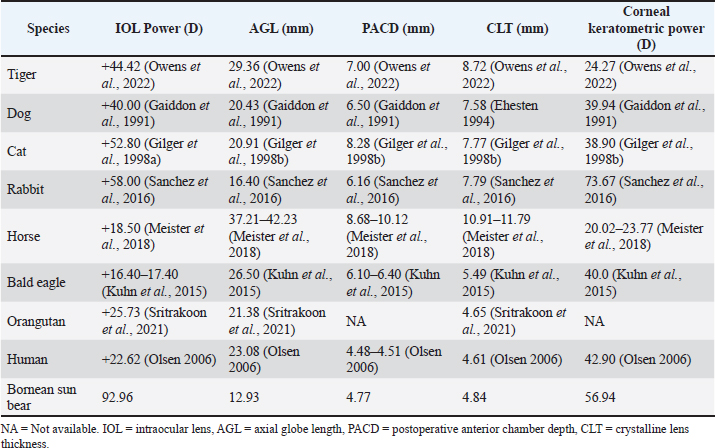
The mean corneal curvature of the Bornean sun bear in this study was 56.94 D. This value exceeds those reported for domestic cats, dogs, horses, eagles, and humans but is lower than that of rabbits. A higher Results and DiscussionOur data indicate that the average AGL and corneal diameter of Bornean sun bears are 12.93 and 10.63 mm, respectively, which are shorter than the reported AGL and corneal diameter of 16.70 and 11.98 mm of the Asiatic black bear based on histopathologic sections (Paszta et al., 2022). This disparity in AGL and corneal diameter likely reflects differences in body size between the two species, as Asiatic black bears typically weigh 130–180 kg (Jeong et al., 2019), whereas Bornean sun bears in our sample weighed between 35 and 41 kg. The average preoperative ACD was 2.35 mm which is similar to an Asiatic black bear ACD of 2.01 mm (Paszta et al., 2022). diopter (D) value indicates a steeper corneal curvature, causing light rays to travel a shorter distance within the globe before focusing on the retina. Hence, the corneal curvature plays a crucial role in determining the refractive strength required for an IOL to effectively focus light onto the retina. The Retzlaff, Binkhorst, Colenbrander, and Fyodorov theoretical formulas were applied in this study to estimate the IOLpower necessary to achieve emmetropia following phacoemulsification. These formulas utilize AGL, mean corneal curvature, mathematical constants for intraocular refractive indices, and PACD. They were selected for their simplicity and their established use in veterinary ophthalmology, enabling comparative analyses. Newer regression formulas that are well- established in human medicine are derived from large datasets and postoperative evaluations and are not applicable to veterinary medicine. The Fyodorov and Retzlaff formulas yielded nearly identical IOL power estimates that were consistently lower than those generated by the Binkhorst and Colenbrander formulas. Similar trends have been reported in studies involving bald eagles, horses, and tigers (Kuhn et al., 2015; Meister et al., 2018; Owens et al., 2022). However, because these formulas were originally developed for the human eye, their accuracy and applicability to Bornean sun bears remain to be fully validated. Our data show that the optimal IOL power for Bornean sun bears ranges from + 84.50 D to + 103.65 D, with an average IOL power of + 92.96 D. The high IOL power requirement was attributed to the relatively short AGL and thick CLT. The CLT comprises approximately 37.4% of the AGL. Table 3 summarizes the predicted IOL power, AGL, PACD, CLT, and mean corneal keratometric power for various species (Gaiddon et al., 1991; Ehesten, 1994; Gilger et al., 1998a; Gilger et al., 1998b; Olsen, 2006; Kuhn et al., 2015; Sanchez et al., 2016; Meister et al., 2018; Sritrakoon et al., 2021; Owens et al., 2022). Table 3. Comparisons of predicted IOL power, AGL, PACD, CLT, and corneal keratometric power for different species.
This study had several limitations, including the potential for user error in measurements and calculations, the small sample size, and the lack of standardized body positioning during measurements. Greater accuracy can be achieved using a B-scan ultrasound device equipped with an A-scan module. In addition, it is unclear whether the results are generalizable to the broader Bornean sun bear population. The IOL power estimations proposed in this study can only be validated through actual phacoemulsification surgeries, where the calculated IOLs are implanted and evaluated. ConclusionBornean sun bears apparently require higher-power IOL to focus light on the retina because of their short AGL combined with moderate corneal keratometric power. This requires customization of IOLs with powers as high as +93 D. Aphakia in Bornean sun bears should lead to significant hyperopic refractive error. The timing of cataract extraction is crucial to prevent complications of hypermaturity, such as lens luxation and lens-induced uveitis, resulting in endothelial decompensation and even glaucoma. This may have already been observed in two of the eyes of the bears under investigation. Aphakic cataract surgery was successfully performed on three sun bears a month later, although post-lendectomy hyperopia cannot be mitigated. Future studies with larger sample sizes are needed to refine keratometry, biometry, and IOL calculations specific to Bornean sun bears. In addition, surveillance of this aging population to detect early cataract for surgical treatment before they begin to cause cataract-related visual deficit should be an important thrust area. AcknowledgmentWe appreciate the support from the Bornean Sun Bear Conservation Centre, Hospital Duchess of Kent Sandakan and Sabah Wildlife Department, which greatly facilitated this work. Conflict of interestThe authors declare no conflicts of interest. FundingThis study did not receive any specific grant. Authors contributionYZW, MHS, NAK, and NHMJ were involved in data collection. BNY, JSWH, and NCA were responsible for the veterinary care and anesthesia of the subjects. NNS, WSC, and STW provide resources. Author YZW wrote the first draft of the manuscript. Authors BNY and NCA edited the last manuscript. All authors have read and approved the final manuscript. Data availabilityAll data are presented in the article. ReferencesBinkhorst, R.D. 1975. The optical design of intraocular lens implants. Ophthalmic Surg 6, 17–31. Chiwitt, C.L.H., Baines, S.J., Mahoney, P., Tanner, A., Heinrich, C.L., Rhodes, M. and Featherstone, H.J. 2017. Ocular biometry by computed tomography in different dog breeds. Vet Ophthalmol. 20, 411–419. Crudge, B., Lees, C., Hunt, M., Steinmetz, R., Fredriksson, G. and Garshelis D. 2019. Sun bears: Global status review & conservation action plan, 2019-2028. IUCN SSC Bear Specialist Group / IUCN SSC Conservation Planning Specialist Group / Free the Bears / TRAFFIC Dombrowski, E., McGregor, G.F., Bauer, B.S., Parker, D. and Grahn, B.H. 2016. Blindness in a wild American black bear cub (Ursus americanus). Vet. Ophthalmol. 19, 340–346. Ehesten , B. 1994. Biological variability and measurement error variability in ocular biometry in samoyed dogs. Acta Vet. Scand. 35, 427–433. Fyodorov, S.N., Galin, M.A. and Linksz, A. 1975. Calculation of the optical power of intraocular lenses. Invest. Ophthalmol. 14, 625–628. Gaiddon, J., Rosolen, S.G., Steru, L., Cook, C.S. and Peiffer, R.J. 1991. Use of biometry and keratometry for determining optimal power for intraocular lens implants in dogs. Am. J. Vet. Res. 52, 781–783. Gilger, B.C., Davidson, M.G. and Colitz, C.M. 1998a. Experimental implantation of posterior chamber prototype intraocular lenses for the feline eye. Am. J. Vet. Res. 59, 1339–1343. Gilger, B.C., Davidson, M.G. and Howard, P.B. 1998b. Keratometry, ultrasonic biometry, and prediction of intraocular lens power in the feline eye. Am. J. Vet. Res. 59, 131–134. Hartley, C. and Oliveira, R.P.R. 2022. Ophthalmology of Ursidae: Bears. In: Wild and Exotic Animal Ophthalmology. Eds., Montiani-Ferreira, F., Moore, B.A. and Ben-Shlomo, G. Cham, Switzerland: Springer International Publishing, pp: 215–268. Jeong, D.H., Yang, J.J., Seo, M.K., Lee, A.N. and Lim, Y.K. 2019. Effectiveness of urethral catheterization under ultrasound guidance for semen collection from Asiatic black bears (Ursus thibetanus). Theriogenology 129, 154–159. Kuhn, S.E., Hendrix, D.V.H., Jones, M.P., Ward, D.A., Baine, K.H. and Franklin, S.R. 2015. Biometry, keratometry, and calculation of intraocular lens power for the bald eagle (Haliaeetus leucocephalus). Vet. Ophthalmol. 18, 106–112. Maehara, S., Matsumoto, N., Takiyama, N., Itoh, Y., Kitamura, Y., Yamashita, K., Sano, T., Itami, T., Oyama, N., Hayashi, M., Kato, R., Shimode, A. and Masuko, A. 2020. Surgical removal of cataract in an asiatic black bear (Ursus thibetanus) by phacoemulsification and aspiration. J. Vet. Med. Sci. 82, 740–744. Meijaard, E. 2004. Craniometric differences among Malayan sun bears (Ursus malayanus); Evolutionary and taxonomic implications. Raffles Bull Zool 52, 665–672. Meister, U., Görig, C., Murphy, C.J., Haan, H., Ohnesorge, B. and Boevé, M.H. 2018. Intraocular lens power calculation for the equine eye. BMC Vet. Res. 14, 1–8. Mirshahi, A., Shafigh, S.H. and Azizzadeh, M. 2014. Ultrasonographic biometry of the normal eye of the Persian cat. Aust. Vet. J. 92, 246–249. Olsen, T. 2006. Prediction of the effective postoperative (intraocular lens) anterior chamber depth. J. Cataract. Refract. Surg. 32, 419–424. Owens, C.D., Michau, T.M., Boorstein, J., Wynn, E.R. and McMullen, R.J. 2022. Keratometry, biometry, and prediction of intraocular lens power in adult tigers (Panthera tigris). Am. J. Vet. Res. 83, 140– 146. Paszta, W., Goździewska-Harłajczuk, K. and Klećkowska-Nawrot, J. 2022. Morphology and histology of the orbital region and eye of the Asiatic black bear (Ursus thibetanus)—Similarities and differences within the Caniformia suborder. Animals 12, 801. Retzlaff, J. 1980. A new intraocular lens calculation formula. J. Am. Intraocul. Implant. Soc. 6, 148– 152. Sakai, H., Goto, M. and Komatsu, T. 2017. Basal cell adenocarcinoma in the gland of the third eyelid of a brown bear (Ursus arctos). J. Vet. Med. Sci. 79, 1348–1351. Sanchez, R.F., Becker, R., Dawson, C., Escanilla, N. and Lam, R. 2016. Calculation of posterior chamber intraocular lens (IOL) size and dioptric power for use in pet rabbits undergoing phacoemulsification. Vet. Ophthalmol. 20, 242–249. Sanders, D., Retzlaff, J., Kraff, M., Kratz, R., Gills, J., Levine, R., Colvard, M., Weisel, J. and Loyd, T. 1981. Comparison of the accuracy of the Binkhorst, Colenbrander, and SRK implant power prediction formulas. J. Am. Intraocul. Implant. Soc. 7, 337– 340. Sritrakoon, N., Karntip, W., Niyom, S., Khemton, S., Pakpiboon, P., Wongsirodkul, K., Arunsri, K. and Thayananuphat, A. 2021. A-scan biometry, phacoemulsification, and foldable intraocular lens implantation in a young orangutan (Pongo pygmaeus). Open Vet. J. 11, 121–127. Uhl, L., Pederson, S., Johnson, V. and Sadar, M. 2019. Phacoemulsification in a 1.5 year old American black bear (Ursus Americanus) with congenital/ juvenile cataracts. The50th Annual Scientific Meeting of the American College of Veterinary Ophthalmologists. Veterinary Ophthalmology, p 62. | ||




| How to Cite this Article |
| Pubmed Style Wai YZ, Yeoh BN, Chiang WS, Sharum MHB, Kadir NA, Jalil NHBM, Ho JSW, Sarkawi NN, Wong ST, Abdullah NCB. Keratometry, biometry, and intraocular lens power calculation in Bornean sun bears (Helarctos malayanus euryspilus). Open Vet. J.. 2025; 15(6): 2889-2894. doi:10.5455/OVJ.2025.v15.i6.58 Web Style Wai YZ, Yeoh BN, Chiang WS, Sharum MHB, Kadir NA, Jalil NHBM, Ho JSW, Sarkawi NN, Wong ST, Abdullah NCB. Keratometry, biometry, and intraocular lens power calculation in Bornean sun bears (Helarctos malayanus euryspilus). https://www.openveterinaryjournal.com/?mno=242904 [Access: June 26, 2026]. doi:10.5455/OVJ.2025.v15.i6.58 AMA (American Medical Association) Style Wai YZ, Yeoh BN, Chiang WS, Sharum MHB, Kadir NA, Jalil NHBM, Ho JSW, Sarkawi NN, Wong ST, Abdullah NCB. Keratometry, biometry, and intraocular lens power calculation in Bornean sun bears (Helarctos malayanus euryspilus). Open Vet. J.. 2025; 15(6): 2889-2894. doi:10.5455/OVJ.2025.v15.i6.58 Vancouver/ICMJE Style Wai YZ, Yeoh BN, Chiang WS, Sharum MHB, Kadir NA, Jalil NHBM, Ho JSW, Sarkawi NN, Wong ST, Abdullah NCB. Keratometry, biometry, and intraocular lens power calculation in Bornean sun bears (Helarctos malayanus euryspilus). Open Vet. J.. (2025), [cited June 26, 2026]; 15(6): 2889-2894. doi:10.5455/OVJ.2025.v15.i6.58 Harvard Style Wai, Y. Z., Yeoh, . B. N., Chiang, . W. S., Sharum, . M. H. B., Kadir, . N. A., Jalil, . N. H. B. M., Ho, . J. S. W., Sarkawi, . N. N., Wong, . S. T. & Abdullah, . N. C. B. (2025) Keratometry, biometry, and intraocular lens power calculation in Bornean sun bears (Helarctos malayanus euryspilus). Open Vet. J., 15 (6), 2889-2894. doi:10.5455/OVJ.2025.v15.i6.58 Turabian Style Wai, Yong Zheng, Boon Nie Yeoh, Wai Seng Chiang, Muhammad Hazim Bin Sharum, Nurhayati Abdul Kadir, Nur Hafizah Binti Mat Jalil, Jessie Si Wai Ho, Nur Nabila Sarkawi, Siew Te Wong, and Nadzariah Cheng Binti Abdullah. 2025. Keratometry, biometry, and intraocular lens power calculation in Bornean sun bears (Helarctos malayanus euryspilus). Open Veterinary Journal, 15 (6), 2889-2894. doi:10.5455/OVJ.2025.v15.i6.58 Chicago Style Wai, Yong Zheng, Boon Nie Yeoh, Wai Seng Chiang, Muhammad Hazim Bin Sharum, Nurhayati Abdul Kadir, Nur Hafizah Binti Mat Jalil, Jessie Si Wai Ho, Nur Nabila Sarkawi, Siew Te Wong, and Nadzariah Cheng Binti Abdullah. "Keratometry, biometry, and intraocular lens power calculation in Bornean sun bears (Helarctos malayanus euryspilus)." Open Veterinary Journal 15 (2025), 2889-2894. doi:10.5455/OVJ.2025.v15.i6.58 MLA (The Modern Language Association) Style Wai, Yong Zheng, Boon Nie Yeoh, Wai Seng Chiang, Muhammad Hazim Bin Sharum, Nurhayati Abdul Kadir, Nur Hafizah Binti Mat Jalil, Jessie Si Wai Ho, Nur Nabila Sarkawi, Siew Te Wong, and Nadzariah Cheng Binti Abdullah. "Keratometry, biometry, and intraocular lens power calculation in Bornean sun bears (Helarctos malayanus euryspilus)." Open Veterinary Journal 15.6 (2025), 2889-2894. Print. doi:10.5455/OVJ.2025.v15.i6.58 APA (American Psychological Association) Style Wai, Y. Z., Yeoh, . B. N., Chiang, . W. S., Sharum, . M. H. B., Kadir, . N. A., Jalil, . N. H. B. M., Ho, . J. S. W., Sarkawi, . N. N., Wong, . S. T. & Abdullah, . N. C. B. (2025) Keratometry, biometry, and intraocular lens power calculation in Bornean sun bears (Helarctos malayanus euryspilus). Open Veterinary Journal, 15 (6), 2889-2894. doi:10.5455/OVJ.2025.v15.i6.58 |


