





| Research Article | ||
Open Vet. J.. 2025; 15(6): 2798-2805 Open Veterinary Journal, (2025), Vol. 15(6): 2798-2805 Research Article Effects of ground dates on rumen fermentation and milk composition parameters in local ewesJassim Edan Al-Musawi, Mohammed M. Dakheel*, Basim Jasim Wadi*Corresponding Author: Mohammed M. Dakheel. Department of Veterinary Public Health, College of Veterinary Medicine, University of Baghdad, Baghdad, Iraq. Email: m.m.dakheel [at] covm.uobaghdad.edu.iq Submitted: 10/03/2025 Revised: 15/05/2025 Accepted: 19/05/2025 Published: 30/06/2025 © 2025 Open Veterinary Journal
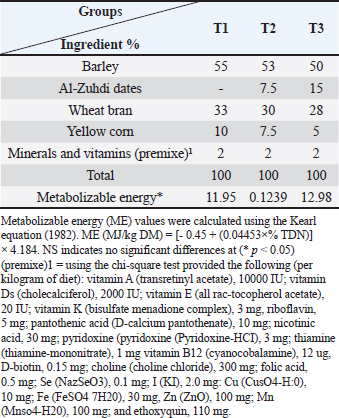
AbstractBackground: Enhancing the nutritional components of milk would improve its quality, especially ewe milk, due to its economic importance to dairy industry companies. Aim: This study evaluated the effects of adding ground dates (Al-Zuhdi) to the concentrated diet on the productive performance of milk components and bacterial fermentation products in the rumen during the lactation period. Methods: Eighteen ewes, aged 2.0–2.5 years old, in good health, with an average weight of 53.60 ± 7.25 kg B.W, were equally divided into three equal groups. The first group (T1) was fed a basal diet as a control, whereas the ewes of the second group (T2) were fed a basal diet with ground dates at a ratio of concentrated diet. The third group (T3) was fed a basal diet supplemented with 15% ground dates from the concentrate diet. Results: The findings demonstrated that rumen fermentation rates were significantly increased (p < 0.05) when dates were added to the diet of ewes. Supplementation with ground dates raised the levels of NH3-N and total volatile fatty acids. When comparing the treated groups with the control, the relative abundance of rumen fluid’s pH acidity decreased (p < 0.05). A diet supplemented with ground dates significantly increased milk protein and fat percentages in T2 and T3 ewes, but no significant difference was observed in milk lactose and solid non-fat. Conclusion: The current study concluded that incorporating ground dates into nutritional supplements can enhance the activation of rumen microorganisms and provide nutrients to ewes, which is reflected in the enrichment of milk components. Keywords: Feed energy, Milk composition, Al-Zuhdi dates, Rumen fluid, Awassi ewe. IntroductionWith global development and increased availability of food products such as dairy, previous studies have resorted to focusing on the quality of these products because milk’s nutritional content reflects its overall value. Marked differences in macronutrient composition between multiple milk sources have been documented, particularly in terms of fat and protein content. For instance, 100 g of milk sheep provides a markedly greater amount of fat (5.9 g) and protein (5.5 g) than goat fat (3.8 g) and protein (3.75 g), cow fat (3.3 g); protein (3.4 g) (Arrichiello et al., 2022; Alkaisy et al., 2023). The abundant production of fats, proteins, and minerals content provides an excellent opportunity to develop the sheep milk industry (LiR et al., 2022). Research on nutritional requirements is critical, particularly regarding the nutrition of ewes, which is vital for enhancing production. Evidence suggests that studies have focused on the protein and energy level requirements of sheep over the past decade (Yang et al., 2020). Nonetheless, as feeding procedures have gradually improved, they are inadequate for contemporary needs due to climate shifts. Although digestion and absorption in ruminants are rapid, resulting in high feed intake, a lack of dietary energy in ewes negatively impacts their production. Protein- or carbohydrate-rich foods significantly affect rumen fermentation, which in turn affects growth performance and milk production in ewes (AL- Mosawi, 2015; Wang et al., 2021). The significance of the rumen lies in its ability to convert non-protein nitrogen and low-quality protein into higher-quality nutrients, including microbial protein and short-chain fatty acids, through the fermentation processes of various microorganisms in the rumen (Ma and Faciola, 2024). Dates and leftovers from palm trees in factories are examples of feed materials used as energy sources for farm animals; these elements are important by stimulating palatability and increasing the ability to digest food (Čolović, 2019; Najafi et al., 2021). Moreover, studies have confirmed that dates or their waste benefit animal performance by stimulating microorganisms in the rumen and improving microbial digestion (Al-Musawi, 2014; Hassan, 2021; Hamdon et al., 2022; Faleh et al., 2024). Research has validated the effectiveness of dietary energy on rumen microbial activity, and its beneficial effects on boosting fiber digestion efficiency have been validated. This is one of the elements that has contributed to the rise in milk production (Dakheel, 2012; Faleh et al., 2024) This study investigated sheep milk as one of the dairy industry’s small ruminant products. This study also aimed to determine the feasibility of processing sheep milk into a high-quality product to maximize the economic interests of local and international businesses by examining the effect of adding ground dates to the concentrated diet on the performance of milk components and rumen bacterial fermentation products. Materials and MethodsAnimalsThe trial sheep used in this research received approval from the Iraqi Agricultural Research Administration, and the study was conducted from January to the end of February 2021. Eighteen clinically healthy Awasy ewes were randomly assigned to groups (average BW: 53.60 ± 7.25 kg) based on physical examination and disease-free status during the second birthing season, which was a month after birth was selected and were allocated among three equal groups. Animals were housed in 5 × 5 m isolated pens (one group per pen) and underwent a 5-day adaptation period. Experimental dietsEach group received a concentrated meal comprising 2% of the body weight. Group T1, which served as the control, received a concentrated basal diet. At the same time, the second group (T2) had the same basal diet supplemented with 7.5% whole dates ground from a concentrated diet (dry Zuhdi dates purchased from the local market). The third group (T3) had the same basal diet augmented with 15% whole dates ground from the concentrated diet. These percentages of dates were used for the purpose of raising metabolic energy and obtaining different energy contents within the range of one megajoule/kg. All animals were provided water and hay ad libitum and grazed daily. The dietary formulas used in this experiment are shown in Table 1. Table 1. Proximate analysis of experimental diets and formula feeding (%).
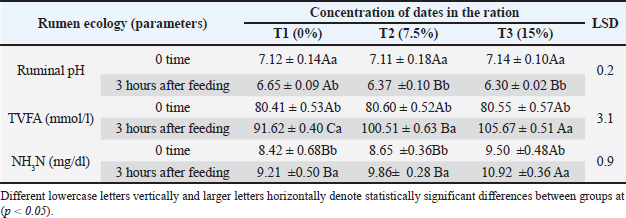
Rumen samplesDuring the concluding week of the experiment, rumen fluid samples were collected from three animals (before feeding at 0 time and after feeding at 3 hours) using a suction pump and stomach tube. Rumen samples of about 30 ml from the ewes selected for milk sample collection were collected using a stomach tube, and the pH was measured immediately using a digital pH meter (WPACD70). The rumen contents were filtered through 4 layers of cheesecloth; the rumen fluid samples were used in the analysis for rumen fermentation parameters (for ammonia and VFA analysis, 2 ml of rumen fluid samples were transferred to 5 ml test tubes and acidified with 400 μl of 25% (w/v) supernatant phosphoric acid, and the samples were then stored at –20°C for later analysis). After thawing, the samples were centrifuged at 30,000 × g (5,000 rpm, JA-17 rotor) for 5 minutes, and the resulting supernatant was used for VFA and ammonia determination. For rumen ammonia nitrogen (NH3-N) measurements, 250 μl of the supernatant was assayed using a caloric ammonia assay kit (Biodiagnostics, Germany). The remaining supernatants (750 μl) were transferred to GC vials for VFA analysis using a capillary column (TR-FFAP 30 m × 0.53 mm I D × 0.5 μm) in a Scientific TRACE 1,300-tem gas chromatography system (Thermo Scientific, Massachusetts, USA) (Rabee et al., 2024). Milk samplesThe samples were taken for milk composition at the commencement of the trial and 15 and 30 days. Samples were taken from morning and evening milking (6 am and 6 pm), with 10 ml collected from each animal (a milk sample was taken from all experimental ewes). The samples were combined with an antimicrobial preservative (Bronopol from Spectrum Company), (romo alcohol, which included 2-bromo-2-nitro-1-mine 3-propanediol), and stored at 5°C. Fat, milk protein, lactose, and total solids nonfat percentages. These analyses were performed in the Animal Nutrition Laboratory of the Veterinary Public Health Branch. The measurements were performed using the fluorometric technique with the MilkoScan FT6000 apparatus (Foss Electric A/S, Hillered, Denmark), as described by Koczura (2019). Statistical analysisData were analyzed using SPSS software (version 26). Data are presented as mean ± standard error (Mean ±SE). A two-way analysis of variance was used to assess differences in milk characteristic values between different species, using the multi-range test, Duncan’s test at a significance level (p < 0.05). Ethical approvalThe Animal Ethics Committee at Al-Dabouni Station approved all procedures (4124–2023), which were conducted in accordance with ARRIVE guidelines; the project does not include euthanized animals. ResultsFeeding formula and proximate analysisThe energy source represented by Al-Zahdi dates was chosen in this research because of its good effect on rumen fermentation, as well as the quality of the milk produced, which may contribute to the economic value of milk products based on quality parameters, which is an indicator of the novelty of the topic in supporting the theoretical virtual labor market. The results of the different groups showed significant (p < 0.05) differences in the means of rumen fermentation products during the time 3 hours after feeding TVFA (91.62, 100.51,105.67 mmol/l)and NH3-N (9.21,9.86, 10.92 mg/dl), respectively (Table 2). Table 2. Rumen fermentation properties in ewes fed on different proportions of dates in the concentrated diet (Mean ± SE).
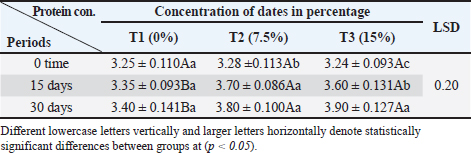
T2 and T3 recorded significant (p < 0.05) decreases in rumen pH (6.37,6.30) compared to T1(6.65), while they recorded an increase in TVFA and NH3-N as compared to the control (T1). The period also illustrated noticeable differences in these parameters studied after 3 hours of feeding compared with the beginning period of feeding at zero time. The ingredients of ewe milkProteinIn Table 3, the analysis of milk protein revealed a significant effect (p < 0.05) of meals containing crushed dates on milk protein levels. The proportion of milk protein was elevated in the treatment groups consuming crushed dates in their diet after 15 and 30 days of feeding, in comparison to the control (3.70, 3.60), (3.80, 3.90), (3.25,3.40), respectively. During the first consuming period, no significant differences were observed in the proportion of total milk protein among the several groups, suggesting that the baseline was almost uniform and that the study began appropriately. In contrast, differences with progression periods showed increasing differences (p < 0.05). Table 3. Effect of adding crush dates to the diet of ewes on the percentage of milk protein (Mean ± SE).
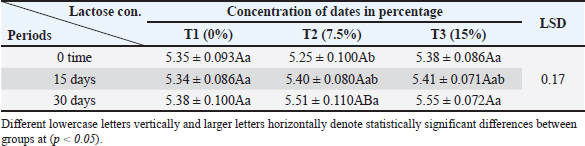
LactoseThe milk lactose percentage results in Table 4 indicated that there was no significant effect of the date crushed with the diet on the proportion of milk lactose in different groups; this is attributed to the fact that lactose is one of the least homogeneous components of milk. Table 4. Effect of adding crush date to the diet of ewes on the percentage of milk lactose (Mean ± SE).
FatThe milk fat percentage findings shown in Table 5 indicated no significant variation throughout the first phase of the investigation. In the second and third periods, the treated groups T2 and T3 exhibited a substantial and significant increase in milk fat percentage compared with the control group (4.50, 4.80),(4.90, 5.30), and (4.30, 4.30), respectively. Although the treatment T2 and T3 groups showed significant differences between the periods, the control T1 group did not show significant differences between the periods. Table 5. Effect of adding crush date to the diet of ewes on the percentage of milk fat (Mean± SE).
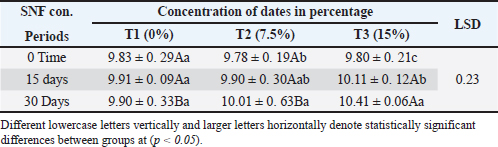
Total solids non-fatTable 6 presents the total solids non-fat content in sheep’s milk, revealing that the findings across various groups exhibited no significant variations in total solids non-fat content in the first period. Treatment groups T2 and T3 exhibited an increase relative to the control group. Moreover, T3 had a significant effect (p < 0.05) compared with the control and T2 groups during the last period, reaching values of (9.90 ± 0.33, 10.01 ± 0.63, and 10.40 ± 0.06) after 30 days, respectively, despite the treated groups exhibiting elevated non-fat values for milk solids. Table 6. Effect of adding crush date to the diet of ewes on the percentage of milk solid non- fat SNF (Mean ± SE).
DiscussionFeeding analysisThrough the results, the significant differences (p < 0.05) in treated groups of rumen fermentation as compared with a control group (Table 2), the superiority in TVFA and NH3-N may be the concentrate diet of sheep containing crushed date, which effect on the feed intake and also the influence of DM digestion. These results agreed with those obtained by many studies (Al-Musawi, 2014; Hassan, 2021; Bakr et al., 2022), demonstrating that the dates and levels (5%, 10%, and 15%) in the concentrate diet have beneficial effects on feed intake and consumption with increased dry matter digestibility. Moreover, the activity of microorganisms was more stimulated due to the easily soluble CHO presence in the diet, which affected the improvement of rumen fermentation (Hurley, 2021). The rumen pH is close to the neutrality point and increased TVFA and NH3-N in the sheep-fed concentrate diets containing crush dates, which is consistent with the indications of the researchers (Khezri et al., 2016; Hamdon et al., 2022). Rabee et al. (2021) noted that fiber digestion efficiency increases when small ruminants are fed on the date. Furthermore, the effect of feed energy mainly available from dates in the diet on the rumen fermentation properties was observed; the treated groups had a positive effect on the activity of rumen microorganisms and improved the rumen pH and TVFA with NH3-N compared to a control group. Microbial activity in the rumen and fermentation efficiency, in conjunction with pH, influence the production of trans-fatty acids, enhancing the overall health and productivity of ruminants, which is consistent with what is indicated by Al-Musawi (2014) and Rabee et al. (2022), who focused on feeding sheep on ration containing ground dates had a positive effect on rumen fermentation of pH, volatile fatty acids, and NH3-N. In addition, the concentrated feed contains a certain percentage of soluble carbohydrates prepared and nitrogen sources in the diet that encourage microbial activities and VFA production with a lower rumen pH. On the other hand, high dietary fiber from roughage intake had an equalizing effect on the rumen pH. This applies to the results of this experiment, which are consistent with those reported in previous research (Sujani et al., 2024). The percentage of ammonia nitrogen increased in the treated groups, consistent with what Sheikh et al. (2019) indicated, the activity of microorganisms in the rumen affects the digestion of nitrogenous material present in the feed, which may be due to the feed containing ground whole dates. Additionally, agreeing with the researchers, Rabee et al. (2024) and Suriyapha et al. (2021) mentioned that the activity of microorganisms in the rumen and the decomposition of nitrogenous compounds have a significant role in increasing ammonia concentration NH3-N. The ingredients of ewe milkConcerning the ewes’ milk ingredients, research has indicated a relationship between nutrition and food components and milk production and components, as well as the sources and energy levels. It was found that the energy and nutrients available from the dates in the ewes’ diet may affect the digestion and absorption of nutrients and the effectiveness of rumen microbes, influencing milk production and its components (protein, fats, lactose, and non-fat solids). The results showed that diets containing different concentrations of crushed dates as food additives, which is a rich source of easily released carbohydrates, positively and significantly increased the production of milk components, which was observed in groups of animals fed on crushed dates with a concentrated diet of 7.5%. Moreover, it was 15% compared with the control group. The notable rise in the percentage of milk protein among animals consuming crushed dates can be ascribed to enhanced metabolism of crude protein in feed supplies and improved efficiency in the conversion ratio of crude protein, in addition to an increase in the formation of microbial protein. This aligns with the findings of Al- Musawi (2014), who emphasized that incorporating crushed dates into the sheep diet significantly affects the digestion of dry matter (DM) and crude protein (CP), thereby enhancing Feed Conversion Efficiency (FCE). Furthermore, incorporating crushed dates into the meal enhances microbial activity in the rumen, augmenting microbial protein synthesis. As a result, there was an increase in the protein yield reached the animal, which was reflected in the blood levels of a nitrogenous substance in the animal increased, and this served as a catalyst for use in the manufacture of milk protein that was consistent with some researchers. Rabee et al. (2021) reported an improvement in CP content and DM digestibility of animals fed dates, as well as a significant increase in blood protein, as previous studies showed the potential of using dates in the diet of lactating cows and consistent with mentioned by Rezaeenia et al. (2018), who indicated that the activity of rumen microbiota works to increase the production of MP. This high-quality protein has a significant effect in raising the proportion of milk protein. On the other hand, some references have indicated that the chemical composition of dates may have hormonal effects on the udder glandular tissue, which then produces milk (Almusawi, 2014; Sangar et al., 2024). This allows the genetic material in the nucleus cell to maximize mammary gland gene expression and milk production and components, such as the high ability to produce milk protein, which is consistent with (Al-Musawi, 2014; Ebrahimi et al., 2017). In addition, no significant differences were observed during the experimental period for the three treatments, which is consistent with researchers (Al-Musawi, 2014; Magan et al., 2021). Milk sugar is considered one of the constants in the nutritional components of milk, as it is in constant proportions in all periods, with the stability of the dietary ratios. The intervention considerably enhanced the proportion of milk fat, consistent with (Luo et al., 2022), as increased dietary energy levels in ewes resulted in higher fat utilization efficiency, hence raising the milk fat percentage. The percentage of milk fat in the animals given crushed dates significantly increased. It may enhance the activity of rumen microbes due to the presence of simple nutrients in dates and an elevation in volatile fatty acids. The rumen bacteria contributed to the accumulation of sheep fat to a certain degree, as the heightened generation of volatile fatty acids in the rumen influenced an elevated fat concentration in the bloodstream (Al-Musawi, 2014; Zhang et al., 2021). An imbalance among bacterial populations, characterized by a deficiency of fibrinolytic bacteria, adversely affects dry matter intake and milk production, in contrast to a greater prevalence of bacteria associated with starch degradation and lactate synthesis (Singh et al., 2020). Moreover, the improvement in milk fat percentage may be due to the inclusion of ground dates in the diet, its effect on taste, dry matter intake, and its effect on the production of volatile fatty acids in the rumen, which positively affects milk fat content. This finding is consistent with the findings of Singh et al. (2020), who suggested that increased propionic acid levels could diminish the proportion of milk fat. The enhancement in productivity was ascribed to the intake of crushed dates alongside a concentrated diet, which influences animal palatability, enhances digestibility by stimulating digestive juices, and generates additional energy and/ or nutrients for rumen microbes (Mahrous et al., 2021). In addition to the energy content and beneficial nutrients of dates, such as dietary fiber, carbohydrates, fats, proteins, polyphenols, and oleic acid, they may play a crucial role in the productivity of treated animals, which positively influences the total solid content of milk. This aligns with the observations of researchers (Al-Musawi, 2014; Shiasi et al., 2021), who noted that the enhancement of all milk components resulted from marginal increases in milk yield when animals were fed crushed dates alongside feed materials. However, no significant difference was observed between groups at zero and 15 days. This may have been due to the short period, as observed in the last period of the experiment. ConclusionThe results indicated that crushed dates enhance animal performance and product quality; thus, they may be used in dairy sheep diets. Consequently, it is recommended to include dates at a proportion of 7.5%–15% of the concentrated diet, and trials with equivalent or greater percentages on lactating animals may be performed to evaluate their productivity. The originality of the problem is the potential enhancement of milk constituents via varying degrees of ascetic dates as an energy source, which may favorably influence palatability and ensure economic viability regarding product quality. AcknowledgmentThe authors sincerely thank the General Authority for Animal Resources-Agricultural Research in Abu Ghraib and the Al-Dabuni Research Station in Wasit for conducting this research. It also extends to the Scientific Committee in the Department of Veterinary Public Health, College of Veterinary Medicine, University of Baghdad, which must obtain official research approval. Conflict of interestThe authors did not declare any conflicts of interest. FundingNo grant was received for this study, and the study was supported by self-funding. Authors’ contributionsDr. Mohammed M Dakheel is the author of this article. Dr. Jassim Edan was the study’s author and was involved in observation and research management. Basim Jasim Wadi is the author of Animal Care. The authors equally wrote the article. Data availabilityAll data were provided in the manuscript. ReferencesALKaisy, Q.H., Al-Saadi, J.S., Al-Rikabi, A.K.J., Altemimi, A.B., Hesarinejad, M.A. and Abedelmaksoud, T.G. 2023. Exploring the health benefits and functional properties of goat milk proteins. Food Sci. Nutr. 11(10), 5641–5656. Available via https://onlinelibrary.wiley. com/doi/pdfdirect/10.1002/fsn3.3531 AL-Mosawi, J.E. 2015. Effect of adding sunflower oil in the ration on some productive traits in Awassi ewes. Iraqi J. Vet. Med. 39(2), 108–112; doi: 10.30539/ijvm Al-Musawi, J.E. 2014. Effect of different levels of whole date on feed intake, digestibility, rumen fermentation, some blood parameters, milk production and composition of Awassi sheep. Ph.D. Dissertation, College of Veterinary Medicine. Baghdad, Iraq: University of Baghdad. Available via https://covm.uobaghdad.edu.iq Arrichiello, A., Auriemma, G. and Sarubbi, F. 2022. Comparison of nutritional value of different ruminant milks in human nutrition. Int. J. Nutr. 3(4), 5; doi: 10.3892/ijfn.2022.28 Čolović, D., Rakita, S., Banjac, V., Đuragić, O. and Čabarkapa, I. 2019. Plant food by-products as feed: characteristics, possibilities, environmental benefits, and negative sides. Food Rev. Int. 35(4), 363–389; doi: 10.1080/87559129.2019.1573431 Dakheel, M.M. 2012. The effect of using Ginger (Zingiber officinale) or parsley seeds (Petroselinum sativum) on some of physiologically traits of black: Mudhaffar NR Al-Saigh and Mohammed M. Dakheel. Iraqi J. Vet. Med. 36(0A), 142–150; doi: 10.30539/IRAQIJVM.V36I0A.367 Ebrahimi F S., Hemmati, M. and Malekaneh, M. 2017. Effects of the date palm fruit (Phoenix dactylifera L.) on prolactin, IGF-1, and stress factors in lactating female rats and its impact on their litters’ development. Med. J. Nutr. Metab. 10(3), 251–258; doi: 10.3233/MNM-17164 Faleh, H., Dakheel, M.and Quijada, J. 2022. Effect of Ziziphus spina-christi leaves on the level of testosterone hormone and semen parameters of Iraqi bucks semen. Iraqi J. Vet. Med. 48(1), 9–14; doi: 10.30539/pmhyvr54 Hamdon, H.A, Kassab, A.Y., Vargas-Bello-Pérez, E., Abdel Hafez, G.A., Sayed, T.A., Farghaly, M.M. and Kholif, A.E. 2022. Using probiotics to improve the utilization of chopped dried date palm leaves as a feed in diets of growing Farafra lambs. Front. Vet. Sci. 9, 1048409; doi: 10.3389/fvets.2022.1048409 Hassan, T.M.M. 2021. Effect of feeding discarded dates, palm leaves and its combination on growth performance, diet digestibility, blood metabolites and profitability of Ossimi Lambs. Ann. Agric. Sci. 59(5), 153–160; doi: 10.21608/assjm.2021.192152 Hurley, M., Lewis, E., Beecher, M., Garry, B., Fleming, C., and Boland, H.D. 2021. Dry matter intake and in vivo digestibility of grass-only and grass-white clover in individually housed sheep in Spring, Summer, and Autumn. J. Anim. 11, 306; doi: 10.3390/ani11020306 Sangar, G.H.M., Mirazi, N., Roodbari, N.H. and Hossieni, A. 2024. Nutritional value of palm meristem from Phoenix dactylifera L. and its effect on polycystic ovary syndrome in female rats induced with estradiol valerate. World J. Tradit. Chin. Med. 10(4), 476–484; doi: 10.4103/wjtcm.wjtcm_65_24 Khezri, A., Dayani, O. and Tahmasbi, R. 2016. Effect of increasing levels of wasted date palm on digestion, rumen fermentation, and microbial protein synthesis in sheep. J. Anim. Physiol. Anim. Nutr. doi: 101.n/a-n/a.10.1111/jpn.12504 Koczura, M., Martin, B., Turille, G., Marchi, M.D., Kreuzer, M. and Berard, J. 2019. Milk composition, but not cheese properties, are impaired the day after transhumance to alpine pastures. Int. Dairy J. (99), 104–540; doi: 10.1016/j.idairyj.2019.104540 Li, R., Ma, Y. and Jiang, L. 2022. Research progress of dairy sheep milk genes. Agriculture 12(2), 169; doi: 10.3390/agriculture12020169 Luo, S.H., Wang, Y., Wang, X., Dai, C. and Wang, Q. 2022. Dietary energy and protein levels on lactation performance and progeny growth of Hu sheep. J. Appl. Anim. Res. 50, 1; doi: 10.1080/09712119.2022.2110501 Ma, S.W. and Faciola, A.P. 2024. Impacts of slow-release urea in ruminant diets: a review. Fermentation. 10(10), 527; doi: 10.3390/fermentation10100527 Magan, J.B., ′Callaghan, T.F., Kelly, A.L. and McCarthy, N.A. 2021. Compositional and functional properties of milk and dairy products derived from cows fed pasture or concentrate-based diets. Compr. Rev. Food Sci. Food Saf. 20, 1−32; doi: 10.1111/1541- 4337.12751 Mahrous, A.A., El-Tahan, A.A.H. and Hafez, Y.H. 2021. Effect of date palm (Phoenix dactylifera L.) leaves on productive performance of growing lambs. Trop. Anim. Health Prod. 53, 72; doi: 10.1007/s11250- 020-02493-2 Najafi, S., Ghasemi, H.A., Hajkhodadadi, I. and Khodaei-Motlagh, M. 2021. Nutritional value of whole date waste and evaluating its application in ostrich diets. Anim. 15(3), 100165; doi: 10.1016/j.animal.2020.100165 Rabee, A., Ghandour, M., Sallam, A., Elwakeel, E., Mohammed, R., Sabra, E., Abdel-Wahed, A., Mourad, D., Hamed, A. and Hafez, O. 2024. Rumen fermentation and microbiota in Shami goats fed on condensed tannins or herbal mixture. BMC Vet. Res. 20; doi: 10.1186/s12917-024-03887-2 Rabee, A.E., Kewan, K.Z., El Shaer, H.M., Lamara, M., and Sabra, E.A. 2022. Effect of olive and date palm by-products on rumen methanogenic community in Barki sheep. AIMS Microbiol. 8(1), 26–41; doi: 10.3934/microbiol.2022003 Rabee, A.E., Kewan, K.Z., Sabra, E.A., El Shaer, H.M. and Lamara, M. 2021. Rumen bacterial community profile and fermentation in Barki sheep fed olive cake and date palm byproducts. PeerJ. 9, e12447; doi: 10.7717/peerj.12447 Rezaeenia, A., Naserian, A., Valizadeh, R., Tahmasbi, A. and Mokhtarpour, A. 2018. Effect of dietary inclusion of date seed (Phoenix dactylifera L.) on intake, digestibility, milk production, and milk fatty acid profile of Holstein dairy cows. Trop. Anim. Sci. 50, 1427–1433; doi: 10.1007/ s11250-018-1576-9 Bakr, M.H., Ali, R.A., Mahmoud, A.E.M. and Rahmy, H.A.F. 2022. Nutritional effects of feeding date pits to Barki lambs on their growth performance, rumen and blood parameters, and economic efficiency. EJNF 25(2), 211–222; doi: 10.21608/ ejnf.2022.256905 Sheikh, G.G., Ganai, A.M. and Sheikh, A. 2019. Rumen microflora, fermentation pattern and microbial enzyme activity in sheep fed paddy straw based complete feed fortified with probiotics. Biol. Rhythm Res. 8, 1. doi: 10.1080/09291016.2019.1644019 Shiasi, S.R., Alikhani. and Hashemzadeh, F. 2021. Effects of different planes of milk feeding and milk total solids concentration on growth, ruminal fermentation, health, and behavior of late-weaned dairy calves during summer. J. Ani. Sci. Biotechnol. 12, 96; doi: 10.1186/s40104-021- 00615-w Singh, R.K., Dey, A., Paul, S.S., Singh, M., Dahiya, S.S. and Punia, B.S. 2020. Associative effects of plant secondary metabolites in modulating in vitro methanogenesis, volatile fatty acids production, and fermentation of feed in buffalo (Bubalus bubalis). Agrofor. Syst. 94, 1555–1566; doi: 10.1007/ s10457-019-00395-3 Sujani, S., Gleason, C.B., Dos Reis, B.R. and White, R.R. 2024. Rumen fermentation of meal-fed sheep in response to diets formulated to vary in fiber and protein degradability. Anim. Sci. J. 102, 406; doi: 10.1093/jas/skad406 Suriyapha, C.H., Cherdthong, A., Suntara, C.H. and Polyorach, S. 2021. Utilization of yeast waste fermented citric waste as a protein source to replace soybean meal and various roughage to concentrate ratios on in vitro rumen fermentation, gas kinetic, and feed digestion. J. Ferment. Technol. 7(3), 120; doi: 10.3390/fermentation7030120 Wang, J., Hao, Z., Hu, J., Liu, X., Li, S., Wang, J., Shen, J., Song, Y., Ke, N. and Luo, Y. 2021. Small RNA deep sequencing reveals the expressions of microRNAs in ovine mammary gland development at peak-lactation and during the non-lactating period. Genomics 113(1), 637–646; doi: 10.1016/j. ygeno.2020.09.060 Yang, C.T., Wang, C.M., Zhao, Y.G., Chen, T.B., Aubry, A., Gordon, A.W. and Yan, T. 2020. Updating maintenance energy requirement for the current sheep flocks and the associated effect of nutritional and animal factors. Anim. 14(2), 295–302; doi: 10.1017/S1751731119002064 Zhang, Y., Zhang, X., Li, F., Li, C., Zhang, D., Li, X., Zhao, Y. and Wang, W. 2021. Exploring the ruminal microbial community associated with fat deposition in lambs. Anim. 11(12), 3584; doi: 10.3390/ani11123584 | ||

| How to Cite this Article |
| Pubmed Style Al-musawi JE, Dakheel MM, Wadi BJ. Effects of ground dates on rumen fermentation and milk composition parameters in local ewes. Open Vet. J.. 2025; 15(6): 2798-2805. doi:10.5455/OVJ.2025.v15.i6.48 Web Style Al-musawi JE, Dakheel MM, Wadi BJ. Effects of ground dates on rumen fermentation and milk composition parameters in local ewes. https://www.openveterinaryjournal.com/?mno=246730 [Access: June 26, 2026]. doi:10.5455/OVJ.2025.v15.i6.48 AMA (American Medical Association) Style Al-musawi JE, Dakheel MM, Wadi BJ. Effects of ground dates on rumen fermentation and milk composition parameters in local ewes. Open Vet. J.. 2025; 15(6): 2798-2805. doi:10.5455/OVJ.2025.v15.i6.48 Vancouver/ICMJE Style Al-musawi JE, Dakheel MM, Wadi BJ. Effects of ground dates on rumen fermentation and milk composition parameters in local ewes. Open Vet. J.. (2025), [cited June 26, 2026]; 15(6): 2798-2805. doi:10.5455/OVJ.2025.v15.i6.48 Harvard Style Al-musawi, J. E., Dakheel, . M. M. & Wadi, . B. J. (2025) Effects of ground dates on rumen fermentation and milk composition parameters in local ewes. Open Vet. J., 15 (6), 2798-2805. doi:10.5455/OVJ.2025.v15.i6.48 Turabian Style Al-musawi, Jassim Edan, Mohammed M. Dakheel, and Basim Jasim Wadi. 2025. Effects of ground dates on rumen fermentation and milk composition parameters in local ewes. Open Veterinary Journal, 15 (6), 2798-2805. doi:10.5455/OVJ.2025.v15.i6.48 Chicago Style Al-musawi, Jassim Edan, Mohammed M. Dakheel, and Basim Jasim Wadi. "Effects of ground dates on rumen fermentation and milk composition parameters in local ewes." Open Veterinary Journal 15 (2025), 2798-2805. doi:10.5455/OVJ.2025.v15.i6.48 MLA (The Modern Language Association) Style Al-musawi, Jassim Edan, Mohammed M. Dakheel, and Basim Jasim Wadi. "Effects of ground dates on rumen fermentation and milk composition parameters in local ewes." Open Veterinary Journal 15.6 (2025), 2798-2805. Print. doi:10.5455/OVJ.2025.v15.i6.48 APA (American Psychological Association) Style Al-musawi, J. E., Dakheel, . M. M. & Wadi, . B. J. (2025) Effects of ground dates on rumen fermentation and milk composition parameters in local ewes. Open Veterinary Journal, 15 (6), 2798-2805. doi:10.5455/OVJ.2025.v15.i6.48 |


