





| Research Article | ||
Open Vet. J.. 2026; 16(1): 396-400 Open Veterinary Journal, (2026), Vol. 16(1): 396-400 Research Article A comparative study between two fishing areas, one near and other far from industrial cities, for estimating mercury levels in octopus’s liver and armsElhadi Emhmmed Gunbaej1 and Omima Saleh Eljadidi2*1Libyan Center for Researches and Studies of Food and Nutrition, Department of Toxins, Sabratha University, Sabratha, Libya 2Division of Zoology, Department of Life Sciences, School of Basic Sciences, Higher Institute of Marine Science Techniques, Academy of Graduate Studies Tripoli, Sabratha, Libya *Corresponding Author: Omima Saleh Eljadidi. Higher Institute of Marine Science Techniques, Sabratha, Libya. Email:Omima.aljadede [at] gmail.com Submitted: 18/03/2025 Revised: 11/11/2025 Accepted: 04/12/2025 Published: 31/01/2026 © 2025 Open Veterinary Journal
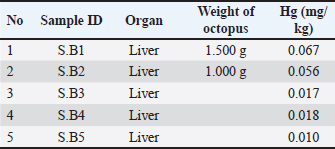
AbstractBackground: Molluscs, especially octopus, is a nutritious seafood, containing high levels of proteins, omega-3 fatty acids, and essential minerals. However, marine pollution with heavy metals such as mercury (Hg), lead, and cadmium (Cd) is a growing concern, as these elements can accumulate in octopus tissues as a result of the marine food chain. Aim: This study aimed to determine the from beaches near the Zawiya refinery and compare them with samples taken from beaches far from industrial cities (Marsa Zawagha/b). Methods: Hg concentrations (mg/kg wet weight) were measured using the Buck Scientific USA 210 VGP model Atomic Absorption Spectrophotometer at the Central Laboratory of Delta Technical Services Company, Tripoli, Libya, in accordance with Association of Official Analytical Chemists (1990). Results: The results were average concentrations of 0.0336 and 0.1576 mg/kg in liver and arm samples taken from Zawiya, respectively, and 0.0050 and 0.0069 mg/kg were detected in liver and arm samples taken from Marsa Zawagha, respectively. Below the internationally recommended level (0.5 mg/kg) according to the World Health Organization and the European Union. Conclusion: The amount was within permissible bounds. Statistical analysis, that the Zawia Refinery area has a statistically significant (p < 0.05) advantage over Marsa Zawagha in terms of the (mg/kg) in liver samples. Additionally, average concentrations for both areas were below the World Health Organization and European Union standards (<0.5 mg/kg). Keywords: Octopus, Mercury, Atomic Absorption Spectrometer, Zawiya refinery; Marsa Zawagha Sabratha. IntroductionThe Mediterranean Sea, in the center of Europe and Asia long been regarded as the sea of many civilizations. This makes it a unique ecosystem with a wide variety of marine species, many of which are becoming endangered due to pollution from various sources (Coll et al., 2010). Its beaches are spread across 22 countries, receives massive amounts of various pollutants, including 129 thousand tons of mineral oils, 60 thousand tons of highly toxic mercury (Hg), 650 million tons of sewage, and 70% of untreated wastewater. It is estimated that roughly 730 tons of plastic are dumped into the Mediterranean Sea every day. Libya of the nations with a roughly km2 Mediterranean coastline, as one of those nations whose coastlines are severely polluted by a variety of human activities. Cities along the coast of Libya rely on the direct release of water and wastewater from industrial centers the Zawiya refinery, into the sea. Marine organisms algae, mollusks, that have made these beaches their home may be impacted if pollutants, heavy metals, are not removed and treated from the beach. This could lead (Pb) to both pollution and tissue contamination (Bonsignore et al., 2018; Pandiyan et al., 2021). Libya’s coastal waters are naturally contaminated with oil and other heavy elements because the country is one of those that extracts and exports oil (Essam Abdel and Al-Turki, 2012), such as Pb, cadmium (Cd), As, and Hg, toxic. These elements are fixed and ingested in the human chain. Since mollusks, like octopuses, are marine animals, the amount of heavy metal accumulation in their tissues is higher than in the marine environment in which they live (Abdullah, 2013). Additionally, the rate at which these organisms absorb Hg through their gills and food varies depending on the species, which has a detrimental effect on the health of the person who eats mollusks (Al-Dheeb, 2020). In many Middle Eastern countries, including Libya, marine fishes octopus are sold and consumed as a valuable food source, to the few international published studies about the heavy contents in these and the toxic effects of heavy metals on public health, the current study aimed to assess the residual levels of harmful Hg in the tissues of mollusk (octopus) samples collected from beaches near city (Zawiya oil refinery) and levels in the samples collected from beaches far from city (Marsa Zawagha, Sabratha). Materials and MethodsSample collectionA total of five samples of octopus vulgaris were collected from beaches near the Zawiya refinery and from industrial cities (Marsa Zawagha), Libya, during the period from 01/03/2024 to 25/09/2024. Each sample was individually packed into an impermeable plastic bag, marked, and promptly transported to the Central Laboratory of Delta Technical Services Company, Tripoli, Libya, where samples were prepared and digested for heavy analysis. Reagents washing proceduresStandard solutions of Hg, arsenic, Pb, and Cd (E-Merck; Darmstadt, Germany) as well as 65% nitric acid, 70% perchloric acid, 37% hydrochloric acid, and 30% hydrogen peroxide were among the reagents used. Before, all glassware and equipment were submerged in soap and water for After that, they were rinsed several times with tap water and again with distilled water to remove any last bits of dirt. The products were then washed once using Therand solution (100 ml concentrated HCL 37% + 40 ml H2O2 30% + 125 ml deionized water). Received a single wash with diluted acid (450 of distilled water plus 50 of 37% HCL). With deionized water and then dried in a sanitized environment. Preparation and digestionThe octopus samples were digested using the method described by Abd-Elghany et al. (2024). Each raw octopus sample was aseptically cut, finely chopped, and placed in a sterile screw-capped tube along with of 65% HNO3 and of 70% HCLO4. After of vigorous shaking, the tube was to sit at room temperature overnight. To guarantee thorough digestion, the tubes were heated in a water bath. The tubes were allowed to cool at room temperature before the digest was diluted with deionized water and filtered through. Finally, the filter was diluted with. The diluted filtrate was stored at room temperature in a sterile screw-capped tube labeled with the sample number and the heavy metal concentrations. To ensure the accuracy of the heavy analysis by the blank solutions (HNO3, HCL, HCLO4, H2O2, and deionized water) were prepared using the same wet digestion method without the addition. By diluting a stock solution of 1,000 mg/l of the metal under analysis (Hg, As, Pb, and Cd) with acidified ultrapure water (5% v/v HNO3), working standard solutions of 0.005, 0.01, 0.1, and 0.2 ppm for each metal were created to construct the calibration curves. Heavy analysisHg concentrations (mg/kg wet weight) were measured using the Buck Scientific USA 210 VGP model Atomic Absorption Spectrophotometer (AAS) at the Central Laboratory of Delta Technical Services Company, Tripoli, Libya, in accordance with AOAC (1990). The Hg was estimated using a flameless AAS equipped with a hydride system and a cold vapor method. The instrument was run at 253.7, and detection limits ranging from 0.005 to 0.2 mg/kg. The tested samples were estimated according to the following: Element (mg/kg wet weight)=R × D/W D is the, W is the element concentration (mg/l) as read by the AAS digital scale. Additionally, the amount of metals in the blank solutions was measured and subtracted from each. Validation methodWorking standard solutions of 0.01, 0.05, 0.1, 0.5, 2, and 5 mg/l for Hg construct calibration curves. The validation for heavy analysis was previously designated in a study performed by Abd-Elghany et al. (2024) of quantification at 0.685 mg/kg, of detection at 0.201 mg/kg, (CV%) that of spiking recovery at 96.4%. All analytical procedures employed in the current experiment were validated using a certified reference material, such as dogfish liver (DOLT-4, imported from Canada), yielding recovery values ranging from 97.7% to 104.7%. Statistical analysisThe tested liver samples were subjected to three analyses. All collected, tabulated, and analyzed using the Vassar Stats website (http://vassarstats.net). The mean ± SE values for metals were computed. To determine if there was a significant difference between the samples, a one-way was assessed. Ethical approvalNot needed for this study. ResultsTable 1 concentration of (Hg) in the liver collected from Zawia. Table 1. Concentration of (Hg) in collected from the Zawia Refinery.
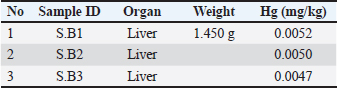
The results in that the Hg concentration increased as the sample size increased. Table 2 concentration of (Hg) in liver collected from Marsa. Table 2. Concentration of (Hg) in collected from the Marsa Zawagha.
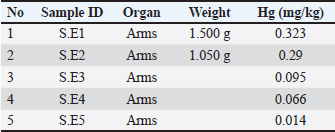
The analyses in this table showed a direct relationship between the large size of the liver samples and the increased. Table 3 concentration of (Hg) in arms collected from Zawia Refinery. Table 3. Concentration of (Hg) in octopus collected from the Zawia Refinery.
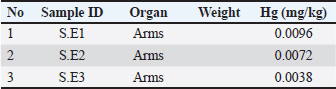
After collecting octopus arm samples from Zawia Refinery, varied depending on the size of the sample. Table 4 concentration of (Hg) in arms collected from Marsa Zawagha. Table 4. Concentration of (Hg) in collected from the Marsa Zawagha.
Table 5 significance of differences in (Hg) concentration in (mg/kg) between Zawia Refinery and Marsa Zawagha areas (n1=5, n2=3). Table 5. Concentration of Mercury (Hg) in octopus’s liver collected from the first area of the study (Zawia Refinery).
The p-value (p=0.025) is less than the significance level of 0.05, indicating that the difference in concentrations between Zawia Refinery and Marsa Zawagha is statistically significant. This means that the observed difference is unlikely to have occurred by chance. Table 6 shows the significance of differences in Hg concentration in arms sample (mg/kg) between Zawia Refinery and Marsa Zawagha areas (n1=5, n2=3). Table 6. Concentration of Mercury (Hg) in octopus’s liver collected from the second area of the study (Marsa Zawagha).
The results show that the concentration in the Zawia Refinery area (mean=0.1576 mg/kg) is significantly higher than the Marsa Zawagha area (mean=0.0069 mg/kg). DiscussionHg levels in the liver concentration samples of octopuses from the first study area (Zawia Refinery) ranged from 0.010 to 0.067 mg/kg, with a mean of 0.0336 ± 0.0259 mg/kg (Tables 1 and 5). Meanwhile, the findings showed that the Hg levels in the liver samples of octopuses in the second study area (Marsa Zawagha) varied between 0.0047 and 0.0057 mg/kg, with an average of 0.0050 ± 0.0003 mg/kg (Tables 2 and 5). Identical to that reported by Saixas et al. (2002); Inzunza et al. (2023); Yousney et al. (2018) and Geely (2024) who concluded that the amount of Hg in the water was within permissible limits. Raimondo et al. (2006) discovered that octopus tissue samples taken from three locations along the Portuguese coast had. In contrast to our findings, found higher levels of heavy metals in coastal seawater at untreated wastewater outlets in the city of Tripoli. Al-Rujabi et al. (2010) also discovered elevated (Rossman, 2019). Table 5 shows that the Zawia Refinery area has a statistically significant (p < 0.05) advantage over Marsa Zawagha in terms of the Hg concentration (mg/kg) in liver samples. Additionally, average concentrations for both areas were below the WHO and EU standards (<0.5 mg/kg). The AAS results showed that the Hg levels in the octopus arms samples collected from the first area of the study (Zawia Refinery) ranged from 0.014 to 0.0323 mg/kg, with a mean of 0.1576 ± 0.1395 mg/kg (Tables 3 and 6). The findings showed that the concentrations of Hg in the octopus arms taken from the second study area (Marsa Zawagha) ranged from 0.0029 to 0.009 mg/kg, with an average of 0.0069 ± 0.0029 mg/kg (Tables 4 and 6). All in this study contained Hg, but the levels were within defined safe limits. This is consistent with findings from other studies, including Bustamante et al. (2003); Rjeibi et al. (2010); Al-Rabaoui et al. (2015); Ahmed et al. (2017) ; Minet et al. (2021) and Geely (2024) who found that the amounts of Hg in the octopus arms and edible parts were within acceptable limits. Meanwhile, octopus tissue samples taken from Gokceada Island in the northeastern Aegean Sea contained Hg (Belivermiş et al., 2019). Statistically, table that there was a difference (p < 0.05) between the concentrations of (Hg) (mg/kg) (arms sample) from the Zawia Refinery and Marsa Zawagha areas. Average concentrations of Hg from the Zawia Refinery area were within and EU standards (<0.5 mg/kg). ConclusionThe investigation demonstrated that all samples contained Hg in an amount below the 0.5 mg/kg threshold recommended by the European Union and the Despite the low levels of Hg in these samples, it is important to remember that Hg is a toxic substance, and to high levels of its compounds, such as methyl mercuric chloride, can cause health issues. Additionally, levels of Hg in the liver and arms of samples taken from beaches close to the Zawiya refinery and samples taken from beaches farther away from industrial cities (Marsa Zawagha/Sabratha) were statistically significant. AcknowledgmentsNone. Conflict of interestThe authors have no conflicts of interest to declare. FundingThis study received no external funding. Authors contributionThe author solely contributed to the conception and design of the review, data collection, drafting, and manuscript revision. Data availabilityAll data were provided in the manuscript. ReferencesAbd-Elghany, S.M., Sayed-Ahmed, M.Z., Rahmo, H.M., Zakaria, A.I., Ahmad, S., Alam, N., Ali, M.S. and Sallam, K.I. 2024. Carcinogenic and noncarcinogenic health risks associated with the consumption of fishes contaminated with heavy metals from Manzala Lake, Egypt. Mar. Pollut. Bull. 202, 116391; doi:10.1016/j.marpolbul.2024.116391 Abdullah, M. 2013. Bioaccumulation of heavy metals in mollusk species and assessment of potential human health risks. NCBI. Ahmed, H.O., Moustafa, A.Y., Abd El-wakeil, K.F. and Omer, M.Y. 2017. Heavy metals distribution in the body parts of cephalopods (Sepia officinalis and Octopus vulgaris). Egypt. J. Aquat. Biol. Fish. 26(2), 79–92.. Al-Dheeb, N. 2020. Variation in individual behavior. (Master’s thesis). Zawiya, Libya. Ali, S., Elfaki, J., Adam, M. and Dafalla, M. 2017. Assessment of heavy metals contamination in the Nile River water and adjacent sediments: A case study from Khartoum City and Nile River State, Sudan. Eurasian J. Soil Sci. 6(3), 285–294. doi: 10.18393/ejss.298949 AOAC. 1990. Official methods of analysis of the Association of Official Analytical Chemists (15th ed., Vol. 2). Washington, DC: AOAC. Bustamante, P., Bocher, P., Cherel, Y., Miramand, P. and Caurant, F. 2003. Distribution of trace elements in the tissues of benthic and pelagic fish from the Kerguelen Islands. Sci. Total Environ. 313(1-3), 25–39. doi: 10.1016/S0048-9697(03)01270-7 Bonsignore, M., Manta, D.S., Mirto, S., Quinci, E.M., Ape, F., Montalto, V. and Sprovieri, M. 2018. Bioaccumulation of heavy metals in fish, crustaceans, molluscs and echinoderms. Ecotoxicol. Environ. Saf. 162, 554–562. Coll, M., Shannon, L. J., Yemane, D., Link, J. S., Ojaveer, H., Neira, S., Jouffre, D., Labrosse, P., Heymans, S., Fulton, E. A. and Shin, Y.-J. 2010. Ranking the ecological relative status of exploited marine ecosystems. ICES J. Marine Sci. 67(4), 769–786. doi: 10.1093/icesjms/fsp261 Essam Abdel, M. and Al-Turki, A. 2012. Heavy elements: their sources and environmental harm. Inzunza, J.R.R., Alvarez, C.D., Sanchez, O.E. and Espericueta, M.G.F. 2023. Mercury concentrations in canned bivalves and cephalopods. Cienc. Mar. 49(1), 3. Kılıç, Ö., Belivermiş, M., Sezer, N., Kalaycı, G. and Gözel, F. 2019.Multi-pollutant Monitoring in a Rehabilitated Estuary: Elements and Radionuclides. Bull. Environ. Contamin. Toxicol. 103(2), 354–361. HYPERLINK “https://doi.org/10.1007/s00128-019-02636-8” doi: 10.1007/s00128-019-02636-8 Minet, A., Manceau, A., Valada-Mennuni, A., Brault-Favrou, M., Churlaud, C., Fort, J. and Lacoue-Labarthe, T. 2021. Mercury in tissues of cephalopods. Sci. Total Environ. 759, 143907. Pandiyan, J., Mahboob, S., Govindarajan, M., Al-Ghanim, K.A., Ahmed, Z., Al-Mulhm, N. and Krishnappa, K. 2021. Assessment of heavy metals pollution. Saudi. J. Biol. Sci. 28(2), 1218–1225. Raimondo, S., Montague, B. J. and Barron, M. G. 2007. Determinants of variability in acute to chronic toxicity ratios for aquatic invertebrates and fish. In Y. Feng (Ed.), Ecological risk assessment of heavy metals in surface environments. Springer. Rjeibi, M., Metian, M., Hajji, T., Guyot, T., Ben Chaouacha-Chekir, R. and Bustamante, P. 2014.Interspecific and geographical variations of trace metal concentrations in cephalopods from Tunisian waters. Environ. Monitor. Assess. 186(6), 3767–3783. doi: 10.1007/s10661-014-3767-8 Rabaoui, L., El Zrelli, R., Ben Mansour, M., Balti, R., Mansour, L., Tlig-Zouari, S. and Guerfel, M. 2015.On the relationship between the diversity and structure of benthic macroinvertebrate communities and sediment enrichment with heavy metals in Gabes Gulf, Tunisia. J. Marine Biol. Assoc. United Kingdom 95(2), 233–245. doi: 10.1017/S0025315414001489 Rossman. 2019. Analysis of heavy metals in the coastal city of Bribir, Indonesia. Seixas, S., Bustamante, P. and Pierce, G.J., 2005. Patterns of variation in concentrations of trace elements in arms of Octopus vulgaris. Chemosphere 59(8), 1113–1124. Yusni, E. and Hartono, E.S. 2019. Analysis of Pb and Hg in octopus in Medan City. Younis, A. M., Hanafy, S., Elkady, E. M., et al. 2024. Assessment of health risks associated with heavy metal contamination in selected fish and crustacean species from Temsah Lake, Suez Canal. Sci. Rep. 14, 18706. doi: 10.1038/s41598-024-69561-7 | ||


| How to Cite this Article |
| Pubmed Style Gunbaej EE, Eljadidi OS. A comparative study between two fishing areas, one near and other far from industrial cities, for estimating mercury levels in octopus’s liver and arms. Open Vet. J.. 2026; 16(1): 396-400. doi:10.5455/OVJ.2026.v16.i1.36 Web Style Gunbaej EE, Eljadidi OS. A comparative study between two fishing areas, one near and other far from industrial cities, for estimating mercury levels in octopus’s liver and arms. https://www.openveterinaryjournal.com/?mno=248172 [Access: June 26, 2026]. doi:10.5455/OVJ.2026.v16.i1.36 AMA (American Medical Association) Style Gunbaej EE, Eljadidi OS. A comparative study between two fishing areas, one near and other far from industrial cities, for estimating mercury levels in octopus’s liver and arms. Open Vet. J.. 2026; 16(1): 396-400. doi:10.5455/OVJ.2026.v16.i1.36 Vancouver/ICMJE Style Gunbaej EE, Eljadidi OS. A comparative study between two fishing areas, one near and other far from industrial cities, for estimating mercury levels in octopus’s liver and arms. Open Vet. J.. (2026), [cited June 26, 2026]; 16(1): 396-400. doi:10.5455/OVJ.2026.v16.i1.36 Harvard Style Gunbaej, E. E. & Eljadidi, . O. S. (2026) A comparative study between two fishing areas, one near and other far from industrial cities, for estimating mercury levels in octopus’s liver and arms. Open Vet. J., 16 (1), 396-400. doi:10.5455/OVJ.2026.v16.i1.36 Turabian Style Gunbaej, Elhadi Emhmmed, and Omima Saleh Eljadidi. 2026. A comparative study between two fishing areas, one near and other far from industrial cities, for estimating mercury levels in octopus’s liver and arms. Open Veterinary Journal, 16 (1), 396-400. doi:10.5455/OVJ.2026.v16.i1.36 Chicago Style Gunbaej, Elhadi Emhmmed, and Omima Saleh Eljadidi. "A comparative study between two fishing areas, one near and other far from industrial cities, for estimating mercury levels in octopus’s liver and arms." Open Veterinary Journal 16 (2026), 396-400. doi:10.5455/OVJ.2026.v16.i1.36 MLA (The Modern Language Association) Style Gunbaej, Elhadi Emhmmed, and Omima Saleh Eljadidi. "A comparative study between two fishing areas, one near and other far from industrial cities, for estimating mercury levels in octopus’s liver and arms." Open Veterinary Journal 16.1 (2026), 396-400. Print. doi:10.5455/OVJ.2026.v16.i1.36 APA (American Psychological Association) Style Gunbaej, E. E. & Eljadidi, . O. S. (2026) A comparative study between two fishing areas, one near and other far from industrial cities, for estimating mercury levels in octopus’s liver and arms. Open Veterinary Journal, 16 (1), 396-400. doi:10.5455/OVJ.2026.v16.i1.36 |


