





| Research Article | ||
Open Vet. J.. 2025; 15(10): 5018-5031 Open Veterinary Journal, (2025), Vol. 15(10): 5018-5031 Research Article Effect of agronomic practices on the nutritional composition and in vitro digestibility of Tithonia diversifolia and Moringa oleifera in pig dietsJose de la Torres -Moreira1*, Veronica Andrade-Yucailla2, Alvaro Arias-Vega3,4, Raciel Lima-Orozco3,4and Veronica Rivadeneyra-Espin11Fauna, Conservation and Global Health Research Group, Universidad Regional Amazonica (Ikiam), Tena, Ecuador 2Centro de Investigaciones Agropecuarias, Facultad de Ciencias Agropecuarias, Universidad Estatal Península de Santa, La Libertad, Ecuador 3Departamento de Medicina Veterinaria, Universidad Central “Marta Abreu” de Las Villas, Santa Clara, Cuba 4Centro de Investigaciones Agropecuarias, Universidad Central “Marta Abreu” de Las Villas, Santa Clara, Cuba *Corresponding Author: Jose de la Torres-Moreira. Fauna, Conservation and Global Health Research Group, Universidad Regional Amazonica (Ikiam), Tena, Ecuador. Email: jose.delatorres [at] ikiam.edu.ec Submitted: 26/05/2025 Revised: 28/08/2025 Accepted: 14/09/2025 Published: 31/10/2025 © 2025 Open Veterinary Journal
AbstractBackground: Tropical livestock production systems face challenges related to the availability and digestibility of quality forages. Tithonia diversifolia and Moringa oleifera have emerged as promising alternatives due to their high nutritional value and adaptability, although their performance is influenced by agronomic practices. Aim: This study aimed to evaluate how agronomic factors, such as cutting height and frequency in T. diversifolia and planting density in M. oleifera, affect forage yield, chemical composition, and in vitro digestibility and to determine the effect of including their flours in pig diets. Methods: Four experimental trials were conducted in the Ecuadorian Amazon. Cutting heights (10, 25, and 40 cm) and frequencies (40–60 days) were tested for T. diversifolia, whereas three planting densities (60, 80, and 100 k plants/ha) were evaluated for M. oleifera. In vitro digestibility assays were performed using diets with 5%, 10%, and 15% flour inclusion levels. Proximate analysis, fiber fractionation, and energy estimations were performed. Data were analyzed using analysis of variance, Kruskal–Wallis, and GLM models. Results: Cutting T. diversifolia at 40 cm and harvesting at 50–55 days maximized biomass and crude protein content while minimizing structural fiber. Moringa oleifera showed no significant differences in composition among planting densities, although higher densities tended to increase yield. The in vitro digestibility of organic matter remained above 70% with 5%–10% forage inclusion, and the energy values (DE, EM, and NE) were maintained. Higher inclusion levels (15%) decreased the starch content and digestibility rates. Conclusion: Agronomic optimization significantly improves the forage quality of T. diversifolia and M. oleifera. Their moderate inclusion in pig diets is viable without compromising digestibility or energy supply, offering a sustainable feeding strategy in tropical systems. Keywords: Agronomic management, Forage quality, Tropical forages, In vitro digestibility, Swine feeding. IntroductionAnimal production in tropical regions faces structural constraints associated with forage seasonality, limited availability of high-nutritional inputs, and increasing pressure to adopt more sustainable and climate-resilient production systems (Rusdy, 2021). There has been renewed interest in identifying non-conventional forage resources that are both adaptable to local edaphoclimatic conditions and rich in nutritional value, especially protein and fermentable fiber (Kumar et al., 2020; Khan et al., 2024). Tithonia divers folia and Moringa oleifera are among the most promising candidates, widely recognized for their high crude protein content, low lignin levels, rapid regrowth, and tolerance to marginal soils (Singh et al., 2023; Sachan et al., 2024). Agronomic management, such as cutting height and frequency, can significantly influence both biomass yield and chemical composition (Botero Londoño et al., 2019; Canto et al., 2023). Similarly, M. oleifera has been extensively investigated under different planting densities and harvest ages, demonstrating resilience and nutritional stability across various agroecological zones (Bopape-Mabapa et al., 2020; Demiroğlu Topçu et al., 2024; Lago et al., 2024). However, the current state of the art highlights key gaps. Most studies evaluate agronomic performance and nutritional composition separately, without integrating these aspects to assess the full effect of cultivation practices on digestibility and energy availability. Moreover, much of the available research has been conducted in Africa and Southeast Asia (Osuga et al., 2012; Mahfuz and Piao, 2019) under conditions that do not represent the Amazonian ecosystem, which differs in soil pH, rainfall distribution, and altitude. This limitation limits the extrapolation of the findings to the Ecuadorian Amazon and other humid tropical regions in Latin America (Paumier et al., 2022; Alcívar Acosta et al., 2023). Although several studies have evaluated the inclusion of these forages in ruminant diets, limited attention has been given to monogastric animals, particularly pigs, which are more sensitive to fiber quality, anti-nutritional compounds (e.g., tannins and saponins), and digestibility constraints (Hassan et al., 2020; Li et al., 2021; Saliu et al., 2022). This is a crucial gap, especially in smallholder systems where feed costs are a major limitation and alternative forages could reduce the dependency on imported concentrates. While in vivo trials provide definitive evidence of feed efficacy, in the current study, ethical and logistical constraints restricted their implementation. In vitro digestibility assays were selected as a cost-effective and ethically compliant alternative, offering validated estimations of nutrient availability prior to animal experimentation (Noblet and Jaguelin-Peyraud, 2007; Gaillard et al., 2020). Similar approaches have been endorsed in recent safety assessments of M. oleifera, wherein in vitro or short-term in vivo models provided preliminary evidence for functional use (Su and Chen, 2020; Adetuyi et al., 2025). In vitro digestibility assays have become essential tools for evaluating the feeding potential of unconventional forages. These methods offer predictive and cost-efficient estimates of nutrient availability and energy yield prior to in vivo trials, especially where ethical, logistical, or financial limitations exist (Noblet and Jaguelin-Peyraud, 2007; Su and Chen, 2020; Gaillard et al., 2020). Unlike prior studies that assessed either agronomic variables or nutritional composition in isolation, this study integrates both agronomic practices and digestibility outcomes in a single experimental framework. Furthermore, this approach is applied to swine diets, a species underrepresented in tropical forage evaluation, where dietary fiber tolerance is limited and in vitro methodologies offer predictive power. This dual assessment under Amazonian conditions provides novel insights into how management practices affect the composition and digestibility of T. diversifolia and M. oleifera. Recent efforts in ecological engineering have focused on water purification and bioactive compound extraction from M. oleifera (Orisawayi et al., 2025; Adetuyi et al., 2025), yet few have addressed its application in animal feeding with integrated agronomic and nutritional criteria. Thus, this study contributes to a growing body of work on sustainable livestock feed development by bridging agronomic optimization and nutrient bioavailability in monogastric species. This study addresses these gaps by evaluating how cutting height and frequency (T. diversifolia) and planting density (M. oleifera) affect forage quality and digestibility. This study also examines how different inclusion levels of their flours impact the estimated energy contribution in swine diets under Amazonian conditions. Materials and MethodsDescription of the study areaThis study integrates four experimental trials to evaluate the agronomic performance and in vitro digestibility of T. diversifolia and M. oleifera as potential pig feeding agents. The trials include the evaluation of the height and frequency of cutting of T. diversifolia and the seeding density of M. oleifera, as well as the in vitro digestibility of meals of both species incorporated in diets with different levels of inclusion for pigs. The experimental part of the crop was developed in the province of Napo, Tena canton, Misahuallí parish, Santo Urku community, at an altitude of 565 m above sea level, geographically located at coordinates 0°57′01′′S and 77°51′46′′W. The soil had a sandy loam texture, with a pH ranging between 4.5 and 5.5 (GADMT, 2020). In vitro digestibility tests were conducted in the biology laboratory of the Universidad Regional Amazónica Ikiam in the Muyuna parish of the Tena canton. In each plot, 16 m² were harvested from the central area (0.5 m edge effect), and the obtained material was weighed, chopped, and homogenized (Rodríguez et al., 2018). Harvesting was carried out at a cutting height of 50 cm from the ground (Guatusmal-Gelpud et al., 2020), and the evaluation of green and dry matter production was carried out using the method proposed by Rodríguez et al. (2020). The stomatological characterization of the meals was carried out on samples of 2 kg of green forage, in triplicate for each treatment, using a vertical solar dryer in which approximately 5 kg of plant material was dehydrated for each treatment. The leaves were weighed daily to measure moisture loss and establish the optimum drying time according to the climatic variability of the environment, ground to a particle size of 1 mm, and subjected to proximate analysis according to U. Florida (1970): dry matter (DM), organic matter (OM), crude protein (CP: N × 6.25), ethereal extract (EE) and nitrogen free extract (NFE). NDF, ADF, and hemicellulose were obtained according to Van Van Soest et al. (1991). These equations (Table 1) were used to estimate the GE, DE, and ME contents of each treatment based on their stomatological composition. The formulas integrate key nutritional parameters, such as crude protein, ether extract, lignin, ash, and fiber fractions, and are commonly used in monogastric animal feed evaluation (Noblet et al., 1994; NRC, 2001). Table 1. Equations used to estimate gross energy, digestible energy, and metabolizable energy of T. diversifolia based on its nutritional composition. CP: crude protein; EE: ether extract; NFE: nitrogen-free extract; NDF: neutral detergent fiber.
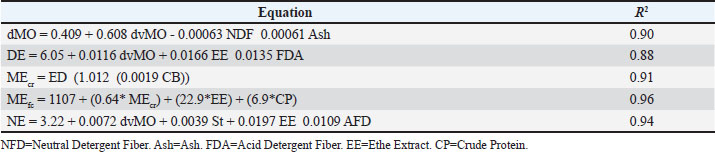
Cutting Height of Tithonia diversifoliaTo evaluate the cutting height in T. diversifolia, the experiment was conducted in a randomized complete block design with three treatments corresponding to the cutting heights: T1 (10 cm), T2 (25 cm), and T3 (40 cm), with four replications each. The first growth cycle lasted for 90 days, after which the plants were cut and regrown for another 90-day cycle before the second cut. Both cycles were independently evaluated. The experimental units consisted of 5 m² plots established under tropical agroecological conditions. Tithonia diversifolia cuttings that were uniform in size and previously rooted were used. Variables evaluated included plant height, number of shoots, fresh weight of leaves and stems, DM yield, and leaf proportion. For nutritional characterization, DM, CP, Ash, NFD, AFD, and Hcell were determined. Cutting frequency of Tithonia diversifoliaTo evaluate the frequency of cutting, an agronomic experiment was conducted to evaluate the effect of five cutting frequencies (T1=40, T2=45, T3=50, T4=55, and T5=60 days of regrowth age) on the variables DM yield and chemical composition. A homogenization cut was made in established crops, and 25 experimental plots of 25 m2 (5 × 5 m) each were delimited, five in each replicate, in which the five cutting frequencies were randomly distributed. Planting density of Moringa oleiferaThree densities were evaluated: T1=60 k, T2=80 k, and T3=100 k plants/ha, established in a completely randomized design with five replications. In both cases, plant height, number and thickness of stems, and weight of leaves and stems per plant were collected. Variables evaluated included plant height, number of shoots, fresh weight of leaves and stems, dry matter yield, and leaf ratio. DM, CP, Ash, NDF, AFD, and Hcell were determined for nutritional characterization. In vitro digestibility of Tithonia diversifolia and Moringa oleiferaThis study was carried out in the Ikiam biology laboratories using seven treatments based on formulated diets combined with different proportions of T. diversifolia (T2=5%; T3=10%; T4=15%) and M. oleifera meals (T5=5%, T6=10%, and T7=15%) and a control treatment (T1). The proximal chemical composition parameters of all treatments (DM, EE, CP, OM, NDF, AFD, and Hcell) were evaluated. The in vivo digestibility of OM (dMO) was estimated from the results of in vitro digestibility of OM (dvMO), digestible energy (DE), net energy (NE) (Noblet and Jaguelin-Peyraud, 2007), and ME for growing pigs (MEcr) (May and Bell, 1971) will allow estimation of ME for finishing fattening pigs (MEfc) (Noblet and Shi, 1993). Table 2 summarizes the regression equations employed to estimate the in vivo dMO, DE, and metabolizable energy (ME) for growing (MEcr) and MEfc based on in vitro results and stomatological parameters. These equations exhibit high coefficients of determination (R² ≥ 0.88), supporting their reliability for predicting energy values in monogastric nutrition trials (Noblet and Shi, 1993; May and Bell, 1971; Noblet and Jaguelin-Peyraud, 2007). Table 2. Regression equations were used to estimate the in vivo digestibility of organic matter (dMO), digestible energy (DE), and metabolizable energy for growing pigs (EMcr) and pigs finishing fattening (EMfc).
Statistical analysisThe statistical analysis was based on randomized block experimental designs to evaluate the effect of treatments such as cutting heights, sowing densities, and diet inclusion levels. For the comparison of means, ANOVA was applied when the data met the normality and homogeneity of variances assumptions. In cases where these assumptions were not met, as in the cut-off frequency effect analysis, the Kruskal–Wallis test was used, complemented by Dunn’s and Bonferroni’s tests for multiple comparisons. In the in vitro digestibility study of T. diversifolia and M. oleifera meal at different inclusion levels (5%, 10%, and 15%) in pig diets, the GLM was used to evaluate the effect of inclusion on the chemical composition, digestibility, and energy content of the treatments evaluated by the model: Yij=μ + Ti=1-7 + DIj=1-3 + Eij With Ti=1-7, the treatment (one vs. 2 vs. 3 vs. 4 vs. 5 vs. 6 vs. 7); DIj=1-3, the day of incubation (one vs. 2 vs. 3); ε, the experimental error. Dunnett’s C analysis was used to discern differences between treatments. Statistical significance in all studies was generally established at the p < 0.05 level. Data processing was performed using the R statistical package, and the statistical methods were adapted according to compliance with model assumptions. LimitationsThis study presents relevant findings on the agronomic performance, nutritional composition, and in vitro digestibility of Tithonia diversifolia and M. oleifera under Amazonian conditions. However, certain limitations should be acknowledged. Although in vitro digestibility techniques provide reliable estimates of nutrient availability and are widely used in early-stage evaluations, they do not fully replicate the complex physiological responses of live animals. Therefore, the absence of in vivo feeding trials limits the ability to validate the actual effects of the tested diets on animal growth performance, feed conversion, or gut health. In addition, the use of a controlled laboratory setting for digestibility assays may not capture the variability found under commercial or field conditions, including fluctuations in forage palatability, feed intake behavior, and microbiota interactions in monogastric animals. The scope of the study was also limited to a single geographical location and season, which may affect the generalizability of the results to other tropical regions or production systems. Future research should include controlled feeding trials to confirm the effects of T. diversifolia and M. oleifera inclusion on animal performance, as well as studies that explore the interaction of these forages with gut microbiota and animal health parameters under practical farm conditions. Ethical approvalNot needed for this study. The procedures performed in this study did not require animal intervention or manipulation. ResultsThe main effects and interactions of cutting the height of T. diversifolia, planting density of M. oleifera, and in vitro digestibility of both species are described below. Cutting height of Tithonia diversifoliaThe cutting height had a significant effect (p < 0.01) on several morphological and productive variables at the second cut. T-3 (40 cm cutting height) obtained the highest values in all evaluated variables: plant height, number of shoots, leaf weight, and forage yield in both fresh and dry matter. In contrast, T-1 (10-cm cutting height) had the lowest values among these variables. The stomatological components significantly differed in cutting height (p < 0.001). T-3 showed the highest crude protein and hemicellulose values and the lowest NDF and AFD values, showing better digestibility. The DM and OM levels were similar between the treatments. Table 3 summarizes the stomatological composition of T. diversifolia at two harvest times and three cutting heights. At the first cut (90 days), cutting height significantly influenced crude protein (p < 0.001), NDF (p < 0.001), and ADF (p < 0.001) contents. T-3 (40 cm) exhibited the highest CP (244 g/kg DM) and hemicellulose (83.5 g/kg DM) and the lowest NDF and ADF values (302 and 185 g/kg DM, respectively), indicating superior nutritive quality. These trends were consistent in the second cut (90 days after the first), where T-3 again showed elevated CP and reduced fiber fractions, reinforcing the forage quality advantage of higher cutting height. Table 3. Dry matter (DM), organic matter (OM), crude protein (CP), NDF, ADF, and Hcell of Tithonia diversifolia at two harvest times and three cutting heights.
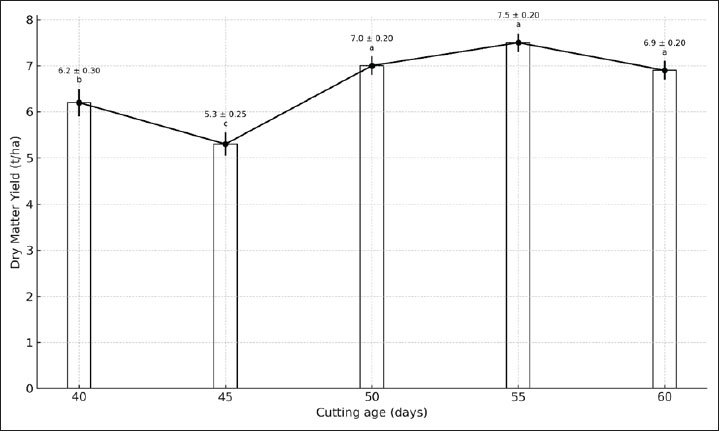
Cutting frequency of Tithonia diversifoliaThe DM content ranged from 81.1% to 88.8% at different cutting frequencies. No significant differences were detected between treatments (H=4.00; p=0.406). Descriptively, cuts between 50 and 55 days showed higher values, which may favor the formulation of flours with lower water content and better preservation (Fig. 1).
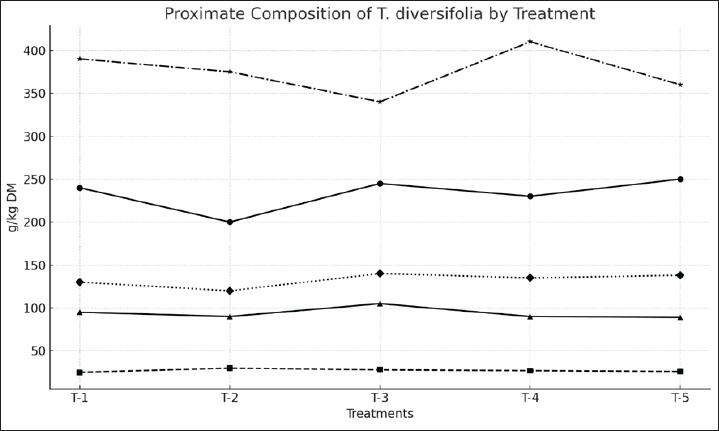
Fig. 1. Dry matter content (%) of Tithonia diversifolia at different cutting ages. Bars represent means ± standard error. No statistically significant differences were found among treatments according to the Kruskal-Wallis test (H(4)=4.00; p=0.406). Different letters above the bars indicate numerical trends although they are not statistically significant. Stomatological analyses revealed moderate differences between the treatments. CP increased from 20.0% (45 days) to 25.1% (60 days). Crude fiber decreased from 9.6% to 8.8%. EE remained between 2.33% and 2.78%. NFE peaked at 55 days (41.2%), while ash content was highest at 50 days (14.19%) (Fig. 2). ME values were estimated between 253.5 and 276.6 kcal/kg DM, peaking at 55 days. DE and GE showed concordant behavior, which was consistent with the increase in AFD and the reduction in NDF.
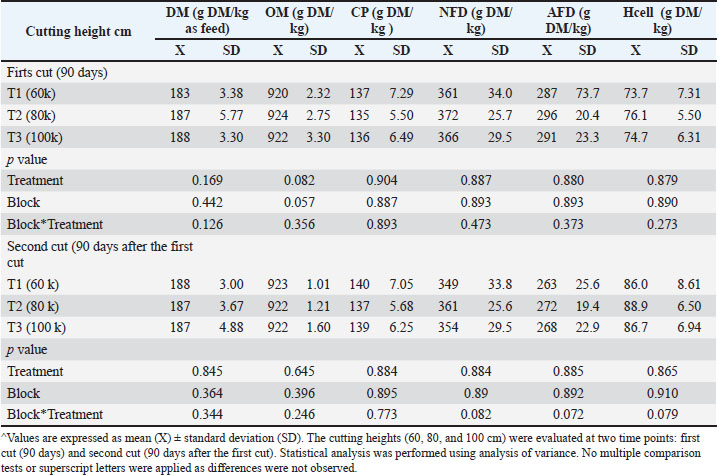
Fig. 2. Chemical composition of Tithonia diversifolia according to cutting age. Values represent means per treatment. CP: crude protein; EE: ether extract; NFE: nitrogen-free extract; AF, ash. Planting density of Moringa oleiferaNo significant statistical differences (p > 0.05) were observed between treatments for plant height, number of shoots, stem weight, number of leaves, leaf weight, total plant weight, or forage yield (t GF/ha and t DM/ha) in either of the two cuts. However, higher sowing densities were associated with higher forage yields. Nutrient composition values for CP ranged from 135 to 140 g/kg DM in all treatments, with no significant differences between sowing densities. DM was consistent (~187 g DM/kg GF), and NDF, FAD, and Hcell values did not differ significantly between the cuts or treatments. Table 4 presents the stomatological composition of M. oleifera harvested at two time points (90 and 90 days after the first cut) under three planting densities. No statistically significant differences (p > 0.05) were observed for any of the nutritional parameters (DM, OM, CP, NDF, ADF, and Hcell) across treatments or cuts. Crude protein values ranged between 135 and 140 g/kg DM, while NDF values remained around 340–355 g/kg DM. The dry matter content was stable (~187 g/kg as feed), and the hemicellulose content ranged from 6.2 to 7.3 g/kg DM. T-2 (80k plants/ha) tended to show slightly higher OM and CP values at both cuts, confirming a possible trend worth further exploration in future studies. Table 4. Dry matter (DM), organic matter (OM), crude protein (CP), neutral detergent fiber (NDF), acid detergent fiber (ADF), and hemicellulose (Hcell) from Moringa oleifera at two harvest times and three planting densities.
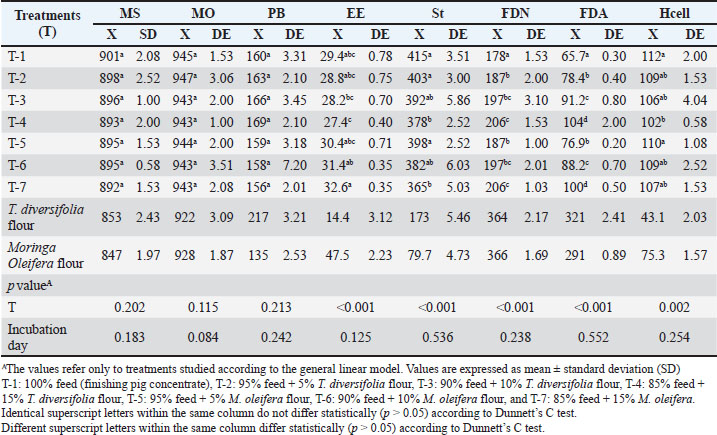
In vitro digestibility of Tithonia diversifolia and Moringa oleiferaStomatological analysis of the flours prior to formulation showed that T. diversifolia flour had higher CP (217 g/kg DM) and starch (173 g/kg DM) concentrations than M. oleifera (135 g/kg DM and 79.7 g/kg DM, respectively). Moringa oleifera also had higher EE (47.5 g/kg DM) and Hcell (75.3 g/kg DM) contents. T. diversifolia showed higher AFD (321 g/kg DM) and lower Hcell (43.1 g/kg DM) levels. Stomatological analysis of the experimental diets showed no significant differences (p > 0.05) in DM and OM between treatments. However, there were significant differences (p < 0.001) in NDF, SDF, Hcell, EE, and starch (St), with T-1 having the lowest fiber and the highest St values (Table 5). Table 5. Proximate chemical analysis of dry matter (DM, g/kg as feed), organic matter (OM), crude protein (CP), ether extract (EE), starch (St), neutral detergent fiber (NDF), acid detergent fiber (ADF), and hemicellulose (Hcell), (g/kg DM) of the studied treatments and of the T. diversifolia and M. oleifera flours (n=3).
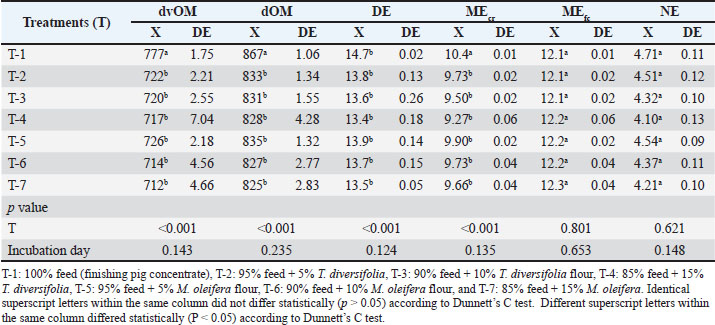
The in vitro digestibility process determined that T-1 had the highest in vitro digestibility of OM (dvMO=777 g/kg) and estimated in vivo digestibility (dMO=867 g/kg), followed by the 5% inclusion treatments. No significant statistical differences were detected in metabolizable energy for MEfc and NE (Table 6). These results demonstrate that lower inclusion levels, particularly T-1, may enhance digestibility parameters, although energy estimates remained statistically similar across treatments. Table 6. Analysis of in vitro digestibility of organic matter (dvOM) and estimates of in vivo digestibility of organic matter (dOM), digestible energy (DE), metabolizable energy for growing pigs (EMcr) and finishing fattening pigs (EMfc) and net energy (NE) of the treatments studied (n=3).
Rapid digestion of organic matter was observed in the first three hours of digestion. T1 showed the highest values in all phases of the kinetic analysis, while T-4 and T-7, with 15% inclusion, showed the lowest values (Fig. 3).
Fig. 3. In vitro digestibility of organic matter (g/kg DM) across incubation times (0–24 hours) for the seven dietary treatments (T-1 to T-7). Each curve represents the digestibility kinetics of a formulated diet containing different inclusion levels of Tithonia diversifolia and Moringa oleifera flours. T-1 (100% basal diet) showed the highest digestibility peak, particularly during the early fermentation phases (1–3 hours). Differences among treatments reflect the influence of fiber and starch content on fermentation dynamics. DiscussionCutting height of Tithonia diversifoliaThe agronomic behavior and forage yield of T. diversifolia show that cutting height determines vegetative development and yield; at 40 cm, a greater plant height, number of shoots, and forage yield were observed in fresh weight and dry matter. This tendency can be explained by the more dormant buds activated at higher cuts, favoring vigorous regeneration, a principle widely recognized in forage shrub species (Canto et al., 2023). Similar studies have shown that cutting management influences not only the amount but also the persistence of regrowth. This aligns with reports by Uu-Espens et al. (2022) and Botero Londoño et al. (2019), who reported higher biomass at optimized planting densities. This complements our findings by demonstrating that crop architecture and cutting height influence yield. According to Angulo-Arizala et al. (2024), the yield obtained, which exceeds 59 t GF/ha per cutting, even under low rainfall conditions, reinforces the forage potential of the species. This is especially relevant in contexts where seasonality limits the biomass supply of traditional grasses. From a nutritional point of view, T-3 not only allowed a higher yield but also a better quality of the harvested forage. Significant increases in CP and Hcell content and reductions in structural fiber fractions (NDF and SDF) were observed. This pattern is desirable; according to Vargas Velazquez et al. (2024) and Putri et al. (2024), a lower proportion of lignified stems leads to higher dry matter digestibility and better nitrogen utilization efficiency. Soares et al. (2024) reported high protein levels in T. diversifolia, especially in the early vegetative stages. In this case, the higher cutting strategy possibly favored a higher leaf/stem ratio, resulting in a leaf fraction richer in nutrients (Andrade Villaroel et al., 2024). Compared with other tropical shrubs, such as Gliricidia septum and Leucaena leucocephala, T. diversifolia shows a promising balance between yield and quality, considering its lower input requirement and higher adaptability (Canul et al., 2018). In pigs, hemicellulose is a source of fermentable fiber that can be partially degraded in the large intestine, contributing secondarily to energy production via short-chain fatty acids (Liu et al., 2022). Although this pathway represents a minor fraction of the total energy intake in monogastric pigs, its presence, combined with a high CP content and low lignin level, favors better digestive efficiency and optimizes the overall utilization of the diet in growing pigs (Hu et al., 2023). Cutting frequency of Tithonia diversifoliaThe lack of statistical differences in DM does not rule out its practical relevance in animal feeding; values above 85% in intermediate and late cuts indicate greater physiological maturity, associated with lower water content and greater conservation as meal or hay; this coincides with studies by Verdecia et al. (2018) and Zamora (2019), who observed increases in DM with age, attributed to progressive lignification. However, these benefits may compromise palatability and digestibility, as indicated by Sampaio and Da Costa (2018), who attributed higher DM levels to reduced soluble nutrients and changes in cellular architecture. Therefore, the balance between water content, ease of storage, and digestive quality is key to agronomic decision-making. In contrast to what has been reported in most studies (Ramírez et al., 2023), where CP tends to decrease with the age of cutting, an increasing trend was observed in this study up to 60 days. This finding demonstrates a favorable soil and climatic environment in the Ecuadorian Amazon, which allows for maintaining a high leaf proportion even in advanced stages of regrowth (Uu-Espens et al., 2023). Protein synthesis remains active due to a leaf pattern dominated by young leaves with high metabolism, which has also been observed in tropical systems by Vivas-Arturo et al. (2022). This poses an optimal scenario for intermediate cuts where yield and nutritional quality are maximized. The decreasing trend in crude fiber is unusual, as maturation generally increases structural components. This exception may be influenced by the management of 50 cm cutting and the high regeneration of T. diversifolia in humid climates, as described by Navas Panadero and Montaña (2019) and Vargas Velázquez et al. (2024). A lower proportion of stem and greater leaf area explain this phenomenon, which is favorable for its inclusion in diets for young ruminants or monogastric, where digestibility is critical. NFD peaked at 55 days (41.2%), suggesting that this is the stage with the highest accumulation of soluble carbohydrates; these components are key to the net energy and fermentative profile of the forage, as highlighted by Kaur et al. (2021) and Getachew et al. (2018); thus, a subsequent decrease in NFD at 60 days indicates that the forage begins to mobilize reserves or invest in structural tissue. The energy estimation peaked at 55 days (ME=276.6 kcal/kg DM), supported by a better combination of CP, NFD, and lower NDF. This result reinforces the intermediate cut approach proposed by Hidalgo L. and Valerio C. (2020) and Noblet et al. (1994), who stress that energy digestibility is an accurate indicator of zootechnical value beyond chemical content. The ME values of T. diversifolia are competitive or superior to those of other tropical forages such as Moringa oleifera or Pennisetum purpureum, which increases its potential as a sustainable and local energy source (Osuga et al., 2012). Identifying an optimal cutting frequency (50–55 days) allows the integration of agronomic and nutritional criteria to maximize productivity. This strategy favors a better cost-benefit ratio, reduces dependence on concentrates, and promotes more resilient and environmentally friendly livestock farming in silvopastoral or IFSs. Moringa oleifera planting densityPlanting density and forage yield did not show statistically significant differences, with higher densities tending to increase forage yield, especially in the second cut. This pattern coincides with that reported by Demiroğlu Topçu et al. (2024) who documented that M. oleifera yield increases as density increases to a certain threshold (Alvarado et al., 2022). This could be attributed to the agroclimatic conditions of the experimental area, particularly the limited rainfall regime (<60 mm/month), which may influence the full development of the crop (Bopape-Mabapa et al., 2020). The CP values found (135–140 g/kg DM) were lower than those reported in studies where only leaves were considered, as reported by Utami et al. (2022), where up to 250 g/kg DM was reached. According to Martínez-Hernández et al. (2022), this can be attributed to the inclusion of stems at levels higher than 10 % of the entire sample content, which tends to decrease the protein content. However, the nutritional profile of M. oleifera is still superior to that of many traditional tropical grasses (Pennisetum purpureum, Saccharum spp.), which supports M. oleifera as a complementary forage (Azevedo et al., 2020). NDF and AFD values remained stable but low compared to other forages, favoring their digestibility (García et al., 2020). The low dry matter content found (~18%) could limit its management as hay but make it ideal for fresh consumption as long as its daily supply is guaranteed. In addition, M. oleifera’s high palatability, nutritional balance, and resistance to drought and diseases make it a viable option for diversified animal production systems (Arteaga Marcillo et al., 2024). In vitro digestibility of Tithonia diversifolia and M. oleiferaThe proximate chemical analysis of T. diversifolia and M. oleifera meal shows a high nutritional potential for use in swine feed. Tithonia diversifolia meal, with a concentration of 217 g CP/kg DM, is in the upper range of those reported for tropical non-leguminous shrubs, surpassing even Leucaena leucocephala and Erythrina poeppigiana in nutritional content (Fasuyi and Okeke, 2014). This component is key not only as a fast-fermenting energy source but also as a digestibility marker. On the other hand, M. oleifera meal showed a more balanced profile in fiber and ethereal extract, which may translate into advantages in the diet’s palatability and oxidative stability (Arif et al., 2020; and Singh et al., 2023). The protein profile of M. oleifera, which is noted for its integrity, containing essential amino acids often lacking in other plant sources and essential for dietary purposes (Wong et al., 2024), should be considered. NDF and SDF values increased as the level of inclusion of both meals increased, consistent with previous studies on including fibrous forages in balanced diets (Li et al., 2021). The significant reduction in starch content in the 15% inclusion treatments may have important metabolic implications. As Noblet and Jaguelin-Peyraud (2007) pointed out, starch is one of the primary substrates for energy production in monogastric, and its reduction can limit net energy intake if it is not adequately compensated. In vitro, dvMO values exceeded 700 g/kg in all treatments, which is considered a minimum threshold for classifying a diet as having good nutritional value (Su and Chen, 2020). This digestibility level indicates adequate fermentation and nutrient utilization, which can improve animal performance and gut health (Gaillard et al., 2020). T-1 was significantly superior (p < 0.05). However, the treatments with 5% and 10% inclusions showed similar values, which reflects the good digestive compatibility of the evaluated plant meals. The estimated in vivo digestibility dMO and DE followed a similar trend. The estimated NE showed no significant differences between treatments, which is encouraging from a practical point of view, as it suggests that even moderate levels of inclusion (up to 15%) do not compromise the feed’s overall energy efficiency (Saliu et al., 2022). This indicates that including fibrous forages, such as M. oleifera and T. diversifolia, may be a viable strategy for improving the nutritional quality of diets without negatively affecting the energy available to animals (Pomar et al., 2021). Ruiz Vázquez (2023) and Chen et al. (2021) evaluated the inclusion of T. diversifolia and M. oleifera in diets for pigs and observed gains in feed conversion rate and daily gain, provided that the inclusion did not exceed 20% dry basis. Kinetic analysis revealed a rapid degradation of the soluble components in the first three hours of incubation. This digestion rate is critical for high-efficiency diets in intensive systems (Bai et al., 2021). The observed digestion peak (250 g OM/kg OM) in this interval coincides with a high initial solubility favored by the low lignin content in the treatments with lower AFD (Heyer et al., 2022). T-4 and T-7, with 15% inclusion, showed the lowest values in this initial phase, suggesting that the structural fraction limits the digestion rate. This result is consistent with that of Mahfuz and Piao (2019) who showed that the in vitro digestion rate decreases as the AFD-to-OM ratio increases. From a practical perspective, the results are promising for pig production systems, especially those aimed at cost reduction through local ingredients. The possibility of substituting up to 15% of commercial feed without compromising digestibility or net energy allows the design of more economical, accessible, and sustainable diets. The integration of resources such as T. diversifolia and M. oleifera not only provides quality plant protein but also contributes to productive diversification, food security, and resilience of the agricultural system, which are key elements in the current context of input crisis and climate change. ConclusionThe agronomic management practices evaluated in this study had significant effects on the nutritional composition and forage yield of tropical fodder species. Cutting Tithonia diversifolia at a height of 40 cm and harvesting it between 50 and 55 days improved both biomass production and crude protein content, while higher planting densities in Moringa oleifera tended to enhance forage yield without compromising nutritional quality. In vitro digestibility analyses indicated that moderate inclusion levels of these flours (5%–10%) in pig diets maintained high OM digestibility and energy values. These results provide evidence that incorporating T. diversifolia and M. oleifera under optimized agronomic management offers a viable and sustainable alternative for improving swine feeding strategies in tropical regions. AcknowledgmentsThe authors would like to thank the Universidad Regional Amazónica Ikiam (Tena, Ecuador) for providing the facilities, logistical support, and funding necessary to develop this research project. Conflict of interestThe authors have no conflicts of interest to declare. FundingNone. Authors' contributionsConception and design of the study: José Alberto de la Torres Moreira Acquisition of data: Raciel Lima Orozco Analysis and/or interpretation of data: José Alberto de la Torres Moreira Drafting the manuscript: Alvaro Arias Vega Critical review/revision: Veronica Cristina Andrade Yucailla Critical review/revision: Verónica Gabriela Rivadeneyra Espín. Data availabilityAll data were provided in the manuscript. ReferencesAdetuyi, F.O., Akintimehin, E.S., Karigidi, K.O. and Orisawayi, A.O. 2025. Safety evaluation of fermented and nonfermented Moringa oleifera seeds in healthy albino rats: biochemical, haematological, and histological studies. Int. J. Food Sci. 2025, 1–12. Alcívar Acosta, E.H., Fernández Romay, Y., Vivas, W.F., Cusme Rivas, K.E., Verduga López, C.D. and Heredia Mendoza, J.D. 2023. Evaluación del potencial nutritivo de especies arbustivas tropicales para la alimentación de cerdos de traspatio. Ciencia Y Tecnología Agropecuaria 24(3), 2991. Alvarado-Ramírez, E. R., Joaquín-Cancino, S., Estrada-Drouaillet, B., Romero-Treviño, E. M., LLanes-Gil-López, D.I., and Garay-Martínez, J. 2022. Yield and nutritional value of Moringa oleifera forage at different population densities. Agro Productividad. doi:10.32854/agrop.v15i7.2333 Andrade Villaroel, G.M., Murillo Nazareno, T.T. and González Buitrón, K.T. 2024. Comportamiento agronómico y productivo del Botón de oro (Tithonia diversifolia) en tres edades de corte en la Granja Mishilí, Santo Domingo de los Tsáchilas. Revista Social Fronteriza 4(1), e41171. Angulo-Arizala, J., Mahecha-Ledesma, L., Barragán Hernández, W.A. and Casas-Toro, N. 2024. Evaluación agronómica de Tithonia diversifolia (Hemsl.) A. Gray basado en criterio de corte con tiempo térmico. Rev. Investig. Vet. Del Perú 35(5), e29287. Arif, M., Singh, M., Onte, S., Dey, D. and Kumar, R. 2020. Comparative evaluation of fodder qualities in different parts of locally available moringa (Moringa oleifera) strains. Indian J. Anim. Sci. 90(1), 80–84. Arteaga Marcillo, M.N., Buste Bailón, R.A. and Campozano - Marcillo, G.A. 2024. Moringa oleifera: alternativa nutricional en pollos de engorde. Rev. Científ. Arbitrada Multidiscip. Pentacienc. 6(4), 46–52. Azevedo, M., Guimaraes, A., Cabral, D.S., Barbosa, C., Machado, L., De Carvalho Pantoja, J. and Aguiar, A. 2020. Características de silagens de capim-elefante (Pennisetum purpureum Schum.) com níveis de inclusão de moringa (Moringa oleífera Lam.). Braz. J. Develop. 6(9), 71418–71433. Bai, Y., Zhou, X., Li, N., Zhao, J., Ye, H., Zhang, S., Yang, H., Pi, Y., Tao, S., Han, D., Zhang, S. and Wang, J. 2021. In Vitro fermentation characteristics and fiber-degrading enzyme kinetics of cellulose, arabinoxylan, β-glucan and glucomannan by pig fecal microbiota. Microorganisms 9(5), 1071. Bopape-Mabapa, M., Ayisi, K. and Mariga, I. 2020. Biomass production and nutritional composition of Moringa oleifera under different planting spacings in a semi-arid condition of the northern South Africa. Afr. J. Food. Agriculture. Nutr. Develop. 20(03), 15857–15875. Botero Londoño, J.M., Gómez Carabalí, A. and Botero Londoño, M.A. 2019. Rendimiento, parámetros agronómicos y calidad nutricional de la Tithonia diversifolia con base en diferentes niveles de fertilización. Rev. Mexicana De Cienc. Pecuarias 10(3), 789–800. Canto Saenz, F.M., Ampuero Trigoso, G. and Quispe-Ccasa, H.A. 2023. Efecto de la altura de corte sobre los parámetros agronómicos de Tithonia diversifolia. Rev. Investig. Altoandinas - J. High Andean Res. 25(2), 117–121. Canul, J.R., Castillo, L.E., Escobedo, J.G., López, M.A. and Lara, P.E. 2018. Rendimiento y calidad forrajera de Gliricidia sepium, Tithonia diversifolia y Cynodon nlemfuensis en monocultivo y sistema agroforestal. Agrociencia 52(6), 853–862. Chen, Z., Xie, Y., Luo, J., Chen, T., Xi, Q., Zhang, Y. and Sun, J. 2021. Dietary supplementation with Moringa oleifera and mulberry leaf affects pork quality from finishing pigs. J. Anim. Physiol. Nutr. 105(1), 72–79. Demiroğlu Topçu, G., Özkan, S.S. and Basmacıoğlu Malayoğlu, H. 2024. Effect of different plant density on the forage yield and some forage quality characteristics of moringa (Moringa oleifera Lam.). Turkish J. Field Crops 29(2), 140–148. Fasuyi, A. and Okeke, P. 2014. Extrapolating nutritional potentials of ensiled wild sunflower (Tithonia diversifolia) leaf meal: proximate composition and functional properties. Int. J. Biol. Chem. Sci. 8(1), 8–16. GADMT (Gobierno Autónomo Descentralizado Municipal de Tena). 2021. Plan de Desarrollo y Ordenamiento Territorial 2021-2023. Gaillard, C., Brossard, L. and Dourmad, J.Y. 2020. Improvement of feed and nutrient efficiency in pig production through precision feeding. Anim. Feed Sci. Technol. 268, 114611. García, I.I., Mora-Delgado, J., Estrada, J. and Piñeros, R. 2020. Kinetics of gas production of fodder of Moringa oleifera Lam grown in tropical dry forest areas from Colombia. Agroforestry Syst. 94(4), 1529–1537. Getachew, G., Laca, E.A., Putnam, D.H., Witte, D., Mccaslin, M., Ortega, K.P. and Depeters, E.J. 2018. The impact of lignin downregulation on alfalfa yield, chemical composition, and in vitro gas production. J. Sci. Food Agriculture 98(11), 4205–4215. Guatusmal-Gelpud, C., Escobar-Pachajoa, L.D., Meneses-Buitrago, D.H., Cardona-Iglesias, J.L. and Castro-Rincón, E. 2020. Producción y calidad de Tithonia diversifolia y Sambucus nigra en trópico altoandino colombiano. Agronomía Mesoamericana 31(1), 193–208. Hassan, Z.M., Manyelo, T.G., Selaledi, L. and Mabelebele, M. 2020. The effects of tannins in monogastric animals with special reference to alternative feed ingredients. Molecules 25(20), 4680. Heyer, C.M.E., Jaworski, N.W., Page, G.I. and Zijlstra, R.T. 2022. Effect of fiber fermentation and protein digestion kinetics on mineral digestion in pigs. Animals 12(16), 2053. Hidalgo L., V. and Valerio C., H. 2020. Digestibilidad y energía digestible y metabolizable del gluten de maíz, hominy feed y subproducto de trigo en cuyes (Cavia porcellus). Revista De Investigaciones Veterinarias Del Perú 31(2), 31. Hu, R., Li, S., Diao, H., Huang, C., Yan, J., Wei, X., Zhou, M., He, P., Wang, T., Fu, H., Zhong, C., Mao, C., Wang, Y., Kuang, S. and Tang, W. 2023. The interaction between dietary fiber and gut microbiota, and its effect on pig intestinal health. Front. Immunol. 14, 1095740. Kaur, M., Tak, Y., Bhatia, S., Asthir, B., Lorenzo, J.M. and Amarowicz, R. 2021. Crosstalk during the carbon-nitrogen cycle that interlinks the biosynthesis, mobilization and accumulation of seed storage reserves. Int. J. Mol. Sci. 22(21), 12032. Khan, N.M., Qadeer, A., Khan, A., Nasir, A., Sikandar, A., Adil, M., Horky, P., Nevrkla, P., Slama, P., Weisbauerova, E. and Kopec, T. 2024. Alternatives sources of proteins in farm animal feeding. J. Microbiol. Biotechnol. Food Sci. 13(5), e10605. Kumar, V., Kumar, A., Nayik, G.A. and Rafiq, S.M. 2020. Drum stick (Moringa oleifera). In Antioxidants in vegetables and nuts-properties and health benefits. Singapore: Springer Singapore, pp: 249–264. Lago, V., Matos, S., Almora, E., Pereira, L.B., Monteagudo, R. and Rodríguez, E. 2024. Evaluación de diferentes densidades de cultivo de Moringa oleifera y su manufactura como suplemento nutricional. Revista Ingeniería Agrícola 14(1), 1–8. Li, H., Yin, J., Tan, B., Chen, J., Zhang, H., Li, Z. and Ma, X. 2021. Physiological function and application of dietary fiber in pig nutrition: a review. Anim. Nutr. 7(2), 259–267. Liu, J., Luo, Y., Kong, X., Yu, B., Zheng, P., Huang, Z., Mao, X., Yu, J., Luo, J., Yan, H. and He, J. 2022. Effects of dietary fiber on growth performance, nutrient digestibility and intestinal health in different pig breeds. Animals 12, 3298. Mahfuz, S. and Piao, X.S. 2019. Application of Moringa (Moringa oleifera) as a natural feed supplement in poultry diets. Animals 9(7), 431. Martínez-Hernández, M.E., Silva-Martínez, K.L., Del Ángel-piña, O. and Arrieta-González, A. 2022. Inclusión de diferentes concentraciones de Moringa oleifera lam. en dietas para pollos de engorda. Revista Biológico. Agropecuaria Tuxpan 10(1), 103–116. May, R.W. and Bell, J.M. 1971. Digestible and metabolizable energy values of some feeds for the growing pig. Can. J. Anim. Sci. 51, 271–278. National Research Council (NRC). 2001. Nutrient Requirements of Dairy Cattle (7th ed.). National Academy Press. Navas Panadero, A. and Montaña, V. 2019. Comportamiento de Tithonia diversifolia bajo condiciones de bosque húmedo tropical. Revista De Investigaciones Veterinarias Del Perú 30(2), 721–732. Noblet, J. and Jaguelin-Peyraud, Y. 2007. Prediction of organic matter and energy digestibility in the growing pig from an in vitro method. Anim. Feed Sci. Technol. 134, 211–222. Noblet, J. and Shi, X.S. 1993. Comparative digestibility of energy and nutrients in growing pigs fed ad libitum and adult sows at maintenance. Livestock Prod. Sci. 34, 137–152. Noblet, J., Fortune, H., Shi, X.S. and Dubois, S. 1994. Prediction of net energy value of feeds for growing pigs. J. Anim. Sci. 72(2), 344–354. Orisawayi, A.O., Boylla, P., Koziol, K.K. and Rahatekar, S.S. 2025. Sustainable wet-spun cellulose–Moringa oleifera composite fibres for potential water purification. RSC. Adv. 15, 17730–11740. Osuga, I.M., Abdulrazak, S.A., Muleke, C.I. and Fujihara, T. 2012. Potential nutritive value of various parts of wild sunflower (Tithonia diversifolia) as source of feed for ruminants in Kenya. J. Food. Agriculture & Environ. 10(2), 632–635. Paumier, M., Herrera-Herrera, R.C., Toapanta-Mendoza, E.O., González-Aguilera, D.A., Verdecia, D.M., Ramírez, J.L. and Herrera, R.S. 2022. Productivity of Tithonia diversifolia under Edaphoclimatic Conditions of Eastern Cuba. New Countryside 1(1), 21–27. Pomar, C., Andretta, I. and Remus, A. 2021. Feeding strategies to reduce nutrient losses and improve the sustainability of growing pigs. Front. Vet. Sci. 8, 742220. Putri, E.M., Pazla, R., Jamarun, N., Agustin, F., Yanti, G., Ikhlas, Z. and Lestari, P. 2024. Optimizing ruminant feed efficiency: the synergistic effects of BMR sorghum and Tithonia diversifolia on nutrient digestibility, rumen function, and methane mitigation. J. Anim. Behaviour Biometeorology 12(3), 2024022. Ramírez-Pérez, Y., Herrera-Herrera, R.C., Verdecia-Acosta, D.M., Herrera García, R.S., Chacón-Marcheco, E., Ledea-Rodríguez, J.L. and Ramírez-De la Ribera, J.L. 2023. Effect of regrowth age and climatic factors on primary metabolites content of Tithonia diversifolia. Cuban J. Agri. Sci. 57(1), 1–10. Rodríguez, B., Savón, L., Vázquez, Y., Ruiz, T. and Herrera, M. 2018. Evaluación de la harina de forraje de Tithonia diversifolia para la alimentación de gallinas ponedoras. Energía 17(17.0), 17–10. Rodríguez, I., Padilla, C. and Torres, V. 2020. Evaluación de tres métodos de poda de Tithonia diversifolia (Hemsl.) Gray bajo condiciones de pastoreo. Livestock Res. Rural Dev. 32, (73). Ruiz Vázquez, T.E. 2023. Silvopastoral systems with Leucaena leucocephala and Tithonia diversifolia in Cuba. In Murgueitio, E., Chará, J. and Solorio, F. (Eds.), Silvopastoral Systems of Mesoamerica and Northern South America (pp. 325–345). Cham, Switzerland: Springer International Publishing. Rusdy, M. 2021. Grass-legume intercropping for sustainability animal production in the tropics. CABI. Rev.16, 021. doi:10.1079/PAVSNNR202116021 Sachan, P., Goswami, M. and Goswami, K. 2024. Moringa Oleifera (Moringaceae) an in-depth review of its nutritional classification and therapeutic application. Res. Pharm. 14, 16–24. Saliu, E.M., Martínez, B., Aschenbach, J.R., Brockmann, G.A., Fulde, M., Hartmann, S. and Zentek, J. 2022. Dietary fiber and its role in pigs performance, welfare, and health. Anim. Health Res. Rev. 23(2), 165–193. Sampaio, B.L. and Da Costa, F.B. 2018. Influence of abiotic environmental factors on the main constituents of the volatile oils of Tithonia diversifolia. Revista. Brasileira. De. Farmacognosia-Brazilian. J. Pharmacognosy 28(2), 135–144. Singh, K., Oberoi, H., Dhakad, A.K., Lamba, J.S. and Gill, R.I.S. 2023. Effect of phenophases on nutritive value, fodder quality and digestibility of different ecotypes of Moringa oleifera. Range Manage. Agroforestry 44(1), 142–151. Soares, N.O., Lazo, J.A., Donato, L.M.S., Ferreira, E.A., Menezes, G.L.P., Souza, R.F., Oliveira, V.A.V., Azevedo, A.M. and Santos, L.D.T. 2024. Tithonia diversifolia potential for forage production: selection of accessions occurring in Cerrado and Atlantic Forest Biomes in Brazil. Arquivo Brasileiro De Medicina Veterinaria. E Zootecnia 76(6), e13185. Su, B. and Chen, X. 2020. Current Status and Potential of Moringa oleifera Leaf as an Alternative Protein Source for Animal Feeds. Front. Vet. Sci. 7, 53. Universidad de Florida. . 1970. Protocolos para determinar los contenidos de materia seca, materia orgánica, proteína bruta, extracto etéreo, digestibilidad in vitro de materia seca, materia orgánica. Gainesville, FL: Universidad de Florida. Utami, D., Rahim, A.R. and Prayitno, S.A. 2022. Quantitative and qualitative analysis of protein content in moringa leaves (Moringa oleifera L.). Kontribusia 5(2), 98. Uu-Espens, C., Canul-Solís, J.R., Chay-Canul, A.J., Piñeiro-Vázquez, A.T., Villanueva-López, G., R. Aryal, D., Pozo-Leyva, D. and Casanova-Lugo, F. 2022. Seasonal variation in biomass yield and quality of Tithonia diversifolia at different cutting heights. Ecosistemas Y Recursos Agropecuarios 9(3). Uu-Espens, C.E., Pozo-Leyva, D., Aryal, D.R., Dzib-Castillo, B.B., Villanueva-López, G., Casanova-Lugo, F., Chay-Canul, A.J. and Canúl-Solís, J.R. 2023. Producción de biomasa y composición química de Tithonia diversifolia por fecha de cosecha a diferentes alturas de corte. Trop. SubTrop. Agroecosystems 26(3). Van Soest, P.J., Robertson, J.B. and Lewis, B.A. 1991. Methods for dietary fiber, neutral detergent fiber, and non starch polysaccharides in relation to animal nutrition. J. Dairy Sci. 74(10), 3583–3589. Vargas Velazquez, V.T., López Ortiz, S., Castillo Gallegos, E., Pérez Hernández, P., Cruz Lazo, C., Jarillo-Rodríguez, J. and Lucas-Leyva, C. 2024. Degradabilidad in situ de la materia seca de Tithonia diversifolia (Hemsl.) A. Grey en tres épocas del año. Trop. SubTrop. Agroecosystems 27(1). Vargas Velázquez, V.T., Pérez Hernández, P., López Ortiz, S., Castillo Gallegos, E., Cruz Lazo, C. and Jarillo Rodríguez, J. 2022. Producción y calidad nutritiva de Tithonia diversifolia (Hemsl.) A. Grey en tres épocas del año y su efecto en la preferencia por ovinos Pelibuey. Revista 13(1), 240–257. Verdecia, D.M., Herrera, R., Ramírez, J., Bodas, R., Leonard, I., Giráldez, F.J., Andrés, S., Santana, A., Méndez-Martínez, Y. and López, S. 2018. Yield components, chemical characterization and polyphenolic profile of Tithonia diversifolia in Valle del Cauto, Cuba. Cuban J. Agricult. Sci. 52(4). Vivas-Arturo, W.F., Mendoza-Rivadeneira, F.A., Fernández-Romay, Y., La O-león, O. and Ledea Rodríguez, J.L. 2022. Comportamiento biológico de seis cultivares de Tithonia diversifolia (Helms.) A. Gray. Trop. SubTrop. Agroecosystems 25(009), 25. Wong, S.E., Illingworth, K.A. and Siow, L.F. 2024. Moringa proteins: nutrition, functionality, and applications. In Nadathur, S.R., Wanasundara, J.P.D. and Scanlin, L. (Eds.), Sustainable Protein Sources: Advances for a Healthier Tomorrow (2nd ed., pp. 493–513). Amsterdam, The Netherlands: Academic Press (Elsevier). doi:10.1016/B978-0-323-91652-3.00020-4 Zamora, J.L. 2019. Composición química, degradabilidad y cinética ruminal in situ del botón de oro (Tithonia diversifolia) en diferentes periodos de corte. Quito, Ecuador: Universidad Técnica Equinoocial del Ecuador. | ||



| How to Cite this Article |
| Pubmed Style Torres-moreira JDL, Andrade-yucailla V, Arias-vega A, Lima-orozco R, Rivadeneyra-espin V. Effect of agronomic practices on the nutritional composition and in vitro digestibility of Tithonia diversifolia and Moringa oleifera in pig diets. Open Vet. J.. 2025; 15(10): 5018-5031. doi:10.5455/OVJ.2025.v15.i10.20 Web Style Torres-moreira JDL, Andrade-yucailla V, Arias-vega A, Lima-orozco R, Rivadeneyra-espin V. Effect of agronomic practices on the nutritional composition and in vitro digestibility of Tithonia diversifolia and Moringa oleifera in pig diets. https://www.openveterinaryjournal.com/?mno=260807 [Access: June 26, 2026]. doi:10.5455/OVJ.2025.v15.i10.20 AMA (American Medical Association) Style Torres-moreira JDL, Andrade-yucailla V, Arias-vega A, Lima-orozco R, Rivadeneyra-espin V. Effect of agronomic practices on the nutritional composition and in vitro digestibility of Tithonia diversifolia and Moringa oleifera in pig diets. Open Vet. J.. 2025; 15(10): 5018-5031. doi:10.5455/OVJ.2025.v15.i10.20 Vancouver/ICMJE Style Torres-moreira JDL, Andrade-yucailla V, Arias-vega A, Lima-orozco R, Rivadeneyra-espin V. Effect of agronomic practices on the nutritional composition and in vitro digestibility of Tithonia diversifolia and Moringa oleifera in pig diets. Open Vet. J.. (2025), [cited June 26, 2026]; 15(10): 5018-5031. doi:10.5455/OVJ.2025.v15.i10.20 Harvard Style Torres-moreira, J. D. L., Andrade-yucailla, . V., Arias-vega, . A., Lima-orozco, . R. & Rivadeneyra-espin, . V. (2025) Effect of agronomic practices on the nutritional composition and in vitro digestibility of Tithonia diversifolia and Moringa oleifera in pig diets. Open Vet. J., 15 (10), 5018-5031. doi:10.5455/OVJ.2025.v15.i10.20 Turabian Style Torres-moreira, Jose De La, Veronica Andrade-yucailla, Alvaro Arias-vega, Raciel Lima-orozco, and Veronica Rivadeneyra-espin. 2025. Effect of agronomic practices on the nutritional composition and in vitro digestibility of Tithonia diversifolia and Moringa oleifera in pig diets. Open Veterinary Journal, 15 (10), 5018-5031. doi:10.5455/OVJ.2025.v15.i10.20 Chicago Style Torres-moreira, Jose De La, Veronica Andrade-yucailla, Alvaro Arias-vega, Raciel Lima-orozco, and Veronica Rivadeneyra-espin. "Effect of agronomic practices on the nutritional composition and in vitro digestibility of Tithonia diversifolia and Moringa oleifera in pig diets." Open Veterinary Journal 15 (2025), 5018-5031. doi:10.5455/OVJ.2025.v15.i10.20 MLA (The Modern Language Association) Style Torres-moreira, Jose De La, Veronica Andrade-yucailla, Alvaro Arias-vega, Raciel Lima-orozco, and Veronica Rivadeneyra-espin. "Effect of agronomic practices on the nutritional composition and in vitro digestibility of Tithonia diversifolia and Moringa oleifera in pig diets." Open Veterinary Journal 15.10 (2025), 5018-5031. Print. doi:10.5455/OVJ.2025.v15.i10.20 APA (American Psychological Association) Style Torres-moreira, J. D. L., Andrade-yucailla, . V., Arias-vega, . A., Lima-orozco, . R. & Rivadeneyra-espin, . V. (2025) Effect of agronomic practices on the nutritional composition and in vitro digestibility of Tithonia diversifolia and Moringa oleifera in pig diets. Open Veterinary Journal, 15 (10), 5018-5031. doi:10.5455/OVJ.2025.v15.i10.20 |


