





| Research Article | ||
Open Vet. J.. 2025; 15(10): 5157-5174 Open Veterinary Journal, (2025), Vol. 15(10): 5157-5174 Research Article Mitigating heat stress in commercial broilers through feeding management approaches: Insights into growth, serum biochemical indices, meat quality, and gut histomorphologyAnkon Lahiry1,2, Tanvir Ahmed2, Afifa Afrin2, Md. Shahidur Rahman2, Mohiuddin Amirul Kabir Chowdhury1 and Shubash Chandra Das2*1Poultry Innovation Research Division, Maverick Innovation, Kaliakair, Gazipur, Bangladesh 2Department of Poultry Science, Bangladesh Agricultural University, Mymensingh, Bangladesh *Corresponding Author: Shubash Chandra Das. Department of Poultry Science, Bangladesh Agricultural University, Mymensingh, Bangladesh. Email: das.poultry [at] bau.edu.bd Submitted: 03/07/2025 Revised: 04/09/2025 Accepted: 16/09/2025 Published: 31/10/2025 © 2025 Open Veterinary Journal
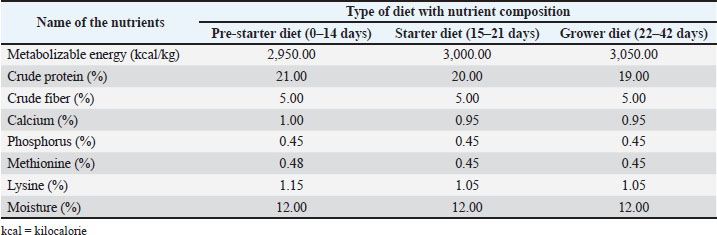
AbstractBackground: Heat stress (HS) significantly affects tropical broiler farming by impairing growth, physiology, meat quality, survival, and profitability. Since feed constitutes a major production cost, adopting feeding management approaches may reduce costs while enhancing bird resilience under HS without compromising productivity. Aim: This study aimed to evaluate the effectiveness of different feeding management approaches on growth, rectal temperature, water intake, serum biochemistry, meat quality, gut histomorphology, and profitability in heat-stressed broilers. Methods: A total of 750 broiler day-old chicks were reared in an open-sided house for 6 weeks and allocated to five feeding approaches: T1=ad libitum feeding (AdLF); T2=quantitative feed restriction (6, 9, and 12% restrictions during the 4th, 5th, and 6th weeks, respectively, QuantFR); T3=fixed-period feed withdrawal (8 hours restriction, 8hFW); T4=different periods of feed withdrawal (5, 7, and 9 hours restrictions during the 4th, 5th, and 6th weeks, respectively, DPFW); and T5=intermittent feed withdrawal (2 hours of feeding and 2 hours of fasting, InterFW), with 5 replications of 30 chicks each. All groups were fed ad libitum for the first 3 weeks; thereafter, feed restriction protocols were applied. Data on growth, water intake, rectal temperature, serum biochemistry, carcass yields, meat quality, and gut histomorphology were analyzed. Results: The 8hFW group showed significantly (p < 0.05) improved FCR, survivability, and production efficiency compared with the AdLF group. The InterFW group exhibited the highest weight gain and feed intake. The 8hFW group also exhibited significantly (p < 0.05) reduced rectal temperature and water intake and improved serum glucose, lipid profile, and liver enzyme levels, with similar trends observed in the QuantFR and DPFW groups. Feeding approaches markedly (p < 0.05) influenced dressing, breast, liver, and abdominal fat, while enhancing various meat quality parameters compared with the AdLF group. Similarly, intestinal histomorphometry improved significantly (p < 0.05) in all feed-restricted groups compared with the AdLF group. Economically, 8hFW yielded the highest benefit-cost ratio (p < 0.05), while AdLF had the lowest. Conclusion: Fixed-period feed withdrawal (8hFW) was the most effective approach in mitigating HS effects, improving growth performance, meat quality, gut morphology, and profitability. Therefore, this approach is a practical and cost-effective solution for broiler production under extreme HS. Keywords: Feed restriction, Growth performance, Gut histomorphology, Heat stress, Survivability. IntroductionIn recent years, global climate change, marked by a consistent rise in ambient temperature, has posed significant challenges to poultry production, particularly in tropical and subtropical regions. This phenomenon has intensified the frequency and duration of heat waves, inducing heat stress (HS) in modern commercial broilers and adversely affecting their health and productivity. These birds, selected for rapid growth and high productivity, are especially vulnerable to HS because they generate more metabolic heat and possess limited thermoregulatory capacity due to thick plumage and a lack of sufficient sweat glands (Saeed et al., 2019). When the ambient temperature exceeds the thermoneutral zone (18ºC - 22ºC), broilers struggle to maintain thermal equilibrium, which leads to HS (Juiputta et al., 2023). This disrupts physiological stability, with negative consequences for broiler performance, health, and profitability during the later stages of the rearing period. During the grower and finisher stages, broilers under HS conditions exhibit compromised body weight (BW), body weight gain (BWG), feed intake (FI), feed efficiency, and survival (Zhu et al., 2017; Liu et al., 2020; Zampiga et al., 2021). Physiologically, affected birds show elevated rectal temperatures, rapid breathing, excessive panting, and respiratory alkalosis (Saeed et al., 2019; Abdel-Moneim et al., 2021). Metabolically, HS alters the serum glucose levels, lipid metabolism, and liver enzyme activity (Khan et al., 2021). Under HS, carcass yields decline and meat quality deteriorates, leading to reduced muscle mass and the production of pale, soft, exudative meat (Zeferino et al., 2016; Zaboli et al., 2019). Additionally, gut integrity and nutrient absorption are compromised (Khonyoung and Yamauchi, 2019), further impairing birds’ performance. Collectively, these repercussions cause substantial economic downturns for broiler farmers, especially in tropical and subtropical regions, where broilers are raised in open-sided houses with limited environmental control. In 2024, such consequences were evident in Bangladesh during a prolonged 25-day heat wave, when the temperature peaked at 43ºC, causing severe mortality and financial losses (about 590 million USD) for broiler farmers (Rahman et al., 2025). The country’s poultry sector, producing approximately 17.5–20.0 million broiler chicks weekly (Das et al., 2024), faces extreme challenges during the summer due to high humidity and temperature, which severely intensify HS. Reliance on open-sided broiler houses further intensified the crisis, which, while economically viable, offers minimal protection against harsh climatic conditions, leaving farmers vulnerable. These incidents highlight the urgent need for practical and cost-effective mitigation strategies that can be rapidly implemented under tropical conditions to sustain broiler productivity, welfare, and profitability during HS periods. Numerous adaptive interventions, including genetic manipulation, housing modifications (e.g., cooling systems), management practices, nutritional interventions, and additive use, have been explored to counter HS in broilers. Among these, nutritional strategies are the most cost-effective and immediately implementable for small-scale producers (Saeed et al., 2019). One such approach, feed restriction (FR), has received increasing attention because it reduces metabolic heat production by limiting FI (Azis and Afriani, 2017). FR involves planned restrictions on feed quantity, nutrient availability, or timing of feed access, designed to reduce metabolic heat load during the hottest period of the day and to improve thermal tolerance. There are two main FR approaches: quantitative FR (reducing daily feed allotment) and time FR (limiting feed access for fixed, periodic, or intermittent durations) (Teyssier et al., 2022). Quantitative FR has multiple benefits, including enhanced nutrient utilization (Gratta et al., 2019; Metzler-Zebeli et al., 2019), reduced abdominal fat, and lower metabolic disorders such as ascites and leg problems (Mohammadalipour et al., 2017). Although it may decrease the average daily gain, birds often exhibit compensatory growth during refeeding (Van der Klein et al., 2017; Tůmová et al., 2019). In contrast, the time-based FR allows the birds to consume feed during thermally favorable periods, typically early morning or late evening, thereby minimizing the thermogenic effect of digestion during peak heat hours (Farghly et al., 2018; Saeed et al., 2019). In heat-stressed broilers, both approaches have been associated with decreased rectal temperatures, mortality, and abdominal fat, while enhancing oxidative status and gut health without compromising immunity (Metzler-Zebeli et al., 2019; Mohamed et al., 2019a; Trocino et al., 2020; Ogbuagu et al., 2023). Given that feed expenses account for over 70% of the total broiler production costs, FR may also enhance economic efficiency by improving feed utilization and reducing waste. Despite these advantages, comprehensive and comparative studies evaluating the relative effectiveness of different feeding management approaches under practical tropical conditions are lacking, especially during the rapid growth phase (4th–6th week of age) when broilers are more susceptible to HS (Erensoy et al., 2020). To address this gap, the current study aimed to evaluate the effectiveness of quantitative and time-based (fixed, periodic, or intermittent) feeding management approaches in mitigating the effects of HS in commercial broilers reared in open-sided houses under tropical conditions. Growth, serum biochemical indices, rectal temperature, meat quality, gut histology, and profitability of heat-stressed broilers were assessed. We hypothesized that both quantitative and time-based feeding management approaches would improve growth performance, thermal tolerance, and economic efficiency in heat-stressed broilers without compromising meat quality or gut health. Materials and MethodsExperimental design, birds, and their managementA total of 750-day-old chicks (DOCs) of Indian River Meat (procured from AG Agro Industries Limited, Gazipur, Dhaka, Bangladesh) were allocated randomly into 5 distinct treatment groups, each with 5 pen replicates of 30 birds (1.2 sq. ft. per bird) and reared for 6 weeks in a naturally ventilated open-sided gable-type house. The house, oriented east-west and equipped with wire-mesh sidewalls to facilitate airflow, relied solely on natural ventilation without any artificial temperature or humidity controls. The treatment groups included T1=ad libitum feeding (AdLF); T2=quantitative FR (6 %, 9 %, and 12% FR during the 4th, 5th, and 6th weeks, respectively, QuantFR); T3=fixed-period feed withdrawal during the hottest period of the day (8 hours of FR, 8hFW); T4=different periods of feed withdrawal during the hottest period of the day (5, 7, and 9 hours of FR during the 4th, 5th, and 6th weeks, respectively, DPFW); and T5=intermittent feed withdrawal (2 hours of feeding and 2 hours of fasting throughout the day, InterFW). The initial body weights (IBW) of the DOCs were nearly identical among the groups, averaging 44.51 g/chick. Before chick placement, the solid floor was evenly layered with fresh, dried rice husk (5 cm) as litter material, and unused newspapers were placed over it as chick sheets. The lighting was maintained at 23 hours/day (days 0–3), then gradually adjusted to 20 hours/day (days 4–10), and finally set at 18 hours/day from day 11 onward, following standard broiler guidelines. The birds were immunized against infectious bronchitis (IB), Newcastle disease (ND), and infectious bursal disease (IBD), or Gumboro disease. The IB+ND vaccine (RaniVexTM Plus, containing the live, freeze-dried Massachusetts B48 strain of IB virus, and the LaSota strain of ND virus) was administered via eye drops on day 4, and the ND booster was administered via eye drops on day 22. The IBD vaccine (GumboMedTM Vet, which contains a live attenuated intermediate strain of the Gumboro virus) was administered via eye drops on days 10 and 17. To ensure uniform delivery and minimize stress, all vaccinations were performed in the early morning by trained personnel. Feed and water managementAn organized three-phase feeding regimen was followed: pre-starter (crumble) from day 1 to 14, starter (crumble) from day 15 to 21, and grower (pellet) from day 22 to 42, using commercial feed (Nourish Poultry and Hatchery Limited, Table 1). Clean, potable drinking water was readily accessible to the birds. Based on the experimental design, the birds were not exposed to different feeding management approaches as per treatments for the first 3 weeks, supplying ad libitum feed during this period. Thereafter, only the AdLF group continued on this regimen throughout the experiment, and the feed restriction protocol was applied for all other treatment groups from the beginning of the 4th week (day 22). The QuantFR treatment included 6%, 9%, and 12% quantitative FR in weeks 4, 5, and 6, respectively, with feed supply adjusted daily based on AdLF intake. In the 8hFW group, the feeders were kept empty for 8 hours (9:00 a.m.–5:00 p.m.). The DPFW group experienced progressive feed withdrawal, and the feeders were kept empty for 5 hours during week 4 (11:00 a.m.–4:00 p.m.), 7 hours during week 5 (10:00 a.m.–5:00 p.m.), and 9 hours during week 6 (9:00 a.m.–6:00 p.m.). Finally, the InterFW group had available feed for 2 hours, followed by a 2 hours withdrawal. Table 1. Nutrient composition of the pre-starter, starter, and grower diets fed to experimental broiler chickens.
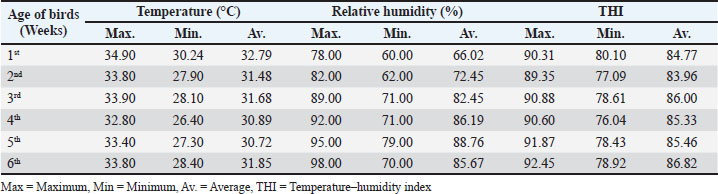
Temperature–humidity index (THI)Five automatic thermo-hygrometers were placed at different points within the experimental house to record the ambient temperature and relative humidity six times daily. The weekly average temperature and humidity were used to calculate the THI values following Hahn et al. (2009). The THI values were categorized as follows: <70 (no HS), 70–75 (potential HS), 76–81 (under HS), and >81 (extreme HS). During the final three weeks, the average THI values consistently ranged from 85.33 to 86.82, indicating severe HS in the later phase of the experiment (Table 2). Table 2. Indoor temperatures, relative humidity, and temperature–humidity index values recorded at the bird’s body level.
Production performance and efficiency indicatorsWeekly assessments of growth performance were conducted, focusing on average BW, BWG, FI, and FCR. The BWG was determined by subtracting the IBW from the final BW (FBW), whereas the FI was derived by subtracting the residual feed from the provided quantity. Subsequently, the FI was divided by BWG to determine FCR. Mortality was recorded daily to assess survival. Both the European Performance Efficiency Factor (EPEF) and European Broiler Index (EBI) were computed using the following formulas: EPEF={BW × Survivability (%)/FCR × Days of slaughter} × 100 and EBI=Average daily gain ((g/chick)/day) × Survivability (%)/FCR × 10. Water consumption and rectal temperatureDaily water consumption was assessed by measuring the difference between the supplied and leftover water per pen, expressed in milliliters per day per bird. The rectal temperature was recorded using a digital thermometer (Thermalert TH-5, Physitemp Instruments Inc., USA; ± 0.1°C accuracy) by inserting the thermistor probe 1–2 cm into the cloaca. Measurements were taken thrice daily during peak ambient temperature hours (at 10:00 a.m., 1:00 p.m., and 4:00 p.m.) to capture the thermal response of the birds under HS conditions. Serum biochemical analysis (SBA)Blood was sampled from five birds per treatment group, with one per replicate close to the average pen weight, on days 21 and 42 following a 12 hours fasting period. The samples were drawn from the left-wing vein in sterile glass tubes, kept undisturbed in an acclivous position at room temperature for 1 hour to allow clotting, and subsequently centrifuged at 3,000 rpm for 10 minutes. The resultant serum was frozen at −20°C for further analysis. Serum glucose, triglycerides, cholesterol, high-density lipoprotein (HDL), aspartate aminotransferase (AST), and alanine aminotransferase (ALT) levels were quantified using commercial kits (CHEMELEX, S. A., Barcelona, Spain) following spectrophotometric techniques. Low-density lipoprotein (LDL) levels were calculated as follows: LDL=total cholesterol−HDL−VLDL, with VLDL, very low-density lipoprotein=Triglyceride/5 (Friedewald et al., 1972). Carcass yield and physicochemical properties of meatOn day 42, one bird from each replicate group (5 birds/treatment) was selected based on pen average weight to assess carcass yields, meat physicochemical properties, and gut histomorphometry. Feed was withdrawn from the pens approximately 12 hours before slaughtering, while water remained available. Subsequently, the selected birds were weighed, euthanized via cervical dislocation, and processed following Afrin et al. (2024). The dressing percentage (DP) and organ weights were expressed in relation to the BW. The breast meat was cut out, separated, trimmed of adipose tissues, and then preserved at 4°C for 24 hours for meat color analysis. Meat color, including lightness (L*), redness (a*), and yellowness (b*), was measured from the outer meat surfaces using a calibrated Chroma Meter (CR-410, Konica Minolta Inc., Tokyo, Japan) against a white tile (standard values: L*=56.41, a*=3.34, and b*=7.87). The Hue angle (HA) and saturation index (SI) were calculated as follows: HA=tan−1 (b* / a*) and . The meat pH was determined at 24- hours (pHu) postmortem using a calibrated pH meter (Hi 99163, HANNA Instruments Inc., USA). The water holding capacity (WHC) was calculated after centrifuging (ScanSpeed 1730R, LaboGene, Denmark) about 1 g of chopped meat at 10,000 RCF for 10 minutes (4°C) using the following formula: WHC (%)=(Sample weight after centrifugation/Sample weight before centrifugation) × 100. The cooking loss (CL) was determined by weighing approximately 20 g of meat before and after cooking at 80°C for 30 minutes in a water bath (PolyScience, USA), expressed as: CL (%)={(Initial weight − Final weight) / Initial weight} × 100. The drip loss (DL) was calculated by weighing deboned meat samples before and after 24 hours refrigeration at 4°C and then expressed as: DL (%)={(Initial weight − Final weight) / Initial weight} × 100. Gut sample collection and preparationThe midsegments (2 cm) of the duodenum, jejunum, and ileum were collected immediately after dissection, rinsed with phosphate-buffered saline (PBS) to wash out the digesta, and processed following the methodology outlined by Luna (1968). The harvested samples were preserved in 10% neutral-buffered formalin, appropriately trimmed, and placed in histocassettes. After a 30 minutes PBS wash, the tissues were dehydrated with graded ethanol (50, 70, 80, 90, and 100%) (Merck, Darmstadt, Germany), cleared with xylene (Daejung, South Korea), and subsequently embedded in paraffin. The tissue sections (approximately 5 µm thick) were cut with a microtome (RM2016, LEICA, Germany), immersed in a gelatinized water bath (40°C–42°C), mounted on slides, and subsequently stained with conventional hematoxylin and eosin (H&E) staining (Merck, Darmstadt, Germany). Morphometric analysis was conducted using Image-Pro Plus software (Media Cybernetics Inc., Bethesda, Rockville, MD, USA). Villus height (VH) was measured from the crypt-villus junction to the tip, villus width (VW) at the midpoint of the villus, and crypt depth (CD) from the base to the villus-crypt junction, near the lamina propria. The ImageJ Software (Version 1.8.0) was used for precise measurements, with data collected from five well-oriented villi per section to ensure reliability. Benefit-cost analysisA comprehensive benefit-cost analysis was conducted, considering the expenses associated with the purchase of chicks, feed, equipment (feeders, drinkers), litter, disinfectants, vaccine, labor, and other necessary variables. The mortality cost was calculated by multiplying the total number of dead birds by the income per bird. The income per bird was determined by dividing the total income by the total number of birds. The total income was calculated using the average live weight of the birds and the selling price. Profits were computed by subtracting the total cost from the total revenue, and the benefit-cost ratio was derived by dividing the total revenue by the total cost. Statistical analysisAll experimental data were recorded in Excel spreadsheets, and normality (Shapiro-Wilk test) and homogeneity of variance (Levene’s test) were checked. Subsequently, the one-way analysis of variance (ANOVA) was performed using SPSS (Version 20.00; SPSS Inc. Chicago, USA 2013), following completely randomized design (CRD) principles. The standard error (SE) was computed, and Duncan’s multiple range test (DMRT) was used to compare the significance of different treatments. Ethical approvalThe handling and slaughtering of the experimental birds and sample collection procedures were conducted following internationally accepted standards for chicken welfare and ethics, as approved by the “Animal Welfare and Experimentation Ethics Committee (AWEEC)” of Bangladesh Agricultural University (BAU), Mymensingh-2202 [AWEEC/BAU/2024(26)]. ResultsProduction performance and efficiencyDuring the first 3 weeks, broilers were kept under uniform husbandry conditions with ad libitum feeding, revealing no significant variations in BW, BWG, FI, FCR, or survivability (p > 0.05). However, from the 4th to 6th weeks, heat-stressed broilers subjected to different feeding management approaches displayed significant differences in performance indices (Table 3). By the end of the experiment, the birds assigned to InterFW exhibited significantly (p < 0.05) superior BW and BWG, followed by the 8hFW, DPFW, and AdLF groups, while the QuantFR group displayed the lowest. Notably, InterFW birds exhibited significantly (p < 0.05) the highest FI, followed by AdLF, whereas the QuantFR group demonstrated the lowest FI. The AdLF group had significantly (p < 0.05) the highest FCR value (1.69), whereas the results across all the FR groups were statistically insignificant, ranging from 1.58 to 1.64. Compared with the AdLF group, broilers undergoing FR protocols had better survivability, with the highest observed in the 8hFW group. Additionally, the EPEF and EBI values remained unaffected by different feeding management approaches until the 4th week. However, similar to the performance metrics, significant differences (p < 0.05) emerged at the end of the 5th and 6th weeks, with the highest EPEF and EBI values observed in the 8hFW group, followed by DPFW and InterFW, while the AdLF and QuantFR showed the lowest values. Table 3. Production performance and efficiency of birds exposed to different feeding management approaches under HS conditions.
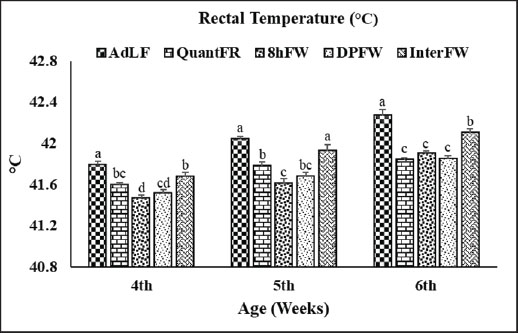
Rectal temperatureFigure 1 depicts the variations in rectal temperature of heat-stressed broilers subjected to different feeding management approaches at 4th, 5th, and 6th weeks of age. The AdLF group consistently exhibited the highest rectal temperature compared with the feed-restricted groups (p < 0.05). The lowest rectal temperature was recorded in the QuantFR, 8hFW, and DPFW groups during the 6th week of age.
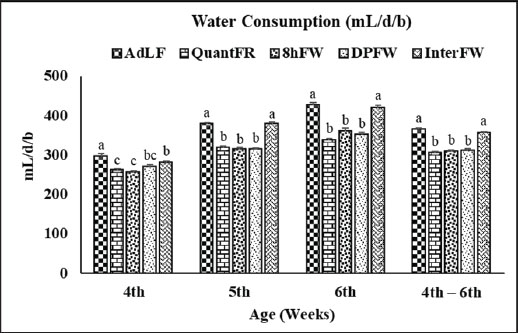
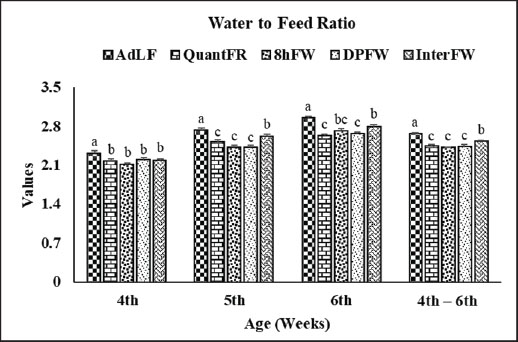
Fig. 1. Rectal temperature (°C) of experimental birds exposed to different feeding management approaches under HS conditions. a,b,c,dMeans assigned to different superscripts are significantly different (p < 0.05), where a, b, c, d mean the highest, medium, and lowest mean, respectively. AdLF=ad libitum feeding; QuantFR=quantitative feed restriction; 8hFW=fixed-period feed withdrawal; DPFW=different periods of feed withdrawal; InterFW=intermittent feed withdrawal. Water consumption and the water-to-feed ratioThe water consumption (Fig. 2) and water-to-feed ratio (Fig. 3) in heat-stressed broilers were significantly influenced by the different feeding management approaches employed in the current study. At the 4th, 5th, and 6th weeks of age, broilers subjected to the AdLF or InterFW regimens consistently exhibited the highest water consumption and water-to-feed ratio (p < 0.05). However, when the birds were exposed to QuantFR, 8hFW, or DPFW feeding protocols, they consumed significantly less water and exhibited the lowest water-to-feed ratios. The cumulative data collected over the final three weeks of the trial period (4th–6th) also demonstrated a similar pattern of results (p < 0.05).
Fig. 2. Water consumption of experimental birds exposed to different feeding management approaches under HS conditions. a,b,cMeans assigned to different superscripts are significantly different (p < 0.05), where a, b, c means the highest, medium, and lowest mean, respectively. AdLF=ad libitum feeding; QuantFR=quantitative feed restriction; 8hFW=fixed-period feed withdrawal; DPFW=different periods of feed withdrawal; InterFW=intermittent feed withdrawal.
Fig. 3. Water to feed ratio of experimental birds exposed to different feeding management approaches under HS conditions. a,b,cMeans assigned to different superscripts are significantly different (p < 0.05), where a, b, c mean the highest, medium, and lowest mean, respectively. AdLF=ad libitum feeding; QuantFR=quantitative feed restriction; 8hFW=fixed-period feed withdrawal; DPFW=different periods of feed withdrawal; InterFW=intermittent feed withdrawal. Serum biochemical indicesNo significant variations appeared at the 3rd week of age; however, at the 6th week of age, different feeding management approaches significantly influenced serum biochemical indices (Table 4). The AdLF and InterFW groups demonstrated significantly (p < 0.05) elevated glucose levels, whereas the QuantFR, 8hFW, and DPFW groups showed reduced levels. Similarly, total cholesterol, triglycerides, LDL, and VLDL levels were significantly (p < 0.05) the highest in the AdLF group, followed by the InterFW group, and the lowest in the QuantFR, 8hFW, and DPFW groups. In contrast, HDL was significantly elevated in the QuantFR, 8hFW, and DPFW groups (p < 0.05). The liver enzyme levels were also influenced by the FR approaches, with ALT and AST levels being the highest in the AdLF, moderate in the InterFW, and lowest in the 8hFW, DPFW, and QuantFR groups (p < 0.05). Table 4. Serum biochemical indices of birds exposed to different feeding management approaches under HS conditions.
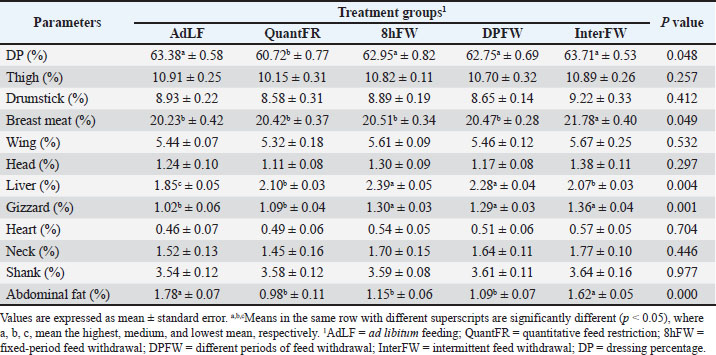
Carcass yieldsThe overall carcass yields of all five treatment groups demonstrated that the different feeding management approaches exerted a significant influence on the percentages of DP, breast meat, gizzard, liver, and abdominal fat (Table 5). As anticipated, broilers under InterFW had significantly (p < 0.05) better DP, breast meat, and gizzard weights, whereas those under QuantFR showed the lowest DP among the treatment groups. The liver weight significantly (p < 0.05) increased when the birds were subjected to 8hFW and DPFW treatments. The abdominal fat was significantly (p < 0.05) higher in the AdLF and InterFW groups, whereas the QuantFR group had the lowest. Other carcass metrics, including head, neck, heart, wing, thigh, drumstick, and shank, showed no significant variations among treatments. Table 5. Carcass yields of experimental birds exposed to different feeding management approaches under HS conditions.
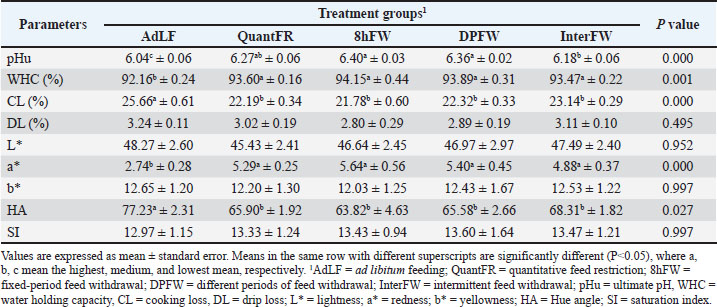
Physicochemical properties of breast meatTable 6 demonstrates the influence of different feeding management approaches on the physicochemical properties of the breast meat of heat-stressed broilers. The 8hFW and DPFW groups exhibited significantly (p < 0.05) higher breast meat pHu and WHC, whereas the AdLF recorded the lowest. In contrast, the AdLF group had significantly (p < 0.05) elevated CL compared with the other groups, although DL remained unaffected by feeding management approaches. Feeding management approaches did not significantly affect L* and b* while evaluating the breast meat color; however, the a* values were considerably higher in the 8hFW and DPFW groups and lower in the AdLF groups (p < 0.05). Significantly higher HA was found in the AdLF group than in the other groups (p < 0.05), although the SI was unaffected by treatments. Table 6. Physicochemical properties of breast meat of experimental birds exposed to different feeding management approaches under HS conditions.
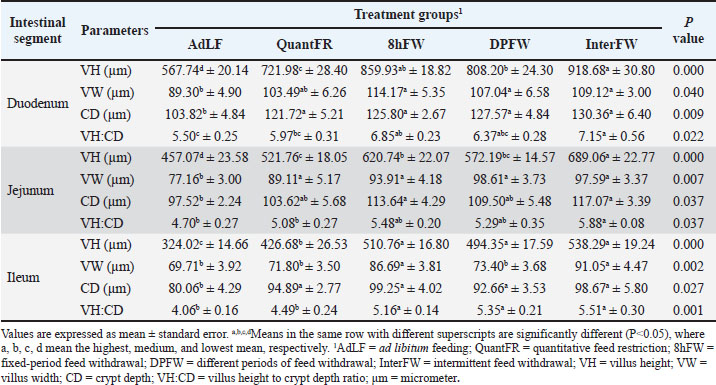
Intestinal histomorphologyDifferent feeding management approaches significantly influenced the intestinal histomorphology of the birds under HS, as evidenced by significant variations in VH, VW, CD, and VH: CD across the intestinal segment (Table 7). The morphometric values for VH, VW, CD, and VH: CD of the duodenum, jejunum, and ileum were all significantly higher in the heat-stressed broilers subjected to FR protocols than in the AdLF group (p < 0.05). The broilers subjected to the QuantFR approach demonstrated somewhat moderate values of the histomorphological changes examined in the current study. Table 7. Intestinal histomorphology of experimental birds exposed to different feeding management approaches under HS conditions.
Benefit-cost analysis (BCR)Table 8 shows the calculation of the benefits over the costs of heat-stressed broilers fed ad libitum or reared with different feeding management approaches. The DOCs used in this experiment were purchased at the same price and raised with identical care and management; thus, the chick and miscellaneous costs were the same for all five treatments. The overall feed cost per bird was significantly (p < 0.05) higher for the InterFW birds (BDT 202.52), followed by the AdLF (BDT 197.60), while the QuantFR, 8hFW, and DPFW groups had the lowest (BDT 185.39, 188.43, and 188.85, respectively). The AdLF group exhibited the highest mortality cost per bird (BDT 22.87) due to increased mortality, whereas the 8hFW group had the lowest (BDT 1.91) (p < 0.05). As anticipated, the AdLF group displayed the highest total production costs per kg live bird and yielded the lowest profit (p < 0.05). Similarly, the BCR was significantly (p < 0.05) the highest in the 8hFW (1.16) group, moderate in DPFW (1.11), QuantFR (1.11), and InterFW (1.10), and the lowest in the AdLF group (1.02). Table 8. Benefit-cost ratio of experimental birds exposed to different feeding management approaches under HS conditions.
DiscussionIt is evident that FR in broilers, particularly the age at initiation, intensity, or duration, collectively influences performance outcomes (Ebeid et al., 2022a). In this study, broilers exposed to QuantFR, 8hFW, and DPFW showed significantly reduced FI due to restricted feeding, which may lead to lower metabolic heat production and better FCR. Despite consuming the highest feed and attaining the highest BW, the birds in the InterFW group maintained an FCR comparable to the other FR groups, possibly due to better appetite and more efficient nutrient assimilation following intermittent feed access. Conversely, broilers fed ad libitum (AdLF) achieved average BW with moderate FI but showed poorer FCR, probably due to inefficient feed utilization. Several studies have suggested that FR, whether quantitative, time-limited, or intermittent, enhances FCR in commercial broilers (Farghly and Makled, 2015; Meloche et al., 2018; Farghly et al., 2019; Livingston et al., 2019). During hot weather, FR has been reported to improve BW, BWG, and FCR while decreasing FI (Uzum and Toplu, 2013; Mohamed et al., 2019a). During the growing period, FR can optimize performance without impairing physiological functions (Azis et al., 2019; Farghly et al., 2019). The poorer FCR observed in AdLF birds might result from insufficient nutrient utilization time, whereas birds under FR might benefit from longer durations for proper nutrient digestion, absorption, and utilization, ultimately resulting in better FCR (Abdel-Hafeez et al., 2017). Additionally, FR may contribute to reduced metabolic heat production per unit of BW, potentially offering thermoregulatory benefits to heat-stressed broilers (Uzum and Toplu, 2013; Desoky and Kamel, 2018; Mohamed et al., 2019a). Following the restriction period, birds compensate by consuming more feed, typically during cooler hours, recovering part of the intake lost during the fasting period (De Baets et al., 2024), which promotes compensatory growth without negatively affecting FCR. Moreover, FR may stimulate physiological adaptability that enhances crop, proventriculus, and gizzard functions, improving feed retention, palatability, moisture content, and absorptive capacity, thereby promoting better feed utilization and compensatory growth (Svihus et al., 2013; Fondevila et al., 2020). Furthermore, FR did not appear to impair digestive system growth; instead, it may have supported intestinal histomorphology (Metzler-Zebeli et al., 2019; Fondevila et al., 2020). These mechanisms may better explain the observed improvements in FCR of the different feeding management approach groups compared with AdLF, particularly from 4 to 6 weeks of age. Nonetheless, a few studies contradict our findings, where the general production parameters remained nearly unchanged in feed-restricted birds (Svihus et al., 2013; Abdel-Hafeez et al., 2017; Khurshid et al., 2019; Abo Ghanima et al., 2023). The higher survivability noted in the 8hFW, DPFW, and QuantFR groups may be associated with lower FI and BW, which in turn reduces metabolic heat generation during the peak heat period and improves thermal resilience, aligning with previous reports (Uzum and Toplu, 2013; Shamma et al., 2014; Mohamed et al., 2019a,b). In addition to the growth performance, the production efficiency values (EPEF and EBI) serve as reliable indicators of optimal management and efficient broiler farm operations, with the highest values yielding the best returns. The current study revealed that these values were markedly higher in the different feeding management groups than in the AdLF group, highlighting the positive effect of FR on profitability. Different feeding management approaches significantly enhanced several performance metrics, including survival, BW, average daily BWG, and FCR, which in turn positively affected the EPEF and EBI values. Commercial broilers tend to experience HS once the ambient temperature exceeds 26°C, in which the rectal temperature is a reliable metric for evaluating heat adaptation (He et al., 2019 ; Lu et al., 2019). HS hinders lipid utilization, causing increased abdominal fat deposition and diminishing the body’s heat dissipation capacity (Lu et al., 2019). Consequently, the birds cannot fully release excess body heat, resulting in an elevated rectal temperature (Du et al., 2023). In the present study, heat-stressed broilers subjected to different feeding management approaches, particularly 8hFW, DPFW, and QuantFR, exhibited significantly lower rectal temperatures than their ad libitum (AdLF) counterpart. These groups consumed less feed, generating less metabolic heat and maintaining lower rectal temperatures. Previous studies also reported that FR helps to lower rectal temperatures in heat-stressed broilers by limiting metabolic heat during peak heat periods (Uzum and Toplu, 2013; Desoky and Kamel, 2018). Therefore, the adoption of feeding management approaches, especially quantitative, fixed, or periodic FR, may enhance thermotolerance by reducing internal heat load in broilers under HS conditions. Broilers increase their water intake as a physiological response to aid thermoregulation and maintain hydration under extreme HS conditions. When sensible heat loss is impeded, this response helps dissipate body heat through water vaporization from the body surface (Saeed et al., 2019). Birds begin panting to dissipate heat through evaporative cooling, which paradoxically elevates body temperature due to increased muscular activity and dehydration, further increasing water demand (Wang et al., 2018). Under HS conditions, broilers significantly increase their drinking duration, consuming 2–4 times more water than normal (Saeed et al., 2019). Usually, the water-to-feed ratio in broilers is approximately 2.02:1 (Williams et al., 2013); however, in this study, the ratio increased to 2.91:1 as the ambient temperature increased to 34°C. Birds in the AdLF group exhibited higher BW, BWG, rectal temperature, and panting, leading to increased water intake. Conversely, the QuantFR, 8hFW, and DPFW groups, which had lower FI, produced less metabolic heat and consumed less water. These findings indicate that feeding management approaches can indirectly regulate water intake by modulating metabolic heat production and thermoregulatory demand. The glucose metabolism cycle significantly contributes to HS-associated hyperglycemia (Mohamed et al., 2019a). Heat-stressed broilers exhibit elevated serum glucose levels due to the excessive secretion of stress hormones, such as glucocorticoids, adrenaline, and noradrenaline, which activate gluconeogenic pathways (Khan et al., 2021). This response reflects a physiological adaptation, releasing glucose into the circulation to prepare for a “fight-or-flight” state (Beckford et al., 2020; Al-Garadi et al., 2023). Broilers in the AdLF group exhibited significantly increased serum glucose levels, potentially in response to HS challenges. In contrast, feed-restricted birds had lower serum glucose levels, possibly due to reduced FI, leading to lower carbohydrate intake and hepatic glycogen reserves, both of which are recognized as rapid energy sources. These findings are supported by Mohamed et al. (2019a,b), though other studies found that FR had a negligible or no impact on glucose levels in heat-stressed broilers (Abdel-Hafeez et al., 2017; Tůmová et al., 2019). HS also elevates serum cholesterol and triglyceride levels due to excessive cellular production of reactive oxygen species (ROS) that disrupt serum metabolites (Khan et al., 2021). Cholesterol levels may increase due to adrenal gland hyperactivity, which produces adrenocorticotropic hormones, for which cholesterol is a precursor (Chand et al., 2018; Khan et al., 2021). Similarly, elevated triglycerides may arise from HS-induced glucocorticoid and corticosterone secretion, which promotes triglyceride synthesis and mobilization in the liver via the enzyme phosphatidate phosphohydrolase (Chand et al., 2018; Khan et al., 2021). The current study found reduced triglycerides, total cholesterol, and LDL but increased HDL in the feed-restricted groups compared with the ad libitum counterpart, consistent with the findings of Rahimi et al. (2015) and Mohamed et al. (2019a,b). The liver, which is highly sensitive to HS, may experience reduced function, possibly related to redirected blood flow from the hepato-splanchnic area toward the skin and respiratory musculature to enhance heat release, causing associated complications (Emami et al., 2021). As observed in previous studies (Chand et al., 2018; Khan et al., 2021), elevated serum liver enzyme levels (AST and ALT) under HS indicate liver damage due to neurotic and degenerating cells that excessively release enzymes from the cytoplasm. Our results revealed reduced liver weight in the AdLF group, implying possible heat-induced liver damage and dysfunction, which may lead to higher blood AST and ALT levels. In contrast, feed-restricted birds, specifically 8hFW and DPFW, had a significantly increased liver weight, which may reflect reduced liver damage and consequently decreased blood AST and ALT levels. These findings are consistent with those of Desoky and Kamel (2018) and Simões et al. (2020), although some studies have reported contradictory results (Farghly and Mackled, 2015; Abo Ghanima et al., 2023). In this study, heat-stressed broilers underwent different feeding management approaches, which resulted in an increase in DP, breast meat, liver, and gizzard weights but reduced abdominal fat. These results align with previous studies that have demonstrated that FR may improve carcass quality by improving DP, breast, gizzard, liver, or heart percentages while simultaneously reducing abdominal fat deposition under HS (Desoky and Kamel, 2018; Mohamed et al., 2019a; Falowo et al., 2025). In contrast, the AdLF group exhibited almost reverse results when subjected to HS. Ebeid et al. (2022b) further clarified that the effects of FR depend on the timing, duration, rate of feed management, or refeeding practices, which influence meat quality characteristics and yield. The decreased liver weight in AdLF birds may be due to oxidative stress-induced damage, resulting from an excessive presence of free radicals, as evidenced by the elevated levels of liver enzymes (Nisar et al., 2021). In contrast, different feeding management approaches improved liver percentages and empty gizzard weights in heat-stressed broilers. Broilers raised under HS conditions tend to accumulate excessive body fat, which is undesirable for most poultry consumers (Lu et al., 2018). However, FR may effectively reduce this through decreased FI, inhibited lipogenesis, stimulated fatty acid oxidation, and decreased adipocyte formation, collectively facilitating easy fat mobilization for energy during the FR period (Englmaierová et al., 2021). Mohamed et al. (2019b) further asserted that FR is associated with reduced lipoprotein lipase activity in adipose tissues and controls fatty acid release from lipoproteins and their absorption into adipocytes, ultimately limiting abdominal fat deposition. Previous studies found a marked reduction in abdominal fat accumulation in heat-stressed broilers when FR was implemented (Abdel-Hafeez et al., 2017; Koçer et al., 2018; Englmaierová et al., 2021). The physiological properties of meat, including pH, WHC, CL, DL, color, tenderness, and juiciness, are key determinants of meat shelf life and consumer acceptance (Ebeid et al., 2022b). Meat pHu critically influences several meat quality indices, including color, WHC, tenderness, and juiciness (Zaboli et al., 2019; Hussein et al., 2020). Previous research indicates that decreased breast meat pHu in heat-stressed broilers results from glycolysis-induced lactate accumulation in the muscle tissues (Zhang et al., 2012; Zaboli et al., 2019), potentially impairing meat quality. Birds under different feeding management approaches exhibited significantly elevated pHu, WHC, and a* values, along with decreased CL and HA, indicating better meat quality than AdLF birds, while DL and b* values remained unaffected. Previous studies have shown that HS decreases pH, WHC, and a* and increases L*, CL, and DL in broiler breast meat (Zhang et al., 2012; Chen et al., 2021; Jing et al., 2024). HS produces and accumulates excessive ROS, which causes sarcoplasmic and myofibrillar protein oxidation, reducing the solubility of these proteins and water-binding capacity, leading to higher DL and CL and decreased WHC (Zaboli et al., 2019). It also oxidizes myoglobin protein, reducing meat redness (Zhang et al., 2012), and promotes lipid peroxidation, producing malondialdehyde, which compromises the meat shelf life (Wang et al., 2009), collectively increasing the occurrence of pale, soft, and exudative meat. In this study, the implementation of different feeding management approaches reduced metabolic heat generation in heat-stressed broilers, subsequently lowering ROS generation and accumulation. This decrease may help to minimize muscle protein degradation and enhance water-binding ability, contributing to increased breast meat pH, WHC, a*, and reduced CL, DL, and L*. The current study found that ad libitum-fed birds exhibited the highest HA values compared with those under different feeding management approaches. Abudabos et al. (2021) reported that HA, a key indicator of meat discoloration, is significantly elevated in broilers subjected to HS. Therefore, strategic feeding management may play a role in preserving meat quality under HS conditions. The histomorphology of the intestines, particularly VH and CD, is a key indicator of gut health, digestive efficiency, cell maturity, and nutrient uptake capacity (Zhang et al., 2021). However, in broiler chickens, HS disrupts the gut structure by impairing thermoregulation, triggering heat shocks, gut ischemia, epithelial shedding, and histomorphological damage, ultimately reducing VH and CD (Mazzoni et al., 2022; Madkour et al., 2024). Our study showed the AdLF birds had significantly lower VH, VW, and CD, likely due to the destruction of gut mucosal epithelial cells caused by elevated body temperature. As suggested by Rostagno (2020) these alterations are attributed to stress from oxidation and inflammation resulting from limited FI and blood supply, although Nanto-Hara et al. (2020) emphasized HS as the primary driver rather than reduced FI. In contrast, birds subjected to different feeding management approaches, particularly fasting, exhibited improved VH, VW, and VH: CD, indicating enhanced absorptive capacity and gut adaptation. Reduced metabolic heat from FR may contribute to the preservation of gut structure and digestion efficiency, ultimately promoting better nutrient absorption, better feed conversion efficiency, and overall superior growth performance (Onderci et al., 2006; Buwjoom et al., 2010). These observations are consistent with previous findings indicating that FR is associated with improved gut integrity, possibly through adaptive mechanisms that optimize nutrient uptake (Azouz et al., 2019; Metzler-Zebeli et al., 2019). Fixed, different, or intermittent FR practices allow for gut rest, recovery, and repair, enhancing tissue integrity by activating intestinal epithelium adaptation to nutrient fluctuations. The most crucial parameters influencing the economic benefits of broiler production are feed cost, FBW, and mortality. In this study, InterFW birds incurred significantly higher feed costs due to increased FI, whereas QuantFR birds consumed less feed, thereby reducing feed expenses. Although AdLF birds had moderate feed costs, their total production costs were the highest, largely due to elevated mortality. In contrast, the 8hFW group had lower mortality, thereby lowering production costs. The InterFW birds showed better feed efficiency and FBW, which contributed to higher income. However, 8hFW birds achieved higher profits due to reduced FI and mortality costs, eventually resulting in higher BCR. Thus, the net benefits of broiler farming can likely be maximized through some crucial factors, including lower FI, improved FCR, enhanced FBW, and minimized mortality. Several studies have confirmed that different feeding management approaches can enhance economic returns (Shamma et al., 2014; Farghly and Makled, 2015; Azouz et al., 2019) by lowering feed costs compared with their unrestricted counterparts (Abo Ghanima et al., 2023; Falowo et al., 2025). Notably, Abo Ghanima et al. (2023) found that an 8 hours feed-restricted broilers achieved a higher net return per kg gain than control broilers. This study indicates that implementing different feeding management approaches may support improved BCR under HS, of which 8hFW can be recommended for practical farm operations. ConclusionThe findings of this study unequivocally demonstrate that different feeding management approaches can mitigate the adverse effects of HS on commercial broilers. Under HS conditions, these approaches positively influenced growth, survivability, carcass yields, meat physicochemical properties, gut histomorphology, and profitability. Among them, the 8 hours fixed-period feed withdrawal (8hFW) approach yielded consistent superior performance. Considering these findings, to mitigate HS-related challenges, this approach can be recommended as a practical strategy for farmers while rearing commercial broilers in open-sided housing systems under hot and humid climate conditions. AcknowledgmentsThe authors express their gratitude to the “Department of Poultry Science” and “Department of Animal Science” for assistance with logistics and provision of laboratory facilities. FundingThis research was supported by the Ministry of Science and Technology, Bangladesh, under the project entitled “Minimize the heat stress of commercial broilers through different feeding management approaches under the hot and humid conditions of Bangladesh (Project No. BS-25, 2021)”. Author’s contributionsAL: Conceptualization, visualization, investigation, methodology, data curation, formal analysis, original draft writing, review, and editing. TA: Methodology and data curation. AA: Methodology. MSR: Validation and visualization. MAKC: Validation and visualization. SCD: Conceptualization, funding acquisition, methodology, project administration, resources, supervision, validation, original draft writing, review and editing. Conflict of interestThe authors declare no conflict of interest. Data availabilityAll data supporting this study’s findings are available within the manuscript. ReferencesAbdel-Hafeez, H.M., Saleh, E.S.E., Tawfeek, S.S., Youssef, I.M.I. and Abdel-Daim, A.S.A. 2017. Effects of probiotic, prebiotic, and synbiotic with and without feed restriction on performance, hematological indices and carcass characteristics of broiler chickens. Asian-Australas. J. Anim. Sci. 30, 672–682; doi:10.5713/ajas.16.0535 Abdel-Moneim, A.M.E., Shehata, A.M., Khidr, R.E., Paswan, V.K., Ibrahim, N.S., El-Ghoul, A.A., Aldhumri, S.A., Gabr, S.A., Mesalam, N.M., Elbaz, A.M., Elsayed, M.A., Wakwak, M.M. and Ebeid, T.A. 2021. Nutritional manipulation to combat heat stress in poultry – a comprehensive review. J. Therm. Biol. 98, 102915; doi:10.1016/j.jtherbio.2021.102915 Abo Ghanima, M.M., Abd El-hack, M.E., Al-Otaibi, A.M., Nasr, S., Almohmadi, N.H., Taha, A.E., Jaremko, M. and El-Kasrawy, N.I. 2023. Growth performance, liver and kidney functions, blood hormonal profile, and economic efficiency of broilers fed different levels of threonine supplementation during feed restriction. Poult. Sci. 102, 102796; doi:10.1016/j.psj.2023.102796 Abudabos, A.M., Suliman, G.M., Al-Owaimer, A.N., Sulaiman, A.R.A. and Alharthi, A.S. 2021. Effects of nano emulsified vegetable oil and betaine on growth traits and meat characteristics of broiler chickens reared under cyclic heat stress. Animals 11, 1911; doi:10.3390/ani11071911 Afrin, A., Ahmed, T., Lahiry, A., Rahman, S., Dey, B., Hashem, M.A. and Das, S.C. 2024. Profitability and meat quality of fast-, medium- and slow-growing meat-type chicken genotype as affected by growth and length of rearing. Saudi J. Biol. Sci. 31, 104025; doi:10.1016/j.sjbs.2024.104025 Al-Garadi, M.A., Suliman, G.M., Hussein, E.O., Al-Owaimer, A.N., Swelum, A.A., Almalamh, N.A., Alhotan, R.A. and Qaid, M.M. 2023. The effects of betaine and nano-emulsified plant-oil supplementation on growth performance and serum biochemistry indices of heat-stressed broiler chickens. Ital. J. Anim. Sci. 22, 398–406; doi:10.1080/1828051X.2023.2206417 Azis, A. and Afriani, A. 2017. Effect of feeding time restriction during the growing period on growth performance of broiler chickens. Asian J. Poult. Sci. 11, 70–74; doi:10.3923/ajpsaj.2017.70.74 Azis, A., Berliana, S. and Afriani. 2019. Effects of feeding time restriction during the whole rearing period on the growth performance of broiler chickens. Int. J. Poult. Sci. 18, 14–20; doi:10.3923/ijps.2019.14.20 Azouz, H.M.M., Gadelrab, S.S. and El-Komy, H.M. 2019. Effects of late feed restriction on growth performance and intestinal villi parameters of broiler chicks under summer conditions. Egypt. Poult. Sci. J. 39, 913–934; doi:10.21608/e.psj.2019.67514 Beckford, R.C., Ellestad, L.E., Proszkowiec-Weglarz, M., Farley, L., Brady, K., Angel, R., Liu, H.C. and Porter, T.E. 2020. Effects of heat stress on performance, blood chemistry, and hypothalamic and pituitary mRNA expression in broiler chickens. Poult. Sci. 99, 6317–6325; doi:10.1016/j.psj.2020.09.052 Buwjoom, T., Yamauchi, K., Erikawa, T. and Goto, H. 2010. Histological intestinal alterations in chickens fed low protein diet. J. Anim. Physiol. Anim. Nutr. 94, 354–361; doi:10.1111/j.1439-0396.2008.00915.x Chand, N., Naz, S., Rehman, Z. and Khan, R.U. 2018. Blood biochemical profile of four fast-growing broiler strains under high ambient temperature. Appl. Biol. Chem. 61, 273–279; doi:10.1007/s13765-018-0358-4 Chen, Y., Cheng, Y., Du, M. and Zhou, Y. 2021. Protective effects of dietary synbiotic supplementation on meat quality and oxidative status in broilers under heat stress. Environ. Sci. Pollut. Res. 28, 30197–30206; doi:10.1007/s11356-021-12535-3 Das, S.C., Tasmin, M.Z., Afrin, A., Ahmed, T., Lahiry, A. and Rahman, S. 2024. Challenges in the profitability of small-scale broiler farming by avoiding injudicious use of drugs and additives. Heliyon 10, e25001; doi:10.1016/j.heliyon.2024.e25001 De Baets, R., Buyse, K., Antonissen, G. and Delezie, E. 2024. Betaine and feed restriction as potential mitigation strategies against heat stress in two strains of laying hens. Poult. Sci. 103, 104104; doi:10.1016/j.psj.2024.104104 Desoky, A.A. and Kamel, N.N. 2018. Effect of feed restriction and vitamin C supplementation on growth performance, carcass characteristics and some blood parameters of broiler reared under heat stress. Egypt. J. Nutr. Feed. 21, 823–832; doi:10.21608/ejnf.2018.75800 Du, M., Cheng, Y., Chen, Y., Wang, S., Zhao, H., Wen, C. and Zhou, Y. 2023. Dietary supplementation with synbiotics improves growth performance, antioxidant status, immune function, and intestinal barrier function in broilers subjected to cyclic heat stress. Environ. Sci. Pollut. Res. 30, 18026–18038; doi:10.1007/s11356-022-23385-y Ebeid, T.A., Tůmová, E., Al-Homidan, I.H., Ketta, M. and Chodová, D. 2022a. Recent advances in the role of feed restriction in poultry productivity: part I- performance, gut development, microbiota and immune response. Worlds. Poult. Sci. J. 78, 971–988; doi:10.1080/00439339.2022.2097149 Ebeid, T.A., Tůmová, E., Ketta, M. and Chodová, D. 2022b. Recent advances in the role of feed restriction in poultry productivity: part II- carcass characteristics, meat quality, muscle fibre properties, and breast meat myopathies. Worlds. Poult. Sci. J. 78, 989–1005; doi:10.1080/00439339.2022.2121674 Emami, N.K., Jung, U., Voy, B. and Dridi, S. 2021. Radical response: effects of heat stress-induced oxidative stress on lipid metabolism in the avian liver. Antioxidants 10, 35; doi:10.3390/antiox10010035 Englmaierová, M., Skřivan, M., Taubner, T., Skřivanová, V. and Čermák, L. 2021. Effect of housing system and feed restriction on meat quality of medium growing chickens. Poult. Sci. 100, 101223; doi:10.1016/j.psj.2021.101223 Erensoy, K., Noubandiguim, M., Sarıca, M. and Aslan, R. 2020. The effect of intermittent feeding and cold water on performance and carcass traits of broilers reared under daily heat stress. Asian-Australasian. J. Anim. Sci. 12, 2031–2038; doi:10.5713/ajas.19.0980 Falowo, A.B., Oloruntola, O.D., Atiba, O.I., Ayodele, O.A., Olarotimi, O.J. and Gbore, F.A. 2025. Growth performance, carcass quality, immune response, and production economics of broiler chickens fed avocado seed meal under feed restriction. Translational Anim. Sci. , 47; doi:10.1093/tas/txaf047 Farghly, M.F., Mahrose, K.M., Ahmad, E.A.M., Rehman, Z.U. and Yu, S. 2019. Implementation of different feeding regimes and flashing light in broiler chicks. Poult. Sci. 98, 2034–2042; doi:10.3382/ps/pey577 Farghly, M.F.A. and Makled, M.N. 2015. Application of intermittent feeding and flash lighting regimens in broiler chickens management. Egypt. J. Nutr. Feeds 18, 261–276; doi:10.21608/ejnf.2015.105816 Farghly, M.F.A., Alagawany, M. and Abd El-hack, M.E. 2018. Feeding time can alleviate negative effects of heat stress on performance, meat quality and health status of turkey. Brit. Poult. Sci. 59, 205–210; doi:10.1080/00071668.2017.1413233 Fondevila, G., Archs, J.L., Cámara, L., de Juan, A.F. and Mateos, G.G. 2020. The length of the feed restriction period affects eating behavior, growth performance, and the development of the proximal part of the gastrointestinal tract of young broilers. Poult. Sci. 99, 1010–1018; doi:10.1016/j.psj.2019.10.011 Friedewald, W.T., Levy, R.I. and Fredrickson, D.S. 1972. Estimation of the concentration of low-density lipoprotein cholesterol in plasma, without use of the preparative ultracentrifuge. Clin. Chem. 18, 499–502; doi:10.1093/clinchem/18.6.499 Gratta, F., Birolo, M., Sacchetto, R., Radaelli, G., Xiccato, G., Ballarin, C., Bertotto, D., Piccirillo, A., Petracci, M., Maertens, L. and Trocino, A. 2019. Effect of feed restriction timing on live performance, breast myopathy occurrence, and muscle fiber degeneration in 2 broiler chicken genetic lines. Poult. Sci. 98, 5465–5476; doi:10.3382/ps/pez352 Hahn, G.L., Gaughan, J.B., Mader, T.L. and Eigenberg, R.A. 2009. Chapter 5: thermal indices and their applications for livestock environments. In Livestock energetics and thermal environment management. DeShazer, J.A MI: American Society of Agricultural and Biological Engineers, pp: 113–30. doi:10.13031/2013.28298 He, S., Li, S., Arowolo, M.A., Yu, Q., Chen, F., Hu, R. and He, J. 2019. Effect of resveratrol on growth performance, rectal temperature and serum parameters of yellow-feather broilers under heat stress. Anim. Sci. J. 90, 401–411; doi:10.1111/asj.13161 Hussein, E.O.S., Suliman, G.M., Alowaimer, A.N., Ahmed, S.H., Abd El-hack, M.E., Taha, A.E. and Swelum, A.A. 2020. Growth, carcass characteristics, and meat quality of broilers fed a low-energy diet supplemented with a multienzyme preparation. Poult. Sci. 99, 1988–1994; doi:10.1016/j.psj.2019.09.007 Jing, J., Wang, J., Xiang, X., Yin, S., Tang, J., Wang, L., Jia, G., Liu, G., Chen, X., Tian, G., Cai, J., Kang, B., Che, L. and Zhao, H. 2024. Selenomethionine alleviates chronic heat stress-induced breast muscle injury and poor meat quality in broilers via relieving mitochondrial dysfunction and endoplasmic reticulum stress. Anim. Nutr. 16, 363–375; doi:10.1016/j.aninu.2023.12.008 Juiputta, J., Chankitisakul, V. and Boonkum, W. 2023. Appropriate genetic approaches for heat tolerance and maintaining good productivity in tropical poultry production. A review. Vet. Sci. 10, 591; doi:10.3390/vetsci10100591 Khan, R.U., Naz, S., Ullah, H., Ullah, Q., Laudadio, V., Qudratullah., Bozzo, G. and Tufarelli, V. 2021. Physiological dynamics in broiler chickens under heat stress and possible mitigation strategies. Anim. Biotechnol. 34, 438–447; doi:10.1080/10495398.2021.1972005 Khonyoung, D. and Yamauchi, K.E. 2019. Improved growth performance due to hypertrophied intestinal absorptive epithelial cells by heat-killed Lactobacillus sakei HS-1 in broiler chickens. J. Anim. Sci. 97, 2066–2075; doi:10.1093/jas/skz075 Khurshid, A., Khan, A.A., Banday, M.T., Ganai, A.M., Khan, H.M., Choudhary, A.R., Adil, S., Manzoor, A., Afzal, I. and Untoo, M. 2019. Effect of feed restriction on performance of broiler chicken. J. Entomol. Zool. Stud. 7, 1054–1056. Koçer, B., Bozkurt, M., Ege, G., Tüzün, A.E., Konak, R. and Olgun, O. 2018. Effects of a meal feeding regimen and the availability of fresh alfalfa on growth performance and meat and bone quality of broiler genotypes. Br. Poult. Sci. 59, 318–329; doi:10.1080/00071668.2018.1440378 Liu, L., Ren, M., Ren, K., Jin,, Y. and Yan, M. 2020. Heat stress impacts on broiler performance: a systematic review and meta-analysis. Poult. Sci. 99, 6205–6211; doi:10.1016/j.psj.2020.08.019 Livingston, M.L., Landon, C., Barnes, H.J. and Brake, J. 2019. White striping and wooden breast myopathies of broiler breast muscle is affected by time-limited feeding, genetic background, and egg storage. Poult. Sci. 98, 217–226; doi:10.3382/ps/pey333 Lu, Z., He, X., Ma, B., Zhang, L., Li, J., Jiang, Y., Zhou, G. and Gao, F. 2018. Serum metabolomics study of nutrient metabolic variations in chronic heat-stressed broilers. Bri. J. Nutr. 119, 771–781; doi:10.1017/S0007114518000247 Lu, Z., He, X.F., Ma, B.B., Zhang, L., Li, J.L., Jiang, Y., Zhou, G.H. and Gao, F. 2019. The alleviate effects and related mechanisms of taurine supplementation on growth performance and carcass characteristics in broilers exposed to chronic heat stress. Poult. Sci. 98, 878–886; doi:10.3382/ps/pey433 Luna. L.G. 1968. Manual of histologic staining methods of the armed forces institute of pathology. 3rd ed., New York: McGraw-Hill Book Company, p: 249. Madkour, M., Aboelenin, M.M., Habashy, W.S., Matter, I.A., Shourrap, M., Hemida, M.A., Elolimy, A.A. and Aboelazab, O. 2024. Effects of oregano and/or rosemary extracts on growth performance, digestive enzyme activities, cecal bacteria, tight junction proteins, and antioxidants-related genes in heat-stressed broiler chickens. Poult. Sci. 103, 103996; doi:10.1016/j.psj.2024.103996 Mazzoni, M., Zampiga, M., Clavenzani, P., Lattanzio, G., Tagliavia, C. and Sirri, F. 2022. Effect of chronic heat stress on gastrointestinal histology and expression of feed intake-regulatory hormones in broiler chickens. animal 16, 100600; doi:10.1016/j.animal.2022.100600 Meloche, K.J., Fancher, B.I., Emmerson, D.A., Bilgili, S.F. and Dozier, W.A. 2018. Effects of quantitative nutrient allocation on myopathies of the Pectoralis major muscles in broiler chickens at 32, 43, and 50 days of age. Poult. Sci. 97, 1786–1793; doi:10.3382/ps/pex453 Metzler-Zebeli, B.U., Siegerstetter, S.C., Magowan, E., Lawlor, P.G., Petri, R.M., O´Connell, N.E. and Zebeli, Q. 2019. Feed restriction modifies intestinal microbiota-host mucosal networking in chickens divergent in residual feed intake. mSystems 4, e00261-18; doi:10.1128/mSystems.00261-18 Mohamed, A.S.A., Lozovskiy, A.R. and Ali, A.M.A. 2019a. Nutritional strategies to alleviate heat stress effects through feed restrictions and feed additives (vitamins and minerals) in broilers under summer conditions. J. Anim. Behav. Biometeorol. 7, 123–131; doi:10.31893/2318-1265jabb.v7n3p123-131 Mohamed, A.S.A., Lozovskiy, A.R. and Ali, A.M.A. 2019b. Strategies to combat the deleterious impacts of heat stress through feed restrictions and dietary supplementation (vitamins, minerals) in broilers. J. Indonesian Trop. Anim. Agric. 44(2), 155–166; doi:10.14710/jitaa.44.2.155-166 Mohammadalipour, R., Rahmani, H.R., Jahanian, R., Riasi, A., Mohammadalipour, M. and Nili, N. 2017. Effect of early feed restriction on physiological responses, performance and ascites incidence in broiler chickens raised in normal and cold environment. Animal 11, 219–226; doi:10.1017/S1751731116001555 Nanto-Hara, F., Kikusato, M., Ohwada, S. and Toyomizu, M. 2020. Heat stress directly affects intestinal integrity in broiler chickens. J. Poult. Sci. 57, 284–290; doi:10.2141/jpsa.0190004 Nisar, H., Sharif, M., Rahman, M.A., Rehman, S., Kamboh, A.A. and Saeed, M. 2021. Effects of dietary supplementations of synbiotics on growth performance, carcass characteristics and nutrient digestibility of broiler chicken. Braz. J. Poult. Sci. 23, 1–10; doi:10.1590/1806-9061-2020-1388 Ogbuagu, N.E., Ayo, J.O., Aluwong, T. and Akor-Dewu, M.B. 2023. L-serine modulates activities of antioxidant enzymes and behavioral responses in broiler chickens subjected to feed restriction during the hot-dry season. J. Vet. Behav. 60, 1–9; doi:10.1016/j.jveb.2022.11.004 Onderci, M., Sahin, N., Sahin, K., Cikim, G., Aydín, A., Ozercan, I. and Aydín, S. 2006. Efficacy of supplementation of α-amylase-producing bacterial culture on the performance, nutrient use, and gut morphology of broiler chickens fed a corn-based diet. Poult. Sci. 85(3), 505–510; doi:10.1093/ps/85.3.505 Rahimi, S., Seidavi, A., Sahraei, M., Blanco, F.P., Schiavone, A. and Marín, A.L.M. 2015. Effects of feed restriction and diet nutrient density during re-alimentation on growth performance, carcass traits, organ weight, blood parameters and the immune response of broilers. Ital. J. Anim. Sci. 14, 4037; doi:10.4081/ijas.2015.4037 Rahman, S., Ahmed, T., Lahiry, A., Afrin, A., Dey, B., Paul, M. and Das, S.C. 2025. Ameliorative effects of different additives on growth, meat quality, and histological indices in heat-stressed broilers exposed to prolonged fasting. Livest. Sci. , 105750; doi:10.1016/j.livsci.2025.105750 Rostagno, M.H. 2020. Effects of heat stress on the gut health of poultry. J. Anim. Sci. 98, 90; doi:10.1093/jas/skaa090 Saeed, M., Abbas, G., Alagawany, M., Kamboh, A.A., Abd El-hack, M.E., Khafaga, A.F. and Chao, S. 2019. Heat stress management in poultry farms: a comprehensive overview. J. Therm. Biol. 84, 414–425; doi:10.1016/j.jtherbio.2019.07.025 Shamma, T.A., Khalifa, H.H., El-Shafei, A.A. and Abo-Gabal, M.S. 2014. Mitigating heat stress in broilers: 1- effect of feed restriction and early heat acclimation on productive performance. Middle East J. Appl. Sci. 4, 967–982. Simões, C.T., Vieira, S.L., Stefanello, C., Kindlein, L., Ferreira, T., Favero, A. and Xavier, B. 2020. An in vivo evaluation of the effects of feed restriction regimens on wooden breast using ultrasound images as a predictive tool. Br. Poult. Sci. 61, 583–589; doi:10.1080/00071668.2020.1764909 Svihus, B., Lund, V.B., Borjgen, B., Bedford, M.R. and Bakken, M. 2013. Effect of intermittent feeding, structural components and phytase on performance and behaviour of broiler chickens. Br. Poult. Sci. 54, 222–230; doi:10.1080/00071668.2013.772952 Teyssier, J.-R., Brugaletta, G., Sirri, F., Dridi, S. and Rochell, S.J. 2022. A review of heat stress in chickens. Part II: insights into protein and energy utilization and feeding. Front. Physiol. 13, 943612; doi:10.3389/fphy.2022.943612 Trocino, A., White, P., Bordignon, F., Ferrante, V., Bertotto, D., Birolo, M., Pillan, G. and Xiccato, G. 2020. Effect of feed restriction on the behaviour and welfare of broiler chickens. Animals 10, 830; doi:10.3390/ani10050830 Tůmová, E., Chodová, D., Härtlová, H., Fučiková, A. and Ketta, M. 2019. Effect of feeding regime on the performance and blood parameters of male and female broiler chickens. S. Afr. J. Anim. Sci. 49(2), 244–252; doi:10.4314/sajas.v49i2.5 Uzum, M.H. and Toplu, H.D.O. 2013. Effects of stocking density and feed restriction on performance, carcass, meat quality characteristics and some stress parameters in broilers under heat stress. Rev. Méd. Vét. (Toulouse). 164, 546–554. Van der Klein, S.A.S., Silva, F.A., Kwakkel, R.P. and Zuidhof, M.J. 2017. The effect of quantitative feed restriction on allometric growth in broilers. Poult. Sci. 96, 118–126; doi:10.3382/ps/pew187 Wang, R.R., Pan, X.J. and Peng, Z.Q. 2009. Effects of heat exposure on muscle oxidation and protein functionalities of pectoralis majors in broilers. Poult. Sci. 88, 1078–1084; doi:10.3382/ps.2008-00094 Wang, W.C., Yan, F.F., Hu, J.Y., Amen, O.A. and Cheng, H.W. 2018. Supplementation of Bacillus subtilis based probiotic reduces heat stress-related behaviors and inflammatory response in broiler chickens. J. Anim. Sci. 96, 1654–1666; doi:10.1093/jas/sky092 Williams, C.L., Tabler, G.T. and Watkins, S.E. 2013. Comparison of broiler flock daily water consumption and water-to-feed ratios for flocks grown in 1991, 2000-2001, and 2010-2011. J. Appl. Poult. Res. 22, 934–941; doi:10.3382/japr.2013-00767 Zaboli, G., Huang, X., Feng, X. and Ahn, D.U. 2019. How can heat stress affect chicken meat quality? – a review. Poult. Sci. 98, 1551–1556; doi:10.3382/ps/pey399 Zampiga, M., Laghi, L., Zhu, C., Mancinelli, A.C., Mattioli, S. and Sirri, F. 2021. Breast muscle and plasma metabolomics profile of broiler chickens exposed to chronic heat stress conditions. Animal 15, 100275; doi:10.1016/j.animal.2021.100275 Zeferino, C.P., Komiyama, C.M., Pelícia, V.C., Fascina, V.B., Aoyagi, M.M., Coutinho, L.L., Sartori, J.R. and Moura, A.S.A.M.T. 2016. Carcass and meat quality traits of chickens fed diets concurrently supplemented with vitamins C and E under constant heat stress. Animal 10, 163–171; doi:10.1017/S1751731115001998 Zhang, S., Zhong, G., Shao, D., Wang, Q., Hu, Y., Wu, T., Ji, C. and Shi, S. 2021. Dietary supplementation with Bacillus subtilis promotes growth performance of broilers by altering the dominant microbial community. Poult. Sci. 100, 100935; doi:10.1016/j.psj.2020.12.032 Zhang, Z.Y., Jia, G.Q., Zuo, J.J., Zhang, Y., Lei, J., Ren, L. and Feng, D.Y. 2012. Effects of constant and cyclic heat stress on muscle metabolism and meat quality of broiler breast fillet and thigh meat. Poult. Sci. 91, 2931–2937; doi:10.3382/ps.2012-02255 Zhu, Y.W., Li, W.X., Lu, L., Zhang, L.Y., Ji, C., Lin, X., Liu, H.C., Odle, J. and Luo, X.G. 2017. Impact of maternal heat stress in conjunction with dietary zinc supplementation on hatchability, embryonic development, and growth performance in offspring broilers. Poult. Sci. 96, 2351–2359; doi:10.3382/ps/pew481 | ||



| How to Cite this Article |
| Pubmed Style Lahiry A, Ahmed T, Afrin A, Rahman MS, Chowdhury MAK, Das SC. Mitigating heat stress in commercial broilers through feeding management approaches: Insights into growth, serum biochemical indices, meat quality, and gut histomorphology. Open Vet. J.. 2025; 15(10): 5157-5174. doi:10.5455/OVJ.2025.v15.i10.33 Web Style Lahiry A, Ahmed T, Afrin A, Rahman MS, Chowdhury MAK, Das SC. Mitigating heat stress in commercial broilers through feeding management approaches: Insights into growth, serum biochemical indices, meat quality, and gut histomorphology. https://www.openveterinaryjournal.com/?mno=268554 [Access: June 26, 2026]. doi:10.5455/OVJ.2025.v15.i10.33 AMA (American Medical Association) Style Lahiry A, Ahmed T, Afrin A, Rahman MS, Chowdhury MAK, Das SC. Mitigating heat stress in commercial broilers through feeding management approaches: Insights into growth, serum biochemical indices, meat quality, and gut histomorphology. Open Vet. J.. 2025; 15(10): 5157-5174. doi:10.5455/OVJ.2025.v15.i10.33 Vancouver/ICMJE Style Lahiry A, Ahmed T, Afrin A, Rahman MS, Chowdhury MAK, Das SC. Mitigating heat stress in commercial broilers through feeding management approaches: Insights into growth, serum biochemical indices, meat quality, and gut histomorphology. Open Vet. J.. (2025), [cited June 26, 2026]; 15(10): 5157-5174. doi:10.5455/OVJ.2025.v15.i10.33 Harvard Style Lahiry, A., Ahmed, . T., Afrin, . A., Rahman, . M. S., Chowdhury, . M. A. K. & Das, . S. C. (2025) Mitigating heat stress in commercial broilers through feeding management approaches: Insights into growth, serum biochemical indices, meat quality, and gut histomorphology. Open Vet. J., 15 (10), 5157-5174. doi:10.5455/OVJ.2025.v15.i10.33 Turabian Style Lahiry, Ankon, Tanvir Ahmed, Afifa Afrin, Md. Shahidur Rahman, Mohiuddin Amirul Kabir Chowdhury, and Shubash Chandra Das. 2025. Mitigating heat stress in commercial broilers through feeding management approaches: Insights into growth, serum biochemical indices, meat quality, and gut histomorphology. Open Veterinary Journal, 15 (10), 5157-5174. doi:10.5455/OVJ.2025.v15.i10.33 Chicago Style Lahiry, Ankon, Tanvir Ahmed, Afifa Afrin, Md. Shahidur Rahman, Mohiuddin Amirul Kabir Chowdhury, and Shubash Chandra Das. "Mitigating heat stress in commercial broilers through feeding management approaches: Insights into growth, serum biochemical indices, meat quality, and gut histomorphology." Open Veterinary Journal 15 (2025), 5157-5174. doi:10.5455/OVJ.2025.v15.i10.33 MLA (The Modern Language Association) Style Lahiry, Ankon, Tanvir Ahmed, Afifa Afrin, Md. Shahidur Rahman, Mohiuddin Amirul Kabir Chowdhury, and Shubash Chandra Das. "Mitigating heat stress in commercial broilers through feeding management approaches: Insights into growth, serum biochemical indices, meat quality, and gut histomorphology." Open Veterinary Journal 15.10 (2025), 5157-5174. Print. doi:10.5455/OVJ.2025.v15.i10.33 APA (American Psychological Association) Style Lahiry, A., Ahmed, . T., Afrin, . A., Rahman, . M. S., Chowdhury, . M. A. K. & Das, . S. C. (2025) Mitigating heat stress in commercial broilers through feeding management approaches: Insights into growth, serum biochemical indices, meat quality, and gut histomorphology. Open Veterinary Journal, 15 (10), 5157-5174. doi:10.5455/OVJ.2025.v15.i10.33 |


