




| Research Article | ||
Open Vet. J.. 2025; 15(10): 4865-4872 Open Veterinary Journal, (2025), Vol. 15(10): 4865-4872 Research Article Knowledge, attitude, and implementation of animal welfare among duck farmers in West Kalimantan, Indonesia: The role of farmers’ characteristicsSutiastuti Wahyuwardani1, Ivan Mambaul Munir1, Eny Martindah1, Susan Maphilindawati Noor1, Prima Mei Widiyanti1, Sri Suryatmiati Prihandani1, Harimurti Nuradji1, Aswin Rafif Khairullah1, Bachtar Bakrie2*, Lisa Praharani2 and Difa Widyasari31Research Center for Veterinary Science, National Research and Innovation Agency (BRIN), Bogor, Indonesia 2Research Center for Animal Husbandry, National Research and Innovation Agency (BRIN), Bogor, Indonesia 3Center Diagnostic Standard of Agricultural Quarantine Laboratory Test Service, South Jakarta, Indonesia *Corresponding Author: Bachtar Bakrie. Research Center for Animal Husbandry, National Research and Innovation Agency (BRIN), Bogor, West Java, Indonesia. Email: bachtar.bakrie [at] brin.go.id Submitted: 23/07/2025 Revised: 02/09/2025 Accepted: 08/09/2025 Published: 31/10/2025 © 2025 Open Veterinary Journal
AbstractBackground: Animal welfare (AW) encompasses all matters relating to the physical and mental conditions of animals based on their natural behaviors. Aim: This study aimed to evaluate the AW status of duck farms (local laying ducks and Muscovy ducks) across three regencies in West Kalimantan Province: Bengkayang, Sambas, and Sanggau. Methods: A purposive sampling technique was applied, with 49 farmers as respondents. Data were collected through questionnaires and observations. Non-parametric tests (Kruskal–Wallis and Goodman and Kruskal’s Gamma) were used due to the ordinal nature and non-normal distribution of variables. Results: Farmers’ knowledge of AW was moderate (58.98 ± 11.07), with education showing a strong positive correlation with knowledge (Gamma=0.576, p < 0.01). Knowledge was also strongly associated with attitude (Gamma=0.764, p=0.011), but not with implementation (Gamma=0.130, p=0.622). Neither age nor farming experience had a significant effect on knowledge, attitude, or implementation. These findings indicate that while education enhances awareness and attitudes, structural and economic barriers may limit the translation of knowledge into practice. Conclusion: Farmers in West Kalimantan should enhance duck farming to meet AW requirements. Additional information and training on good farming practices are required to strengthen implementation. Keywords: Animal welfare, Attitude, Farmers, Knowledge, West Kalimantan. IntroductionAnimal welfare (AW) encompasses the physical and psychological well-being of animals and is often assessed based on their ability to express natural behaviors, absence of suffering, and overall health (Franks et al., 2021). It is increasingly recognized as a vital component of sustainable agriculture and is closely aligned with several UN Sustainable Development Goals, particularly those related to responsible consumption and climate action (Doyle et al., 2021). Implementing AW practices protects animals from mistreatment while promoting ethical and productive livestock systems (AVMA, 2023). As the recognition of animals’ emotional states—such as fear, stress, and contentment—gains prominence in welfare discussions, evaluations must incorporate both behavioral and physiological indicators (Hemsworth et al., 2015; Paul and Mendl, 2018). Farmers play a pivotal role in implementing AW standards, as their perceptions, values, and practical knowledge directly shape the interpretation and application of these principles within farming systems (Balzani and Hanlon, 2020; Alemayehu et al., 2022). Farmer characteristics, such as age, educational background, years of farming experience, and access to formal training, have been shown to significantly influence their awareness, attitudes, and adoption of AW practices (Clark et al., 2016; Rault et al., 2020; Pulina et al., 2022). Duck farming is a significant source of livelihood in Indonesia, particularly in provinces such as West Kalimantan, where approximately 1.5 million ducks are raised annually (CSA, 2020). Although cage-based systems can improve biosecurity and feed efficiency, they frequently limit the ability of ducks to perform species-specific behaviors such as swimming and foraging, raising significant AW concerns (Li et al., 2016; Abdel-Hamid et al., 2020). Poor welfare conditions, including overcrowded and unsanitary cages, can negatively affect duck health, productivity, and ultimately, farm profitability (Carnovale et al., 2021; Fernandes et al., 2021). Awareness of AW among Indonesian farmers remains limited, particularly in rural areas where the concept is still emerging (Villettaz Robichaud et al., 2019). Globally, increasing consumer awareness and preference for ethically produced animal products are driving demand for higher welfare standards, prompting producers to reconsider traditional farming methods (Sinclair et al., 2019a). However, challenges, such as increased costs and lack of knowledge, hinder the transition to welfare-enhanced systems (Hartcher et al., 2023). Understanding the current levels of Knowledge, Attitudes, and Practices (KAP) related to AW among farmers is crucial for advancing humane and sustainable duck farming. Therefore, this study assesses KAP regarding AW among duck farmers in West Kalimantan and investigates how farmer characteristics—including age, level of education, and farming experience—influence these factors. The findings are expected to provide insights for developing effective interventions to enhance AW in Indonesia’s duck farming sector. Materials and MethodsSampling and data collectionThis study was conducted across three regencies in West Kalimantan from April to December 2023 to examine the factors influencing AW practices among duck farmers raising laying and Muscovy ducks (hereafter referred to as farmers). Participants were selected using purposive sampling. Based on focus group discussion outcomes with the West Kalimantan Provincial Livestock Service, 49 farmers were chosen from the three regencies, with respondent numbers per region determined through purposeful selection techniques. The research employed a cross-sectional field study design, utilizing checklists and questionnaires to assess the attitudes, knowledge, and AW implementation practices of the participants (Kumah et al., 2023; Tiruneh et al., 2023). The current status of farmer characteristics and their relationship to AW practices across five welfare facets were evaluated: freedom from hunger and thirst, pain, injury, and disease, stress and distress, and freedom to express normal behavior (Mellor, 2016). Farmer attributes, including age, education level, and previous duck-rearing experience, were analyzed. Additional analyses were conducted to identify the AW components associated with specific farmer characteristics or farm categories linked to knowledge, attitude, and implementation (KAI) levels. The study also examined the interrelationships among AW implementation, attitudes, and knowledge. Assessment using questionnairesSocial scientific instruments, such as surveys and interviews, are commonly employed to assess knowledge, attitudes, and AW implementation practices aimed at fostering positive AW improvements (Spooner et al., 2014; De la Fuente et al., 2017). Questionnaire scoring was binary: correct responses received 1 point, whereas incorrect or ambiguous responses received 0 points. A comprehensive 27-item questionnaire was administered to evaluate the KAI of AW across five welfare domains based on the Five Freedoms framework:
This structured approach minimized farmer response bias. The AW standards determined the criteria for correct responses. The scoring methodology involved calculating the percentage of correct answers using the following formula: (total correct responses ÷ total questions) × 100. The performance classifications were established as follows:
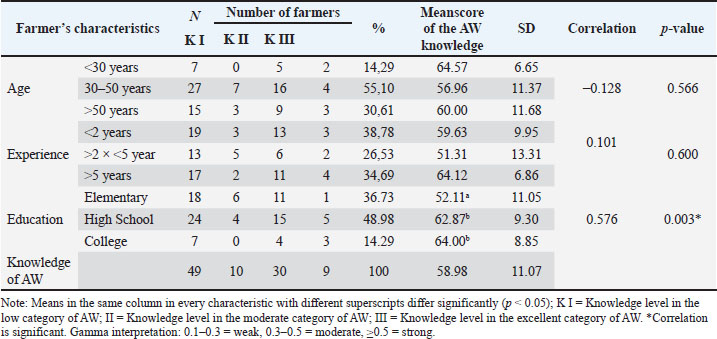
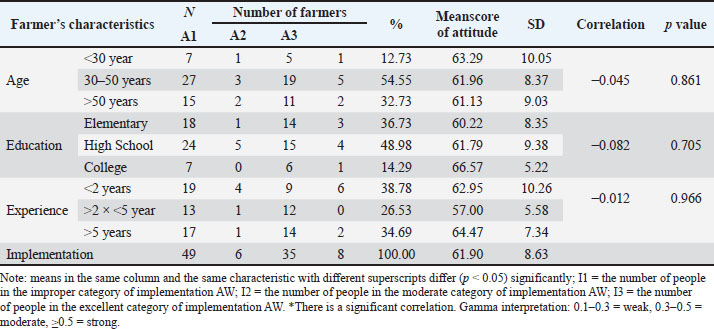
This systematic evaluation framework enabled a comprehensive assessment of farmers’ knowledge, attitudes, and practical implementation of AW principles. Data analysisA statistical analysis was conducted to examine potential differences in mean ratings across the implementation, attitude, and knowledge categories. Given the non-normal data distribution, the non-parametric Kruskal-Wallis test was selected for this purpose. Correlation analysis using the gamma test was performed to explore relationships between variables and the characteristics of KAI. This study investigated which AW attributes were associated with knowledge-correlated categories. Correlation analysis was performed to assess the relationships among knowledge, attitude, and AW implementation. All statistical analyses were conducted using SPSS 26 software, with statistical significance established at p < 0.05. Ethical approvalThe Ethics Committee of the National Research and Innovation Agency of Indonesia has approved this research, with approval number 071/KE.02/SK/04/2023. ResultsThree West Kalimantan regencies, namely, Sambas (34 farmers), Bengkayang (8 farmers), and Sanggau (7 farmers), were selected for the study, involving a total of 49 farmers. Generally, 81.63% of the farmers who handle ducks are men, while the rest are women. All respondents are smallholders with ownership of 10–500 heads of livestock. Duck rearing is primarily semi-intensive at 79.59%, and the cages are often constructed of wood or bamboo. A fence encloses a small pond and the surrounding area at the rear of their home, where ducks can swim and move about. Respondents’ ages ranged from 21 to 83 years, with the majority falling within the 30- to 50-year age category (54.55%) (Table 1). Most farmers have worked for fewer than 5 years. Two farmers have received training to oversee duck farming. Table 1. Correlation between farmers’ characteristics and AW knowledge level.
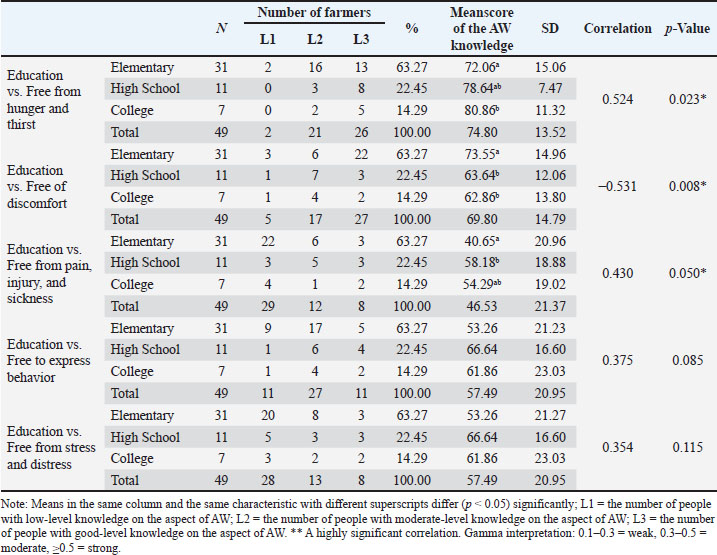
Farmer’s characteristics and AW knowledge levelThe average score for AW knowledge was 58.98 ± 11.07, which is considered moderate (Table 1). Up to 61.22% of farmers are classified as moderate; the remaining farmers have excellent and low levels of 20.40% and 18.37%, respectively. The examination of farmers’ AW knowledge revealed variations in mean scores among the categories of the education variable (Table 1). However, no difference was found in the average score between age and experience-based categories. The majority of farmers have completed high school, with 48.98% having a high school degree or its equivalent. Education and knowledge of AW were substantially connected (p < 0.01). The strength of this correlation was strong (Gamma=0.576, 95% CI: 0.21–0.82), indicating that higher education levels were consistently associated with better knowledge of AW. However, experience in livestock husbandry did not affect knowledge of AW (p > 0.05). Table 2 presents a more detailed examination of the relationship between schooling and the five AW components. Education was associated with three of the five AW characteristics: being free from hunger and thirst (strong relationship of 0.524, significance (p-value < 0.05), being free from discomfort (negative strong relationship of −0.531, significance (p-value < 0.05), and being free from illness and injury (strong relationship of 0.430, significance (p-value < 0.05). Table 2. Correlation between education and 5 aspects of AW knowledge.
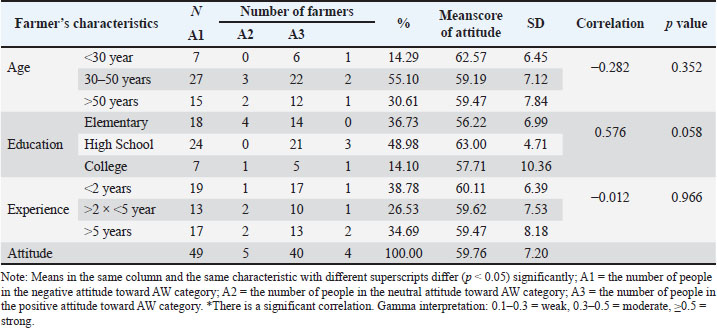
Farmer’s characteristics and attitude toward AWTable 3 shows no relationship between farmers’ opinions regarding AW and attributes. The average attitude score was 59.76 ± 7.20, with high school having the highest mean score (63.00). Farmers’ traits and their opinions about AW did not correlate with each other. Table 3. Correlation between farmers’ characteristics and AW attitudes.
Farmer’s characteristics and AW implementationTable 4 demonstrates that not every farmer used AW’s duck-keeping methods. The farmer’s attitude toward AW is 61.90 ± 8.63 on average. These findings demonstrate that traits and AW implementation are unrelated. Table 4. Correlation between farmers’ characteristics and AW implementation level.
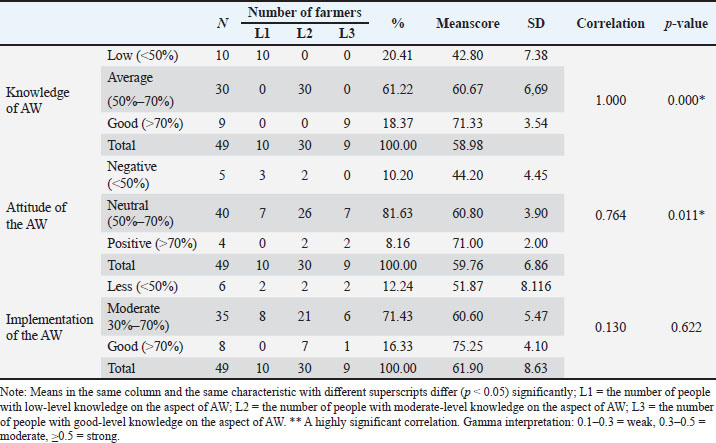
Correlation between knowledge, attitude, and AW implementationTable 5 demonstrates a significant association (r=0.764) between AW’s knowledge and attitude, with a significance level below 0.05. Conversely, no relationship was found between the implementation of AW and the level of knowledge. The correlation between knowledge and attitude was strong (Gamma=0.764, p=0.011), indicating that greater knowledge is associated with more favorable attitudes toward AW. However, the correlation between knowledge and implementation was weak (Gamma=0.130, p=0.622), indicating that awareness alone does not necessarily translate into practice, possibly due to economic or infrastructural constraints. Table 5. Correlation between attitude, implementation, and knowledge level of AW.
DiscussionThe study’s findings indicate that age does not affect the level of KAI of AW. This result is consistent with the results of Randler et al. (2021). In contrast, Carnovale et al. (2021) stated that age affects respondents’ perceptions or attitudes toward AW in China. Likewise, Peden et al. (2019) stated that older pig farmers have a more positive attitude toward AW and are more motivated to resolve pig conflicts than younger farmers. The evaluation of aggression scores was also influenced by age; participants between the ages of 20 and 35 years scored lower than those older. Farmers’ education influenced their knowledge of AW rather than their attitude and implementation of AW. Farmers with college attainment demonstrated a higher capacity to learn new knowledge than those with lower educational backgrounds (Wulandari et al., 2024). This result is in line with a study by Descovich et al. (2019), which found that the AW knowledge assessment scores of participants with elementary school education were lower than those of their peers with higher levels of education. Educational attainment correlated with understanding AW, particularly freedom from pain, injury, and disease. Many farmers lack awareness of the significance of disease prevention and treatment in ducks, instead relying on practical experience that prioritizes profitability over AW considerations. For instance, egg-laying duck farmers believe that allowing ducks to swim during their egg-laying period could disrupt egg production, leading them to conclude that providing swimming facilities is unnecessary. Farmers assume that without additional support, ducks can adapt to their natural environment. This finding highlights the need for targeted training programs to enhance the knowledge and practices of the participants. This version focuses on clarity and emphasizes the importance of training. According to an Ethiopian study (Alemayehu et al., 2022), KAP scores among livestock owners indicated that training was necessary to enhance AW (i.e., housing, management, nutrition, and responsible care) in all livestock-owning communities. Farmers with limited education often struggle to access knowledge and information. In contrast, according to the interview results, farmers with higher education can access knowledge independently by reading books or using social media. Young farmers and farmers with higher formal education were significantly associated with social media use. Kanjina (2021) recommended maximizing social media’s potential for agricultural extension and encouraging more farmers to use it. Meanwhile, relevant agencies are also required to support this effort, including training staff in the use of social media and implementing social media policies. In addition, many farmers need higher levels of knowledge, posing a challenge for the government to effectively convey AW principles and practices. Appropriate education and outreach programs are required to ensure that all farmers, regardless of their educational background, can access accurate and up-to-date AW information. The study’s findings demonstrate that most farmers with a high AW-level knowledge score, who have yet to receive training in optimal breeding practices, learn through self-study. Farmers should be thoroughly educated on the importance of AW (MacKay, 2020). Farmers acquire knowledge in duck rearing from their experiences and established practices or by consulting with more experienced farmers. They also use social media, especially for young farmers. Farmers’ access to training is limited, as the number of participants allowed to attend training sessions is usually restricted. Relevant agencies should develop and execute a more comprehensive and easily accessible AW training program to meet farmers’ needs, increase understanding of FAW, and encourage changes in attitudes and behaviors toward improved FAW practices (Balzani and Hanlon, 2020). Based on these findings, training and extension programs should be developed with farmers at all age levels. These programs should educate farmers on the importance of AW and how it can be implemented in their farming practices. In addition, government policies should be developed to support farmers who adopt and enforce AW. Generally speaking, attitudes indicating a higher level of technical knowledge, compassion for the problem, perceived responsibility, perceived control of the situation, better human–animal relations, or beneficial assessments of the advantages of management decisions tend to influence favorable outcomes. The attitude of farmers is an essential factor in implementing AW. A relationship exists between farmer attitude and production parameters (Kauppinen et al., 2012; Adler et al., 2019). Observations suggest that the increasing trend of duck farming activities necessitates the development of customized support systems for novice and experienced farmers. Education programs, extension, and community outreach initiatives can disseminate essential knowledge and practices (Kaur and Kaur, 2018), empower farmers to improve their AW skills, promote AW, and increase agricultural productivity. Despite the prevalence of micro-scale duck farming in West Kalimantan, the overall duck population in the region still needs to be higher than that of other areas in Indonesia. This presents an excellent opportunity to establish and expand duck farming enterprises in West Kalimantan. The region has sufficient resources and favorable conditions for duck production, making it a promising area for developing the agricultural sector. The attitude of farmers toward AW affects the condition of the animals kept (Hansson and Lagerkvist, 2014). This finding reveals a strong correlation between farmers’ knowledge level about AW (FAW) and their attitude toward AW. This outcome is consistent with the findings of Alemayehu et al., 2022, who reported a significant correlation (p < 0.01) between farmers’ knowledge and attitude toward AW and its practice. Previous studies have shown that farmers’ personalities and attitudes lead to livestock being closer or friendlier to the farmer. The significant variation in farmers’ approaches to improving FAW could be attributed to varying motivational orientations (Balzani and Hanlon, 2020). According to research conducted in China, farmers’ attitudes toward AW in the farming system are still low. Likewise, poultry farmers in Turkey need a better understanding of AW. Cultural, moral, and social norms and beliefs influence farmers’ views on AW and promote more beneficial ones (Bozkurt et al., 2017). If sound AW practices are not implemented in livestock systems, livestock will suffer and production will decrease. Decreased production can impact food security, a key strategic focus of the World Health Organization (Sinclair et al., 2019b). ConclusionThe moderate levels of knowledge and implementation, along with the identified gaps, highlight the need for enhanced education and training in good farming practices to improve duck farming welfare across West Kalimantan. Strengthening farmer awareness and understanding is essential for ensuring alignment with AW standards. AcknowledgmentsThe authors would like to thank the National Research and Innovation Agency. Conflict of interestThe authors declare no conflict of interest. FundingThis study is part of a research project funded by the Research Organization for Health, the National Research and Innovation Agency of Indonesia. Author’s contributionsSW and EM: Conceived, designed, and coordinated the study. SMN and SSP: designed data collection tools, supervised field sample and data collection, and performed laboratory work and data entry. HN and ARK: Validation, supervision, and formal analysis of data. IMM and PMW: contributed analysis tools. LP, DW, and BB: performed statistical analysis and interpretation and participated in the preparation of the manuscript. All authors have read, reviewed, and approved the final version of the manuscript. Data availabilityAll data are available in the revised manuscript. ReferencesAbdel-Hamid, S.E., Saleem, A.Y., Youssef, M.I., Mohammed, M.H. and Abdelaty, A.I. 2020. Influence of housing systems on duck behaviour and welfare. J. Adv. Vet. Anim. Res. 7(3), 407–413. Adler, F., Christley, R. and Campe, A. 2019. Invited review: examining farmers’ personalities and attitudes as possible risk factors for dairy cattle health, welfare, productivity, and farm management: A systematic scoping review. J. Dairy Sci. 102(5), 3805–3824. Alemayehu, G., Berhe, T., Gelan, E., Mokria, M., Jaldessa, J., Molu, J., Wieland, B., Knight-Jones, T. and Doyle, R.E. 2022. Animal welfare knowledge, attitudes, and practices among livestock holders in Ethiopia. Front. Vet. Sci. 9(1), 1006505. AVMA (American Veterinary Medical Association). 2023. Animal welfare: What is it?. Available via https://www.avma.org/resources/animal-health-welfare/animal-welfare-what-it Balzani, A. and Hanlon, A. 2020. Factors that Influence Farmers’ Views on Farm Animal Welfare: a Semi-Systematic Review and Thematic Analysis. Animals 10(9), 1524. Bozkurt, Z., Koçak, S., Kılıç, I., Çelikeloğlu, K., Hacan., Lenger. and Tekerli, M. 2017. Attitudes of Staff Regarding Animal Welfare: a Illustration From Layer Farms in Afyonkarahisar. Kocatepe Vet. J. 10(4), 308–316. Carnovale, F., Jin, X., Arney, D., Descovich, K., Guo, W., Shi, B. and Phillips, C.J.C. 2021. Chinese Public Attitudes towards, and Knowledge of, Animal Welfare. Animals 11(3), 855. Clark, B., Stewart, G.B., Panzone, L.A., Kyriazakis, I. and Frewer, L.J. 2016. A systematic review of public attitudes, perceptions and behaviors towards production diseases associated with farm animal welfare. J. Agric. Environ. Ethics 29(3), 455–478. CSA (Central Statistics Agency). 2020. Livestock Development Statistics (Livestock Statistics). Central Statistics Agency (Statistics Indonesia). https://www.bps.go.id/id De La Fuente, M.F.C., Souto, A., Caselli, C.B. and Schiel, N.N. 2017. People’s perception of animal welfare: why does it matter?. Ethnobiol. Conserv. 6(1), 18. Descovich, K., Li, X., Sinclair, M., Wang, Y. and Phillips, C.J.C. 2019. The Effect of Animal Welfare Training on the Knowledge and Attitudes of Abattoir Stakeholders in China. Animals 9(11), 989. Doyle, R.E., Wieland, B., Saville, K., Grace, D. and Campbell, A.J.D. 2021. The importance of animal welfare and veterinary services in a changing world. Sci. Tech. Rev. 40(2), 469–481. Fernandes, J.N., Hemsworth, P.H., Coleman, G.J. and Tilbrook, A.J. 2021. Costs and Benefits of Improving Farm Animal Welfare. Agriculture 11(2), 104. Franks, B., Ewell, C. and Jacquet, J. 2021. Animal welfare risks of global aquaculture. Sci. Adv. 7(14), 677. Hansson, H. and Lagerkvist, C. 2014. Defining and measuring farmers’ attitudes to farm animal welfare. Anim. Welf. 23(1), 47–56. Hartcher, K., Nuggehalli, J., Yang, Q., De Luna, M.C.T., Agus, A., Ito, S., Idrus, Z., Rahayu, I.H.S., Jattuchai, J., Descovich, K., Lane, E. and Sinclair, M. 2023. Improving hen welfare on cage-free egg farms in Asia: egg producers’ perspectives. Anim. Welf. 32(1), 64. Hemsworth, P.H., Mellor, D.J., Cronin, G.M. and Tilbrook, A.J. 2015. Scientific assessment of animal welfare. N. Z. Vet. J. 63(1), 24–30. Kanjina, S. 2021. Farmers’ use of social media and its implications for agricultural extension: evidence from Thailand. Asian J. Agric. Rural Dev. 11(4), 302–310. Kauppinen, T., Vesala, K.M. and Valros, A. 2012. Farmer attitude toward improving animal welfare is correlated with piglet production parameters. Livest. Sci. 143(2–3), 142–150. Kaur, K. and Kaur, P. 2018. Agricultural Extension Approaches to Enhance Farmers’ Knowledge. Int. J. Curr. Microbiol. App. Sci. 7(2), 2367–2376. Kumah, E.A., Bettany-Saltiko, J., Schaik, P.V., McSherry, R. and Boadu, P. 2023. Development and validation of a questionnaire to assess evidence-based practice and evidence-informed practice knowledge, attitudes, understanding, and behaviour. Teach. Learn. Nurs. 18(4), e220–e228. Li, X., Chen, D., Li, J. and Bao, J. 2016. Effects of Furnished Cage Type on Behavior and Welfare of Laying Hens. Asian-Australas. J. Anim. Sci. 29(6), 887–894. Mackay, J.R.D. 2020. Discipline-based education research for animal welfare science. Front. Vet. Sci. 7(1), 7. Mellor, D. 2016. Moving beyond the “Five Freedoms” by updating the “Five Provisions” and introducing aligned “Animal Welfare Aims”. Animals 6(10), 59. Paul, E.S. and Mendl, M.T. 2018. Animal emotion: descriptive and prescriptive definitions and their implications for a comparative perspective. Appl. Anim. Behaviour. Sci. 205(1), 202–209. Peden, R.S.E., Camerlink, I., Boyle, L.A., Akaichi, F. and Turner, S.P. 2019. Farmer Perceptions of Pig Aggression Compared to Animal-Based Measures of Fight Outcome. Animals 9(1), 22. Pulina, G., Carta, S., Pulino, D., Spanu, S., Deriu, R. and Mazzette, A. 2022. Farm animal welfare: a survey of the opinion of farmers and consumers in Sardinia. Anim. - Open Space 1(1), 100020. Randler, C., Adan, A., Antofie, M.M., Arrona-Palacios, A., Candido, M., Boeve-de Pauw, J., Chandrakar, P., Demirhan, E., Detsis, V., Di Milia, L., Fančovičová, J., Gericke, N., Haldar, P., Heidari, Z., Jankowski, K.S., Lehto, J.E., Lundell-Creagh, R., Medina-Jerez, W., Meule, A., Milfont, T.L., Orgilés, M., Morales, A., Natale, V., Ortiz-Jiménez, X., Pande, B., Partonen, T., Pati, A.K., Prokop, P., Rahafar, A., Scheuch, M., Sahu, S., Tomažič, I., Tonetti, L., Medina, P.V., van Petegem, P., Vargas, A. and Vollmer, C. 2021. Animal welfare attitudes: effects of gender and diet in University samples from 22 Countries. Animals 11(7), 1893. Rault, J.L., Waiblinger, S., Boivin, X. and Hemsworth, P. 2020. The Power of a Positive Human-Animal Relationship for Animal Welfare. Front. Vet. Sci. 7(1), 590867. Sinclair, M., Fryer, C. and Phillips, C.J.C. 2019a. The Benefits of Improving Animal Welfare from the Perspective of Livestock Stakeholders across Asia. Animals 9(4), 123. Sinclair, M., Yan, W. and Phillips, C.J.C. 2019b. Attitudes of Pig and Poultry Industry Stakeholders in Guandong Province, China, to Animal Welfare and Farming Systems. Animals (Basel). 9(11), 860. Spooner, J.M., Schuppli, C.A. and Fraser, D. 2014. Attitudes of Canadian citizens toward farm animal welfare: a qualitative study. Livest. Sci. 163(1), 150–158. Tiruneh, G.A., Erega, B.B., T/Mariam, A.B., Abebe, E.C., Ayele, T.M., Baye, N.D., Tilahun, Z., Taye, A. and Kassa, B.G. 2023. Level of knowledge, attitude, and practice on modern contraceptive method and its associated factors among housemaids living in Debre Tabor town, northwest Ethiopia: a community-based cross-sectional study. BMC. Womens. Health 23(1), 632. Villettaz Robichaud, M., Rushen, J., De Passillé, A.M., Vasseur, E., Orsel, K. and Pellerin, D. 2019. Associations between on-farm animal welfare indicators and productivity and profitability on Canadian dairies: i. On freestall farms. J. Dairy Sci. 102(5), 4341–4351. Wulandari, C.R., Burhanuddin, A., Faradina, P.L., Wibawati, P.A. and Abdramanov, A. 2024. Understanding the level of animal welfare and associated factors among cat owners in Banyuwangi, Indonesia. Vet. World 17(6), 1210–1215. | ||
| How to Cite this Article |
| Pubmed Style Wahyuwardani S, Munir IM, Martindah E, Noor SM, Widiyanti PM, Prihandani SS, Nuradji H, Khairullah AR, Bakrie B, Praharani L, Widyasari D. Knowledge, attitude, and implementation of animal welfare among duck farmers in West Kalimantan, Indonesia: The role of farmers’ characteristics. Open Vet. J.. 2025; 15(10): 4865-4872. doi:10.5455/OVJ.2025.v15.i10.6 Web Style Wahyuwardani S, Munir IM, Martindah E, Noor SM, Widiyanti PM, Prihandani SS, Nuradji H, Khairullah AR, Bakrie B, Praharani L, Widyasari D. Knowledge, attitude, and implementation of animal welfare among duck farmers in West Kalimantan, Indonesia: The role of farmers’ characteristics. https://www.openveterinaryjournal.com/?mno=272752 [Access: June 26, 2026]. doi:10.5455/OVJ.2025.v15.i10.6 AMA (American Medical Association) Style Wahyuwardani S, Munir IM, Martindah E, Noor SM, Widiyanti PM, Prihandani SS, Nuradji H, Khairullah AR, Bakrie B, Praharani L, Widyasari D. Knowledge, attitude, and implementation of animal welfare among duck farmers in West Kalimantan, Indonesia: The role of farmers’ characteristics. Open Vet. J.. 2025; 15(10): 4865-4872. doi:10.5455/OVJ.2025.v15.i10.6 Vancouver/ICMJE Style Wahyuwardani S, Munir IM, Martindah E, Noor SM, Widiyanti PM, Prihandani SS, Nuradji H, Khairullah AR, Bakrie B, Praharani L, Widyasari D. Knowledge, attitude, and implementation of animal welfare among duck farmers in West Kalimantan, Indonesia: The role of farmers’ characteristics. Open Vet. J.. (2025), [cited June 26, 2026]; 15(10): 4865-4872. doi:10.5455/OVJ.2025.v15.i10.6 Harvard Style Wahyuwardani, S., Munir, . I. M., Martindah, . E., Noor, . S. M., Widiyanti, . P. M., Prihandani, . S. S., Nuradji, . H., Khairullah, . A. R., Bakrie, . B., Praharani, . L. & Widyasari, . D. (2025) Knowledge, attitude, and implementation of animal welfare among duck farmers in West Kalimantan, Indonesia: The role of farmers’ characteristics. Open Vet. J., 15 (10), 4865-4872. doi:10.5455/OVJ.2025.v15.i10.6 Turabian Style Wahyuwardani, Sutiastuti, Ivan Mambaul Munir, Eny Martindah, Susan Maphilindawati Noor, Prima Mei Widiyanti, Sri Suryatmiati Prihandani, Harimurti Nuradji, Aswin Rafif Khairullah, Bachtar Bakrie, Lisa Praharani, and Difa Widyasari. 2025. Knowledge, attitude, and implementation of animal welfare among duck farmers in West Kalimantan, Indonesia: The role of farmers’ characteristics. Open Veterinary Journal, 15 (10), 4865-4872. doi:10.5455/OVJ.2025.v15.i10.6 Chicago Style Wahyuwardani, Sutiastuti, Ivan Mambaul Munir, Eny Martindah, Susan Maphilindawati Noor, Prima Mei Widiyanti, Sri Suryatmiati Prihandani, Harimurti Nuradji, Aswin Rafif Khairullah, Bachtar Bakrie, Lisa Praharani, and Difa Widyasari. "Knowledge, attitude, and implementation of animal welfare among duck farmers in West Kalimantan, Indonesia: The role of farmers’ characteristics." Open Veterinary Journal 15 (2025), 4865-4872. doi:10.5455/OVJ.2025.v15.i10.6 MLA (The Modern Language Association) Style Wahyuwardani, Sutiastuti, Ivan Mambaul Munir, Eny Martindah, Susan Maphilindawati Noor, Prima Mei Widiyanti, Sri Suryatmiati Prihandani, Harimurti Nuradji, Aswin Rafif Khairullah, Bachtar Bakrie, Lisa Praharani, and Difa Widyasari. "Knowledge, attitude, and implementation of animal welfare among duck farmers in West Kalimantan, Indonesia: The role of farmers’ characteristics." Open Veterinary Journal 15.10 (2025), 4865-4872. Print. doi:10.5455/OVJ.2025.v15.i10.6 APA (American Psychological Association) Style Wahyuwardani, S., Munir, . I. M., Martindah, . E., Noor, . S. M., Widiyanti, . P. M., Prihandani, . S. S., Nuradji, . H., Khairullah, . A. R., Bakrie, . B., Praharani, . L. & Widyasari, . D. (2025) Knowledge, attitude, and implementation of animal welfare among duck farmers in West Kalimantan, Indonesia: The role of farmers’ characteristics. Open Veterinary Journal, 15 (10), 4865-4872. doi:10.5455/OVJ.2025.v15.i10.6 |


