





| Research Article | ||
Open Vet. J.. 2026; 16(1): 126-135 Open Veterinary Journal, (2026), Vol. 16(1): 126-135 Review Article Effects of Farmer Socio-Demographics on Animal Welfare Knowledge and Practices in Peri-Urban Duck Production SystemsSutiastuti Wahyuwardani1, Siti Sehat Tan2, Bachtar Bakrie3, Aswin Rafif Khairullah1, Eni Siti Rohaeni3*, Dwi Priyanto4, Lisa Praharani3, Etti Diana2, Herlina Tarigan2, Sri Suryatmiati Prihandani1, Tri Bastuti Purwantini2 and Roosganda Elizabeth51Research Center for Veterinary Science, National Research and Innovation Agency (BRIN), Bogor, Indonesia 2Research Center for Animal Husbandry, National Research and Innovation Agency (BRIN), Bogor, Indonesia 3Research Center for Behavioral and Circular Economics, National Research and Innovation Agency (BRIN), Kuningan, Indonesia 4Research Center for Social Welfare, Villages and Connectivity, National Research and Innovation Agency (BRIN), Kuningan, Indonesia 5Research Center for Cooperatives, Corporations, and the People’s Economy, National Research and Innovation Agency (BRIN), Kuningan, Indonesia *Corresponding Author: Eni Siti Rohaeni. Research Center for Animal Husbandry, National Research and Innovation Agency (BRIN), Bogor, Indonesia. Email: eni_najib [at] yahoo.co.id Submitted: 09/10/2025 Revised: 15/12/2025 Accepted: 27/12/2025 Published: 31/01/2026 © 2025 Open Veterinary Journal
AbstractBackground: Animal welfare (AW) is an important issue in sustainable livestock production. However, many small farmers in developing countries still do not understand and widely apply AW. Aim: This study aims to investigate the impact of farm and farmer characteristics, including age, education, farming experience, and flock size, on AW knowledge (AWK) and practices among duck farmers in Bekasi, Indonesia. Methods: A cross-sectional survey was conducted on 29 duck farmers using a structured questionnaire that assessed farm and farmer characteristics, AWK, and AWP in accordance with the Five Freedoms of AW. Binary logistic regression was used to analyze the data and identify factors influencing AWK, and AWP. Receiver operating characteristic (ROC) curve analysis was used to evaluate the discriminatory performance of significant predictors. Results: Among the 29 peri-urban duck farmers, 72.4% demonstrated high AWK, whereas only 20.7% demonstrated high welfare practices. Logistic regression identified education as a significant predictor of welfare knowledge and farming experience as a significant predictor of welfare practices. ROC analysis indicated that farming experience had fair discriminative ability for high welfare practices (area under the curve=0.786). Despite the small sample size, the findings reflect the characteristics of the small duck-farming population in peri-urban Bekasi. Conclusion: AWK did not vary across farmer characteristics, whereas education and experience influenced AWP. These findings highlight the importance of training and extension programs to improve AW in peri-urban duck farming. Keywords: Cross-sectional survey, Farmer characteristics, Five freedoms, Management practices, Duck Smallholder farmers. IntroductionAnimal welfare (AW) has become a significant global concern in livestock production and is recognized as a foundation for sustainable development, food security, and public health (Bozzo et al., 2021; Hendriks et al., 2025). AW principles also align with the One Health framework, which emphasizes the interdependence of human, animal, and environmental health. Integrating AW into livestock systems contributes to healthier and more resilient animals, reduces stress-related diseases, and lowers the risk of zoonotic transmission, thereby supporting safer food production and more sustainable farming environments (Racciatti et al., 2023). In duck production, welfare improvements enhance productivity, product quality, and overall farm sustainability. Appropriate stocking density and housing conditions are key factors that significantly affect growth performance, carcass quality, and health outcomes (El Sabry and Almasri, 2023). Access to water is also crucial, as systems such as misting support natural behaviors and improve resilience to heat stress. Inadequate water management can lead to increased contamination and mortality, underscoring the importance of robust biosecurity practices (Babington and Campbell, 2022; Campbell et al., 2022). In Indonesia, water quality, including salinity, has been shown to influence the egg characteristics of Alabio ducks (Sulaiman et al., 2022). Evidence from Egypt demonstrates that higher biosecurity levels reduce mixed infections in small-scale duck farms, highlighting the importance of farmer training and effective management (Adel et al., 2023). The Five Freedoms framework provides a comprehensive basis for evaluating AW in duck production, emphasizing adequate nutrition, proper housing, disease prevention, natural behavior expression, and freedom from distress (Mellor, 2016; Campbell et al., 2022; EFSA et al., 2023; Nadhira et al., 2024). However, its application in developing regions remains uneven due to infrastructural, financial, and knowledge-related constraints (Alemayehu et al., 2022; Parlasca et al., 2023). Smallholder duck farmers in Indonesia and other low- and middle-income countries face barriers such as high feed costs, limited capital, weak extension support, and inconsistent policy enforcement (Imam Santoso et al., 2023; Azharuddin et al., 2024; Dyanty et al., 2025). These challenges affect farmers’ ability to adopt recommended welfare practices, which are further shaped by cultural norms, institutional support, and resource availability (Alemayehu et al., 2022; Churchil and Jalaludeen, 2022). Although ducks play an important socioeconomic role in Southeast Asia, they remain underrepresented in welfare research compared with broiler and dairy systems (Hernandez et al., 2022; Hötzel et al., 2025). Farmer characteristics, such as education, experience, age, and flock size, are known to influence welfare-related management and decision-making (Hu et al., 2024), although empirical evidence remains mixed across contexts (Alemayehu et al., 2022; Parlasca et al., 2023). Peri-urban Bekasi represents a relevant setting to explore these dynamics, as rapid urbanization, land-use competition, and industrial growth create distinctive production challenges while simultaneously offering improved access to markets and veterinary services (Mponji et al., 2024; Dyanty et al., 2025; Lei et al., 2025). Land conversion for industrial, residential, and commercial use limits duck farming space, often forcing farmers to operate in constrained areas (Yu et al., 2023). Proximity to households and industrial zones increases biosecurity risks, while socioeconomic shifts, such as higher labor costs and reliance on purchased feed, affect farmers’ ability to apply good welfare and biosecurity practices (Pawlak and Kołodziejczak, 2020). In this area, duck farms generally operate on a small scale because land availability is limited and flocks are often kept in narrow plots around households (Nielsen et al., 2025). Despite the strategic importance of peri-urban duck farming, research on AWK, and AWP in these systems is scarce. Given the increasing urban demand and the potential implications of welfare lapses for public health and consumer confidence, addressing this gap is essential. Accordingly, this study uses the Five Freedoms as the conceptual foundation to examine how farmer characteristics shape AWK and practices in peri-urban duck farming in Bekasi. Materials and MethodsStudy areaThe study was conducted in Bekasi Regency, a peri-urban area adjacent to Jakarta, West Java Province, Indonesia. Bekasi represents a unique farming context in which agricultural practices coexist with rapid urbanization, industrial growth, and rising consumer demand for food safety and welfare standards. Peri-urban livestock farming faces specific challenges, including land competition, biosecurity risks, and socio-economic transitions (Mponji et al., 2024; Dyanty et al., 2025). Land conversion for industrial, residential, and commercial use limits duck farming space, often forcing farmers to operate in constrained areas. Proximity to households and industrial zones increases biosecurity risks, while socioeconomic shifts, such as higher labor costs and reliance on purchased feed, affect farmers’ ability to implement good welfare and biosecurity practices. Therefore, the selection of Bekasi was strategic to capture the dynamics of duck farming under strong urban influence. The small scale of duck farms in the study area is due to limited land availability in peri-urban Bekasi. Study design and respondentsA cross-sectional survey design was employed, consistent with previous studies assessing farmer knowledge, attitudes, and practices in livestock systems (Alemayehu et al., 2022). A total of 29 duck farmers were purposively selected based on their active engagement in duck production, flock size of at least 50 birds, and a minimum of 1 year of farming experience. Initially, 32 farmers were visited; however, three were excluded due to incomplete data, leaving 29 respondents for the final analysis. This limitation was attributable to limited farmer availability during the scarcity period in which the study was conducted. Despite the modest sample size, this range has been considered sufficient to provide exploratory insights in socio-economic and welfare-related studies on livestock (Mergenthaler et al., 2025). Data collectionPrimary data were collected using a structured questionnaire administered via face-to-face interviews. The questionnaire consisted of three main parts: (1) Sociodemographic characteristics (age, education level, farming experience, and flock size); (2) AWK, covering housing, feeding, health management, handling, and behavioral needs; and (3) AWP, including cleanliness, feeding and water hygiene, handling of sick or injured ducks, and participation in training. AWK, covering five indicators (housing, feeding, health, and handling) (Alemayehu et al., 2022). AWP included key daily management activities such as maintaining barn cleanliness, ensuring feed and water hygiene, and properly handling sick or vulnerable animals. These fundamental practices are widely recognized as essential components of smallholder AW (Lemma et al., 2022). Responses were scored and dichotomized into low and high levels using cut-off points established in similar studies (Sayili et al., 2024; Ahmed et al., 2025). Data analysisData were analyzed using SPSS version 26.0 (IBM Corp., Armonk, NY, USA). Descriptive statistics were used to summarize the characteristics of the farmers. Binary logistic regression was used to determine the influence of farmer characteristics on AWK, and AWP (Hu et al., 2024; Dyanty et al., 2025). The results are presented as regression coefficients (B), standard errors (SE), Wald statistics, degrees of freedom d), p-values, and odds ratios (OR) with 95% confidence intervals. Farmer age, education level, farming experience, and flock size were included as independent variables based on theoretical relevance and previous empirical studies (Hu et al., 2024; Dyanty et al., 2025). Before constructing the logistic model, correlations among predictor variables were examined. Pearson correlation coefficients were all below r=0.70, and variance inflation factor values were below 2.0, indicating no multicollinearity concerns. Although education and farming experience both relate to learning, they capture different constructs: education reflects formal or informal instructional attainment, while experience represents practical skills accumulated over time. The modest correlation between these variables supported their inclusion in the analysis as separate predictors. The logistic regression model followed the following general form: 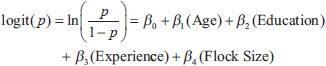
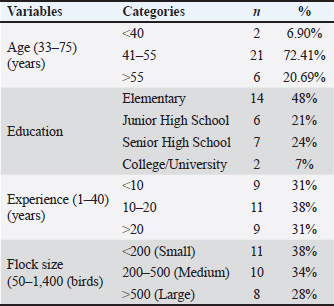
where p represents the probability of a farmer exhibiting a high level of AWK or AWP. Regression coefficients (β) describe the direction and strength of associations, whereas odds ratios (OR=e^β) indicate the change in likelihood associated with a one-unit increase in each predictor. To evaluate the discriminatory performance of significant predictors, the receiver operating characteristic (ROC) curve analysis was conducted. The AUC was interpreted using conventional thresholds: <0.6=poor, 0.6–0.7=fair, 0.7–0.8=moderate, and >0.8=good discrimination (Çorbacıoğlu and Aksel, 2023). A significance level of p < 0.05 was applied throughout the study. Ethical approvalThis study was reviewed and approved by the Humanities Research Ethics Committee, the Ethics Committee on Social Studies and Humanities, and the National Research and Innovation Agency on July 4, 2023, with approval number 450/KE.01/SK/07/2023. All procedures complied with the principles of the Declaration of Helsinki and the COPE guidelines for human participants. Participation was voluntary, and informed consent was obtained before data collection. The respondents were assured of anonymity and confidentiality, and the data were used solely for research. ResultsCharacteristics of the duck farmersThe characteristics of duck farmers in Bekasi (Table 1) revealed that most were in the productive age group of 41–55 years (72.41%), with a predominance of low educational attainment, as nearly half (48%) had only completed elementary school, and only 7% had college or university education. Farming experience was relatively balanced, with the largest proportion having 10–20 years of experience (38%), while flock sizes varied, though small to medium operations (<200–500 birds) were more common (72%) compared to large flocks (>500 birds, 28%). Table 1. Characteristics of Bekasi duck farmers (n=29).
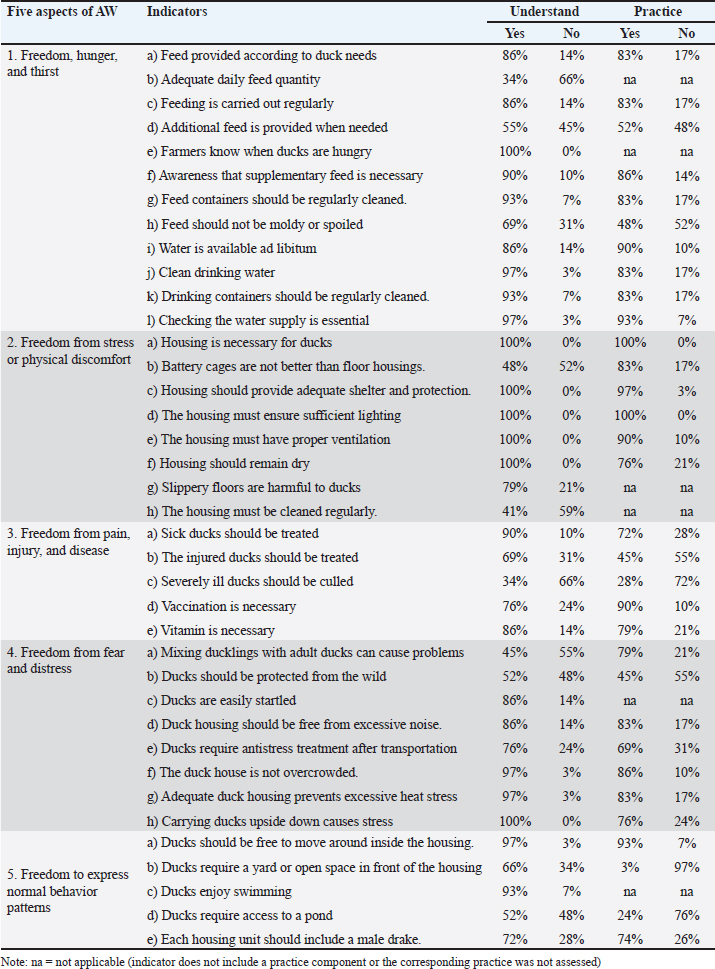
Knowledge and practices of farmers on AWTable 2 presents the assessment of farmers’ knowledge and practices related to AW based on the five freedoms. Farmers’ AWK is generally high across most indicators, especially those related to feed and water provision (86%–100%) and housing conditions such as ventilation and cleanliness (≥90%). However, AW implementation is generally inconsistent. For example, only 48% of farmers routinely clean feed containers, and 52% ensure adequate daily feed quantities. Knowledge about stress management and behavioral needs is also uneven, with lower levels of awareness about the importance of providing yards (66%), pools (52%), or avoiding overcrowding (97% knowledge but only 86% practice). Table 2. Assessing farmers’ AWK, and AWP across five aspects.
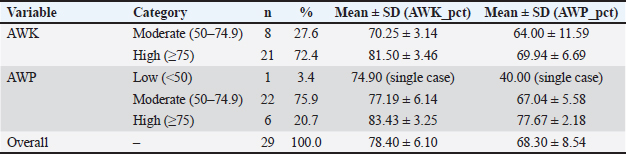
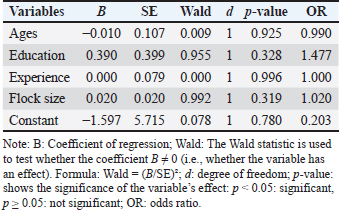
Results on AWKLogistic regression analysis showed that farmer characteristics did not significantly influence the level of AWK. Variables such as age (p=0.225), education (p=0.978), experience (p=0.318), and flock size (p=0.786) were all non-significant, indicating that duck farmers’ AWK was relatively similar regardless of demographic or farm-scale differences (Table 3). Table 3. Distribution and mean scores of AWK, and AWP levels among duck farmers (n=29).
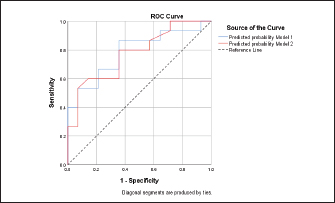
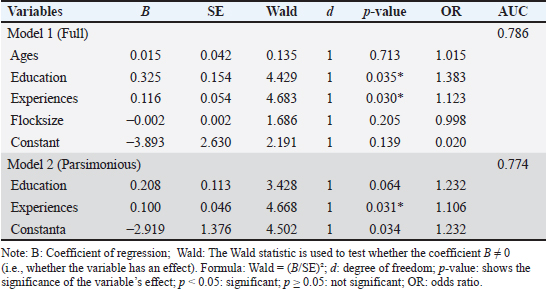
Results on AWP and model performance, and predictive validityLogistic regression analysis revealed that among the characteristics of the farmers, education and farming experience were significant predictors of AWP (Table 4). Farmers with higher education levels were more likely to adopt recommended practices (B=0.325, OR=1.383, p=0.035), indicating that each additional education level increased the odds of implementing welfare measures by 34%. Similarly, farming experience had a positive effect (B=0.116, OR=1.123, p=0.030), indicating that a longer farming involvement increased the likelihood of applying AWP by approximately 11%. In contrast, age (p=0.713, OR=1.015) and flock size (p=0.194, OR=0.998) were not significantly different between the two groups. The model’s performance, assessed using the ROC curve (Fig. 1), yielded an area under the curve (AUC) of 0.786 (Table 5), indicating acceptable discrimination. This indicates that the model correctly distinguished farmers who implemented AWP from those who did not in approximately 78.6% of cases.
Fig. 1. ROC curves comparing the full and parsimonious logistic regression models Table 4. Logistic regression of farmer characteristics on AWK level.
Table 5. Logistic regression of farmer characteristics on AWP level
DiscussionInfluence of education on AWPThis study found that education significantly influences the adoption of AWP. Farmers with higher levels of education were more likely to implement proper welfare standards, aligning with findings that education improves livestock management awareness, critical thinking, and decision-making (Balzani and Hanlon, 2020). The results are consistent with those of Sadiq et al. (2021), who identified education as a key determinant of farmers’ understanding of welfare principles. Another study stated that comprehension of AW principles does not inherently ensure their practical implementation, as such application is influenced by researchers’ educational backgrounds and professional positions (Wahyuwardani et al., 2025a). These findings underscore the importance of targeted educational interventions, as knowledge alone may not guarantee practice, but structured learning opportunities can narrow the gap between knowledge and practice. The role of farming experience in shaping welfare practicesFarming experience also emerged as a significant predictor, indicating that longer involvement in animal husbandry increases the likelihood of welfare practices being applied. Experienced farmers tend to recognize the early signs of animal discomfort and adopt preventive measures (Papakonstantinou et al., 2024). Experience also builds confidence in decision-making, which correlates with higher compliance with recommended management standards (Delpont et al., 2021). Therefore, peer-to-peer mentoring and participatory approaches that use experienced farmers as role models can effectively improve AW at the community level (Prajapati et al., 2025). Non-significant effects of age and flock sizeNeither age nor flock size were significant predictors of AWP. This finding is consistent with previous studies, which have shown that the effect of age is context-dependent and often mediated by education or access to extension services (Calix et al., 2025). Wahyuwardani et al. (2025b) showed that age and experience showed no consistent effects, and although higher knowledge correlated with better attitudes, it did not consistently translate into the practical implementation of AW. Similarly, flock size did not influence welfare adoption, supporting the argument that management quality and resource allocation, rather than herd size, determine welfare outcomes (Makagon and Riber, 2022). Model performance and predictive validityThe logistic regression analysis showed acceptable predictive validity, with an AUC value of 0.786 for the full model. An AUC between 0.7 and 0.9 indicates good discrimination (Zhang et al., 2024a), indicating that the model correctly distinguished farmers who applied welfare practices in approximately 79% of cases. This confirms that the identified predictors are not only statistically significant but also practically relevant. Similar veterinary studies have employed ROC analysis to evaluate model accuracy (Abo Elfadl et al., 2022). Two logistic regression approaches were compared: the full model (Model 1), which included all predictors, and a parsimonious model (Model 2) with fewer variables. Figure 1 shows that both models demonstrated comparable discrimination, with overlapping ROC curves and similar AUC values (0.786 vs. 0.774). This indicates that model simplification did not compromise the accuracy of the prediction. Farming experience remained a consistent and significant predictor across both models, whereas education was significant only in the full model. This indicates that experience is a more robust determinant, whereas the effect of education may depend on model specification. Practical implications for training and policy developmentThese findings have practical implications for policy and extension services. Education and training programs should be prioritized to enhance farmers’ awareness and practices. Experience-based mentoring can be integrated into farmer field schools, where experienced farmers can act as role models. Incorporating welfare standards into certification and cooperative schemes could incentivize adoption while promoting sustainability. Grotsch et al. (2025) emphasized that accessible, low-cost training and mentoring programs can effectively strengthen farmers’ understanding and commitment to AW. Socio-demographic contextThe results show that socio-demographic characteristics such as education, age, experience, and flock size do not consistently predict knowledge about AW among duck farmers. This indicates that informal and experiential learning shape how farmers acquire knowledge about AW more than formal education or demographic traits. According to Balzani and Hanlon (2020), rather than through structured schooling, farmers often gain an understanding of welfare concepts through daily husbandry practices and informal peer interactions. Similarly, Michaelis et al. (2022) reported that advisory and extension services, as well as farmer networks, play a crucial role in transferring knowledge about AW and influencing behavioral change among livestock keepers. Determinants of welfare practiceThe determinants of welfare practice among duck farmers in peri-urban Bekasi varied according to the model specification. In the full model, both education (p=0.035) and farming experience (p=0.030) were significant predictors, consistent with evidence that education enhances awareness, decision-making, and record-keeping (Hu et al., 2024), while experience contributes tacit knowledge and practical judgment. In the parsimonious model, only farming experience remained significant (p=0.031), whereas education no longer remained significant (p=0.064). This finding highlights the stronger and more stable contribution of experience compared with that of education. Although previous studies have found that farm size is associated with welfare adoption, neither age nor flock size was significant (Lindena and Hess, 2022; Hötzel et al., 2025). These results underscore the influence of methodological choices on the identification of predictors and reinforce the importance of standardized welfare assessment tools to ensure comparability and reliability across studies. Broader implications and the context of one healthEducation and experience were the strongest predictors of welfare practice, emphasizing the need for capacity-building through extension services, farmer field schools, and participatory training (Pousga et al., 2022). The Bekasi peri-urban context presents both challenges and opportunities. Although urban proximity increases the pressure for better welfare, it also improves access to veterinary services and markets (Mponji et al., 2024). By integrating welfare standards into local livestock development programs and certification systems, policy interventions can leverage these conditions (Goswami et al., 2024). Relevance of national and one healthIn the Indonesian context, these findings are highly relevant to the Ministry of Agriculture’s strategy for improving livestock health and welfare under the Kesmavet and One Health frameworks. Strengthening AWP aligns with national efforts to prevent zoonotic diseases and enhance sustainable livestock production. Integrating welfare standards into farmer training, cooperative certification, and veterinary extension aligns with SDGs 2, 3, 12, and 15, ensuring that AW contributes to food safety, environmental health, and rural livelihoods. Thus, empowering smallholders through education and mentoring could play a pivotal role in promoting sustainable, resilient, and welfare-conscious farming systems in peri-urban Indonesia. AW intersects with sustainability, biosecurity, and public health. Poor welfare compromises productivity and increases the risk of disease and food safety (Baratta et al., 2021; Zhang et al., 2024b). In peri-urban settings, such as Bekasi, dense animal–human interactions increase zoonotic risks. Ducks can act as asymptomatic carriers of avian influenza viruses (e.g., H5N1) and harbor Salmonella or Campylobacter spp. (Puryear and Runstadler, 2024; Simancas-Racines et al., 2025). Welfare deficiencies, such as overcrowding, poor nutrition, and a lack of veterinary care, increase stress and disease susceptibility, facilitating pathogen shedding (Uddin et al., 2021). Therefore, strengthening AW is both an ethical and a practical strategy for biosecurity and public health. Implementing the Five Freedoms, including adequate nutrition, housing, disease prevention, natural behavior, and freedom from fear, reduces pathogen circulation and supports One Health goals by enhancing food safety, preventing zoonoses, and promoting sustainable duck production (Ngom et al., 2024; Zanon et al., 2024). Policy implicationsThe findings suggest that policy actions should focus on strengthening experience-based and participatory training through farmer field schools or mentoring by skilled farmers; integrating AW standards into certification and cooperative systems that provide economic incentives for compliance; improving access to affordable veterinary and technical support, especially in peri-urban areas vulnerable to zoonoses; and harmonizing AW initiatives with the One Health framework that links AW, public health, and environmental sustainability. Implementing these measures will not only enhance duck welfare and farm productivity but also improve smallholder duck enterprises’ competitiveness and resilience in urbanizing regions. Research limitationsAlthough this study provides valuable empirical insights, several limitations must be acknowledged. The small sample size (n=29) restricts statistical power, making the results for experience and flock size indicative rather than definitive. Reliance on self-reported data may introduce social desirability bias because some farmers may overstate their welfare compliance. Because the sample size reflects a small specific population of peri-urban duck farmers, the statistical power to detect subtle effects may be limited. Therefore, the absence of significant relationships does not necessarily indicate a lack of true association but may reflect constraints in sample size and variability. These findings highlight the need for future studies with larger or multi-regional samples to more conclusively assess the influence of socio-demographic factors on AW outcomes. The cross-sectional design prevents the assessment of behavioral change over time. Moreover, the focus on peri-urban Bekasi limits the generalizability of the findings to rural or fully urban settings. Finally, methodological variations between scoring and partial analyses yielded different outcomes, underscoring the need for standardized welfare assessment tools. Therefore, future research should adopt larger and more diverse samples, incorporate direct on-farm observations, and employ longitudinal designs to capture behavioral dynamics and policy impacts over time. ConclusionThis study concludes that education and farming experience are the key determinants influencing the adoption of AWP among duck farmers in peri-urban Bekasi, whereas age and flock size showed no significant effects. The findings highlight the importance of strengthening experience-based learning and participatory training to bridge the knowledge–practice gap. Improving access to veterinary guidance, practical mentoring, and welfare-oriented extension programs within the One Health framework can effectively enhance AW, support biosecurity, and promote sustainable duck farming. AcknowledgmentsThe authors would like to thank the National Research and Innovation Agency. Conflict of interestThe authors declare no conflict of interest. FundingThis study is part of a research project funded by the Research Organization for Health, the National Research and Innovation Agency of Indonesia. Author’s contributionsSW, RE, and SHT: Conceived, designed, and coordinated the study. BB and ARK: Designed data collection tools, supervised the field sample and data collection, and performed laboratory work and data entry. ESR and DP: Validation, supervision, and formal analysis of data. LP and ED: contributed analysis tools. HT, SSP, and TBP: performed statistical analysis and interpretation, and participated in the preparation of the manuscript. All authors have read, reviewed, and approved the final version of the manuscript. Data availabilityAll data are available in the revised manuscript. ReferencesAbo Elfadl, E., Radwan, H. and Abou-Ismail, U. 2022. Differentiation and classification of productive efficiency of chicken farms using logistic regression and linear discriminant analysis. Mansoura Vet. Med. J. 23(3), 1–11. Adel, A., El-Sayed, H.S., Samir, A., Abdelaty, M.F. and Hamed, E.A. 2023. A cross-sectional survey for the assessment of biosecurity measures in small-scale duck farms in Qalyoubia, Egypt: comprehensive evaluation and procedural recommendations. Vet. World. 16(3), 607–617. Ahmed, M.J., Bhuiyan, M.I.H., Chalise, R., Mamun, M., Bhandari, P., Islam, K., Jami, S.S., Ali, M. and Sabrin, M.S. 2025. One health assessment of farmers’ knowledge, attitudes, and practices (KAPs) on zoonoses in Bangladesh. Sci. Rep. 15(1), 1258. Alemayehu, G., Berhe, T., Gelan, E., Mokria, M., Jaldessa, J., Molu, J., Wieland, B., Knight-Jones, T. and Doyle, R.E. 2022. Animal welfare knowledge, attitudes, and practices among livestock holders in Ethiopia. Front. Vet. Sci. 9(1), 1006505. Azharuddin, M., Goswami, A., Pal, B. and Biswas, S. 2024. Socio-economic, socio-psychological & entrepreneurial characteristics of women duck growers along with perceived constraints in purba Burdwan district of West Bengal, India. Int. J. Vet. Sci. Anim. Husb. 9, 12–17. Babington, S. and Campbell, D.L.M. 2022. Water for domestic ducks: the benefits and challenges in commercial production. Front. Anim. Sci. 3, 782507. Balzani, A. and Hanlon, A. 2020. Factors that influence farmers’ views on farm animal welfare: a semi-systematic review and thematic analysis. Animals (Basel). 10(9), 1524. Baratta, M., Gabai, G. and Celi, P. 2021. Editorial: one health: the parameters of an eco-sustainable farm. Front. Vet. Sci. 8(1), 681288. Bozzo, G., Corrente, M., Testa, G., Casalino, G., Dimuccio, M.M., Circella, E., Brescia, N., Barrasso, R. and Celentano, F.E. 2021. Animal welfare, health and the fight against climate change: one solution for global objectives. Agriculture 11(12), 1248. Calix, A.D., Lamino, P., Rodríguez-Mori, H., Garcia, A. and Artemiou, E. 2025. Attitudes towards animals and calf disbudding techniques: a mixed methods study using the Animal Attitude Scale (AAS-10). Vet. Sci. 12(10), 939. Campbell, D.L.M., Belson, S., Erasmus, M.A. and Lea, J.M. 2022. Behavior and welfare impacts of water provision via misting in commercial Pekin ducks. J. Anim. Sci. 100(12), 341. Churchil, R.R. and Jalaludeen, A. 2022. Duck farming: opportunities, constraints and po licy recommendations. In Duck Production and Management Strategies. Eds., Jalaludeen, A., Churchil, R.R. and Baéza, E. Singapore, Springer Nature Singapore. Çorbacıoğlu, S.K. and Aksel, G. 2023. Receiver operating characteristic curve analysis in diagnostic accuracy studies: a guide to interpreting the area under the curve value. Turk. J. Emerg. Med. 23(4), 195–198. Delpont, M., Racicot, M., Durivage, A., Fornili, L., Guerin, J.L., Vaillancourt, J.P. and Paul, M.C. 2021. Determinants of biosecurity practices in French duck farms after a H5N8 highly pathogenic avian influenza epidemic: the effect of farmer knowledge, attitudes and personality traits. Transbound. Emerg. Dis. 68(1), 51–61. Dyanty, T., Agholor, I.A., Nkambule, T.B., Nkuna, A.A., Nkosi, M., Ndlovu, S.M., Mokoena, J.J., Nkosi, P.N., Nkosi, N.P. and Makhubu, T.H. 2025. Socio-economic determinants of climate change adaptation strategies among smallholder farmers in mbombela: a binary logistic regression analysis. Climate 13(5), 90. EFSA Panel on Animal Health and Animal Welfare (AHAW Panel), Nielsen, S.S., Alvarez, J., Bicout, D.J., Calistri, P., Canali, E., Drewe, J.A., Garin-Bastuji, B., Gonzales Rojas, J.L., Schmidt, C.G., Herskin, M., Michel, V., Chueca, M.Á.M., Padalino, B., Roberts, H.C., Spoolder, H., Stahl, K., Viltrop, A., Winckler, C., Berg, C., Edwards, S., Knierim, U., Riber, A., Salamon, A., Tiemann, I., Fabris, C., Manakidou, A., Mosbach-Schulz, O., Van der Stede, Y., Vitali, M. and Velarde, A. 2023. Welfare of ducks, geese and quail on farm. EFSA J. 21(5), e07992. El Sabry, M.I. and Almasri, O. 2023. Global waterfowl production: stocking rate is a key factor for improving productivity and well-beingu2014a review. Trop. Anim. Health Prod. 55(1), 419. Goswami, M.A., Pal, B. and Biswas, S. 2024. Socio-economic, socio-psychological & entrepreneurial characteristics of women duck growers along with perceived constraints in purba Burdwan district of West Bengal, India. Int. J. Vet. Sci. Anim. Husb. 9(4), 12–17. Grotsch, H., Mergenthaler, M. and Schulze, H. 2025. Analyzing factors influencing dairy farmers’ intention to implement animal welfare practices: a case study of Germany. Front. Anim. Sci. 6(1), 1461282. Hendriks, S.J., Schmitt, O. and Boyle, L. 2025. Rethinking sustainability: recognizing animal welfare’s critical role. Anim. Front. 15(2), 1–7. Hernandez, A., Galina, C.S., Geffroy, M., Jung, J., Westin, R. and Berg, C. 2022. Cattle welfare aspects of production systems in the tropics. Anim. Prod. Sci. 62(13), 1203–1218. Hötzel, M.J., Nogueira, L.B., Hargreaves-Méndez, M.J. and Stadnick, E.C.P. 2025. Farmers’ attitudes toward animal welfare. Anim. Front. 15(2), 12–20. Hu, C., Li, L., Wright, A.L., Zheng, Q., Li, N. and He, S. 2024. Factors associated with farmers’ adoption of standardized planting methods: evidence from China. Front. Sustain. Food Syst. 7(1), 1323034. Imam Santoso, S., Setiadi, A. and Dyah Prastiwi, W. 2023. Sustainability performance of indonesian duck farming and the related determinants. Adv. Anim. Vet. Sci. 11(7), 1176–1182. Lei, J., Xie, Y., Chen, Y., Zhong, T., Lin, Y. and Wang, M. 2025. The transformation of peri-urban agriculture and its implications for urban–rural integration under the influence of digital technology. Land 14(2), 375. Lemma, M., Doyle, R., Alemayehu, G., Mekonnen, M., Kumbe, A. and Wieland, B. 2022. Using Community Conversations to explore animal welfare perceptions and practices of rural households in Ethiopia. Front. Vet. Sci. 9(1), 980192. Lindena, T. and Hess, S. 2022. Is animal welfare better on smaller dairy farms? Evidence from 3,085 dairy farms in Germany. J. Dairy Sci. 105(11), 8924–8945. Makagon, M.M. and Riber, A.B. 2022. Setting research driven duck-welfare standards: a systematic review of Pekin duck welfare research. Poult. Sci. 101(3), 101614. Mellor, D.J. 2016. Updating animal welfare thinking: moving beyond the “five freedoms” towards “a life worth living”. Animals (Basel) 6(3), 21. Mergenthaler, M., Kemnade, M., Ollier-Höppe, C. and Schröter, I. 2025. Association of recruitment pathways and response quality with farm and farmer characteristics within an online-survey among German livestock farmers. Int. J. Food Syst. Dyn. 16(2), 158–180. Michaelis, S., Schubbert, A., Gieseke, D., Cimer, K., Zapf, R., Lühken, S., March, S., Brinkmann, J., Schultheiß, U. and Knierim, U. 2022. A comparison of online and live training of livestock farmers for an on-farm self-assessment of animal welfare. Front. Anim. Sci. 3(1), 915708. Mponji, R.F., Cao, X., Wang, J. and Jia, X. 2024. Meta-analysis on farmers’ adoption of agricultural technologies in East Africa: evidence from Chinese Agricultural Technology Demonstration Centers. Agriculture 14(11), 2003. Nadhira, I.F., Purnawarman, T. and Basri, C. 2024. Animal welfare practices at duck slaughter facilities and their relationship to the microbiological quality of the meat in Bogor City. Adv. Anim. Vet. Sci. 12(12), 2523–2530. Ngom, R.V., Ayissi, G.J., Akoussa, A.M.M., Laconi, A., Jajere, S.M., Zangue, H.A. and Piccirillo, A. 2024. A systematic review and meta-analysis of the efficacy of biosecurity in disease prevention and control in livestock farms in Africa. Transbound. Emerg. Dis. 1(1), 8683715. Nielsen, S.S., Alvarez, J., Bicout, D.J., Calistri, P., Canali, E., Drewe, J.A., Garin-Bastuji, B., Gonzales Rojas, J.L., Schmidt, C.G., Herskin, M., Michel, V., Miranda Chueca, M.A., Padalino, B., Roberts, H.C., Spoolder, H., Stahl, K., Viltrop, A., Winckler, C., Berg, C., Edwards, S., Knierim, U., Riber, A., Salamon, A., Tiemann, I., Fabris, C., Manakidou, A., Mosbach-Schulz, O., Van Der Stede, Y., Vitali, M. and Velarde, A. 2023. Welfare of ducks, geese and quail on farm. EFSA. J. 21(5), e07992. Papakonstantinou, G.I., Voulgarakis, N., Terzidou, G., Fotos, L., Giamouri, E. and Papatsiros, V.G. 2024. Precision livestock farming technology: applications and challenges of animal welfare and climate change. Agriculture 14(4), 620. Parlasca, M., Knößlsdorfer, I., Alemayehu, G. and Doyle, R. 2023. How and why animal welfare concerns evolve in developing countries. Anim. Front. 13(1), 26–33. Pawlak, K. and Kołodziejczak, M. 2020. The role of agriculture in ensuring food security in developing countries: considerations in the context of the problem of sustainable food production. Sustainability 12(13), 5488. Pousga, S., Magnusson, U., Moumouni, I., Dayo, G.K., Kante, A. and Boqvist, S. 2022. Extension services for livestock keepers in low-income countries—a low priority?. Animals 12(6), 726. Prajapati, C.S., Priya, N.K., Bishnoi, S., Vishwakarma, S.K., Buvaneswari, K., Shastri, S., Tripathi, S. and Jadhav, A. 2025. The role of participatory approaches in modern agricultural extension: bridging knowledge gaps for sustainable farming practices. J. Exp. Agric. Int. 47(2), 204–222. Puryear, W.B. and Runstadler, J.A. 2024. High-pathogenicity avian influenza in wildlife: a changing disease dynamic that is expanding in wild birds and having an increasing impact on a growing number of mammals. J. Am. Vet. Med. Assoc. 262(5), 601–609. Racciatti, D.S., Wiemeyer, G.M., González Gracia, L.A., Blanco, C., Szmelc, A. and Orozco, M.M. 2023. Links between animal welfare and ‘One Health’: perception and implementation in Latin America. Front. Anim. Sci. 4(1), 1242917. Sadiq, M.B., Song-Lin, S., Ramanoon, S.Z., Syed-Hussain, S.S., Shaik Mossadeq, W.M., Salisi, M.S. and Mansor, R. 2021. Understanding the awareness, knowledge, and opinion of dairy cattle welfare among dairy farmers in Keningau, Sabah. Animals 11(6), 1750. Sayili, U., Siddikoglu, E., Turgut, D., Arisli, H.E., Ceyhan, B., Gunver, M.G., Ozel Yildiz, S., Yurtseven, E. and Erginoz, E. 2024. Does categorizing scale scores with cutoff points affect hypothesis-testing results?. Discov. Ment. Health. 4(1), 14. Simancas-Racines, A., Reytor-González, C., Toral, M. and Simancas-Racines, D. 2025. H5N1 avian influenza: a narrative review of scientific advances and global policy challenges. Viruses 17(7), 927. Sulaiman, A., Rahmatullah, S., Effendi, H. and Simanungkalit, G. 2022. Production performance of Alabio ducks (Anas platyrhynchos Borneo) under different levels of drinking water salinity. J. Adv. Vet. Anim. Res. 9(2), 241–245. Uddin, M.N., Neogi, S.B., Islam, S.S., Ferdous, J., Khan, M.S.R., Yamasaki, S. and Kabir, S.M.L. 2021. Occurrence and multidrug resistance of Campylobacter spp. at duck farms and associated environmental and anthropogenic risk factors in Bangladesh. BMC Infect. Dis. 21(1), 1139. Wahyuwardani, S., Munir, I.M., Martindah, E., Noor, S.M., Widiyanti, P.M., Prihandani, S.S., Nuradji, H., Khairullah, A.R., Bakrie, B., Praharani, L. and Widyasari, D. 2025. Knowledge, attitude, and implementation of animal welfare among duck farmers in West Kalimantan, Indonesia: the role of farmers’ characteristics. Open Vet. J. 15(10), 4865–4872. Wahyuwardani, S., Praharani, L., Noor, S.M., Bakrie, B., Widiyanti, P.M., Wasito, W., Priyono, P., Mahendri, I.G.A.P. and Wahyuni, D.S. 2025. Assessing the knowledge of ethical clearance and animal welfare among researchers in Indonesia: a cross-sectional study. Vet. World 18(8), 2499–2510. Yu, C., Han, Z., Gao, J., Zheng, Q., Zhang, X. and Gao, H. 2023. Mechanisms of rural sustainable development driven by land use restructuring: a perspective of ‘scale-space’ interactions. Sustainability 15(16), 12600. Zanon, T., Alrhmoun, M. and Gauly, M. 2024. Assessing the impact of biosecurity practices and animal welfare in small-scale mountain dairy farming. Sci. Rep. 14(1), 13294. Zhang, D., Xu, X., Ye, Z., Zhang, Z. and Xiao, J. 2024a. One-year risk prediction of elevated serum uric acid levels in older adults: a longitudinal cohort study. Clin. Interv. Aging 19(1), 1951–1964. Zhang, T., Nickerson, R., Zhang, W., Peng, X., Shang, Y., Zhou, Y., Luo, Q., Wen, G. and Cheng, Z. 2024b. The impacts of animal agriculture on One Health-Bacterial zoonosis, antimicrobial resistance, and beyond. One Health. 18(1), 100748. | ||
| How to Cite this Article |
| Pubmed Style Wahyuwardani S, Tan SS, Bakrie B, Khairullah AR, Rohaeni ES, Priyanto D, Praharani L, Diana E, Tarigan H, Prihandani SS, Purwantini TB, Elizabeth R. Effects of farmer socio-demographics on animal welfare knowledge and practices in peri-urban duck production systems. Open Vet. J.. 2026; 16(1): 126-135. doi:10.5455/OVJ.2026.v16.i1.12 Web Style Wahyuwardani S, Tan SS, Bakrie B, Khairullah AR, Rohaeni ES, Priyanto D, Praharani L, Diana E, Tarigan H, Prihandani SS, Purwantini TB, Elizabeth R. Effects of farmer socio-demographics on animal welfare knowledge and practices in peri-urban duck production systems. https://www.openveterinaryjournal.com/?mno=289162 [Access: June 26, 2026]. doi:10.5455/OVJ.2026.v16.i1.12 AMA (American Medical Association) Style Wahyuwardani S, Tan SS, Bakrie B, Khairullah AR, Rohaeni ES, Priyanto D, Praharani L, Diana E, Tarigan H, Prihandani SS, Purwantini TB, Elizabeth R. Effects of farmer socio-demographics on animal welfare knowledge and practices in peri-urban duck production systems. Open Vet. J.. 2026; 16(1): 126-135. doi:10.5455/OVJ.2026.v16.i1.12 Vancouver/ICMJE Style Wahyuwardani S, Tan SS, Bakrie B, Khairullah AR, Rohaeni ES, Priyanto D, Praharani L, Diana E, Tarigan H, Prihandani SS, Purwantini TB, Elizabeth R. Effects of farmer socio-demographics on animal welfare knowledge and practices in peri-urban duck production systems. Open Vet. J.. (2026), [cited June 26, 2026]; 16(1): 126-135. doi:10.5455/OVJ.2026.v16.i1.12 Harvard Style Wahyuwardani, S., Tan, . S. S., Bakrie, . B., Khairullah, . A. R., Rohaeni, . E. S., Priyanto, . D., Praharani, . L., Diana, . E., Tarigan, . H., Prihandani, . S. S., Purwantini, . T. B. & Elizabeth, . R. (2026) Effects of farmer socio-demographics on animal welfare knowledge and practices in peri-urban duck production systems. Open Vet. J., 16 (1), 126-135. doi:10.5455/OVJ.2026.v16.i1.12 Turabian Style Wahyuwardani, Sutiastuti, Siti Sehat Tan, Bachtar Bakrie, Aswin Rafif Khairullah, Eni Siti Rohaeni, Dwi Priyanto, Lisa Praharani, Etti Diana, Herlina Tarigan, Sri Suryatmiati Prihandani, Tri Bastuti Purwantini, and Roosganda Elizabeth. 2026. Effects of farmer socio-demographics on animal welfare knowledge and practices in peri-urban duck production systems. Open Veterinary Journal, 16 (1), 126-135. doi:10.5455/OVJ.2026.v16.i1.12 Chicago Style Wahyuwardani, Sutiastuti, Siti Sehat Tan, Bachtar Bakrie, Aswin Rafif Khairullah, Eni Siti Rohaeni, Dwi Priyanto, Lisa Praharani, Etti Diana, Herlina Tarigan, Sri Suryatmiati Prihandani, Tri Bastuti Purwantini, and Roosganda Elizabeth. "Effects of farmer socio-demographics on animal welfare knowledge and practices in peri-urban duck production systems." Open Veterinary Journal 16 (2026), 126-135. doi:10.5455/OVJ.2026.v16.i1.12 MLA (The Modern Language Association) Style Wahyuwardani, Sutiastuti, Siti Sehat Tan, Bachtar Bakrie, Aswin Rafif Khairullah, Eni Siti Rohaeni, Dwi Priyanto, Lisa Praharani, Etti Diana, Herlina Tarigan, Sri Suryatmiati Prihandani, Tri Bastuti Purwantini, and Roosganda Elizabeth. "Effects of farmer socio-demographics on animal welfare knowledge and practices in peri-urban duck production systems." Open Veterinary Journal 16.1 (2026), 126-135. Print. doi:10.5455/OVJ.2026.v16.i1.12 APA (American Psychological Association) Style Wahyuwardani, S., Tan, . S. S., Bakrie, . B., Khairullah, . A. R., Rohaeni, . E. S., Priyanto, . D., Praharani, . L., Diana, . E., Tarigan, . H., Prihandani, . S. S., Purwantini, . T. B. & Elizabeth, . R. (2026) Effects of farmer socio-demographics on animal welfare knowledge and practices in peri-urban duck production systems. Open Veterinary Journal, 16 (1), 126-135. doi:10.5455/OVJ.2026.v16.i1.12 |


