




| Review Article | ||
Open Vet. J.. 2026; 16(3): 1451-1457 Open Veterinary Journal, (2026), Vol. 16(3): 1451-1457 Review Article A comprehensive review and proposed operational framework for animal carcass disposal in GCC CountriesKhalifah Khalaf Khatam Ali*Animal Health Administration, Public Authority for Agriculture Affairs and Fisheries (PAAF), Kuwait City, Kuwait *Corresponding Author: Khalifah Khalaf Khatam Ali. Independent Researcher, Kuwait, Kuwait. Submitted: 12/12/2025 Revised: 12/02/2026 Accepted: 27/02/2026 Published: 31/03/2026 © 2026 Open Veterinary Journal
ABSTRACTDisposal of animal carcasses is an environmental and health challenge, especially when it concerns biological security in the Gulf Cooperation Council (GCC) countries. This study provides a comprehensive review of traditional and modern carcass disposal methods and proposes an integrated operational framework designed according to the climatic, environmental, and infrastructural conditions of the Arabian Gulf region, in addition to a proposed pet cemetery. The environmental risks associated with indiscriminate disposal, groundwater contamination, the persistence of pathogens, and antibiotic resistance are reviewed based on published evidence. A practical design for the center, staff requirements, cost estimation, and operational workflow is also provided to support implementation at the governorate level. The study offers a scalable and cost-effective solution for overall biosecurity. This framework can serve as a regional reference model for GCC policymakers. Keywords: Animal carcass disposal, Biosecurity, Environmental impact, GCC countries, Waste management. IntroductionAnimals form a fundamental component of the ecological system on planet Earth, and their numbers far exceed the human population, making them a key factor in global environmental, health, and economic balance. Although the present work is a brief study, its recommendations are highly applicable across Gulf Cooperation Council (GCC) countries due to their shared infrastructure, climatic conditions, and comparable operational costs. International statistics confirm that livestock and companion animals exist in vast and increasing numbers worldwide, which underscores the importance of managing these populations and addressing animal mortality using scientifically sound and environmentally safe methods. In addition to disposal methods, this study also addresses socially acceptable alternatives that align with animal welfare and humane associations, such as cemeteries dedicated to small pets, ensuring environmentally safe and organized burial practices. In this study, we refer to some types of animals that represent a large part of our global ecosystem, as the total number of dogs in the world is estimated to be around 700 million to 1 billion (WHO, 2013; WOAH, 2019). On the other hand, the number of cats in the world has been estimated at 600 million (Dauphiné and Cooper, 2008). Also estimated the number of livestock in the world at 1.43 billion cattle, 1.87 billion sheep and goats, 0.98 billion pigs, and 19.60 billion chickens (Robinson et al., 2014). Problem statementMost Gulf countries face the absence of a unified and comprehensive system for dealing with dead animals, whether they are pets like dogs and cats, livestock on farms, or birds. Most of the current disposal methods used by government authorities rely on burning or burying in desert areas, or individual practices such as random burial in wilderness areas or dumping carcasses in general waste, especially with the increasing number of animals and the expansion of livestock activities in the country. There are also no accurate official statistics indicating the annual mortality rate or the actual disposal methods used, which makes assessing the current situation limited and highlights the need for clear and organized solutions that ensure a suitable environment in line with global standards. Damages resulting from improper animal carcass disposal
Improper disposal of animal carcasses can lead to complex environmental risks. When carcasses decompose, they release a variety of biological and chemical pollutants into the surrounding environment. These pollutants may leach into groundwater, accumulate in the soil, or contribute to the spread of harmful microorganisms. Understanding the scientific evidence behind these risks is essential for assessing the impact of current disposal practices and developing appropriate management solutions. Leachates that seep from mass grave sites and livestock waste dumps have negative effects on groundwater quality (Glanville et al., 2009). As other studies indicate, it is recommended to address groundwater pollution, animal carcasses and their manure, track the sources of microbes, and eliminate them accurately (Palacios et al., 2017). However, recent evidence suggests that some pathogens and microbes from decaying corpses may survive for extended periods. Furthermore, they can be transported in leachate to groundwater and surface water, thereby threatening water quality. For example, fecal coliform, Escherichia coli, and Salmonella species have been detected in groundwater samples taken from nearby burial pits. (Joung et al., 2013). On the other hand, the effects of antibiotics in the environment are significant because they can lead to antibiotic resistance, with the potential consequences of reduced effectiveness of treatment options for both animals and humans) . Some traditional methods for disposing of animal carcassesDespite environmental and health restrictions, traditional methods of disposing of bodies are still widely used in many regions and countries. These methods remain common due to their simplicity, low cost, and speed. The most common are burial, open-air cremation, composting, and random disposal. They are mentioned in the literature as follows:
Recently, significant developments have occurred in the field of environmental health and biosecurity through the innovation of methods aimed at eliminating animals, reducing environmental pollution, and combating the spread of pathogens, widely implemented methods in bio secure carcass management such as: Modern disposal methodsTechnical specifications and operational parameters of the proposed disposal technologies are summarized in Tables 2–4. Table 2. Alkaline hydrolysis unit specifications for animal carcass disposal.
Table 3. Pyrolysis / gasification unit specifications.
Table 4. Incineration unit specifications.
Alkaline hydrolysisIt uses alkaline solutions such as potassium or sodium hydroxide along with high heat and pressure, which leads to biologically breaking down the body within hours (Table 2). One of its features is that it does not produce harmful emissions that kill all microbes and pathogens) National Agricultural Biosecurity Center, 2004). The deviceIs described as relying on alkaline hydrolysis with a closed cylindrical system, in which small or large animal carcasses are placed, and it operates with heat, pressure, and alkaline solutions. The characteristics of the recorded fractures are presented in Table 1. Table 1. General animal carcass collection sources.
Pyrolysis / GasificationIs a method used for disposing of animal carcasses (Table 3). It involves exposing the carcasses to extremely high temperatures, which convert the organic materials into useful by-products such as industrial gas, bio-oil, and charcoal. This process significantly reduces volume, eliminates pathogens, and limits harmful emissions Cascarosa et al., 2011b). The device operatesIn a closed environment and high temperatures, allowing the conversion of corpses into industrial gases, oils, and biochar. IncinerationA double chamber operating at a temperature ≥850°C, designed to ensure the complete elimination of pathogens and reduce corpses to sterile ash, while minimizing harmful emissions (Table 4) (National Agricultural Biosecurity Center, 2004). The device operatesMethodology and proposed operational design (General required supplies)This study relies on a review methodology combined with a proposal for an operational framework. The review section compiles published scientific literature, international guidelines, and institutional reports related to animal carcass disposal, biosecurity, and environmental protection. The proposed operational framework is based on documented best practices and the regional infrastructure conditions in the Gulf countries. No experimental or field trials were conducted as part of this study. Personal protective equipmentgloves - protective suits—boots -face mask—safety goggles—head cover—shoe cover—body cover. Carcass handling toolsCranes—bulldozers Carcass containment materials
Disinfection & safety supplies
Transport equipment
Administrative modelsA- Electronic and manual body B-Report form-receipt form C-Destruction form Main units of the center (2,500–4,000 m)Staff & Welfare Unit (Rest area, bathrooms, locker room, reception, CCTV). Administration & Data Management Unit (Computers, printers, office storage, tracking system). Carcass storage & preservation unitRefrigerated/chilled storage. Rapid-loading platforms. Carcass preparation & shredding unitRemoval of inorganic materials. Optional shredding for large carcasses. Disposal/Destruction unitAlkaline hydrolysis / pyrolysis / incineration. Wastewater & liquid treatment unit- Neutralization tank. - Filtration/safety discharge system. By-products & recycling unit- Handling of biochar, ash, or alkaline effluent. Quality control & laboratory unit- Basic microbiological and chemical testing. -Chemical & Material Storage Unit (Acids, alkalis, disinfectants, tools). -General Storage Unit (Bags, equipment, spare parts). -Safety & Emergency Unit (First aid, safety showers, fire suppression). -Vehicle Washing & Decontamination Bay. -High-pressure wash. -Chemical disinfection pit. Benefiting from animal waste is one of the important measures, as studies have indicated. To accelerate the conversion of biological materials (proteins, nucleic acids, carbohydrates, fats, etc. into a sterile aqueous solution consisting of small peptides, amino acids, sugars, and soap. The only solid products resulting from alkaline hydrolysis are the mineral components of vertebrate bones and teeth other benefits include soil amendments. Operational framework for animal carcass collection and transport in GCC Countries
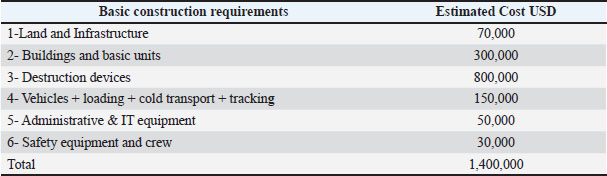
-Owner approval and burial authorization. -Transfer carcass to an approved pet cemetery. -Grave registration and documentation. Payment of burial fees. Cost structure and economic evaluationThe economic assessment relies on establishing a medium-sized center that serves a single governorate, with low operating costs in line with the government's capacity and the current state of the country (Table 5). Table 5. Cost structure and economic evaluation of a medium-sized carcass disposal center.
Land and infrastructure (70,000 $)
Buildings and basic units (300,000 $)
Destruction devices (according to the selected option and the number of devices) assume that each center has two of each type (800,000 $)Alkaline hydrolysis. Pyrolysis / gasification. Incineration. Vehicles + loading + cold transport + tracking (150,000 $)
Administrative & IT equipment (50,000 $)
Safety equipment and crew (30,000 $)
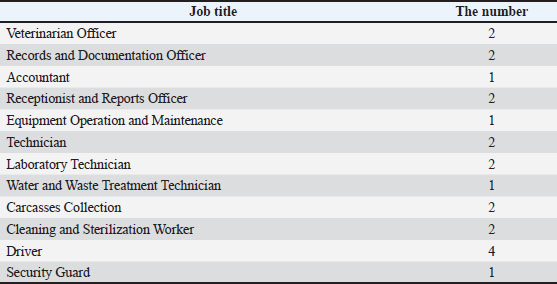
Required staff for the centerThe work schedule is 12 hours and changes according to need (Table 6). Table 6. Required staff for the carcass disposal center.
A cemetery dedicated to petsIn addition to technical disposal methods, establishing a cemetery dedicated to small animals such as dogs, cats, birds, and similar pets is another socially acceptable option that aligns with the principles of animal welfare. An organized pet cemetery provides its owners with an ethical alternative to improper disposal, ensuring burial in a way that respects the animal under controlled environmental and sanitary conditions. Typically, these facilities are designed with lined graves, adequate spacing, drainage systems, and clear documentation to prevent soil or groundwater contamination. Furthermore, pet cemeteries may generate sustainable economic returns through regulated burial fees, memorial services, and optional facilities, contributing to cost recovery for municipalities while enhancing pet ownership. This approach has been successfully implemented in several countries as part of integrated animal management systems and can be adapted to local cultural and environmental contexts in the Gulf Cooperation Council countries. a carcass should be buried 4 feet deep with its body cavity vented (opened), covered with at least 2 inches of quicklime, and back-filled with at least 3 feet of soil. The burial site should be stable and at least 100 feet from a stream, sinkhole, well, spring, public highway, or residence. The burial site should not be in a floodplain or in an area with a high-water table. Proposed area for a pet cemeteryProposed area for a pet cemetery: Far from wells, flood channels, and residential areas, on stable and elevated ground Small cemetery: 5,000–10,000 m² Internal division of the space
Burial fees
The timing for reusing burial sites in pet cemeteries depends on carcass size, burial depth, soil type, and climatic conditions. Small animals such as birds and rabbits typically undergo complete biological decomposition within 6–12 months, allowing for site reuse under controlled conditions. For cats and small to medium-sized dogs, a minimum period of 2–3 years is recommended before reuse. Larger dogs may require 3–5 years to ensure complete decomposition and soil stabilization. These timeframes are consistent with published guidelines on animal carcass disposal and soil safety (National Agricultural Biosecurity Center, 2004; Gwyther et al., 2011). RecommendationsIt is recommended that GCC authorities adopt a unified regulatory framework for animal carcass management based on biosafety and environmental protection standards. Each governorate should establish a medium-sized integrated carcass management center supported by centralized electronic documentation systems. Policymakers should encourage the use of diversified disposal technologies rather than a single method, ensuring operational flexibility during disease outbreaks or mass mortality events. Furthermore, regulated pet cemeteries should be officially recognized as part of national animal welfare strategies. Capacity building, inter-agency coordination, and public awareness campaigns are essential to ensure compliance and long-term sustainability. ConclusionThis study provided a comprehensive and practically applicable operational framework for the safe disposal of animal carcasses in the GCC countries. It not only reviewed the literature and examined traditional and modern disposal methods but also integrated environmental, health, economic, and operational aspects, addressing the scale of the problem in livestock provinces, while identifying the areas, facilities, personnel, and realistic estimated costs in line with governmental capacities. This study is also distinguished by presenting a sequential operational system for managing carcasses from the moment of reporting until final processing and documentation, supported by an administrative and technical framework that ensures traceability, biosafety, and environmental compliance. The integration of modern technologies such as alkaline hydrolysis, pyrolysis/gasification, and high-temperature incineration within a single flexible system is considered an important practical contribution that has not been comprehensively addressed in previous studies within the context of the Gulf countries. Most GCC countries still suffer from the absence of unified and institutional systems for managing animal carcasses, and in many cases rely on traditional practices or temporary solutions that may contribute to environmental pollution, pose public health risks, and complicate epidemiological tracking. Accordingly, the framework proposed in this study can be adopted as an adaptable regional model that helps fill a clear regulatory gap and enhances environmental sustainability, biosecurity, and the proper management of animal waste in GCC countries and the enactment of relevant laws. In addition to disposal facilities such as burial cemeteries, it is considered a humane and socially acceptable option for managing small animal carcasses where there is no documented government cemetery in the GCC countries. When designed according to environmental and health standards, these cemeteries can reduce improper disposal practices, support animal welfare principles, and provide a sustainable service integrated with official carcass management systems. AcknowledgmentsThe author declares that no institutional or individual support was received for this study. Conflict of interestThe author declares no conflict of interest. FundingThis study received no funding from any public, commercial, or not-for-profit organizations. Authors’ contributionsThe author solely conceived, designed, conducted the study, and prepared the manuscript. Data availabilityAll data supporting the findings of this study are included within the article ReferencesCascarosa, E., Becker, J., Ferrante, L., Briens, C., Berruti, F. and Arauzo, J. 2011. Pyrolysis of meat-meal and bone-meal blends in a mechanically fluidized reactor. J. Anal. Appl. Pyrolysis 91(2), 359–367. Dauphiné, N. and Cooper, R.J. 2008. Impacts of free-ranging domestic cats (Felis catus) on birds in the United States: a review of recent research with conservation and management recommendations. In Proceedings of the 4th International Partners in Flight Conference: Tundra to Tropics, 13–16 February 2008, McAllen, TX, USA Ellis, D.B. 2001. Carcass disposal issues in recent disasters, accepted methods, and suggested plan to mitigate future events. Applied Research Project (MPA), Southwest Texas State University, San Marcos, TX. Glanville, T.D., Ahn, H.K., Richard, T.L., Shiers, L.E. and Harmon, J.D. 2009. Soil contamination caused by emergency bio-reduction of catastrophic livestock mortalities. Water. Air. Soil. Pollut. 198(1), 285–295. Gwyther, C.L., Williams, A.P., Golyshin, P.N., Edwards-Jones, G. and Jones, D.L. 2011. The environmental and biosecurity characteristics of livestock carcass disposal methods: a review. Waste Manag. 31(4), 767–778. Joung, H.K., Han, S.H., Park, S.J., Jheong, W.H., Ahn, T.S. and Lee, J.B. 2013. Nationwide surveillance of pathogenic microorganisms in groundwater near carcass burials constructed in South Korea in 2010. Int. J. Environ. Res. Public. Health. 10(12), 7126–7143. Kaczmarek, B. 2019. The heavy metal hazard of undiscovered World War I and II graves in Poland. Glob. Nest. J. 21(4), 461–465. National Agricultural Biosecurity Center (NABC). 2004. Carcass disposal: a comprehensive review. National Agricultural Biosecurity Center, Kansas State University, Manhattan, KS. Palacios, O.A., Contreras, C.A., Muñoz-Castellanos, L.N., González-Rangel, M.O., Rubio-Arias, H. and Palacios-Espinosa, A. 2017. Monitoring of indicator and multidrug resistant bacteria in agricultural oils under different irrigation patterns. Agric. Water. Manag. 184, 19–27. Robinson, T.P., Wint, G.R.W., Conchedda, G., Van Boeckel, T.P., Ercoli, V., Palamara, E., Cinardi, G., D'Aietti, L., Hay, S.I. and Gilbert, M. 2014. Mapping the global distribution of livestock. PLos One 9(5), e96084. WHO (World Health Organization). 2013. Guidance on public health and animal population management. Geneva, Switzerland: WHO Press. Woah. 2019. Stray dog population control. In Terrestrial Animal Health Code. World Organization for Animal Health. | ||




| How to Cite this Article |
| Pubmed Style Khalifah Khalaf Khatam Ali. A comprehensive review and proposed operational framework for animal carcass disposal in GCC Countries. Open Vet. J.. 2026; 16(3): 1451-1457. doi:10.5455/OVJ.2026.v16.i3.4 Web Style Khalifah Khalaf Khatam Ali. A comprehensive review and proposed operational framework for animal carcass disposal in GCC Countries. https://www.openveterinaryjournal.com/?mno=302979 [Access: June 27, 2026]. doi:10.5455/OVJ.2026.v16.i3.4 AMA (American Medical Association) Style Khalifah Khalaf Khatam Ali. A comprehensive review and proposed operational framework for animal carcass disposal in GCC Countries. Open Vet. J.. 2026; 16(3): 1451-1457. doi:10.5455/OVJ.2026.v16.i3.4 Vancouver/ICMJE Style Khalifah Khalaf Khatam Ali. A comprehensive review and proposed operational framework for animal carcass disposal in GCC Countries. Open Vet. J.. (2026), [cited June 27, 2026]; 16(3): 1451-1457. doi:10.5455/OVJ.2026.v16.i3.4 Harvard Style Khalifah Khalaf Khatam Ali (2026) A comprehensive review and proposed operational framework for animal carcass disposal in GCC Countries. Open Vet. J., 16 (3), 1451-1457. doi:10.5455/OVJ.2026.v16.i3.4 Turabian Style Khalifah Khalaf Khatam Ali. 2026. A comprehensive review and proposed operational framework for animal carcass disposal in GCC Countries. Open Veterinary Journal, 16 (3), 1451-1457. doi:10.5455/OVJ.2026.v16.i3.4 Chicago Style Khalifah Khalaf Khatam Ali. "A comprehensive review and proposed operational framework for animal carcass disposal in GCC Countries." Open Veterinary Journal 16 (2026), 1451-1457. doi:10.5455/OVJ.2026.v16.i3.4 MLA (The Modern Language Association) Style Khalifah Khalaf Khatam Ali. "A comprehensive review and proposed operational framework for animal carcass disposal in GCC Countries." Open Veterinary Journal 16.3 (2026), 1451-1457. Print. doi:10.5455/OVJ.2026.v16.i3.4 APA (American Psychological Association) Style Khalifah Khalaf Khatam Ali (2026) A comprehensive review and proposed operational framework for animal carcass disposal in GCC Countries. Open Veterinary Journal, 16 (3), 1451-1457. doi:10.5455/OVJ.2026.v16.i3.4 |


