Open Veterinary Journal, (2026), Vol. 16(6): 4073-4080
Research Article
10.5455/OVJ.2026.v16.i6.73
Poultry farmers’ knowledge, attitudes and practices regarding antibiotic use, resistance, and residues in Mymensingh, Bangladesh
Aminatu Abubakar Sani1,†, Kazi Rafiq1,†, Muhammad Tofazzal Hossain2, Md. Tanvir Rahman2,
A. K. M. Anisur Rahman3* and Md. Mahbub Alam3
1Department of Pharmacology, Bangladesh Agricultural University, Mymensingh, Bangladesh
2Department of Microbiology and Hygiene, Bangladesh Agricultural University, Mymensingh, Bangladesh
3Department of Medicine, Bangladesh Agricultural University, Mymensingh, Bangladesh
† These authors contributed equally to this work
*Corresponding Author: A. K. M. Anisur Rahman. Department of Medicine, Bangladesh Agricultural University, Mymensingh, Bangladesh. Email: arahman_med [at] bau.edu.bd
Submitted: 09/07/2025 Revised: 11/05/2026 Accepted: 02/06/2026 Published: 30/06/2026
© 2025 Open Veterinary Journal
This is an Open Access article distributed under the terms of the Creative Commons Attribution-Non Commercial-No Derivatives License (http://creativecommons.org/licenses/by-nc-nd/4.0/), which permits non-commercial re-use, distribution, and reproduction in any medium, provided the original work is properly cited, and is not altered, transformed, or built upon in any way.
ABSTRACT
Background: Poultry farmers play an important role in the emergence and transmission of antimicrobial resistance (AMR), particularly in low- and middle-income countries where knowledge of prudent antimicrobial use (AMU) is often limited.
Aim: This study evaluated the knowledge, attitudes, and practices (KAP) of poultry farmers regarding AMU, AMR, and antimicrobial residues in Mymensingh, Bangladesh.
Methods: A cross-sectional survey was conducted using a pretested, structured questionnaire administered to 75 poultry farmers from four districts of the Mymensingh Division. Descriptive statistics were used to summarize the data, and associations among KAP were assessed using contingency tables and Pearson’s chi-square test of independence.
Results: Only 33.3% of farmers sought advice exclusively from veterinary professionals. Awareness of antibiotic residues was reported by 81.1% of participants, whereas awareness of AMR was considerably lower (29.6%). Regarding the purpose of use, 22.7% of farmers used antimicrobials strictly for treatment, and none reported using them as growth promoters. Combined drug use was reported by 24.0% of farmers, and ciprofloxacin was the most frequently used antibiotic (85.3%). Overall, 76% of farmers demonstrated adequate knowledge, 33.3% had desirable attitudes, and 60% exhibited appropriate practices. Farmers’ practices were significantly associated with their attitudes toward AMR and AMU (p < 0.001) but were not associated with their level of knowledge.
Conclusion: These findings highlight the need for targeted educational interventions and stronger antimicrobial stewardship programs to promote responsible AMU in the poultry sector in Bangladesh.
Keywords: Antimicrobial residue, Antimicrobial resistance (AMR), Antimicrobial use (AMU), KAP survey, Poultry farmers.
Introduction
Antimicrobial resistance (AMR) is widely recognized as one of the most serious global public health challenges of the twenty-first century. The increasing use of antimicrobials in food-animal production has been identified as an important driver of the emergence and spread of resistant microorganisms. In many low- and middle-income countries, antimicrobials are frequently used in livestock production systems to treat, prevent, or control infectious diseases and to maintain productivity. In South Asia, the poultry sector has expanded rapidly to meet the growing demand for affordable animal protein. Bangladesh represents one of the fastest-growing poultry industries in the region. (Hafez and Attia, 2020). However, the rapid expansion of the sector has been accompanied by increased use of antibiotics, often without adequate veterinary supervision. Such practices may contribute to the development of antimicrobial-resistant bacteria and the presence of antimicrobial residues in animal-derived food products (Mann et al., 2021).
The World Health Organization (WHO) has emphasized that inappropriate use of antimicrobials in livestock production can reduce the effectiveness of critically important drugs used in human medicine (WHO, 2018). In Bangladesh, although a National Action Plan for AMR control (2017–2022) has been implemented, regulatory enforcement and practical guidelines for antibiotic use in livestock production remain limited (Chowdhury et al., 2021). Farmers often obtain veterinary drugs directly from drug sellers or pharmaceutical representatives without a professional prescription (Al Amin et al., 2020).
Understanding farmers’ knowledge, attitudes, and practices (KAPs) regarding antimicrobial use (AMU) is, therefore, essential for designing effective interventions and antimicrobial stewardship programs. Despite the importance of the poultry sector in the Mymensingh Division of Bangladesh, limited information is available on farmers’ awareness and behavior regarding AMU and resistance. Therefore, this study aimed to evaluate the KAP of poultry farmers regarding AMU, resistance, and residues in the Mymensingh Division of Bangladesh.
Materials and Methods
Study design and area
A cross-sectional survey was conducted in the Mymensingh Division of Bangladesh (approximately between 24°–25° N latitude and 89° –91° E longitude) over 6 months (January and June 2019). The study covered four districts: Mymensingh, Jamalpur, Netrokona, and Sherpur (Fig. 1). Sixteen upazilas (sub-districts) were selected based on data from the District Livestock Offices, which identified these areas as having high poultry density and farming activity.
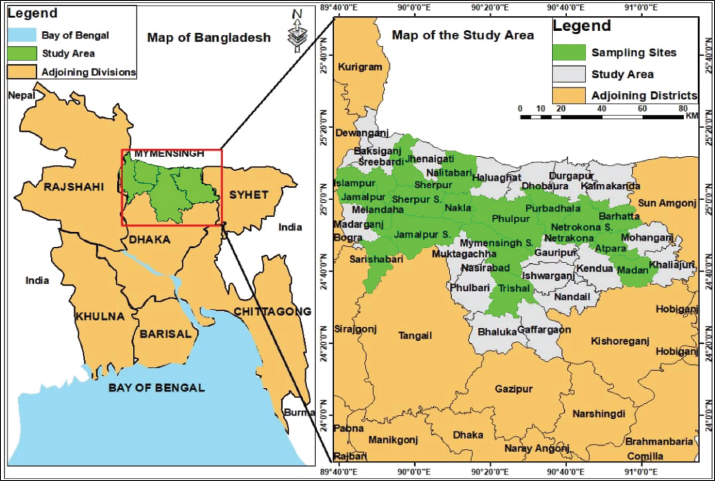
Fig. 1. Map of AMR surveillance study areas. Bangladesh is the country; study area means the Mymensingh division of Bangladesh; study upazila means the selected 16 upazilas within Mymensingh division of Bangladesh.
Study population and sampling
The study population comprised poultry farmers engaged in broiler, layer, or duck farming. A total of 75 farmers were recruited using a convenience sampling approach. This approach was adopted due to logistical constraints and the exploratory nature of the study; however, it is acknowledged that this method may limit the generalizability of the findings. Inclusion criteria required farmers to be at least 18 years of age and willing to provide written informed consent. Farmers were excluded if they declined to participate or were unable to complete the interview.
Data collection
A structured questionnaire comprising both closed- and open-ended questions was developed based on previous research (WHO, 2018; Kemp et al., 2021). The questionnaire was translated into Bengali and pretested to ensure clarity and validity. Data were collected via face-to-face interviews. The questionnaire comprised four sections: (A) demographic information and farm description; (B) knowledge regarding AMR, AMU, and residues; (C) attitudes towards antibiotic use; and (D) practices related to farm management and drug usage.
Data management and statistical analysis
Data were extracted and transferred to a Microsoft Excel spreadsheet (Microsoft Excel 2018, Redmond, WA). Descriptive statistics (frequencies, percentages, and means) were used to summarize the data.
Scoring of KAP
To evaluate the KAP, responses to specific questions were scored using a binary scoring system. For positively framed questions, a response of “Yes” was assigned a score of 2, and “No” was assigned a score of 1. For negatively framed questions, the scoring was reversed. The scores for each domain (KAP) were summed for every respondent. Higher cumulative scores indicated better performance in that domain. Based on the median split of the total scores, respondents were categorized as having “Adequate” or “Inadequate” knowledge, “Desirable” or “Undesirable” attitudes, and “Appropriate” or “Inappropriate” practices.
Statistical analysis
Pearson’s chi-square test of independence was used to assess the relationship between knowledge, attitude, and practice. A p-value < 0.05 was considered statistically significant. Although regression analysis could provide further insight into predictors of good practice, the sample size precluded the use of multivariable modeling; therefore, chi-square tests were the primary statistical tool employed.
Ethical approval
Ethical approval for the study was obtained from the relevant ethics committee of Bangladesh Agricultural University before data collection. The objectives of the study were explained to all participants, and written informed consent was obtained before each interview. Participant confidentiality was maintained throughout the study.
Results
Demographic and socioeconomic characteristics
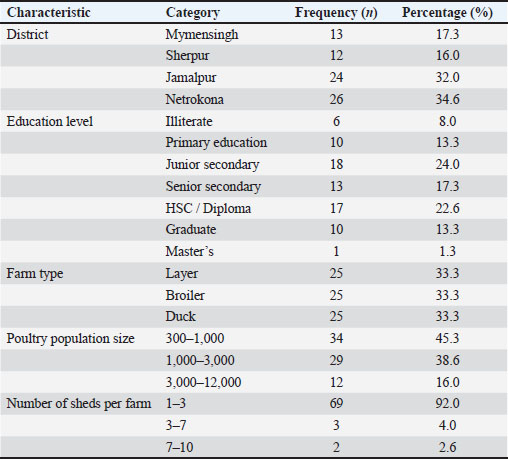
A total of 75 poultry farmers participated in the study. Table 1 summarizes their demographic characteristics. More than half of the farmers (54.6%) had attained education levels ranging from primary to senior secondary school, while 8% were illiterate. Education levels did not differ significantly by district (p=0.256). Farm types (layer, broiler, and duck) were equally distributed (n=25 each); however, the distribution of farm types varied significantly across districts (p < 0.0001). Most farms (45.3%) had a flock size of 300 1,000 birds, and 92% had between one and three sheds.
Table 1. Socio-demographic and farm characteristics of the respondents (n=75).
Knowledge of AMU and resistance
All respondents (100%) had heard of antibiotics; however, their understanding of their mechanism of action was mixed. While 72.0% correctly identified that antibiotics act against bacteria, 76.0% incorrectly believed that antibiotics are also effective against viruses. Regarding AMR, 94.7% had heard of the term, yet only 29.6% could accurately describe it (e.g., as treatment failure). The majority (81.1%) were aware of antibiotic residues, describing them as the accumulation of antibiotics in the human and/or animal body (Fig. 2).
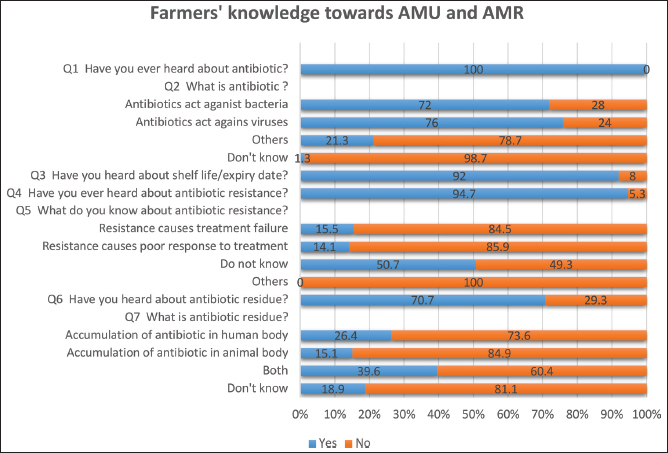
Fig. 2. Distribution of poultry farmers’ responses (%) to questions regarding knowledge of antibiotics, resistance, and residues (n=75). (1) Have you heard about antibiotic? (Yes/No). (2) What is antibiotic? Antibiotics act against bacteria/virus/others/don’t know? (Yes/No). (3) Have you heard about shelf life/expiry date? (Yes/No). (4) Have you heard about antibiotic resistance? (Yes/No). (5) What do you know about antibiotic resistance? Resistance causes treatment failure/resistance causes poor response to treatment/ /Don’t know/ others? (Yes/No). (6) Have you heard about antibiotic residues? (Yes/No). (7) What is antibiotic residue? Accumulation of antibiotics in human body/ accumulation of antibiotics in animal body/ both/Don’t know? (Yes/No). Q1, question 1, Q2, question 2, Q3, question 3, Q4, question 4 Q5, question 5 Q6, question 6 Q7, question 7
Attitudes towards antimicrobial
Most farmers (66.7%) reported seeking advice from veterinary practitioners (Fig. 3). However, a considerable proportion also relied on drug sellers (38.7%) or company professionals (29.3%). Only 45.3% strictly followed a veterinarian’s prescription to purchase the exact drug required. Awareness of the withdrawal period was limited, with only 33% of farmers indicating that their prescribers had mentioned this requirement.
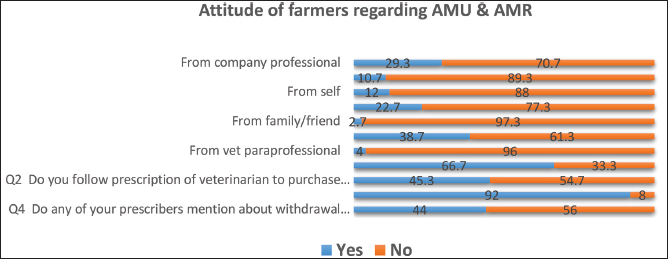
Fig. 3. Distribution of poultry farmers’ attitudes regarding sources of treatment advice, prescription adherence, and awareness of withdrawal periods (n=75). (1) From who do you get treatment suggestion? (veterinarian/vet, paraprofessional/drug seller, family or friend/others/self/quake/company professional). (Yes/No). (2) Do you follow prescription of veterinarian to purchase exact drug? (Yes/No). (3) Do you have idea about shelf life? (Yes/No). (4) Do any of your prescribers mention about withdrawal period? (Yes/No). Q1, question 1, Q2, question 2, Q3, question 3, Q4, question 4.
Practices and management
The most frequently used antibiotics were ciprofloxacin (85.3%), oxytetracycline (69.3%), amoxicillin (68.0%), doxycycline (68.0%), and enrofloxacin (65.3%) (Fig. 4). None of the farmers reported using antibiotics as growth promoters. The majority used antimicrobials for both treatment and prevention (61.3%), while 22.7% used them strictly for treatment. Although 84% claimed to complete the full course of antibiotics, adherence to withdrawal periods was poor, with 82.7% of farmers failing to comply. Record-keeping was generally inadequate, with only 16% of farmers maintaining records consistently (Table 2).
Table 2. Management practices and use of antibiotics by respondents (n=75).
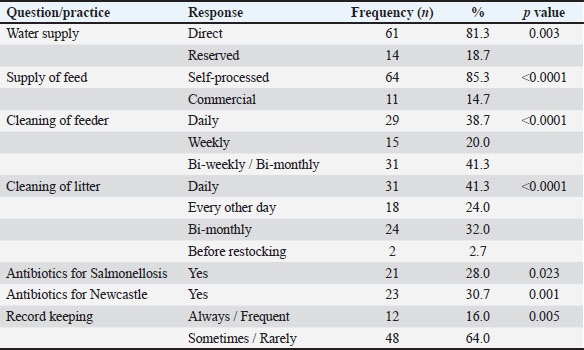
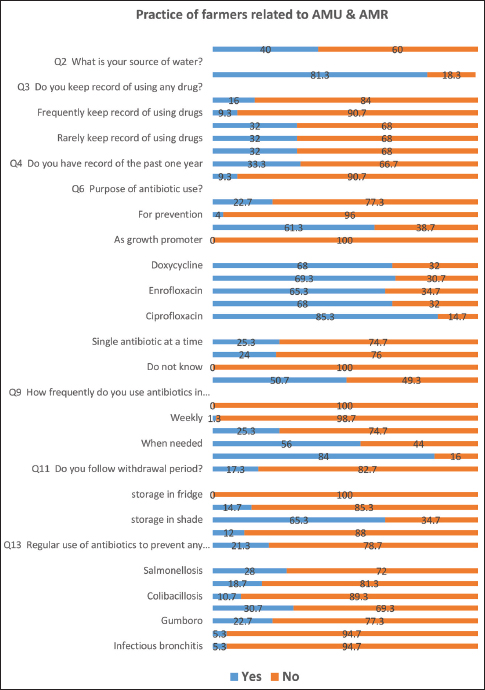
Fig. 4. Distribution of poultry farmers’ practices regarding antibiotic types, frequency of use, withdrawal period compliance, and record-keeping (n=75). (1) Do you clean your feeder/litter daily? (Yes/No). (2) What is your source of water? Direct/reserved supply? (Yes/No). (3) Do you keep record of using any drug? Always/frequently/sometimes/rarely/never? (Yes/No). (4) Do you keep record of the past one year? (Yes/No). (5) Do you add antibiotic during self-feed processing? (Yes/No). (6) What is the purpose for antibiotic use? Treatment/prevention/ Treatment and prevention/growth promoter? (Yes/No). (7) Name five common antibiotics you frequently use. Doxycycline/oxytetracycline/enrofloxacin/amoxicillin/ciprofloxacin? (Yes/No). (8) Number of antibiotics used at a time. Single antibiotic/combined multiple/don’t know/single and combined (Yes/No). (9) How frequently do you use antibiotics in poultry? Daily/weekly/monthly/when needed (Yes/No). (10) Did you complete your last antibiotic course? (Yes/No). (11) Do you follow withdrawal period? (Yes/No). (12) What is your means of drug storage? Fridge/room/shade/other means (Yes/No). (13) Regular use of antibiotics to prevent any disease (Yes/No). (14) What are the specific diseases? Salmonellosis/mycoplasmosis/colibacillosis/New castle disease/Gumboro/Mareks’/infectious bronchitis (Yes/No). Q1, question 1, Q2, question 2, Q3, question 3, Q4, question 4 Q5, question 5 Q6, question 6 Q7, question 7, Q8, question 8, Q9, question 9, Q10, question 10, Q11, question 11 Q12, question 12 Q13, question 13 Q14, question 14.
Relationship between KAP
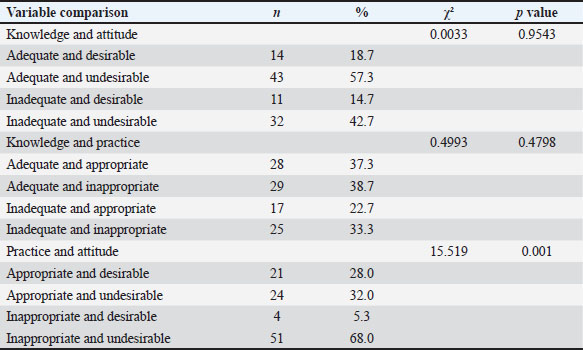
Contingency table analysis (Table 3) revealed that knowledge did not significantly influence attitude (χ²=0.003; p=0.954) or practice (χ²=0.499; p=0.480). However, a highly significant association was observed between attitude and practice (χ²=15.51; p < 0.001). Farmers who held desirable attitudes were significantly more likely to exhibit appropriate practices regarding AMU.
Table 3. Contingency table showing the relationship between farmers’ knowledge of AMU and their corresponding attitudes and practices.
Discussion
This study provides baseline evidence on the KAP of poultry farmers regarding AMU and AMR in the Mymensingh Division of Bangladesh. The findings indicate that while awareness of antibiotics is universal, specific knowledge of AMR mechanisms and principles of antimicrobial stewardship remains limited. Furthermore, the study highlights that attitudes, rather than knowledge, are the primary drivers of farming practices.
Knowledge and awareness
Although 100% of farmers were aware of antibiotics, misconceptions were prevalent; many incorrectly believed that antibiotics are effective against viral infections. Similar misconceptions have been reported in other South Asian countries, where farmers frequently lack formal training in pharmacology (Mouiche et al., 2022). Awareness of residues was higher than awareness of resistance. This may be because residue issues are routinely highlighted during market quality inspections, whereas the concept of microbial resistance is less tangible and visible. Compared with biosecurity standards in more developed Asian poultry sectors (e.g., Thailand and Malaysia), where structured training programmes are common, the knowledge gaps identified in Mymensingh underscore a critical need for strengthened extension services (Dhakal et al., 2023).
Attitudes towards professional advice
Although two-thirds of farmers reported consulting veterinarians, reliance on drug sellers and company professionals remained substantial. This “mixed-sourcing” of treatment advice is a known risk factor for irrational drug use. Economic constraints often compel farmers to seek cheaper advice from non-professionals who may have a vested interest in selling drugs (Kyakuwaire et al., 2019). This finding is consistent with recent studies suggesting that improving the attitude of animal health service providers is as important as educating farmers themselves (Afakye et al., 2020).
Practices and drug usage
The widespread use of fluoroquinolones (ciprofloxacin and enrofloxacin) and tetracyclines is of particular concern. These agents are classified by the WHO as highest priority critically important antimicrobials (HP-CIAs) for human medicine. Their extensive use in poultry, frequently for prophylaxis or metaphylaxis, heightens the risk of AMR transmission to humans. The absence of reported antibiotic growth promoter use is encouraging and may reflect the partial effect of recent regulatory bans in Bangladesh. However, farmers may be avoiding growth promotion terminology while administering antimicrobials for ‘disease prevention,’ which can serve a functionally similar purpose.
The significant association between attitude and practice suggests that disseminating knowledge alone (e.g., explaining what AMR is) is insufficient to change behavior. Interventions must target farmers’ perceptions of risk and their trust in professional veterinary advice. The high proportion of farmers failing to comply with withdrawal periods (82.7%) poses a direct public health risk due to the potential accumulation of antimicrobial residues in poultry products.
Limitations
This study has several limitations. First, the use of convenience sampling may have introduced selection bias. Farms that were easily accessible could differ systematically from more remote ones, limiting the generalizability of our findings to the broader poultry farming population in Bangladesh. Second, the relatively small sample size (n=75) precluded the use of multivariable regression analyses to identify independent predictors of good practice. Finally, reliance on self-reported data may have introduced social desirability bias. Future studies should employ stratified random sampling with larger sample sizes to validate and extend these findings.
Conclusion
Poultry farmers in the Mymensingh division demonstrate high awareness of antibiotics but possess limited specific knowledge of AMR mechanisms and stewardship principles. Attitudes towards prudent drug use significantly influenced actual farming practices, whereas knowledge alone did not drive behavioral change. Fostering desirable attitudes through increased engagement with veterinary professionals could meaningfully improve practices. Policy efforts should focus not only on farmer education but also on regulating antibiotic sales and enforcing prescription-only access to HP-CIAs.
Acknowledgments
The authors acknowledge the support of the District Livestock Officers and the farmers of Mymensingh division for their cooperation.
Funding
This research was funded by the project-based research grant (PBRG) support of the National Agricultural Technology Project-2 (NATP-2) of the Bangladesh Agricultural Research Council [Project ID-138].
Authors’ contributions
KR, AAS, MRI, and MTH conceptualized and managed the project. AAS, MTH, MTR, and MMA performed the experiments and drafted the manuscript. KR and MMA designed and supervised the research. KR, AAS, AKMK, and AKMAR performed statistical analysis and prepared figures/tables. All authors read and approved the final version.
Conflict of interest
The authors declare no conflict of interest.
References
Afakye, K., Kiambi, S., Koka, E., Kabali, E., Dorado-Garcia, A., Amoah, A., Kimani, T., Adjei, B. and Caudell, M.A. 2020. The impacts of animal health service providers on antimicrobial use attitudes and practices: an examination of poultry layer farmers in Ghana and Kenya. Antibiotics 9(9), 554; doi:10.3390/antibiotics9090554
Al Amin, M., Hoque, M.N., Siddiki, A.Z., Saha, S. and Kamal, M.M. 2020. Antimicrobial resistance situation in animal health of Bangladesh. Vet. World. 13(12), 2713–2727; doi:10.14202/vetworld.2020.2713-2727
Chowdhury, S., Ghosh, S., Aleem, M.A., Parveen, S., Islam, M.A., Rashid, M.M., Akhtar, Z. and Chowdhury, F. 2021. Antibiotic usage and resistance in food animal production: what have we learned from Bangladesh?. Antibiotics 10(9), 1032; doi:10.3390/antibiotics10091032
Dhakal, A., Devkota, S., Jethara, S.B., Yadav, R.K. and Phuyal, P. 2023. Assessment of biosecurity in poultry farms in Chitwan, Nepal. Vet. Med. Sci. 11(2), e70232; doi:10.1002/vms3.70232
Hafez, H.M. and Attia, Y.A. 2020. Challenges to the poultry industry: current perspectives and strategic future after the COVID-19 outbreak. Front. Vet. Sci. 7, 516.
Kemp, S.A., Pinchbeck, G.L., Fèvre, E.M. and Williams, N.J. 2021. A cross-sectional survey of the knowledge, attitudes, and practices of antimicrobial users and providers in an area of high-density livestock-human population in Western Kenya. Front. Vet. Sci. 8, 727365; doi:10.3389/fvets.2021.727365
Khan, S.A., Imtiaz, M.A., Sayeed, M.A., Shaikat, A.H. and Hassan, M.M. 2020. Antimicrobial resistance pattern in domestic animal–wildlife–environmental niche via the food chain to humans with a Bangladesh perspective: a systematic review. BMC. Vet. Res. 16(1), 1–3; doi:10.1186/s12917-020-02519-9
Kyakuwaire, M., Olupot, G., Amoding, A., Nkedi-Kizza, P. and Ateenyi Basamba, T. 2019. How safe is chicken litter for land application as an organic fertilizer? A review. Int. J. Environ. Res. Public Health 16(19), 3521; doi:10.3390/ijerph16193521
Mann, A., Nehra, K., Rana, J.S. and Dahiya, T. 2021. Antibiotic resistance in agriculture: Perspectives on upcoming strategies to overcome upsurge in resistance. Curr. Res. Microb. Sci. 2, 100030; doi:10.1016/j.crmicr.2021.100030
Mouiche, M.M.M., Wouembe, F.D.K., Mpouam, S.E., Moffo, F., Djuntu, M., Toukam, C.M.W., Kameni, J.M.F., Okah-Nnane, N.H. and Awah-Ndukum, J. 2022. Cross-sectional survey of prophylactic and metaphylactic antimicrobial use in layer poultry farming in Cameroon: a quantitative pilot study. Front. Vet. Sci. 9, 646484; doi:10.3389/fvets.2022.646484
World Health Organization. 2018. Critically important antimicrobials for human medicine Geneva: World Health Organization.