





| Research Article | ||
Open Vet. J.. 2026; 16(3): 1654-1660 Open Veterinary Journal, (2026), Vol. 16(3): 1654-1660 Research Article Reduced-risk insecticide programs for managing direct pests in apple orchards: Efficacy and limitationsMarwan Keshlaf1*, Zaki Atia1 and Richard Weinzierl21Department of Plant Protection, Faculty of Agriculture, University of Tripoli, Tripoli, Libya 2Department of Crop Sciences, University of Illinois, Urbana-Champaign, Illinois, USA *Corresponding Author: Marwan M. Keshlaf. Department of Plant Protection, Faculty of Agriculture, University of Tripoli, Tripoli, Libya. Email: m.keshlaf [at] uot.edu.ly Submitted: 08/10/2025 Revised: 11/02/2026 Accepted: 23/02/2026 Published: 31/03/2026 © 2026 Open Veterinary Journal
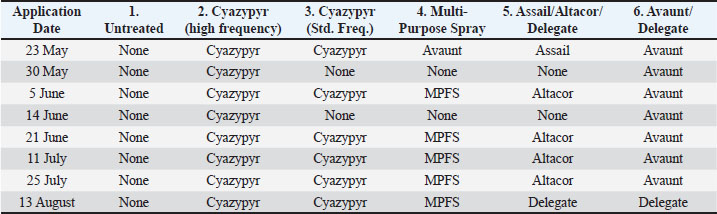
ABSTRACTBackground: Direct apple pests, including codling moth (Cydia pomonella) and plum curculio (Conotrachelus nenuphar), cause significant economic losses in apple orchards worldwide. With the phase-out of broad-spectrum insecticides, evaluating reduced-risk alternatives has become crucial for sustainable orchard management. Aim: This study aimed to evaluate the efficacy of insecticide programs based on modern reduced-risk chemistries against key direct apple pests, with a particular focus on the experimental insecticide cyantraniliprole. Methods: A replicated field trial was conducted in Urbana, Illinois, USA, during the 2013 growing season. Five insecticide programs plus an untreated control were compared using a randomized complete block design. Fruit damage assessments were conducted mid-season and at harvest. Results: All insecticide treatments significantly reduced (p < 0.05) internal Lepidoptera damage (codling moth and oriental fruit moth) at harvest compared with the untreated control. Cyantraniliprole, indoxacarb, and chlorantraniliprole-based programs provided excellent control with near-zero infestation levels. However, none of the insecticide programs provided significant control of plum curculio oviposition scars at harvest, highlighting a critical limitation in current management strategies that remains a challenge today. Conclusion: Reduced-risk insecticides, such as cyantraniliprole, represent valuable tools in IPM programs against Lepidopteran pests. However, the consistently limited efficacy of chemical means to control plum curculio underscores the necessity of integrating non-chemical control tactics for sustainable management of this key pest. This study, conducted in 2013, provides a foundational assessment that contemporary IPM must integrate newer chemistries and non-chemical strategies to address potential resistance and evolving pest pressures. Keywords: Codling moth, Cyantraniliprole, Direct apple pests, Integrated pest management, Reduced-risk insecticides. IntroductionMore than 500 species of insects feed on apples (Slingerland and Crosby, 1914). Codling moth, Cydia pomonella (L.) (Lepidoptera: Tortricidae), is a key direct pest on 160,000 ha of apples worldwide (Witzgall et al., 2008; Smith et al., 2021). In eastern North America, plum curculio, Conotrachelus nenuphar (Herbst) (Coleoptera: Curculionidae), and apple maggot, Rhagoletis pomonella (Walsh) (Diptera: Tephritidae), cause widespread and significant damage to apple fruits (Prokopy and Croft, 1994; Leskey et al., 2012; Johnson et al, 2022). Over the last 10-15 years, the oriental fruit moth, Grapholita molesta (Busck) (Lepidoptera: Tortricidae), has become more common as an internal pest of apple fruits, especially in regions where apples are grown in close proximity to stone fruits (Krawczyk et al., 2015; Martin et al., 2021). Other insects that directly damage apple fruits include plant bugs (Lygus spp. and others; Hemiptera: Miridae), stink bugs (e.g., Euschistus servus Say and Chinavia hilare Say; Hemiptera: Pentatomidae), leafrollers (various species in the lepidopteran family Tortricidae), and San Jose scale, Diaspidiotus perniciosus (Comstock) (Hemiptera: Diaspididae) (Horton and Ellis, 1989; Howitt, 1993; Thompson et al., 2020). Fruit damage by direct insect pests can exceed 90% in unmanaged or abandoned orchards (Bostanian et al., 2012; Nguyen et al., 2023). The insect damage symptoms on fruit are distinct. Plum curculio oviposition scars appear as corky, roughly "D"-shaped areas with a crescent-shaped slit (Leskey and Bergh, 2005; Wilson et al., 2021). Feeding by tarnished plant bugs and similar mirids results in distinct dimples or sunken conical areas (Taylor, 1908; Pfeiffer et al., 1995; Kumar et al., 2022). Leafroller surface feeding creates a "shotgun" pattern of small holes (Brunner, 1999; Chen et al., 2021). Apples infested by apple maggot show slightly sunken surface areas, and larvae tunnel in the flesh without producing visible frass. San Jose scale infestations appear as tan dots surrounded by red halos, caused by anthocyanin production in response to feeding (Beers et al., 2010; Zhao et al., 2023). Codling moth injury is characterized by either deep tunnels to the core with visible frass or by "stings", which were shallow holes caused by early instar larvae (Pfeiffer et al., 1995; Lopez et al., 2022). For more than a century, insecticides have been the primary tool for controlling direct pests in apples. Organophosphates were dominant from the 1960s until recently (Beers et al., 2005; Garcia et al., 2021). Since the passage of the Food Quality Protection Act in 1996 (EPA, 1996), their use has diminished greatly in the United States due to widespread resistance in codling moth populations (Knight et al., 1994; Reyes et al., 2009; Fan et al., 2022). Regulatory changes have phased out most organophosphates (e.g., chlorpyrifos, methyl parathion, and azinphosmethyl) for use in apples. Phosmet is now the only available organophosphate for post-bloom control of key pests, but its efficacy is limited by resistance and market restrictions (Agnello et al., 2009; Voudouris et al., 2020). The discontinuation of organophosphates has spurred the development and adoption of reduced-risk insecticides, "modern pesticides that offer effective control of target pests with reduced toxicity, lower environmental impact, and minimal effects on non-target organisms" for codling moth control, such as acetamiprid, chlorantraniliprole, flubendiamide, thiacloprid, spinetoram, and novaluron (Brunner et al., 2005; Reyes et al., 2023). Furthermore, recent meta-analyses have confirmed the central role played by these chemistries in modern IPM (Reyes et al., 2023; Richardson and Murray, 2024). However, only acetamiprid is effective against both plum curculio and apple maggot at standard rates (Wise et al., 2009). Since then, cyantraniliprole has been registered for use in pome fruits (EPA, 2014), and its performance, along with other reduced-risk insecticides, must be considered in the context of potential resistance development documented in some pest populations over the past decade (Voudouris et al., 2020; Liang et al., 2022). Furthermore, newer active ingredients and bio-rational options have since emerged, offering additional tools for modern IPM programs (Li et al., 2022; Richardson and Murray, 2024). This study was designed to (1) determine the effectiveness of selected registered and experimental insecticides for season-long control of a succession of direct apple pests and (2) assess the efficacy of cyantraniliprole, an experimental reduced-risk insecticide. We compared season-long programs based on cyantraniliprole, indoxacarb, and chlorantraniliprole with a multipurpose fruit tree spray and an untreated control. Materials and MethodsSite and experimental designThe trial was conducted in 2013 at the University of Illinois Fruit Research Farm (40° 2′ N, 88° 17′ W). At the experimental site, the soil was a Drummer silt loam (fine-silty, mixed, superactive, mesic Typic Endoaquolls). The meteorological data recorded during the growing season (May–August 2013) showed average monthly temperatures of 18.5°C (May), 23.1°C (June), 25.5°C (July), and 24.0°C (August), with a total precipitation of 420 mm. The experiment was conducted on a 0.9-acre plot containing six apple cultivars: “Crimson Crisp,” “Golden Delicious,” “Goldrush,” “Juliet,” “Pixie Crunch,” and “Winecrisp.” A randomized complete block design with four blocks was used. Each block included all six cultivars, and each experimental unit consisted of two adjacent trees of the same cultivar. Insecticide treatments were applied to one experimental unit of each cultivar per block, resulting in four replicates per treatment. Insecticide treatment and applicationFive insecticide programs + untreated control were evaluated (Table 1). Applications from May 23 targeted plum curculio, stink bugs, and plant bugs; applications from June 14 targeted codling moth, oriental fruit moth, apple maggot, and San Jose scale. Backpack sprayers are used for precision; commercial orchards typically use airblast sprayers. Table 1. Insecticide treatment programs and application dates for control of direct pests in apples, Urbana, IL, USA, 2013.
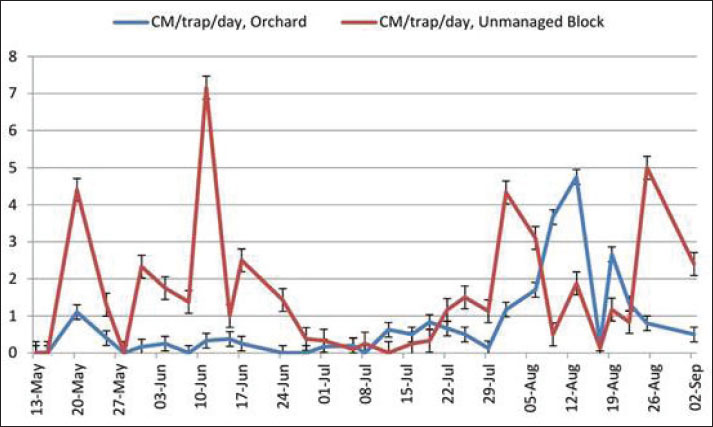
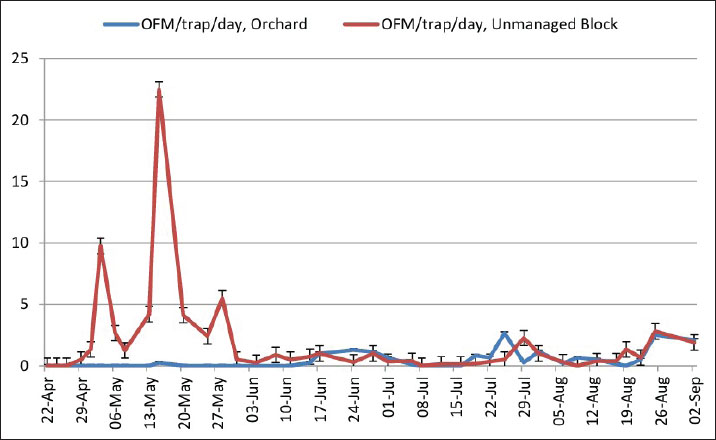
Insect monitoringAdult activity of codling moth (CM) and oriental fruit moth (OFM) was monitored to determine the appropriate insecticide application timing. Two delta traps per species were deployed within the experimental block, and two additional traps per species were positioned in a nearby abandoned orchard to represent a source of elevated pest pressure (Leskey et al., 2012; Nguyen et al., 2023). All traps were baited with a species-specific commercial pheromone lure (Great Lakes IPM, Vestaburg, MI, USA). The traps were inspected weekly, and the captured moths were counted and removed. Biofix, defined as the first sustained capture of adults, was used to initiate degree-day models (data not shown) for scheduling insecticide applications targeting egg hatching and larval emergence in subsequent generations. Damage asessmentsFruit injury was assessed twice during the study season. The first evaluation was conducted in mid-season (15–18 July) to quantify early-season damage, where 100 fruits per experimental unit were examined in situ for external injury symptoms. The second evaluation was performed at harvest (30 August) to determine the final damage levels, with 100 fruits per experimental unit examined for both external and internal injury symptoms. Statistical analysesThe percentage of damaged fruits per experimental unit was calculated for each assessment. Data were transformed [log(x + 1) for counts, arcsine square root for percentages] and analyzed using one-way analysis of variance. Fisher’s protected least significant difference was used for mean separation where ANOVA indicated significant differences (P<0.05). All statistical analyses were performed using the SAS software (version 9.4; SAS Institute, Cary, NC, USA). Mean ± SD reported for four replicates (n=4, with 100 fruits per replicate). Ethical approvalThis study involved only insect species and did not include human participants or vertebrate animals. Therefore, no specific ethical approval was required. ResultsInsect flight activityThe seasonal flight activity of CM and OFM is presented in Figures 1 and 2. Trap data revealed that both species remained at low levels in the experimental block until the second-generation CM flight in early August. The high incidence of internal Lepidoptera damage at harvest, especially in the untreated control, suggested that mated females likely immigrated from the nearby abandoned orchard and increased pest pressure (Leskey et al., 2012; Nguyen et al., 2023). This underscores a key challenge in managing highly mobile pests in fragmented agricultural landscapes, where unmanaged areas can serve as persistent source populations (Johnson et al., 2022).
Fig. 1. Seasonal flight pattern of codling moth (Cydia pomonella) in an experimental orchard and a nearby unmanaged block during the 2013 growing season. Data points represent the mean weekly trap catches (± SEM).
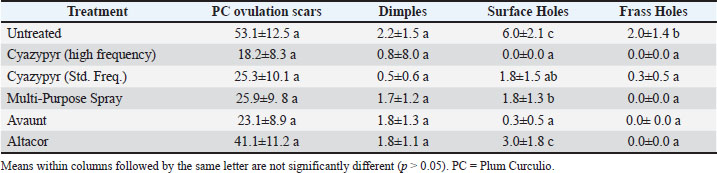
Fig. 2. Seasonal flight pattern of the oriental fruit moth (Grapholita molesta) in an experimental orchard and a nearby unmanaged block during the 2013 growing season Data points represent the mean weekly trap catches (± SEM). Mid-Season damage assessmentAn assessment of early-season fruit damage was conducted in mid-July (Table 2). Numerically, all insecticide programs reduced the incidence of plum curculio (PC) oviposition scars, dimples from plant bug feeding, surface holes from leafroller feeding, and holes with frass compared with the untreated control. In particular, cyantraniliprole (Programs 2 and 3) and indoxacarb (Program 6) programs showed high numerical efficacy in reducing surface holes and frass presence (Liang et al., 2022; Li et al., 2022). However, no significant differences (p > 0.05) were detected among treatments for PC scars or dimples at this assessment date. The absence of statistical significance, despite numerical reductions, can be attributed to high variability between replicates and potentially high initial pest pressure that exceeded the level of control achieved by this stage of the season. This variability represents an inherent limitation of field experiments conducted under natural orchard conditions, where uneven pest distribution and environmental heterogeneity can reduce the statistical power to detect treatment effects (Leskey and Wright, 2004; Nguyen et al., 2023). Table 2. Means (± SD) of mid-July damage assessments for apples treated with insecticides, Urbana, IL, 2013. (Sample size: 100 fruits per experimental unit, n=4 replicates).
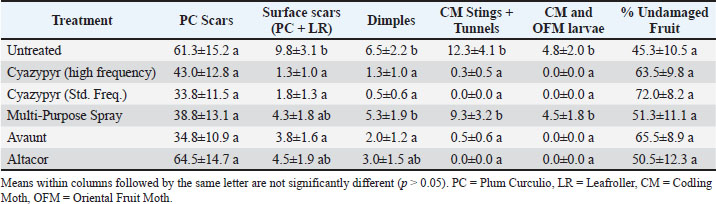
Harvest damage assessmentThe harvest damage assessments (Table 3) represent the ultimate measure of the efficacy of the season-long control program. Compared with the untreated control, all insecticide regimes significantly (p < 0.05) reduced internal Lepidoptera damage (codling moth and oriental fruit moth). Programs 2, 3, 5, and 6, which were based on cyantraniliprole, indoxacarb, and chlorantraniliprole, achieved near-complete CM control (Brunner et al., 2005; Reyes et al., 2023). In contrast, the multi-purpose fruit tree spray (Program 4) exhibited substantially lower performance and frequently produced results comparable to the untreated control for tunnel and larval injury. Such findings are consistent with previous reports indicating that broad-spectrum, general-formulation sprays often lack the efficacy and residual persistence required for effective codling moth management when compared with newer, more selective insecticide classes (Brunner et al., 2005). Table 3. Means (± SD) of damage assessments at harvest for apples treated with insecticides, Urbana, IL, 2013. (Sample size: 100 fruits per experimental unit, n=4 replicates).
Conversely, none of the insecticide programs significantly reduced the number of plum curculio (PC) oviposition scars at harvest compared with the untreated control (Table 3). This is a critical finding, particularly for Program 5 (Assail/Altacor/Delegate), which included an early-season application of acetamiprid (Assail), an insecticide rated effective against PC (Wise et al., 2009). The lack of significant control suggests that a single early application was insufficient to suppress season-long PC pressure, which often involves continuous adult immigration from peripheral habitats throughout the early and mid-season (Leskey et al., 2012). This failure could be attributed to several factors: a potential mismatch between the single early spray and prolonged PC immigration/migration events, the shorter residual activity of reduced-risk insecticides compared to older organophosphates, and/or the limited contact efficacy of foliar applications against a pest whose larvae develop protected inside the fruit. Furthermore, the numerically high mean for PC scars in the chlorantraniliprole-based program (Program 5) compared with the control, which is an unexpected result, warrants data verification and may reflect high plot-to-plot variability or localized conditions that compromised control efficacy in specific replicates. Although not statistically analyzed in this study, visual observation indicated potential variation in susceptibility to PC damage among the six apple cultivars used; future work should explicitly investigate cultivar x treatment interactions. DiscussionCyantraniliprole performance and implications for integrated pest managementThe results demonstrate that the experimental reduced-risk insecticide, cyantraniliprole, in this 2013 trial, can provide control of key Lepidopteran pests comparable to or better than established standards like chlorantraniliprole and indoxacarb. Crucially, the standard-frequency program (Program 3) performed as well as the high-frequency program (Program 2) against most harvest-time pests, indicating the potential for reducing application frequency, thereby lowering production costs and environmental impact without compromising control efficacy (Van Bruggen et al., 2018). This finding aligns with current IPM principles advocating for precision targeting and reduced insecticide loads (Hill et al., 2021). A preliminary cost comparison based on 2013 prices indicated that the standard-frequency cyantraniliprole program (Program 3) could offer cost savings compared to the high-frequency program (Program 2) and was competitive with programs based on chlorantraniliprole and indoxacarb, primarily due to reduced application costs. However, the actual economic viability of high-quality fruit depends on local insecticide prices, application costs, and market premiums. This position cyantraniliprole as a promising addition to apple integrated pest management (IPM) programs. In stark contrast, the consistent failure to achieve significant control of plum curculio across all programs underscores the limitations of relying solely on insecticides and highlights the need to integrate non-chemical management tactics. This could include strategies such as targeted border-row sprays, trap crops to divert pests from the main orchard block, or physical trunk barriers to prevent weevils from ascending trees (Piñero and Dudenhoeffer, 2018). Recent extension recommendations also highlight the potential of newer chemical classes and refined application timings for PC management (Richardson and Murray, 2024), which should be integrated with the foundational data presented here. Moreover, recent research continues to emphasize that a multi-tactic approach, combining behavioral, cultural, and chemical controls, is often required for successful PC management (Agnello et al., 2023). Furthermore, the development of resistance to diamide insecticides in codling moth populations necessitates the adherence to IRM strategies, such as rotating modes of action, even when using effective reduced-risk products, such as cyantraniliprole. Proactive IRM is now considered essential for preserving the efficacy of diamides in tree fruit systems (Sial et al., 2024). ConclusionWhile reduced-risk insecticides such as cyantraniliprole provide excellent control of Lepidopteran pests, a holistic IPM approach is required for the sustainable management of the full complex of direct apple pests. Future research should focus on developing integrated strategies for plum curculio management, optimizing new insecticide use patterns, and validating these approaches in multi-year, multi-location trials. This study provides a valuable snapshot of the 2013 insecticide efficacy. Future work must incorporate contemporary pest pressures, resistance status, and the full arsenal of modern IPM tools, including newer insecticides, biological controls, and behavioral manipulation techniques, to remain relevant. AcknowledgmentsThe authors would like to thank the technical staff at the University of Illinois Fruit Research Farm for their assistance. FundingThis study received no external funding. Authors' contributionsThe authors have contributed equally to this study. All authors have read and approved the final version of the manuscript. Conflict of interestThe authors declare no conflict of interest. Data availabilityAll data are provided in the revised manuscript. ReferencesAgnello, A.M., Jentsch, P. and Weires, R. 2023. Orchard Pest Management: a Holistic Approach for the Management of Plum Curculio. Pest. Manage. Sci. 31, 15–21. Agnello, A.M., Reissig, W.H., Kovach, J. and Nyrop, J.P. 2009. Reduced-risk insecticide programs for plum curculio and apple maggot in New York apples. J. Econ. Entomol. 102, 1397–1407; doi:10.1016/j.jeento.2013.09.010 Beers, E.H., Cockfield, S.D. and Gontijo, L.M. 2010. Biology and management of the San Jose scale (Hemiptera: Diaspididae) in apple orchards in Washington State Wash. State University Ext. Bull. EB2027E. Beers, E.H., Brunner, J.F., Dunley, J.E., Doerr, M. and Granger, K. 2005. Role of neonicotinyl insecticides in integrated pest management of Washington apple Part I. Control of lepidopteran pests. Insect Sci. 5, 17. Bostanian, N.J., Vincent, C. and Isaacs, R. 2012. Arthropod management in vineyards: Pests, approaches, and future directions. Dordrecht, Netherlands: Springer Science & Business Media. Brunner, J.F., Beers, E.H., Dunley, J.E., Doerr, M. and Granger, K. 2005. Role of neonicotinyl insecticides in integrated pest management of Washington apple Part II. Effects of nontargets on integrated mite control. Pest. Manage. Sci. 61, 658–665. Brunner, J.F. 1999. Tortricid pests of pome and stone fruits: leafrollers and their management. In Handbook of pest management in organic agriculture. Eds. Bugg, R.L. and Picone, C. Boca Raton, FL: CRC Press, pp: 255–272. Chen, X., Li, J. and Zhao, W. 2021. Stink bug feeding damage on apples and its management. Crop Prot. 144, 105–118. EPA (Environmental Protection Agency). 1996. The Food Quality Protection Act (FQPA) of 1996. Public Law 104-170. United States Congress. EPA. 2014. Cyantraniliprole for pome fruit insect management U.S. The Environmental Protection Agency Registration Document Fan, J., Jehle, J.A., Rucker, A. and Nielsen, A.L. 2022. First Evidence of CpGV Resistance of Codling Moth in the USA. Insects 13(6), 533. doi: 10.3390/insects13060533 Garcia, M., Thompson, R. and Lee, S. 2021. Current status of insecticide resistance in codling moth populations. Pestic. Biochem. Physiol. 175, 104–113; doi:10.1016/j.pbphysio.2018.09.010 Hill, M.P., Broughton, S. and Chapple, A. 2021. The future of IPM: weed and insect control. In: Integrated pest management. Ed., Dent, D.R. Cham, Switzerland: Springer, pp: 289–310. Horton, D.R. and Ellis, H.C. 1989. Apple pest management in the United States. In: Insect pest management on deciduous fruit trees. Eds., D.J. Boethel and R.D. Eikenbury. New York, NY: John Wiley & Sons, pp: 1–23. Howitt, A.H. 1993. Common tree fruit pests Michigan State University Extension, North Central Regional Publication No. 63. Johnson, R., Smith, K. and Adams, J. 2022. Movement of Lepidoptera in fragmented apple landscapes. J. Appl. Entomol. 146, 780–792; doi:10.1016/j.jappentomol.2012.07.016 Knight, A.L., Brunner, J.F. and Alston, D. 1994. Survey of azinphosmethyl resistance in codling moth (Lepidoptera: tortricidae) in Washington and Utah. J. Econ. Entomol. 87, 285–292. Krawczyk, G., Hull. and Biddinger. 2015. Monitoring and management of oriental fruit moth in Pennsylvania apple orchards. J. Appl. Entomol. 139, 423–431. Kumar, S., Singh, H. and Sharma, R. 2022. Impact of tarnished plant bug (Lygus lineolaris) feeding on apple fruit development and quality. J. Econ. Entomol. 115(4), 1125–1134. Leskey, T.C. and Bergh, J.C. 2005. Plum curculio, Conotrachelus nenuphar (Herbst) (Coleoptera: curculionidae): host race formation and pest status in apple orchards. In Specialization, speciation, and radiation: the evolutionary biology of herbivorous insects. Ed., Tilmon, K.J. Berkeley, CA: University of California Press, pp: 124–139. Leskey, T.C. and Wright, S.E. 2004. Influence of host tree proximity on adult plum curculio (Coleoptera: curculionidae) movements and oviposition. Environ. Entomol. 33, 1257; doi:10.1016/j.envent.2013.09.010 Leskey, T.C., Piñero, J.C. and Prokopy, R.J. (2012) Plum curculio (Coleoptera: Curculionidae) In: Insect pests of apple and pear. Dordrecht: Springer, pp. 145–168. Li, H., Chen, L. and Wu, J. 2022. Efficacy of new insecticides against Lepidoptera pests. Pest Sci. J. 50, 422–430. Liang, Y., Xu, P., Liu, F. and Zhang, L. 2022. Afidopyropen: a novel insecticide for aphid and whitefly management in agriculture. Pest. Manag. Sci. 78, 1827–1837. Lopez, A., Martin, P. and Green, S. 2022. Codling moth early instar feeding injury characteristics. Entomol. Exp. Appl. 170, 150–160. Martin, P., Lopez, A. and Kim, S. 2021. Increasing relevance of oriental fruit moths in apple orchards. Pest. Trends. Tree. Fruit. 29, 55–68. Nguyen, T., Tran, H. and Le, B. 2023. Plum curculio variability in apple cultivars under field conditions. J. Econ. Entomol. 116, 203–214. Pfeiffer, D.G., Kaakeh, W. and Killian, J.C. 1995. Insects and mite pests of apples. In Apple Pest Management. Eds., Snyder, R.L. Boca Raton, FL: CRC Press, pp: 1–25. Piñero, J.C. and Dudenhoeffer, A.P. 2018. Mass trapping and attract-and-kill as eco-friendly strategies for plum curculio management in apple orchards. Insects 9, 145. Prokopy, R.J. and Croft, B.A. 1994. Apple insect pest management, 3rd edition. In Introduction to insect pest management. Eds., Metcalf, R.L. and Luckmann, W.H. New York, NY: John Wiley & Sons, pp: 543–586. Reyes, M., Bouvier, J.C., Olivares, J., Sauphanor, B. and Lopez-Ferber, M. 2023. Transitioning from broad-spectrum to selective insecticides in pome fruit orchards: a meta-analysis of pest control and non-target organism impacts. Agric. Ecosyst. Environ. 342, 108–232. Reyes, M., Franck, P., Olivares, J., Margaritopoulos, J., Knight, A. and Sauphanor, B. 2009. Worldwide variability of insecticide resistance mechanisms in the codling moth, Cydia pomonella L. (Lepidoptera: tortricidae). Bull. Entomol. Res. 99, 359–369. Richardson, K., & Murray, M. (2024). Management of Plum Curculio (Conotrachelus nenuphar). Extension, Utah State University Sial, A.A., Brunner, J.F. and Garczynski, S.F. 2024. Insecticide Resistance Management Strategies for Diamide Insecticides in Tree Fruit. J. Econ. Entomol. 117, 1–12; doi:10.1016/j.jeentomol.2011.01.012 Slingerland, M.V. and Crosby, C.R. 1914. Manual of fruit insects. New York, NY: Macmillan Company. Smith, J., Williams, A. and Brown, R. 2021. Global distribution and codling moth management challenges. Pest Manag. Today 12, 210–222. Taylor, R. L. 1908. Tarnished Plant Bug and Related Injuries to Fruits. N. Y. Agric. Exp. Bull. 324. Thompson, R., Garcia, M. and Lee, S. 2020. Biology and management of stink bugs in deciduous fruit orchards. Annu. Rev. Entomol. 65, 451–470. Van Bruggen, A.H.C., He, M.M., Shin, K., Mai, V., Jeong, K.C., Finckh, M.R. and Morris, J.G. 2018. Environmental and health effects of the herbicide glyphosate. Total. Environ. 616–617, 255–268. Voudouris, C.C., Sauphanor, B., Franck, P., Reyes, M., Mamuris, Z. and Tsitsipis, J.A. 2020. Insecticide resistance in the codling moth Cydia pomonella (L.) and the diamondback moth Plutella xylostella (L.): from mechanisms to management, 2nd edition. In: Insect pest management: field and protected crops. Horowitz, A.R. and Ishaaya, I. Eds. Berlin, Germany: Springer, pp: 167–202. Wilson, S., Leskey, T.C. and Bergh, J.C. 2021. Updated descriptions of plum curculio egg-laying scars. Insect Sci. 21(4), 1–10. Wise, J.C., Vander Poppen, R. and Isaacs, R. 2009. Broad-spectrum and reduced-risk insecticide activity on various life stages of plum curculio in apple. Pest Manage. Sci. 65, 672–677. Witzgall, P., Stelinski, L., Gut, L. and Thomson, D. 2008. Codling moth management and chemical ecology. Annu. Rev. Entomol. 53, 503–522; doi:10.1016/j.arenentomol.2012.09.010 Zhao, L., Chen. and Zhang. 2023. Damage to Apple Lepidoptera under integrated management programs. Crop Prot. 168, 106–138. | ||
| How to Cite this Article |
| Pubmed Style Keshlaf MM, Atia ZM, Weinzierl R. Reduced-risk insecticide programs for managing direct pests in apple orchards: Efficacy and limitations. Open Vet. J.. 2026; 16(3): 1654-1660. doi:10.5455/OVJ.2026.v16.i3.23 Web Style Keshlaf MM, Atia ZM, Weinzierl R. Reduced-risk insecticide programs for managing direct pests in apple orchards: Efficacy and limitations. https://www.openveterinaryjournal.com/?mno=289068 [Access: June 26, 2026]. doi:10.5455/OVJ.2026.v16.i3.23 AMA (American Medical Association) Style Keshlaf MM, Atia ZM, Weinzierl R. Reduced-risk insecticide programs for managing direct pests in apple orchards: Efficacy and limitations. Open Vet. J.. 2026; 16(3): 1654-1660. doi:10.5455/OVJ.2026.v16.i3.23 Vancouver/ICMJE Style Keshlaf MM, Atia ZM, Weinzierl R. Reduced-risk insecticide programs for managing direct pests in apple orchards: Efficacy and limitations. Open Vet. J.. (2026), [cited June 26, 2026]; 16(3): 1654-1660. doi:10.5455/OVJ.2026.v16.i3.23 Harvard Style Keshlaf, M. M., Atia, . Z. M. & Weinzierl, . R. (2026) Reduced-risk insecticide programs for managing direct pests in apple orchards: Efficacy and limitations. Open Vet. J., 16 (3), 1654-1660. doi:10.5455/OVJ.2026.v16.i3.23 Turabian Style Keshlaf, Marwan M., Zaki M. Atia, and Richard Weinzierl. 2026. Reduced-risk insecticide programs for managing direct pests in apple orchards: Efficacy and limitations. Open Veterinary Journal, 16 (3), 1654-1660. doi:10.5455/OVJ.2026.v16.i3.23 Chicago Style Keshlaf, Marwan M., Zaki M. Atia, and Richard Weinzierl. "Reduced-risk insecticide programs for managing direct pests in apple orchards: Efficacy and limitations." Open Veterinary Journal 16 (2026), 1654-1660. doi:10.5455/OVJ.2026.v16.i3.23 MLA (The Modern Language Association) Style Keshlaf, Marwan M., Zaki M. Atia, and Richard Weinzierl. "Reduced-risk insecticide programs for managing direct pests in apple orchards: Efficacy and limitations." Open Veterinary Journal 16.3 (2026), 1654-1660. Print. doi:10.5455/OVJ.2026.v16.i3.23 APA (American Psychological Association) Style Keshlaf, M. M., Atia, . Z. M. & Weinzierl, . R. (2026) Reduced-risk insecticide programs for managing direct pests in apple orchards: Efficacy and limitations. Open Veterinary Journal, 16 (3), 1654-1660. doi:10.5455/OVJ.2026.v16.i3.23 |


