




| Research Article | ||
Open Vet. J.. 2026; 16(6): 4067-4072 Open Veterinary Journal, (2026), Vol. 16(6): 4067-4072 Research Article Efficacy of garlic (Allium sativum) supplements in improving blood biochemical indices and immune response of broiler chickensAhmed Attia Al-Mansory1, Bashir Mohamed Sherif2* and Omar Abdulsalam Azouz31Department of Animal Production, Faculty of Agriculture, Omar Al-Mukhtar University, Bayda, Libya 2Department of Animal Production, Faculty of Agriculture, University of Tripoli, Tripoli, Libya 3Department of Animal Production Technique, Higher Institute of Agriculture Technology, Almarj, Libya *Corresponding Author: Bashir Mohamed Sherif. Department of Animal Production, Faculty of Agriculture, University of Tripoli, Tripoli, Libya. Email: B.Sherif [at] uot.edu.ly Submitted: 06/12/2025 Revised: 15/05/2026 Accepted: 30/05/2026 Published: 30/06/2026 © 2025 Open Veterinary Journal
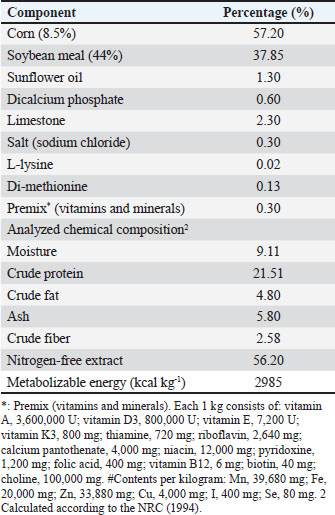
ABSTRACTBackground: Garlic is considered an important natural additive in poultry nutrition because it acts as an antibacterial and antiviral agent, helps boost immunity, improves digestion, and increases growth and production rates, making it a healthy and economical choice in modern farming. Aim: This study aimed to evaluate the effect of dietary garlic powder supplementation on the physiological and biochemical parameters in the blood of broiler chickens. Methods: A total of 120 Ross 308 chicks were randomly assigned to two groups: a control group that was fed a basal diet and a second group that received the basal diet supplemented with 0.5% garlic powder. Hematological traits, lipid profiles, protein profiles, Immunoglobulin G (IgG) and Immunoglobulin M (IgM) levels, and liver and kidney functions were assessed over 4 weeks. Results: There were no significant changes in hematological parameters, including white blood cells, red blood cells, Hemoglobin, Mean Corpuscular Volume Mean Corpuscular Hemoglobin, and Mean Corpuscular Hemoglobin Concentration . Garlic supplementation significantly reduced total cholesterol levels. Other lipid parameters, including TG, High Density Lipoprotein, Low Density Lipoprotein, and Very Low Density Lipoprotein, showed non-significant changes. The second group, fed with garlic, showed a numerical increase in IgG levels. Changes in protein profiles or IgM levels were not significant. Liver and kidney function indicators, including direct bilirubin, alanine aminotransferase, aspartate aminotransferase, creatinine, Na, K, and Cl, remained within normal levels, with a significant decrease in total bilirubin, supporting hepatoprotective effects of garlic. Urea and uric acid levels showed a non-significant decline. Conclusion: Garlic supplementation at 0.5% appears safe and beneficial, offering promising immunomodulatory and lipid-lowering effects without inducing physiological stress. As a natural feed additive, garlic may contribute to sustainable farming practices and reduce the reliance on synthetic antibiotics. Keywords: ALT, AST, Immunity, Lipid profile, Protein profile. IntroductionThe maintenance of animal health is a fundamental requirement for sustainable production and a better quality of life. Among the natural approaches that have stood the test of time, medicinal and aromatic plants have emerged as a safe and intelligent choice. Far beyond their role as flavor enhancers, these plants have therapeutic properties that support disease prevention and treatment, including strengthening immunity, improving digestion, and controlling parasites. Cloves and ginger can positively influence digestive health by stimulating secretions, enhancing nutrient absorption, and improving intestinal morphology (Othman et al., 2022; Đurić Jarić et al., 2025). In addition, many aromatic plants are rich in antioxidant compounds that protect animals against oxidative stress, thereby boosting overall performance. With the growing interest in alternative medicine within animal husbandry, medicinal and aromatic herbs have become an integral part of modern feeding strategies. They offer a natural alternative to conventional antibiotics, reducing the risks associated with chemical use. Garlic (Allium sativum) is a prime example. Long recognized for its medicinal properties (Shetty et al., 2013), garlic is increasingly being used in animal nutrition. It contains bioactive compounds, such as allicin (Amagase et al., 2001), which provide antioxidant, antibacterial, antifungal, antiparasitic, and immune-enhancing effects (Moses et al., 2024). Incorporating garlic into poultry and livestock diets can improve gut health and overall performance (Ogbuewu et al., 2019). Given the rising concerns about antibiotic resistance and the demand for organic, antibiotic-free products, garlic is a promising alternative for sustainable animal farming. Therefore, the present study aimed to evaluate the effectiveness of garlic supplementation in improving hematological traits, immune response, lipid profile, and liver and kidney functions in broiler chickens. Materials and MethodsSpecies bird and experimental treatmentsThis study was conducted at the Poultry Experimental Laboratory, Department of Veterinary Medical Sciences Technology, Higher Institute of Agricultural Technology, Derna, Libya. One-day-old chicks (Ross 308) with an average weight of 40 g were raised in a floor system and randomly allocated at the age of 14 days into two equal groups (60 birds per group); each group contained four replicates (2 × 1.5 m²), and each replicate had 15 birds. The control group was fed a basal diet, and the second group was fed a basal diet supplemented with garlic powder (5 g kg⁻¹ diet). Feed and water were provided ad libitum throughout the experimental period, which lasted for 4 weeks. The chemical analysis of the basal diet is given in Table 1. All birds were maintained under a standard photoperiod with continuous ventilation and an ambient temperature of 33°C in the first week, which gradually decreased to 22°C in the last 2 weeks. Table 1. Ingredients and chemical composition of the experimental basal diet.
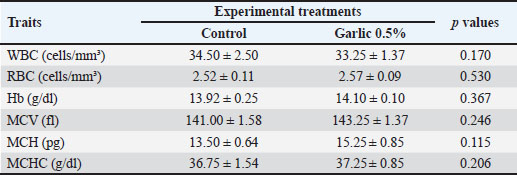
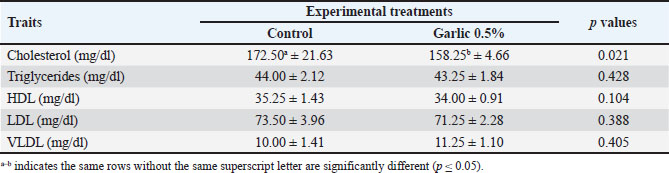
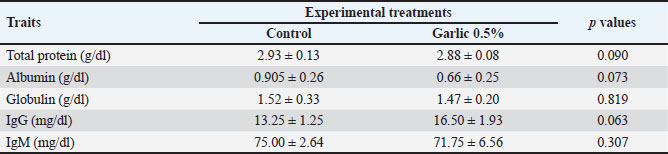
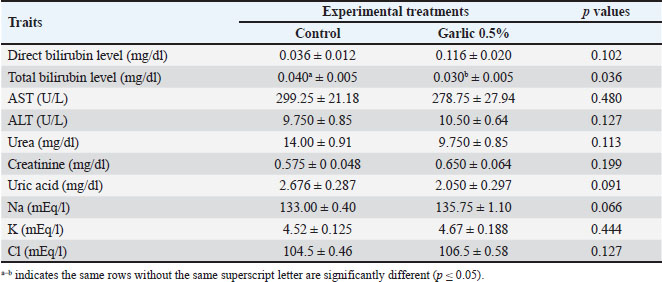
Measured traitsAt the end of the experimental period (sixth week), blood samples were collected from three birds per replicate (12 birds/group). Blood was drawn from the brachial vein using sterile syringes and transferred into collection tubes. Two types of tubes were used: anticoagulant-treated tubes (containing EDTA) were used for hematological assessments, including red blood cells (RBC), white blood cells (WBC), hemoglobin (Hb), Mean Corpuscular Volume (MCV), Mean Corpuscular Hemoglobin (MCH), and Mean Corpuscular Hemoglobin Concentration (MCHC). Tubes without anticoagulant were used for serum separation. These samples were centrifuged at 3,000 rpm for 15 minutes, and the resulting serum was stored at −20°C until biochemical analyses were performed. The following serum parameters were measured: total protein, albumin, globulin, Immunoglobulin G (IgG), Immunoglobulin M (IgM), cholesterol, triglycerides, High Density Lipoprotein (HDL), Low Density Lipoprotein (LDL), Very Low Density Lipoprotein (VLDL), direct and total bilirubin, Alanine Aminotransferase (ALT), Aspartate Aminotransferase (AST), urea, creatinine, uric acid, Na, K, and Chloride. Statistical analysisThis study was conducted using Completely Randomized Design . Data were statistically analyzed using one-way analysis of variance. Significant differences were determined using Duncan’s multiple range test and were considered at p ≤ 0.05. All analyses were performed using the Statistical Package for the Social Sciences software (version 16; Chicago, IL). The results are presented as the mean ± standard error. Ethical approvalEthical standards and animal welfare were fully respected during this study as approved by the Ethics Committee of the University of Tripoli. ResultsTable 2 presents the effect of adding 0.5% garlic powder to broiler chicken feed on hematological parameters, including WBC, RBC, Hb, MCV, MCH, and MCHC. Overall, the results indicate no significant changes or adverse effects on bird health. The most notable is the slight increase in MCV and MCH concentrations in chickens fed the garlic-supplemented diet. Table 3 presents the effect of adding 0.5% garlic powder to broiler chicken diets on blood lipid profiles. The results indicate a general trend toward improved lipid parameters, highlighting the potential health benefits of garlic as a feed additive. A significant reduction of 14.25 mg/dl (8.26%) in cholesterol levels was observed in the garlic-treated group, representing the most prominent finding in the table and a notable health implication. Other blood lipid indicators showed non-significant change in triglycerides, HDL, LDL, and VLDL in the garlic group compared to the control group. Table 4 shows the effect of adding 0.5% garlic powder on blood proteins and immune status in broiler chickens. The results indicate no statistically significant effects on serum total protein, albumin, globulin, IgG, and IgM in broilers fed a garlic-supplemented diet. The most prominent finding in the table is a non-significant increase in IgG levels, which rose to 16.50 mg/dl compared with 13.25 mg/dl in the control group. Table 5 illustrates the effect of adding 0.5% garlic powder on a set of biochemical indicators reflecting liver and kidney health and function in broiler chickens. The most significant result was a significant reduction (p ≤ 0.05) in total bilirubin levels in the garlic group (0.030 mg/dl) compared with the control group (0.040 mg/dl). Non-significant differences were observed in the serum levels of direct bilirubin, urea, uric acid, creatinine, ALT, AST, Na, K, and Cl. Table 2. Effect of garlic supplement on the hematological traits of broiler chickens (x̄±SE).
Table 3. Effect of garlic supplement on the lipid profile of broiler chickens (x̄±SE).
Table 4. Effect of garlic supplement on the protein profile and immune response of broiler chickens (x̄±SE).
Table 5. Effect of garlic supplement on liver and kidney functions of broiler chickens (x̄±SE).
DiscussionThe current findings showed that garlic supplementation in broilers did not significantly affect hematological parameters. The lack of change in WBC count aligns with Zeryehun et al. (2017), whereas Khaidem et al. (2019) and Solomon et al. (2019) reported that garlic may increase WBC levels. The WBC count is a key indicator of the immune and inflammatory status. The absence of a significant increase indicates that garlic supplementation did not trigger an inflammatory response or physiological stress in the birds. However, this effect is highly dependent on the dosage used and the bird’s health status. Under normal, non-stressed conditions, garlic may not cause a noticeable increase in WBC count, which could explain the current findings. Our study's findings are consistent with those of Ismail et al. (2020), who mentioned that although there were no significant changes in red and white blood cell counts and Packed Cell Volume garlic consumption at 0.25%, 0.5%, and 0.75% improved blood parameters. Studies that reported positive results in hematological parameters with garlic supplementation suggested that this may be due to the most bioactive compounds in garlic (allicin and other organosulfur compounds), which could protect RBC membranes from oxidative damage, thereby extending their lifespan and increasing their circulation (Ahmad et al., 2019). The current findings showed that garlic can decrease blood cholesterol levels. Numerous studies have shown that garlic supplementation significantly reduces blood cholesterol levels (Ademola et al., 2009; Ari et al., 2012; Al-Massad et al., 2018). Allicin inhibits key enzymes involved in cholesterol synthesis in the liver, such as HMG-CoA reductase (Abbasi et al., 2023). In addition, a numerical reduction in LDL cholesterol is beneficial, and garlic supplements could improve the LDL-HDL cholesterol ratio (Issa and Omar, 2012). The results showed no significant effect on protein profile and immunoglobulin levels, which may be due to the low garlic powder does used in this study or to a metabolic redirection of hepatic resources toward other pathways. Many studies have supported our finding: garlic supplements have no significant impact on blood protein levels (Fadlalla et al., 2010; Patel et al., 2014), and garlic powder does not affect serum albumin levels (Al-Massad et al., 2018). The non-significant effects on blood immunoglobulin levels align with the findings of Afaq et al. (2016). However, there was a trend toward an improved immune response. The IgG levels show the most notable numerical change in the table, indicating a potential immune-modulating effect. This indicates that garlic might improve certain aspects of immunity without significantly affecting total serum protein levels, which is consistent with the findings of Zeryehun et al. (2017) and El-Gogary et al. (2020). Arreola et al. (2015) and El-Saadony et al. (2024) reported that garlic may act as an immunomodulator rather than a general stimulant of protein synthesis. Overall, garlic supplementation did not induce stress on the liver and kidney and may have contributed to improvement in certain functions. Aydogan et al. (2020) reported similar results. Elbaza et al. (2022) also reported non-significant effects on blood creatinine and urea levels. A significant decrease in total bilirubin level is considered a positive indicator, potentially reflecting improved liver health (hepatoprotective action) or a reduced rate of RBC degradation, which is consistent with the slight increase in RBCs observed in Table 2. S-allyl cysteine, an antioxidant compound found in garlic, protects liver cells from free radicals that cause oxidative stress and cell damage. The maintenance of ALT and AST within normal ranges indicates that garlic at a concentration of 0.5% does not exert hepatotoxic effects and can be considered a safe dose for liver cells. Garlic supplements can minimize the negative changes in liver enzymes and bilirubin levels induced by toxins or stress (Raghu et al., 2012). The numerical reduction in urea and uric acid levels may be attributed to improved cellular protein metabolism or kidney function. The results showed complete stability of the sodium, potassium, and chloride levels. This indicates that garlic did not negatively affect the body’s water and electrolyte balance, indicating healthy kidney function. ConclusionIncluding 0.5% garlic in the diet is safe and effective, providing potential immunomodulatory and lipid-lowering effects without causing physiological stress in animals. As a natural feed additive, garlic may support sustainable farming practices and help reduce the dependence on synthetic antibiotics. AcknowledgmentThe authors deeply appreciate the facilities and supportive environment provided by the Department of Veterinary Medical Sciences Technology at the Higher Institute of Agricultural Technology in Derna for conducting this experiment and gathering data. Conflict of interestThe authors declare no conflicts of interest. FundingThe study was conducted without any external funding; all expenses were covered by the authors. Authors' contributionAhmed Attia Al-Mansory: Sample collection and experimental work execution. Bashir Mohamed Sherif: The experimental design and writing of the manuscript. Omar Abdulsalam Azouz: Analysis and interpretation of the data. Data availabilityAll data are available from the corresponding author upon reasonable request. ReferenceAbbasi, A., Sanej, K.D., Moradi, S., Bazzaz, S., Esmaeili, A., Ghafourian, K., Sabahi, S., Lahouty, M., Akrami, S., Aslani, R. and Hosseini, H. 2023. Bioactive compounds and biological activities of Allium sativum L. In Bioactive compounds in the storage organs of plants. Cham, Switzerland: Springer Nature, pp: 1–40. Ademola, S.G., Farinu, G.O. and Babatunde, G.M. 2009. Serum lipid, growth and haematological parameters of broilers fed garlic, ginger and their mixtures. World J. Agric. Sci. 5(1), 99–104. Afaq, S., Rao, P.V., Tariq, H. and Mondal, B.C. 2016. Effect of garlic and chromium picolinate supplementation on production performance, carcass characteristics and immunological parameters of Guinea fowls. J. Anim. Res. 6(1), 99–104. Ahmad, P., Alvi, S.S. and Khan, M.S. 2019. Functioning of organosulfur compounds from garlic (Allium sativum Linn.) in targeting risk factor-mediated atherosclerosis: a cross talk between alternative and modern medicine. In Natural bio-active compounds: volume 1: production and applications. Singapore: Springer, pp: 561–585. Al-Massad, M., Al-Ramamneh, D., Al-Sharafat, A., Abdelqader, A. and Hussain, N. 2018. Effect of using garlic on the economical and physiological characteristics of broiler chickens. Russ. Agric. Sci. 44(3), 276–281. Amagase, H., Petesch, B.L., Matsuura, H., Kasuga, S. and Itakura, Y. 2001. Intake of garlic and its bioactive components. J Nutr. 131(3), 955S–962S. Ari, M.M., Barde, R.E., Ogah, D.M., Agade, Y.I., Yusuf, N.D., Hassan, I.D. and Muhammed, M.M. 2012. Utilisation of Garlic (Allium Sativum L) as a supplementary phytogenic feed additive for broilers fed commercial feeds. Egypt. Poult. Sci. 32(I), 13–21. Arreola, R., Quintero-Fabián, S., López-Roa, R.I., Flores-Gutiérrez, E.O., Reyes-Grajeda, J.P., Carrera-Quintanar, L. and Ortuño-Sahagún, D. 2015. Immunomodulation and anti-inflammatory effects of garlic compounds. J. Immunol. Res. 2015(1), 401630. Aydogan, I., Yildirim, E., Kurum, A., Bolat, D., Cinar, M., Basalan, M. and Yigit, A. 2020. The effect of dietary garlic (Allium sativum), black cumin (Nigella sativa) and their combination on performance, intestine morphometry, serum biochemistry and antioxidant status of broiler chickens. Braz. J. Poult. Sci. 22(04), eRBCA–2020. Đurić Jarić, M., Gottstein, Ž., Vince, S., Žura Žaja, I., Brus, M., Đuričić, D., Samardžija, M. and Valpotić, H. 2025. Effect of standardized ginger (Zingiber officinale Roscoe) extract on gut morphology, microbiota composition, and growth performance in broiler chickens. Agriculture, 15(13), 1448. Elbaz, A.M., Ashmawy, E.S., Salama, A.A., Abdel-Moneim, A.M.E., Badri, F.B. and Thabet, H.A. 2022. Effects of garlic and lemon essential oils on performance, digestibility, plasma metabolite, and intestinal health in broilers under environmental heat stress. BMC Vet. Res. 18(1), 430. El-Gogary, M.R., El-Khateeb, A.Y. and Megahed, A.M. 2019. Effect of physiological and chemical nano garlic supplementation on broiler chickens. Plant Arch. 19(1), 695–705. El-Saadony, M.T., Saad, A.M., Korma, S.A., Salem, H.M., Abd El-Mageed, T.A., Alkafaas, S.S., Elsalahaty, M.I., Elkafas, S.S., Mosa, W.F., Ahmed, A.E. and Mathew, B.T. 2024. Garlic bioactive substances and their therapeutic applications for improving human health: a comprehensive review. Front. Immunol. 15, 1277074. Fadlalla, I.M.T., Mohammed, B.H. and Bakhiet, A.O. 2010. Effect of feeding garlic on the performance and immunity of broilers. Asian J. Poult. Sci. 4(4), 182–189. Ismail, I.E., Alagawany, M., Taha, A.E., Puvača, N., Laudadio, V. and Tufarelli, V. 2020. Effect of dietary supplementation of garlic powder and phenyl acetic acid on productive performance, blood haematology, immunity and antioxidant status of broiler chickens. Anim. Biosci. 34(3), 363. Issa, K.J. and Omar, J.A. 2012. Effect of garlic powder on performance and lipid profile of broilers. Open J. Anim. Sci. 2(2), 62–68. Khaidem, A., Zuyie, R., Haque, N. and Vidyarthi, V.K. 2019. Effect of garlic supplementation on performance, carcass traits and blood profile of broiler chicken. IJBSM. 10(3), 292–297. Moses, R.J., Edo, G.I., Jikah, A.N. and Agbo, J.J. 2024. Bioactive compounds and biological activities of garlic. Curr. Food Sci. Technol. Rep. 2(2), 111–120. Ogbuewu, I.P., Okoro, V.M., Mbajiorgu, E.F. and Mbajiorgu, C.A. 2019. Beneficial effects of garlic in livestock and poultry nutrition: a review. Agric Res. 8(4), 411–426. Othman, S.M., Naser, K.M.B., Kanoun, A.H., Salim, A.A., Sherif, B.M. and Asheg, A.A. 2022. Effect of adding clove buds powder in feed on performance and jejunum morphology in broiler chickens. OVJ. 12(6), 995–999. Patel, R.M., Garg, D.D., Patel, V.R., Vahora, S.G., Katariya, M.A. and Choubey, M. 2014. Effect of dietary supplementation of garlic (Allium sativum) and fenugreek (Trigonella foenum-graecum L.) seed powder on growth performance and blood biochemical parameters in broilers. Indian J. Poult. Sci. 49(1), 17–20. Raghu, R., Liu, C.T., Tsai, M.H., Tang, X., Kalari, K.R., Subramanian, S. and Sheen, L.Y. 2012. Transcriptome analysis of garlic-induced hepatoprotection against alcoholic fatty liver. J. Agric. Food Chem. 60(44), 11104–11119. Shetty, S., Thomas, B., Shetty, V., Bhandary, R. and Shetty, R.M. 2013. An in-vitro evaluation of the efficacy of garlic extract as an antimicrobial agent on periodontal pathogens: a microbiological study. AYU. 34(4), 445–451. Solomon, K., Oluwasola, B. and Johnson, K. 2019. Effect of garlic supplementation in the diets of cockerel chicks on performance and economy of production. Asian J. Agric. Ext. Econ. Sociol. 35(4), 1–7. Zeryehun, T., Asrat, M., Amha, N. and Urge, M. 2017. Effects of supplementation of different levels of garlic (Allium sativum) on selected blood profile and immunity of white leghorn chicken. Biotechnol. Anim. Husb. 33(3), 333–348. | ||
| How to Cite this Article |
| Pubmed Style Al-mansory AA, Sherif BM, Azouz OA. Efficacy of garlic (Allium sativum) supplements in improving blood biochemical indices and immune response of broiler chickens. doi:10.5455/OVJ.2026.v16.i6.72 Web Style Al-mansory AA, Sherif BM, Azouz OA. Efficacy of garlic (Allium sativum) supplements in improving blood biochemical indices and immune response of broiler chickens. https://www.openveterinaryjournal.com/?mno=301836 [Access: June 28, 2026]. doi:10.5455/OVJ.2026.v16.i6.72 AMA (American Medical Association) Style Al-mansory AA, Sherif BM, Azouz OA. Efficacy of garlic (Allium sativum) supplements in improving blood biochemical indices and immune response of broiler chickens. doi:10.5455/OVJ.2026.v16.i6.72 Vancouver/ICMJE Style Al-mansory AA, Sherif BM, Azouz OA. Efficacy of garlic (Allium sativum) supplements in improving blood biochemical indices and immune response of broiler chickens. doi:10.5455/OVJ.2026.v16.i6.72 Harvard Style Al-mansory, A. A., Sherif, . B. M. & Azouz, . O. A. (2026) Efficacy of garlic (Allium sativum) supplements in improving blood biochemical indices and immune response of broiler chickens. doi:10.5455/OVJ.2026.v16.i6.72 Turabian Style Al-mansory, Ahmed Attia, Bashir Mohamed Sherif, and Omar Abdulsalam Azouz. 2026. Efficacy of garlic (Allium sativum) supplements in improving blood biochemical indices and immune response of broiler chickens. doi:10.5455/OVJ.2026.v16.i6.72 Chicago Style Al-mansory, Ahmed Attia, Bashir Mohamed Sherif, and Omar Abdulsalam Azouz. "Efficacy of garlic (Allium sativum) supplements in improving blood biochemical indices and immune response of broiler chickens." doi:10.5455/OVJ.2026.v16.i6.72 MLA (The Modern Language Association) Style Al-mansory, Ahmed Attia, Bashir Mohamed Sherif, and Omar Abdulsalam Azouz. "Efficacy of garlic (Allium sativum) supplements in improving blood biochemical indices and immune response of broiler chickens." doi:10.5455/OVJ.2026.v16.i6.72 APA (American Psychological Association) Style Al-mansory, A. A., Sherif, . B. M. & Azouz, . O. A. (2026) Efficacy of garlic (Allium sativum) supplements in improving blood biochemical indices and immune response of broiler chickens. doi:10.5455/OVJ.2026.v16.i6.72 |


