





| Research Article | ||
Open Vet. J.. 2026; 16(6): 3671-3677 Open Veterinary Journal, (2026), Vol. 16(6): 3671-3677 Research Article Impact of protected amino acid supplementation on rumen fermentation parameters and nutrient digestibility in Awassi lambsAmer Ibrahim Ali1*, Mohaniman A. Alsalam2, Salih N. Hussein2, Umar M. Sani3 and Mohammed S. Mohammed21Department of Public Health, Faculty of Veterinary Medicine, Tikrit University, Tikrit, Iraq 2Department of Animal Production, Faculty of Agriculture, Tikrit University, Tikrit, Iraq 3Department of Animal Science, Faculty of Agriculture, Federal University of Lafia, Lafia, Nigeria *Corresponding Author: Amer Ibrahim Ali. Department of Public Health, Faculty of Veterinary Medicine, Tikrit University, Tikrit, Iraq. Email: ameribr [at] tu.edu.iq Submitted: 12/01/2026 Revised: 01/04/2026 Accepted: 08/04/2026 Published: 11/06/2026 © 2025 Open Veterinary Journal
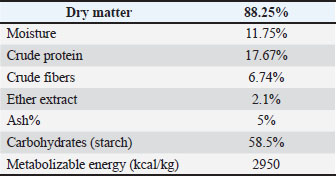
AbstractBackground: Providing a balanced diet is essential to meet the nutritional requirements of animals for optimal health and production. Due to the high cost and limited availability of conventional protein sources, the efficient utilization of available protein resources is necessary. Essential amino acids such as lysine and methionine are key precursors of amino acids used in protein synthesis, growth performance, immune function, and overall metabolic activity in ruminants, resulting in significant nutritional value from increasing their bioavailability with rumen protection modalities. Aim: To examine the effects of protected amino acids on rumen metabolites and nutrient digestibility in Awassi lambs. Methods: The study was conducted at the Department of Animal Production, College of Agriculture, Tikrit University, Iraq, from September 12, 2023, to January 11, 2024. Twelve Awassi lambs with an average weight of 21.79 ± 0.470 kg and an age between 5 and 7 months age was used in this study. The lambs were randomly divided into three treatment groups of (four animals per group). Results: Protected amino acids have a significant effect (p ≤ 0.05) on rumen metabolites. The use of protected amino acids contributed to the reduction of rumen pH after feeding. However, there were no significant differences in ammonia nitrogen (NH3-N) concentration. However, the NH3-N concentration increment was slight. Similarly, protected amino acids had no significant impact (p > 0.05) on the total rumen bacteria count. However, there was a non-significant difference (p > 0.05) in the total number of rumen protozoa. The protected amino acids had a significant effect (p ≤ 0.05) on the digestion coefficient of crude proteins. Conclusion: Protected amino acids contributed to enhancing the rumen environment and crude protein coefficient digestion. Keywords: Growing lambs, Lysine, Methionine, Rumen fluid. IntroductionAwassi sheep are one of the most important and widely distributed breeds in Iraq. Despite extensive research on rumen-protected amino acids in Iraqi literature, limited information is available regarding their effects on rumen fermentation parameters in Awassi lambs under Iraqi production conditions. They are generally characterized by relatively low red meat and milk productivity (Al-Rawi, 2006). However, this breed exhibits a high capacity to adapt to harsh environmental conditions and limited pasture availability (Al-Rawi, 2006; Daoud, 2020; Al-Obaidi et al., 2025). In addition, Awassi sheep have a strong reproductive potential and respond efficiently to management and breeding programs aimed at increasing litter size (Laith et al., 2019; Laith et al., 2019; Najlaa, 2023). The provision of a balanced ration is crucial in providing sufficient energy, protein, minerals, and vitamins for optimal production and health. Green fodder, dry fodder, concentrates, and mineral mixtures are the major sources of these nutrients (Singh et al., 2024). Owing to the high cost and scarcity of conventional protein source feeds, it is essential to efficiently utilize protein resources. Protein is crucial for the reproduction, production, and growth of animals. The type (quality) and amount (quantity) of dietary proteins significantly impact essential amino acid availability for the body (Ajomiwe et al., 2024). Proteins are important in ruminants for supporting effective rumen function and fulfilling the nutritional needs of animals. However, a portion of dietary protein ingested by animals is degraded in the rumen (ruminally degradable protein,) by ruminal anaerobic fermentation, whereas the remaining protein escapes degradation (rumen-undegradable protein, RUP) (Ali et al., 2009; Al-Niaeem et al., 2026). Ruminant animals require two forms of digestible protein: degradable protein, which is utilized by rumen microorganisms to produce microbial protein, and RUP, which is digested in the small intestine for direct absorption (Manoukian et al., 2021; Putri et al., 2021). Rumen-degradable protein plays a crucial role in supporting microbial growth, and the resulting microbial protein represents a major source of metabolic protein (Putri et al., 2021; Millen et al., 2025). Metabolic protein consists of both microbial and by pass proteins. While microbial protein can adequately meet the maintenance requirements of mature cattle, growing animals and lactating cows require supplemental bypass protein to fulfill their higher metabolic protein demands (Wilkerson et al., 1993; Das et al., 2014). Degradation of valuable proteins in the rumen by microorganisms leads to nitrogen losses in the form of urea in urine. Several strategies have been developed to minimize the ruminal degradation of high-quality proteins and reduce excessive ammonia production. These include thermal processing, chemical treatments, suppression of proteolysis activity within the rumen, and the utilization or identification of naturally rumen-protected protein sources (Souza et al., 2022; Bezerra et al., 2025). These approaches help in decreasing energy losses from fermentation and protein losses linked to the conversion of dietary protein into microbial protein (Paredes-Díaz et al., 2024). Supplementation of low-protein diets with protected amino acids has emerged as a cost-effective strategy that can enhance growth performance while mitigating environmental nitrogen pollution (Luo et al., 2025). Lopes et al. (2019)reported that strategic methionine supplementation protected from ruminal Rumen-protected methionine in cattle: influences on reproduction, immune response, and productive performance degradation in cattle, and their influence on aspects related to reproductive efficiency, immune response, and productive performance (Al-Bayati et al., 2024; Shnawa et al., 2025). Harbi Abdul-Noor and Falah Hassan (2021) also reported that supplementing protected amino acids (5 g/kg of feed dose), specifically lysine and methionine, does not normally change blood parameters such as hemoglobin, packed cell volume, red blood cells, or white blood cells, nor does it affect certain metabolic parameters such as triglycerides, cholesterol, and total protein. The combination of these two amino acids enhances the concentrations of glucose and albumin while reducing serum urea levels in lambs. The present study aimed to evaluate the effects of rumen-protected amino acids on rumen fermentation parameters in Awassi sheep. Materials and MethodsExperimental locationThis research was conducted at the livestock farm of the College of Agriculture at Tikrit University in Iraq. Management of experimental animalsThe animals used in this study were experimental lambs purchased from local markets in Salah Al-Din Governorate. Before weighing, the experimental stocks were fasted for 12 hours to stabilize their initial body weight, and the lambs were weighed using an electronic weighing scale. The lambs were allocated to three feeding groups according to body weight containing four lambs of homogeneous average weights. The animals were housed in a semi-open barn divided into individual pens measuring 1.5 × 1.5 m², each equipped with feeders and water drinkers. Experimental designThe experimental animals were offered concentrated feed supplied by the Erbil Feed Company (Table 1). Two weeks of the adaption period has been applied. Both supplements (MetiPEARL®, a rumen-protected or encapsulated D,L-methionine (3c301) at 2 g/head/day, and (LysiGEM®, a rumen-protected or encapsulated L-lysine monohydrochloride (3.2.3.) at 4 g/head/day) were administered orally to each group. The feeding pattern was two ratios daily in the morning and evening with supplemented dry roughage (hay) in addition to green fodder (alfalfa), while ensuring a continuous supply of drinking water. Animals were weighed weekly, and the feed quantity was adjusted based on 3% of body weight. The experimental treatment groups were categorized into three treatment groups. The first treatment, T1 (control). The second treatment, T2, consisted of a concentration feed plus an oral dosage of 2 g/day of methionine. The third treatment, T3, consisted of a concentration feed plus an oral dosage of 4-g lysine head/day. Table 1. Chemical compositions of the basal diet (DM basis).
Collection of the fluid samplesThe rumen fluid samples were collected at the end of the experimental period using a plastic rumen cannula. Fluid aspiration was performed using a 50-ml syringe attached to a plastic stomach tube. Samples were obtained at two time points: immediately before feeding (0 hour) and 4 hours after feeding. Each sample was transferred into labeled plastic test tubes indicating the animal identification number and sampling time. The rumen fluid was then filtered through a fine cloth according to the method described by (De Assis Lage et al., 2020; Xu et al., 2025), and the filtrates were stored frozen (−18°) until further analysis. Measurement of rumen fluid characteristicsThe pHs of the rumen fluid samples were measured directly after collection using a pH meter. The concentration of ammonia nitrogen (NH3-N) in the rumen fluid was determined using 2 ml of the samples, according to the procedures described by (AOAC, 2005; Souza et al., 2013) as follows:
The method for counting protozoa and bacteria, as described by Atlas et al. (1995)involves several steps. The frozen samples were dissolved at room temperature and filtered through a filter paper. They were then diluted nine times. A smear was prepared from this solution onto a glass slide specifically designed for bacterial counting. The smear was dried using heat, after which methylene blue dye was applied and left for 5 minutes. The glass slides were then washed with water and allowed to air dry. The slides were examined using a standard light microscope, and several areas were observed to calculate the average readings. This average was multiplied by the dilution factor to determine the number of bacteria present in cubic centimeters (cm³) of rumen fluids. Total volatile fatty acid (TVFA) concentrations in rumen fluid were analyzed in the Laboratory College of Agricultural University of Tikrit, following the procedure established by Warner (1964).
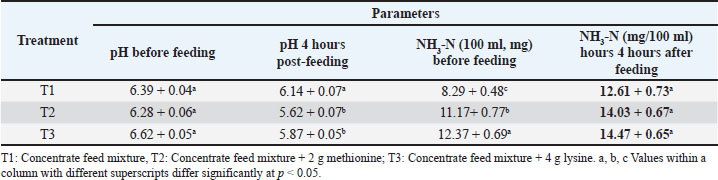
Collection of samples for digestible evaluationA standard digestibility trial was conducted to evaluate the in vivo digestibility of the rations (Pond, 1995). During the final 3 days of the experiment, 20% of the daily feces collected from each animal were composited and stored frozen (−18°) after the total daily fecal output per animal had been measured by weighing. Frozen fecal samples were dried in a forced-air oven at 60°C for 48 hours and then ground. Dry matter, ash, and crude protein analyses were performed on the ground samples (AOAC, 2005). The digestibility coefficients for dry matter, organic matter, and crude protein were subsequently calculated (Pond, 1995). Statistical analysisThe experimental data were statistically analyzed using the SAS software (SAS, 2001). A complete randomized design was used. Data are presented as mean ± SE and were analyzed using one-way analysis of variance. Differences between group means were evaluated using Duncan’s multiple range tests at p ≤ 0.05 (Steel et al., 1997), based on the mathematical model described below: Yij=µ + Ai + eij It represents all of (Yij) represents the view j of transaction i. (µ) is the general mean of the trait under study. (Ai) was the effect of the treatments. (eij) represents the experimental error. Ethical approvalAll procedures involving animals were approved by the Animal Ethics Committee of Tikrit University, Approval No. (Tu. Vet.147). ResultsThe results in Table 2 show that protected amino acids have significantly (p ≤ 0.05) reduced rumen pH after feeding in T2 and T3 compared with T1. The ruminal pH in this study ranged from 5.6 to 6.6 across all lambs. Concerning the concentration of NH₃-N, a numerical increase was noted; however, this difference did not reach statistical significance (p > 0.05). Notably, the concentration of NH₃-N rose in both T2 and T3 after feeding. Table 2. The pH value and ammonia concentration in the rumen fluid of Awassi lambs fed on a concentrate feed mixture with protected amino acids (mean ± standard error).
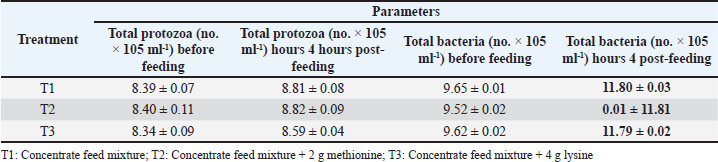
As shown in Table 3, the numbers of protozoa and bacteria were not significantly affected (p > 0.05) by treatments either before or after feeding. A numerical increase was recorded in terms of protozoa and bacteria counts after feeding; however, this difference did not achieve statistical significance (p > 0.05). Table 3. Number of protozoa and bacteria in the rumen fluid of Awassi lambs fed on a concentrate feed mixture with protected amino acids (mean ± standard error).
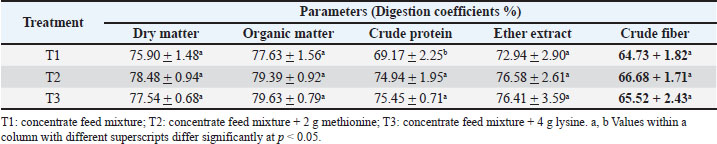
Table 4 shows that TVFA concentrations in rumen fluid were significantly (p ≤ 0.05) affected by protected amino acids after feeding. The effect of protected amino acids on the digestion coefficient is shown in Table 5. There was a significant improvement in the digestion coefficient of nutrient compounds, while there was significantly increased (p ≤ 0.05) in the digestion coefficient of crude protein. Table 4. Concentration of TVFAs in the rumen fluid of Awassi lambs fed on a concentrate feed mixture with protected amino acids (mean ± standard error).
Table 5. Digestion coefficients in Awassi lambs fed on a concentrate feed mixture with protected amino acids (mean ± standard error).
DiscussionThe results in Table 2 show that protected amino acids have significantly (p ≤ 0.05) reduced rumen pH after feeding in T2 and T3 compared with T1. However, a non-significant effect (p > 0.05) on ammonia concentration after feeding was observed. These results are consistent with those of Kamal (2022) who reported similar findings. The ruminal pH values across the post-feeding experimental treatments varied between 5.6 and 6.14, which is marginally below the optimal range of 6.2–7.2 documented in a previous study (Soest, 1994). This difference may be due to the use of concentrate feed. Previous research has shown that the use of concentrated feed can decrease the ruminal pH value (Mao et al., 2016). This may be attributed to the degradation of protected amino acids in the rumen, which are then fermented by the microbiome, leading to a decrease in rumen pH, particularly in high-protein diets (Wang et al., 2024). Regarding the concentration of NH₃-N, a numerical increase was observed; however, the difference was not statistically significant (p > 0.05). The concentration of NH₃-N increased in T2 and T3 after feeding. This may be attributed to the increase in rumen degradable nitrogen, which results in higher concentrations of ruminal NH3-N (Nisa et al., 2008). As shown in Table 3, the numbers of protozoa and bacteria were not significantly affected (p > 0.05) by treatments either before or after feeding, although the numbers of protozoa and bacteria after feeding were higher. These findings conformed to those reported by Wang et al. (2024)in young Holstein bulls. This may be due to the effect of rumen pH value and high protein intake (Dai and Faciola, 2019). Table 4 shows that TVFA concentrations in rumen fluid were significantly (p ≤ 0.05) affected by protected amino acids after feeding. Where (T3) recorded the highest (9.76 ±0.86) TVFAs post-feeding compared to other treatments. This result is consistent with those of Galip (2006), Pereira et al. (2017). This may be due to the increase in the availability of fermentable substrates, primarily dietary carbohydrates, for the microbes in the rumen as forage levels increased. Higher forage levels provide more carbohydrates, which enhances microbial fermentation and activity, leading to greater overall fermentation in the rumen (Liu et al., 2021). The effect of protected amino acids on digestion coefficient is shown in Table 5. There was a statistical improvement in the digestion coefficient of nutrient compounds, while there was significantly increased (p ≤ 0.05) in the digestion coefficient of crude protein in all groups. These findings agree with those of (Ali et al., 2009), who reported similar findings. ConclusionIn conclusion, under the conditions of this study, rumen-protected amino acids (methionine and lysine) improved crude protein digestibility and influenced rumen fluid pH. Protected methionine also significantly affects TVFA concentration. Further studies with larger sample sizes and performance measurements are required. AcknowledgmentsWe wish to extend our heartfelt thanks to all the staff at the College of Agriculture, Department of Animal Production, University of Tikrit, for their invaluable support. Conflict of interestThe authors have no conflicts of interest to declare. FundingNo grant was received for this study, and it has been self-funded. Authors’ contributionsAmer I. Ali was the corresponding author for this article. Mohaniman A. Alsalam and Salih N. Hussein were responsible for animal care. Umar M. Sani and Mohammed S. Mohammed were responsible for sample collection, study observations, and research management. The article was written equally by the authors. Data availabilityAll data are provided in the revised manuscript. ReferencesAjomiwe, N., Boland, M., Phongthai, S., Bagiyal, M., Singh, J. and Kaur, L. 2024. Protein nutrition: understanding structure, digestibility, and bioavailability for optimal health. Foods 13(11), 1771. Al-Bayati, H.H.K., Abdullah, S.A., Shihab, T.J., Sultan, M. and Jumaa, Q.S. 2024. Immunogenicity of culture filtrated proteins and whole-cell killed formalin of Listeria monocytogenes to induced cellular immune response in vivo. Open Vet. J. 14(12), 3581–3598. Ali, C.S., Din, M., Sharif, M., Nisa, A. and Sarwar. 2009. Supplementation of ruminally protected proteins and amino acids: feed consumption, digestion and performance of cattle and sheep. Int. J. Agric. Biol. 11(4), 477–482. Al-Niaeem, S., Al-kanani, H., Resen, K., Jumma, S. and Abd, A. 2026. Use of medicinal plants and plant extracts as nutritional and immunological additives in aquaculture: a review study. Open Vet. J. 16(1), 15–25. Al-Obaidi, M.A., Naji, I.Q. and Abd, A.A. 2025. Manipulating seasonality by using PMSG and Kisspeptin hormones and the impact of the MTNR1A gene on reproduction efficiency in ewes. Open Vet. J. 15(8), 3571–3579. Al-Rawi, A.A. 2006. The project of producing improved Awassi rams: reality and future prospects. J. Agricult. Investment. IV(IV), 109–114. AOAC. 2005. Association of Official Analytical Chemist, Official Methods of Analysis, 18th ed. Gaithersburg, MD: AOAC International. Atlas, R.M., Brown, A.E. and Parks, L.C. 1995. Laboratory manual of experimental microbiology (1st ed.). St. Louis, MO: Mosby. Bezerra, L.R., Mazza, P.H.S., Lucena, K.H.D.O.S.D., Amorim, M.A.F., Moura, J.F.P.D., Oliveira, J.P.F.D., Oliveira, R.L., Barbosa, A.M., Fonseca, M.A. and Pereira Filho, J.M. 2025. Slow-release urea technologies: effects on nitrogen utilization and small ruminant performance. Ruminants 5(4), 50. Dai, X. and Faciola, A.P. 2019. Evaluating strategies to reduce ruminal protozoa and their impacts on nutrient utilization and animal performance in ruminants - a meta-analysis. Front. Microbiol. 10, 2648. Daoud, R.N. 2020. Effect of using sunflower meal as a protein source replacing soybean meal on milk production, milk components, and some blood traits in Awassi ewes. J. Agricult. Environ. Vet. Sci. 4(4), 1–10. Das, L.K., Kundu, S.S., Kumar, D. and Datt, C. 2014. Metabolizable protein systems in ruminant nutrition: a review. Vet. World. 7, 622–629. De Assis Lage, C.F., Räisänen, S.E., Melgar, A., Nedelkov, K., Chen, X., Oh, J., Fetter, M.E., Indugu, N., Bender, J.S., Vecchiarelli, B., Hennessy, M.L., Pitta, D. and Hristov, A.N. 2020. Comparison of two sampling techniques for evaluating ruminal fermentation and microbiota in the planktonic phase of rumen digesta in dairy cows. Front. Microbiol. 11, 618032. Galip , N. 2006. Effects of dietary Saccharomyces cerevisiae live yeast culture supplementation on ruminal digestion and protozoa count in rams fed with diets with low or high ratio forage/concentrate. Revue Med. Vet. 157(12), 609–613. Harbi Abdul-Noor, Y. and Falah Hassan, A. 2021. The effect of adding protected amino acids in the rumen (methionine and lysine and their mixtures) on some physiological characteristics of male Arabi lambs. Diyala. Agricult. Sci. J. 13(2), 16–23. Kamal, N. 2022. Effect of dietary protected lysine supplementation on milk yield, composition and some blood and rumen parameters in local ewes. Iraqi. J. Agricult. Sci. 53(6), 1317–1324. Laith, S.Y., Saad, T.R. and Ali, A.A. 2019. Effect of polymorphism G (129) R in growth differentiation factor 9 gene (GDF9) on Awassi ewes that breed out of season. Biochem. Cellular. Arch. 19(2), 4649–4653. Liu, H., Yang, G., Degen, A., Ji, K., Jiao, D., Liang, Y., Xiao, L., Long, R. and Zhou, J. 2021. Effect of feed level and supplementary rumen protected lysine and methionine on growth performance, rumen fermentation, blood metabolites and nitrogen balance in growing Tan lambs fed low protein diets. Anim. Feed Sci. Technol. 279, 115024. Lopes, M.G., Dominguez, J.H.E., Corrêa, M.N., Schmitt, E. and Fischer, G. 2019. Rumen-protected methionine in cattle: influences on reproduction, immune response, and productive performance. Arq. Instituto Biol. 86, e1292018 Luo, Z., Ou, H., Tan, Z. and Jiao, J. 2025. Rumen-protected methionine and lysine supplementation to the low protein diet improves animal growth through modulating colonic microbiome in lambs. J. Anim. Sci. Biotechnol. 16(1), 46. Manoukian, M., Delcurto, T., Kluth, J., Carlisle, T., Davis, N., Nack, M., Wyffels, S., Scheaffer, A. and Van Emon, M. 2021. Impacts of rumen degradable or undegradable protein supplementation with or without salt on nutrient digestion, and VFA concentrations. Animals 11(11), 3011. Mao, S.Y., Huo, W.J. and Zhu, W.Y. 2016. Microbiome–metabolome analysis reveals unhealthy alterations in the composition and metabolism of ruminal microbiota with increasing dietary grain in a goat model. Environ. Microbiol. 18(2), 525–541. Millen, D.D., Virgínio, G.F., Alves, F.F., Schwab, C.G. and Calsamiglia, S. 2025. Influence of dietary and ruminal factors on microbial and non-microbial nitrogen flows to the small intestine in lactating dairy cows: a meta-analysis. Dairy 6(6), 66. Najlaa, S.I. 2023. Induction of oestrus by sulpiride and measurement of estrogen hormone in Iraqi Awassi Ewes during the out of breeding season. Indian. Vet. J. 100(12), 15–18. Nisa, M., Javaid, A., Shahzad, M.A. and Sarwar, M. 2008. Influence of varying ruminally degradable to undegradable protein ratio on nutrient intake, milk yield, nitrogen balance, conception rate and days open in early lactating Nili-Ravi buffaloes (Bubalus bubalis). Asian-Aust. J. Anim. Sci. 21(9), 1303–1311. Paredes-Díaz, D., Manríquez-Núñez, O.M., Montaño-Gómez, M.F., Ávila-Castañeda, D. and Ramírez-Bribiesca, J.E. 2024. Methods to improve the fraction of nondegradable protein in the rumen: a review. Agro Productividad 17(9), 101–107. Pereira, A.B.D., Whitehouse, N.L., Aragona, K.M., Schwab, C.S., Reis, S.F. and Brito, A.F. 2017. Production and nitrogen utilization in lactating dairy cows fed ground field peas with or without ruminally protected lysine and methionine. J. Dairy Sci. 100(8), 6239–6255. Pond, W.G., Church, D.C. and Pond, K.R. 1995. Measurement of feed and nutrient utilization and requirements in animals. In: Basic Animal Nutrition and Feeding (4th ed). New York, NY: John Wiley & Sons, pp: 49–63. Putri, E.M., Zain, M., Warly, L. and Hermon, H. 2021. Effects of rumen-degradable-to-undegradable protein ratio in ruminant diet on in vitro digestibility, rumen fermentation, and microbial protein synthesis. Vet. World. 14(3), 640–648. SAS. 2001. STAT user’s guide for personal computers, release 6.12. Cary, NC: SAS Institute Inc. Shnawa, S., Abd, A. and Jumma, Q. 2025. Impact of licorice extract on reproductive performance during anestrus season in local Iraqi goats. Alexandria. J. Vet. Sci. 87, 252–258. Singh, N., Gupta, R., Awasthi, A. and Kumar, V. 2024. Feeding balanced ration for improving dairy cattle productivity: a review. J. Biol. Nature 16, 26–31. Soest, P.V. 1994. Nutritional ecology of the ruminant, 2nd ed. Ithaca, NY: Cornell University Press, p: 476. Souza, M.G., Reis, I.A., Carvalho, I.P.C., Porcionato, M.A.F., Prados, L.F., Granja-Salcedo, Y.T., Siqueira, G.R. and Resende, F.D. 2022. Effects of post-ruminal urea supplementation during the seasonal period on performance and rumen microbiome of rearing grazing Nellore cattle. Animals. Open. Access. J. From. MDPI. 12(24), 3463. Souza, N., Detmann, E., Valadares, F., Costa, V., Pina, D. and Mantovani, H. 2013. Accuracy of the estimates of ammonia concentration in rumen fluid using different analytical methods. Exatidão das estimativas de concentração de amônia em fluido ruminal utilizando diferentes métodos analíticos. Arq. Bras. Med. Vet. Zootec. 65, 1752–1758. Steel, R.G., Torrie, J.H. and Dickey, D.A. 1997. Principles and procedures of statistics: a biometrical approach (3rd ed.). New York, NY: John Wiley & Sons. Wang, H., Fu, J., Wu, X., Wang, Y., Li, W., Huang, Y., Zhong, J. and Peng, Z. 2024. Effects of dietary protein level and rumen-protected methionine and lysine on growth performance, rumen fermentation and serum indexes for Yaks. Animals 14(12), 1751. Warner, A.C. 1964. Production of volatile fatty acids in the rumen: methods of measurement. Nutr. Abstr. Rev. 34, 339–352. Wilkerson, V.A., Klopfenstein, T.J., Britton, R.A., Stock, R.A. and Miller, P.S. 1993. Metabolizable protein and amino acid requirements of growing cattle. J. Anim. Sci. 71(10), 2777–2784. Xu, J., Wang, X. and Niu, H. 2025. Effects of corn straw-based fermented total mixed rations supplemented with exogenous cellulase on growth performance, digestibility, and rumen fermentation in growing beef cattle. Anim. Biosci. 38(2), 293–302. | ||



| How to Cite this Article |
| Pubmed Style Ali AI, Alsalam MA, Hussein SN, Sani UM, Mohammed MS. Impact of protected amino acid supplementation on rumen fermentation parameters and nutrient digestibility in Awassi lambs. Open Vet. J.. 2026; 16(6): 3671-3677. doi:10.5455/OVJ.2026.v16.i6.38 Web Style Ali AI, Alsalam MA, Hussein SN, Sani UM, Mohammed MS. Impact of protected amino acid supplementation on rumen fermentation parameters and nutrient digestibility in Awassi lambs. https://www.openveterinaryjournal.com/?mno=306501 [Access: June 26, 2026]. doi:10.5455/OVJ.2026.v16.i6.38 AMA (American Medical Association) Style Ali AI, Alsalam MA, Hussein SN, Sani UM, Mohammed MS. Impact of protected amino acid supplementation on rumen fermentation parameters and nutrient digestibility in Awassi lambs. Open Vet. J.. 2026; 16(6): 3671-3677. doi:10.5455/OVJ.2026.v16.i6.38 Vancouver/ICMJE Style Ali AI, Alsalam MA, Hussein SN, Sani UM, Mohammed MS. Impact of protected amino acid supplementation on rumen fermentation parameters and nutrient digestibility in Awassi lambs. Open Vet. J.. (2026), [cited June 26, 2026]; 16(6): 3671-3677. doi:10.5455/OVJ.2026.v16.i6.38 Harvard Style Ali, A. I., Alsalam, . M. A., Hussein, . S. N., Sani, . U. M. & Mohammed, . M. S. (2026) Impact of protected amino acid supplementation on rumen fermentation parameters and nutrient digestibility in Awassi lambs. Open Vet. J., 16 (6), 3671-3677. doi:10.5455/OVJ.2026.v16.i6.38 Turabian Style Ali, Amer Ibrahim, Mohaniman A. Alsalam, Salih N. Hussein, Umar M. Sani, and Mohammed S. Mohammed. 2026. Impact of protected amino acid supplementation on rumen fermentation parameters and nutrient digestibility in Awassi lambs. Open Veterinary Journal, 16 (6), 3671-3677. doi:10.5455/OVJ.2026.v16.i6.38 Chicago Style Ali, Amer Ibrahim, Mohaniman A. Alsalam, Salih N. Hussein, Umar M. Sani, and Mohammed S. Mohammed. "Impact of protected amino acid supplementation on rumen fermentation parameters and nutrient digestibility in Awassi lambs." Open Veterinary Journal 16 (2026), 3671-3677. doi:10.5455/OVJ.2026.v16.i6.38 MLA (The Modern Language Association) Style Ali, Amer Ibrahim, Mohaniman A. Alsalam, Salih N. Hussein, Umar M. Sani, and Mohammed S. Mohammed. "Impact of protected amino acid supplementation on rumen fermentation parameters and nutrient digestibility in Awassi lambs." Open Veterinary Journal 16.6 (2026), 3671-3677. Print. doi:10.5455/OVJ.2026.v16.i6.38 APA (American Psychological Association) Style Ali, A. I., Alsalam, . M. A., Hussein, . S. N., Sani, . U. M. & Mohammed, . M. S. (2026) Impact of protected amino acid supplementation on rumen fermentation parameters and nutrient digestibility in Awassi lambs. Open Veterinary Journal, 16 (6), 3671-3677. doi:10.5455/OVJ.2026.v16.i6.38 |


