





| Research Article | ||
Open Vet. J.. 2026; 16(6): 3357-3366 Open Veterinary Journal, (2026), Vol. 16(6): 3357-3366 Research Article Effectiveness of Ketapang (Terminalia cattapa Linn.) extract as a feed additive on performance, erythrocyte and hemoglobin levels in broiler chickensKadek Rachmawati1*, Kuncoro Puguh Santoso1, Emy Koestanti Sabdoningrum2, Rochmah Kurnijasanti1, Aswin Rafif Khairullah3 and Nanik Hidayatik11Department of Basic Veterinary Medicine, Faculty of Veterinary Medicine, Universitas Airlangga, Surabaya, Indonesia 2Department of Animal Husbandry, Faculty of Veterinary Medicine, Universitas Airlangga, Surabaya, Indonesia 3Research Center for Veterinary Science, National Research and Innovation Agency (BRIN), Bogor, Indonesia *Corresponding Author: Kadek Rachmawati. Department of Basic Veterinary Medicine, Faculty of Veterinary Medicine, Universitas Airlangga, Surabaya, Indonesia. Email: kadek-r [at] fkh.unair.ac.id Submitted: 17/01/2026 Revised: 22/04/2026 Accepted: 04/05/2026 Published: 05/06/2026 © 2025 Open Veterinary Journal
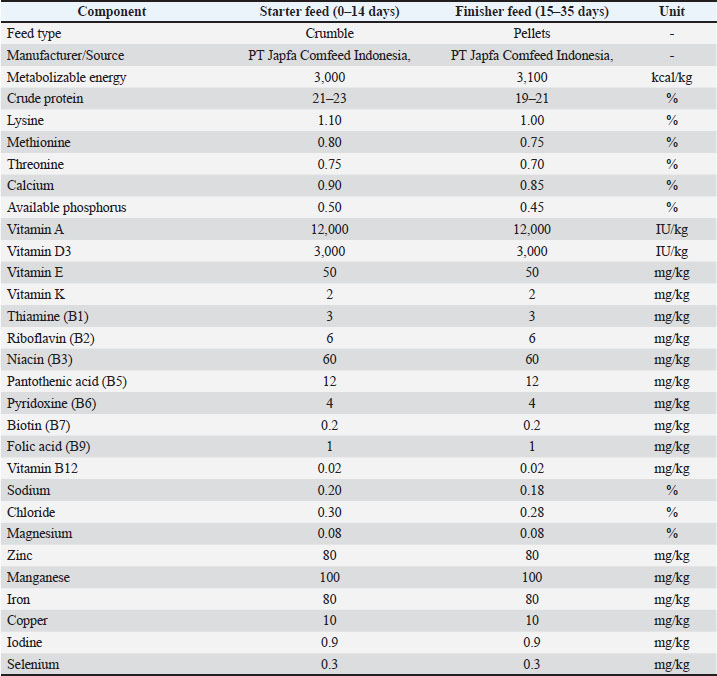
AbstractBackground: Ketapang (Terminalia catappa Linn.) leaves contain bioactive compounds, such as flavonoids, tannins, and saponins, which act as antioxidants, antimicrobials, and immunostimulants. These compounds may serve as an ecofriendly alternative to antibiotic growth promoters in broilers. Previous studies focused mainly on growth, leaving a gap in additional growth indices and hematological assessments. Aim: This study evaluated the effects of 5%, 10%, and 15% Ketapang leaves (KL) extract administered orally as a supplement (w/v of dosing solution) on growth performance [percent daily gain, protein efficiency ratio, feed conversion ratio (FCR), and survival rate] and blood parameters (erythrocyte count and hemoglobin concentration) in broilers. Methods: Twenty male broilers (21 days old, n=5 per group) were assigned to four groups: control (P0) and KL extract doses of 5% (P1), 10% (P2), and 15% (P3) orally for 14 days. Data were analyzed using one-way analysis of variance with Tukey’s honest significant difference post-hoc test. Results: The KL extract significantly (p < 0.05) improved the measured growth and hematological parameters, with highly significant effects observed for weight gain, FCR, erythrocyte count, and hemoglobin concentration (p < 0.01). The FCR values were 1.78 (P0), 1.61 (P1), 1.52 (P2), and 1.67 (P3). The weight gain increased by 14%, 18%, and 10% for P1, P2, and P3, respectively, relative to the control. Erythrocyte counts increased from 2.22 × 10⁶/mm³ (P0) to 2.50 × 10⁶/mm³ (P1), 2.96 × 10⁶/mm³ (P2), and 2.37 × 10⁶/mm³ (P3), while hemoglobin increased from 7.28 g/dl (P0) to 8.07 g/dl (P1), 9.05 g/dl (P2), and 7.87 g/dl (P3). Regression and correlation analyses confirmed that 10% KL extract (P2) was the optimal dose. Conclusion: The 10% KL extract was well tolerated under the conditions of this short-term 14-day study and was associated with improved growth performance and hematological parameters. Further studies with larger sample sizes and extended observation periods are needed to confirm the long-term efficacy and safety of this drug. Keywords: Blood, Broiler, Feed additive, Performance of chicken, Terminalia cantata Linn. IntroductionIn Indonesia, the poultry industry is a crucial sector in providing fast and efficient animal protein (Lokapirnasari et al., 2024). Broiler chickens are a leading commodity due to their rapid growth, efficient feed conversion, and high market demand (Riber and Wurtz, 2024). However, maintaining optimal growth performance amidst stress factors, feed quality, and potential pathogen infection is the main challenge in broiler farming (Oke et al., 2024). Therefore, strategies to increase broiler productivity rely not only on conventional feed formulations but also on natural feed additives that function as immunostimulants, antioxidants, and metabolism boosters (Obianwuna et al., 2024). Antibiotic growth promoters (AGPs) have been widely used as feed additives to improve broiler performance (Paul et al., 2022). However, their use has been restricted or banned in several countries, including Indonesia, due to their potential to trigger antimicrobial resistance (AMR) and leave harmful residues in livestock products (Pasaribu et al., 2024). Recent surveillance data from Nigeria have reported an increasing prevalence of multidrug-resistant Escherichia coli and Salmonella spp. isolated from poultry farms, highlighting the contribution of antimicrobial misuse in livestock production to AMR emergence (Ajibola et al., 2025). This has prompted the search for safe, effective, and sustainable natural alternatives, particularly following the European Union ban on AGPs in 2006 and increasing reports of AMR bacteria in poultry (WHO, 2017). The extract of Ketapang leaves (KL) (Terminalia catappa Linn.), a tropical plant widely grown in Southeast Asia, is one potential candidate (Ramanan S et al., 2025). KL extract contains bioactive compounds, such as flavonoids (e.g., quercetin and kaempferol derivatives), hydrolyzable tannins (e.g., punicalagin and corilagin), saponins, and alkaloids, which act as antioxidants and immunomodulators relevant to blood health and growth performance in broilers (Mwangi et al., 2024; Gulcin, 2025). Antioxidant activity protects erythrocytes from oxidative damage, while tannins and flavonoids may improve nutrient absorption and intestinal health by modulating gut microbiota and digestive enzyme activity, supporting growth indices measured in this study (Xu et al., 2022). Erythrocytes and hemoglobin are key indicators of broiler physiological status and health (Nwaigwe et al., 2020). Blood hematobiochemical parameters reveal immune-related conditions and overall wellness (Chaparro and Suchdev, 2019; Zálešáková et al., 2025). Evaluating these parameters provides an objective picture of the effects of feed additives on broiler physiology (Yuanita et al., 2023). KL extract can improve performance and hematological status in other animals, such as tilapia and catfish, by increasing hemoglobin and erythrocyte levels and reducing oxidative stress (Sanda Lembang et al., 2023; Zarqa et al., 2023). Prior research examined Terminalia catappa Linn. leaves’ effects on growth performance in broilers, but primarily measured feed intake, body weight gain, and feed conversion ratio (FCR) without assessing additional growth indices [percent daily gain (PDG), protein efficiency ratio (PER), FCR, and survival rate] or evaluating hematological parameters beyond erythrocyte and hemoglobin values (Mirino et al., 2025). However, limited information is available regarding its effects on additional growth indices, including PDG, PER, FCR, and survival rate, as well as key hematological responses represented by erythrocyte count and hemoglobin concentration. Furthermore, the optimal oral dose and the relationship between broiler growth performance and hematological responses remain unclear (Suprijatna et al., 2025). This gap highlights the novelty of the present study, which comprehensively evaluates graded doses of KL extract on both advanced growth performance indices and hematological profiles in broiler chickens, followed by correlation and regression analyses to determine the optimal dose-response relationship. Therefore, this study was conducted to evaluate the effects of graded doses of KL extract on growth performance (% weight gain, PDG, PER, FCR, and survival rate) and hematological parameters (erythrocyte count and hemoglobin concentration) in broilers. Statistical, Pearson correlation, and regression analyses were performed to determine the optimum dose of aqueous solution. Materials and MethodsPlace and time of the researchThis research was conducted in the experimental animal cage of the Faculty of Veterinary Medicine, Airlangga University, and the Pharmacology Laboratory, Airlangga University, from October 2024 to December 2024. The environmental conditions were strictly controlled: temperature, 28°C–32°C; relative humidity, 55%–65%; and a 16 hours light:8 hours dark cycle. To maintain air circulation, the cages were ventilated using a mechanical forced-air system. The stocking density was 10 birds/m², and the battery cages measured 120 × 60 × 50 cm (length × width × height), providing adequate space per bird according to the National Research Council (NRC) standard guidelines (NRC, 1994). The environmental conditions were monitored daily using a digital thermometer and hygrometer. Ketapang extract5 kg of KL from Tawangmangu, Central Java, Indonesia were authenticated from the Center for Research and Development of Medical Plants and Traditional Medicines (voucher specimen: B2P2TOOT). Fresh leaves (5 kg) were washed and oven-dried at 50°C (Memmert UN55, Germany) for 7 days until they reached a constant weight. Dry simplicia powder (0.5 kg) was obtained after drying, corresponding to a 10% dry weight yield relative to fresh leaves. The dried material was ground into powder and soaked in 2 l of 96% ethanol for 3 days with occasional stirring (maceration method). The extract solution was filtered through a sterile muslin cloth followed by Whatman No. 1 filter paper and evaporated using a rotary evaporator at 50°C under reduced pressure to obtain a thick brown extract. The extract yield was 18% (w/w). Phytochemical analysis revealed total phenolics (45 mg GAE/g extract), total flavonoids (22 mg QE/g extract), tannins (15 mg/g extract), and saponins (10 mg/g extract). The major bioactive compounds were further quantified using high-performance liquid chromatography (Shimadzu LC-20AT, C18 column, detection at 280 nm). Gas Chromatography–Mass Spectrometry analysis identified additional phenolic acids and terpenoid constituents. Quality control included duplicate extraction, yield calculation, and validation against reference standards. Doses (5%, 10%, and 15%) are expressed as w/v (g extract per 100 ml solution) (Harborne, 1998; Azwanida, 2015). Monitoring of health and mortalityAll birds were monitored daily for disease clinical signs, behavioral changes, and overall health status throughout the study. Body condition was scored weekly based on a scale of 1–5, where 1 indicates emaciated and 5 indicates obese, following standard guidelines (Kestin et al., 1992). Feed and water intake, activity levels, feather condition, and signs of distress (panting, lethargy, and abnormal posture) were recorded. No mortality occurred in any group during the 14-day treatment period (days 21–35). All birds maintained normal body condition scores (3–4), were active, exhibited normal feeding behavior, and showed no clinical signs of disease, indicating that supplementation with 5%, 10%, and 15% KL extract was well tolerated. Treatment of broiler chickens withDay-old male broilers were kept in brooder cages until they were 14 days old and fed commercial starter feed ad libitum. All broilers were provided with a commercial basal diet consisting of starter feed from days 0–14 and finisher feed from days 15–35. Table 1 presents the detailed composition and nutrient content of both diets, including metabolizable energy, crude protein, amino acids, minerals, and vitamin premix. At 15 days of age, 20 birds were randomly assigned to four groups (n=5 per group). The birds were acclimated for 7 days before treatment. Table 1. Composition and nutrient content of the basal diets (starter and finisher) used in the broiler study.
At 21 days of age, the KL extract was freshly prepared daily and dissolved in 1% Carboxymethyl Cellulose (CMC)-Na as a suspending agent. Dosing solutions were prepared at concentrations of 5 g/100 ml (5%), 10 g/100 ml (10%), and 15 g/100 ml (15%) w/v. Each bird received 1 ml of solution per 100-g body weight via oral gavage once daily at 08:00 AM for 14 consecutive days (days 21–35). Thus, the administered doses were equivalent to approximately 500 mg/kg body weight (BW) (P1), 1,000 mg/kg BW (P2), and 1,500 mg/kg BW (P3), adjusted weekly according to individual BW measurements to maintain accurate mg/kg BW dosing. The control group (P0) received an equivalent volume of 1% CMC-Na without extract via oral gavage under identical handling conditions. Daily health monitoring was performed, and no mortality occurred (Siddik et al., 2022; Das et al., 2024; Nag et al., 2025). Growth performance parametersCalculated as previously described. The survival rate was 100% across all groups, consistent with the absence of morbidity or mortality (Li et al., 2024). The following parameters were calculated from feed consumption and weight gain:
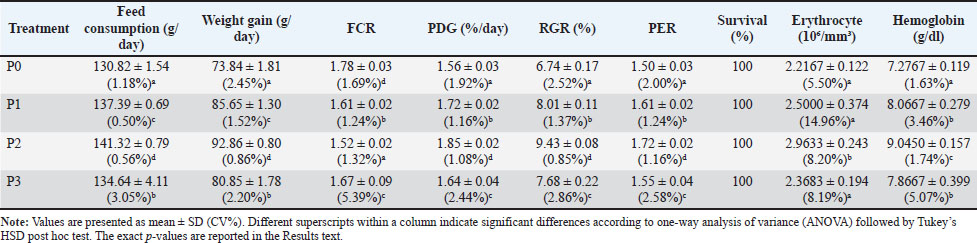
Hematological measurementsOn day 35, the birds were fasted for 4 hours before blood collection to minimize postprandial variations. Blood samples were collected from the brachial vein between 08:00 and 09:00 using sterile syringes containing Ethylenediaminetetraacetic Acid as an anticoagulant. Immediately after collection, blood was gently mixed with the anticoagulant and stored at 4°C until analysis, which was performed within 2 hours of sampling. Erythrocyte measurementErythrocyte counting was performed using a Neubauer hemocytometer after dilution according to standard procedures. Counting was performed in duplicate, and the results were expressed as × 10⁶/mm³ (MG Science Institute, 2021). Hemoglobin measurementThe cyan-methemoglobin method (Drabkin’s reagent) is considered standard. Briefly, 5 ml of Drabkin’s reagent was prepared in a clean test tube, and 20 µl of whole blood was added and gently mixed to ensure complete hemolysis. The mixture was incubated at room temperature (25°C–27°C) for 5–10 minutes. A blank reagent (Drabkin’s reagent without blood) was prepared simultaneously. The absorbance of the sample and blank was measured at 540 nm using a UV–Vis spectrophotometer (Shimadzu UV-1800, Shimadzu Corporation, Kyoto, Japan). A commercially prepared standard cyanmethemoglobin solution was used to generate a calibration curve. The standard solutions at 2, 4, 6, 8, and 10 g/dl were measured in triplicate, and a linear regression equation (y=m•x + b, where y=absorbance and x=hemoglobin concentration) was calculated for each assay. Quality control included duplicate measurements of all samples, periodic remeasurement of standards, and verification of linearity (R² > 0.99) before sample analysis. The hemoglobin concentration of each sample was calculated from the standard curve and expressed in g/dl. Analysis was completed within 2 hours of blood collection to ensure sample integrity (Whitehead RD Jr et al., 2019). Statistical analysisData were analyzed using SPSS v25.0. The normality of the residuals was assessed using the Shapiro–Wilk test, and the variance homogeneity was tested using Levene’s test. One-way analysis of variance was applied for group comparisons; when significant (p < 0.05), Tukey’s honestly significant difference (HSD) post hoc test was used. Superscript letters (a, b, and c) indicate significant differences between treatment means at p < 0.05. Exact p-values are reported where appropriate, and 95% CIs are provided. The effect sizes (partial η²) were calculated to quantify the magnitude of the treatment effects. Pearson correlation and regression analyses were performed to determine the relationships and identify the optimal dose. Statistical power was considered limited due to the small sample size (n=5 per group), which is acknowledged as a limitation of the study. Ethical approvalThe Animal Care and Use Committee, Airlangga University, approved this study (Ethical number: 223/HRECC.FODM/III/2023). All experimental procedures, including animal housing and management, oral gavage administration of Ketapang extract, blood collection from the brachial vein, daily health monitoring, and implementation of humane endpoints to minimize distress, were reviewed and approved. ResultsGrowth performanceThe effects of KL extract on broiler growth performance and hematological parameters are presented in Table 2. The initial body weight at day 21 was 520 ± 10 g/bird across all groups; the final body weight at day 35 ranged from 1,038 ± 15 g (P0) to 1,220 ± 12 g (P2).
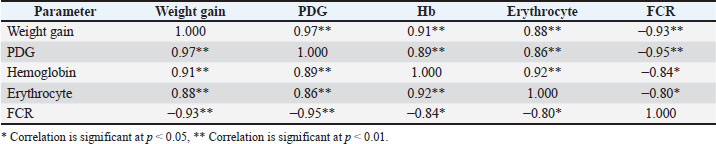
Table 2. Growth performance and hematological parameters of broilers treated with KL extract (mean ± SD). The highest feed consumption was observed in P2 (10% KL extract), followed by P1 (5%) and P3 (15%), whereas the control group (P0) had the lowest intake. Statistical analysis was performed using one-way analysis of variance followed by Tukey’s HSD post-hoc test. One-way ANOVA revealed significant treatment effects on feed consumption (p=0.0003), weight gain (p=0.0001), FCR (p=0.0002), PDG (p=0.0001), RGR (p=0.0001), and PER (p=0.0002). The superscript letters indicate significant pairwise differences. Gain in body weight and growth efficiencyWeight gain, PDG, RGR, and protein efficiency ratio (PER) were calculated from feed intake and weight measurements. The P2 group exhibited the highest performance across all parameters. The FCR was lowest in P2 (1.52), indicating higher feed efficiency, while P0 had the highest FCR (1.78). The survival rate was 100% in all groups. The CV% ranged from 0.56% to 3.05% for growth parameters, indicating low within-group variability and good experimental consistency. Abbreviations: FCR=feed conversion ratio; PDG=percent daily gain; RGR=relative growth rate; PER=protein efficiency ratio; DFI=daily feed intake. Hematological parametersBlood parameters, including erythrocyte count and Hemoglobin (Hb) concentration, were analyzed. The erythrocyte and hemoglobin values remained within the reference ranges for broilers. P2 had the highest erythrocyte count and hemoglobin levels (2.963 × 10⁶/mm³ and 9.045 g/dl, respectively). One-way ANOVA demonstrated significant treatment effects for erythrocyte count (p=0.0014) and Hb concentration (p=0.0008). The erythrocyte and hemoglobin CV% values ranged from 4.1% to 14.9%, reflecting moderate biological variation. Correlation and regression analysis resultsPearson’s correlation analysis revealed strong positive associations between weight gain, PDG, and hematological parameters. Regression analysis indicated that 10% KL extract (P2) was the optimal dose for maximal growth and hematological response. The Pearson’s correlation coefficients between growth performance and hematological parameters are presented in Table 3.
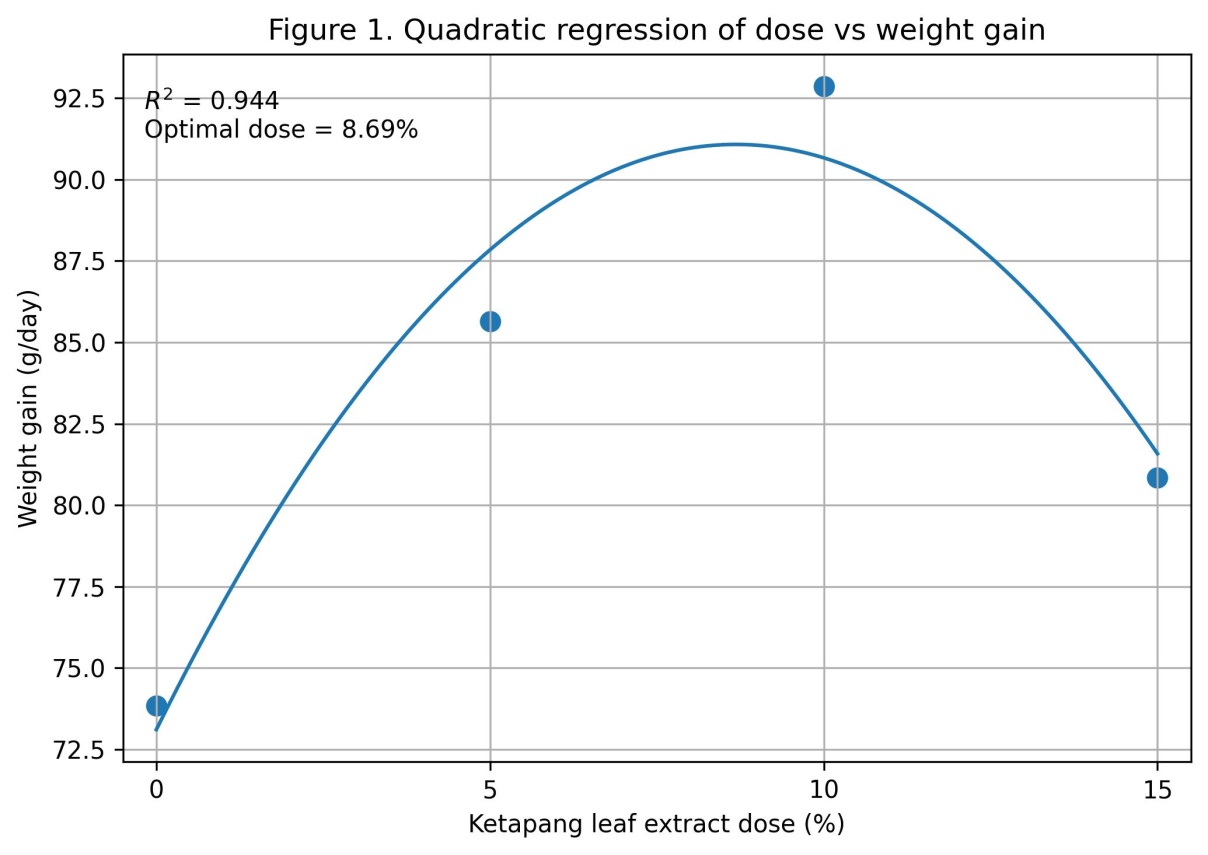
Table 3. Pearson correlation coefficients. Pearson’s correlation analysis demonstrated strong positive correlations between weight gain and PDG (r=0.97, p < 0.001), hemoglobin (r=0.91, p=0.002), and erythrocyte count (r=0.88, p=0.004). The FCR showed a strong negative correlation with weight gain (r=−0.93, p=0.001) and PDG (r=−0.95, p < 0.001), indicating improved feed efficiency at higher growth performance. Linear regression analysis between KL extract dose and weight gain demonstrated a quadratic dose-response trend, with the optimal response observed at the 10% dose (P2). Figure 1 shows the quadratic regression analysis illustrating the effect of KL extract dose on broiler weight gain.
Fig. 1. Quadratic regression analysis showing the relationship between dose of KL extract (%) and weight gain (g/day) in broilers. The highest predicted growth response was observed at approximately 10% supplementation. DiscussionThe administration of KL extract (Terminalia catappa Linn.) as a feed additive significantly affected the growth performance of broiler chickens, including feed consumption, weight gain, feed conversion, blood erythrocyte, and hemoglobin levels. The initial body weight at day 21 was 520 ± 10 g/bird, and the final body weight at day 35 was P0=1,038 ± 15 g, P1=1,180 ± 12 g, P2=1,220 ± 12 g, and P3=1,140 ± 15 g. The 10% dose (P2) showed the most favorable overall growth and hematological outcomes among the tested groups under the conditions of this 14-day study. All statistical comparisons were based on one-way analysis of variance followed by Tukey’s HSD post-hoc test. Effect of ketapang extract on production performanceThe significant increase in feed consumption in the treatment groups indicates that the KL extract was associated with higher voluntary feed intake than the control. Mechanistically, KL extract contains flavonoids, tannins, and saponins, which may modulate gut microbiota, stimulate digestive enzymes, and reduce oxidative stress, potentially improving nutrient absorption and metabolic efficiency. However, these mechanisms were not directly measured in this study and are discussed only as proposed mechanisms based on previous literature (Allyn et al., 2018; Chen et al., 2022; Lemoni et al., 2025). Low-dose tannins can further stimulate digestive enzyme secretion and improve microflora balance, supporting better feed use (Xu et al., 2022). The P2 group showed the highest feed consumption, weight gain, PDG, RGR, and PER and the lowest FCR, indicating improved feed conversion efficiency and growth performance at this optimal dose. The slight decline in performance at the 15% dose (P3) may reflect reduced palatability and gut tolerance due to higher antinutrient content (tannins and saponins), which could manifest as lower feed intake and slower growth, although no clinical signs of physiological stress were observed during daily monitoring (Esenbuga and Ekinci, 2023; Sharma et al., 2023). However, specific digestive tolerance parameters were not evaluated and therefore cannot be interpreted conclusively. Regression analysis confirmed that 10% KL extract is the optimal supplementation level for maximizing growth and hematological outcomes. Influence on erythrocyte levelsErythrocyte levels are key indicators of oxygen transport capacity and overall blood health (Mairbäurl and weber, 2012; Paarvanova et al., 2023). P2 significantly increased erythrocyte counts (2.96 × 10⁶/mm³, p < 0.05), whereas P1 and P3 did not significantly differ from the control. Pearson’s correlation analysis showed positive correlations between erythrocyte counts and growth performance indices (weight gain, PDG, and FCR), indicating that improved hematological status contributes to enhanced productivity. The flavonoids and tannins in KL extract may contribute to erythrocyte stability and support hemopoiesis, as proposed mechanisms reported in previous studies; however, this was not directly confirmed in the present study (Aimola et al., 2014; Zahra et al., 2024). Speculative mechanistic explanations regarding protection against oxidative damage or stimulation of hemopoiesis have been minimized because oxidative stress markers and bone marrow activity were not assessed in this study. Effect on Hb levelsHemoglobin levels, which are closely linked to erythrocyte counts, reflect oxygen-carrying capacity and tissue oxygenation (Jensen, 2009). The highest hemoglobin levels were observed in P2 (9.05 g/dl, p < 0.05), with all values remaining within the reference ranges, indicating that the condition was well tolerated during the short-term experimental period (Dasofunjo et al., 2023). Regression and correlation analyses confirmed the relationship between hemoglobin concentration, erythrocyte counts, and growth indices, reinforcing the optimal 10% dose recommendation. Proposed mechanisms from previous literature suggest that flavonoids and polyphenols may support Hb synthesis and erythropoiesis through antioxidant activity; however, these pathways were not directly assessed in the present study and should not be interpreted as findings derived from our data (Adeneye, 2009; Liu et al., 2019). Physiological and production implicationsHigher erythrocyte and hemoglobin levels improve oxygen transport, supporting aerobic metabolism and protein synthesis, which aligns with lower FCR and higher growth efficiency in P2 (Prihambodo et al., 2021; Astuti et al., 2022). However, specific metabolic pathways were not directly examined in this study. This highlights the integrated effect of KL extract on both digestive and systemic physiological functions, contributing to broiler productivity. Dose and safety evaluationHigh concentrations of tannins and saponins can reduce digestibility and affect cell membranes (Özoğul et al., 2025). Within the parameters measured in this short-term study, the 10% KL extract dose was well tolerated and associated with no observable clinical signs of toxicity during the 14-day trial period. The results indicate that 10% was the most favorable dose among those tested under the present experimental conditions rather than indicating full “optimization.” However, this study has some limitations, including a relatively small sample size (n=20) and a short trial duration (14 days), which may restrict the generalizability of the findings. In addition, only selected hematological parameters were measured. Multivariate analyses were not performed due to sample size limitations. Economic considerationsAlthough the study primarily focused on growth performance and hematological parameters, the economic aspects of using KL extract as a feed additive were not formally assessed. The cost of extract production, including raw material collection, drying, ethanol extraction, and standardization, could influence the feasibility of commercial broiler production (Azwanida, 2015). A preliminary estimate suggests that KL extract can be produced at a moderate cost at a small scale. However, formal cost–benefit analysis and comparison with commercial feed additives are needed to evaluate the practical adoption of KL by farmers. Therefore, future studies should investigate the economic feasibility and scalability of KL supplementation. Future directionsFuture studies should explore optimal extraction methods (e.g., solvent type, temperature, and duration) to maximize bioactive compound yield to further develop KL extract as a practical feed additive. To ensure consistent efficacy, standardization procedures for extract composition and potency should be established. Investigations into commercial application pathways, including integration into feed formulations, shelf-life stability, and large-scale production feasibility, are recommended. In addition, long-term feeding trials are necessary to assess chronic effects on growth performance, hematological health, and broader safety parameters, including liver and kidney function biomarkers, histopathology, and additional hematological indices, if prospective evaluation is intended. Such studies will provide robust data to validate the preliminary findings of this short-term trial and facilitate its translation into sustainable poultry production practices. ConclusionThis study fills a research gap by evaluating the detailed growth and hematological parameters of broilers fed with KL (Terminalia catappa Linn.) extract, which previous studies did not fully address. Among the tested treatments, the oral administration of 10% KL extract (P2) for 14 days showed the most favorable overall response, with improved feed consumption, weight gain, % weight gain, PDG, RGR, PER, FCE, and 100% survival rate. Erythrocyte and hemoglobin levels were also enhanced, indicating potential benefits for blood health and oxygen-carrying capacity. Regression and correlation analyses indicated that the optimal supplementation level under the present experimental conditions was 10% and was positively associated with improved growth performance and hematological status. Oral administration of high doses (15%) may reduce performance due to the antinutritional effects of phenolics, affecting palatability and nutrient use. However, these findings should be interpreted within the limitations of this pilot study, including the relatively small sample size and short experimental duration of 14 days. To confirm efficacy and tolerability, further long-term studies with larger sample sizes and dedicated toxicity assessments are needed. Overall, oral supplementation with 10% KL extract was well tolerated during the study period and may serve as a promising natural alternative to AGPs in broiler production. AcknowledgmentsThanks to Faculty of Veterinary Medicine, Institute for Research and Community Services Universitas Airlangga and Universitas Airlangga. Conflict of interestThe authors declare no conflict of interest. FundingThis research is supported by the Faculty of Veterinary Medicine and Research and Community Service Institute, contract number: 1506/UN3.FKH/PT.01.03/2024, Airlangga University, Indonesia. Authors’ contributionsK.R. and N.H.: Conceived, designed, and coordinated the study. A.R.K.: Designed data collection tools, supervised field sample and data collection, and performed laboratory work and data entry. K.P.S.: Validation, supervision, and formal analysis of data. E.K.S.: Reagents, materials, and analysis tools were contributed. R.K.: performed statistical analysis and interpretation and participated in the preparation of the manuscript. All authors have read, reviewed, and approved the final version of the manuscript. Data availabilityAll data are available in the revised manuscript. ReferencesAdeneye, A.A. 2009. Protective activity of the stem bark aqueous extract of Musanga cecropioides in carbon tetrachloride- and acetaminophen-induced acute hepatotoxicity in rats. Afr. J. Tradit. Complement. Altern. Med. 6(2), 131–138. Aimola, I.A., Inuwa, H.M., Nok, A.J. and Mamman, A.I. 2014. Induction of foetal haemoglobin synthesis in erythroid progenitor stem cells: mediated by water-soluble components of Terminalia catappa. Cell. Biochem. Funct. 32(4), 361–367. Ajibola, A.T., De Lagarde, M., Ojo, O.E., Balogun, S.A., Vanier, G., Fairbrother, J.M. and Shittu, O.B. 2025. Antimicrobial resistance and virulence gene profiles of Escherichia coli isolated from poultry farms using One Health perspective in Abeokuta, Nigeria. BMC. Microbiol. 25(1), 440. Allyn, O.Q., Kusumawati, E. and Nugroho, R.A. 2018. Antimicrobial activity of Terminalia catappa brown leaf extracts against Staphylococcus aureus ATCC 25923 and Pseudomonas aeruginosa ATCC 27853. F1000Research 7(1), 1406. Astuti, F.D., Sugiharto, S., Yudiarti, T., Widiastuti, E., Wahyuni, H.I. and Ayaşan, T. 2022. Growth performance, blood variables, intestinal bacterial content, and morphological measurements of broilers supplemented with Lactobacillus casei-fermented mixture of red rice and aromatic ginger. Vet. World 15(4), 818–826. Azwanida, N.N. 2015. A review on the extraction methods use in medicinal plants, principle, strength and limitation. Med. Aromat. Plants. 4(3), 196. Chaparro, C.M. and Suchdev, P.S. 2019. Anemia epidemiology, pathophysiology, and etiology in low- and middle-income countries. Ann. N. Y. Acad. Sci. 1450(1), 15–31. Chen, X., Pan, S., Li, F., Xu, X. and Xing, H. 2022. Plant-derived bioactive compounds and potential health benefits: involvement of the gut microbiota and its metabolic activity. Biomolecules 12(12), 1871. Das, B., Islam, S.M.M., Nag, S.K., Al-Azim, A., Vatsos, I.N. and Siddik, M.A.B. 2024. Earthworm, Perionyx excavatus as an alternate protein source for Nile tilapia: effects on growth performance, blood biochemistry, erythrocyte morphology and intestinal health. Aquac. Int. 32(6), 7647–7669. Dasofunjo, K., Nwachukwu, G.C., Emerole, C.G., Nnamani, V.I., Asuquo, U.U., Ejim, C.I., Wilson, A.O. and Ogar, B.O. 2023. Effect of leaf extract of Terminalia catappa on haematological profile in poloxamer induced hypercholesterolemia in Wistar rats. GSC. Adv. Res. Rev. 17(1), 107–116. Esenbuga, N. and Ekinci, O. 2023. Dietary effects of some plant extracts on laying performance, egg quality, and some blood parameters in laying hens at different cage densities. Animals (Basel) 13(24), 3866. Gulcin, İ. 2025. Antioxidants: a comprehensive review. Arch. Toxicol. 99(5), 1893–1997. Harborne, J.B. 1998. Phytochemical methods: a guide to modern techniques of plant analysis, Jensen, F.B. 2009. The dual roles of red blood cells in tissue oxygen delivery: oxygen carriers and regulators of local blood flow. J. Exp. Biol. 212(Pt 21), 3387–3393. Kestin, S.C., Knowles, T.G., Tinch, A.E. and Gregory, N.G. 1992. Prevalence of leg weakness in broiler chickens and its relationship with genotype. Vet. Rec. 131(9), 190–194. Lemoni, Z., Evangeliou, K., Lymperopoulou, T. and Mamma, D. 2025. Incorporation of edible plant extracts as natural food preservatives: green extraction methods, antibacterial mechanisms and applications. Foods 14(23), 4000. Li, Y., Ma, R., Qi, R., Li, H., Li, J., Liu, W., Wan, Y., Li, S., Sun, Z., Xu, J. and Zhan, K. 2024. Novel insight into the feed conversion ratio in laying hens and construction of its prediction model. Poult. Sci. 103(10), 104013. Liu, K., Luo, M. and Wei, S. 2019. The bioprotective effects of polyphenols on metabolic syndrome against oxidative stress: evidences and perspectives. Oxidative Med. Cellular Longevity 1(1), 6713194. Lokapirnasari, W.P., Al-Arif, M.A., Hidayatik, N., Safiranisa, A., Arumdani, D.F., Zahirah, A.I., Yulianto, A.B., Lamid, M., Marbun, T.D., Lisnanti, E.F., Baihaqi, Z.A., Khairullah, A.R., Kurniawan, S.C., Pelawi, E.B.S. and Hasib, A. 2024. Effect of probiotics and acidifiers on feed intake, egg mass, production performance, and egg yolk chemical composition in late-laying quails. Vet. World 17(2), 462–469. Mairbäurl, H. and Weber, R.E. 2012. Oxygen transport by hemoglobin. Compr. Physiol. 2(2), 1463–1489. MG Science Institute. 2021. RBC and WBC manual count: protocol hemocytometer. Tokyo, Japan: MG Science Institute. Mirino, M.N., Maslachah, L., Lokapirnasari, W.P., Rachmawati, K., Tacharina, M.R. and Hidayatik, N. 2025. The effect of ketapang leaf extract (Terminalia catappa L.) on the number and type of leukocytes in broiler chickens. J. Agro. Vet. 8(2), 81–89. Mwangi, W.C., Waudo, W., Shigwenya, M.E. and Gichuki, J. 2024. Phytochemical characterization, antimicrobial and antioxidant activities of Terminalia catappa methanol and aqueous extracts. BMC Complement. Med. Ther. 24(1), 137. Nag, S.K., Majharul Islam, S.M., Das, B., Rohani, M.F., Sharker, M.R., Azim, A., Vatsos, I.N. and Siddik, M.A.B. 2025. Co-supplementation of vitamins C and E ameliorates growth, blood biochemistry, histomorphometry and mucosal health in Nile tilapia, Oreochromis niloticus under high stocking density. Aquac. Fish. Fish. 5(6), e70127. NRC. 1994. Nutrient requirements of poultry, 9th ed. Washington, DC: National Academies Press. Nwaigwe, C.U., Ihedioha, J.I., Shoyinka, S.V. and Nwaigwe, C.O. 2020. Evaluation of the hematological and clinical biochemical markers of stress in broiler chickens. Vet. World 13(10), 2294–2300. Obianwuna, U.E., Chang, X., Oleforuh-Okoleh, V.U., Onu, P.N., Zhang, H., Qiu, K. and Wu, S. 2024. Phytobiotics in poultry: revolutionizing broiler chicken nutrition with plant-derived gut health enhancers. J. Anim. Sci. Biotechnol. 15(1), 169. Oke, O.E., Akosile, O.A., Uyanga, V.A., Oke, F.O., Oni, A.I., Tona, K. and Onagbesan, O.M. 2024. Climate change and broiler production. Vet. Med. Sci. 10(3), e1416. Özoğul, Y., Uçar, Y., Tadesse, E.E., Rathod, N., Kulawik, P., Trif, M., Esatbeyoglu, T. and Özoğul, F. 2025. Tannins for food preservation and human health: a review of current knowledge. Appl. Food Res. 5(1), 100738. Paarvanova, B., Tacheva, B., Savova, G., Karabaliev, M. and Georgieva, R. 2023. Hemolysis by saponin is accelerated at hypertonic conditions. Molecules 28(20), 7096. Pasaribu, T., Sinurat, A.P., Silalahi, M. and Lase, J.A. 2024. Phytogenic cocktails fed in different feeding regimes as alternatives to antibiotics for improving performance, intestinal microbial, and carcass characteristics of slow growth chickens. Vet. World 17(7), 1423–1429. Paul, S.S., Rao, S.V.R., Hegde, N., Williams, N.J., Chatterjee, R.N., Raju, M.V.L.N., Reddy, G.N., Kumar, V., Kumar, P.S.P., Mallick, S. and Gargi, M. 2022. Effects of dietary antimicrobial growth promoters on performance parameters and abundance and diversity of broiler chicken gut microbiome and selection of antibiotic resistance genes. Front. Microbiol. 13(1), 905050. Prihambodo, T.R., Sholikin, M.M., Qomariyah, N., Jayanegara, A., Batubara, I., Utomo, D.B. and Nahrowi, N. 2021. Effects of dietary flavonoids on performance, blood constituents, carcass composition and small intestinal morphology of broilers: a meta-analysis. Anim. Biosci. 34(3), 434–442. Ramanan, S.S., Arunachalam, A., Singh, R. and Verdiya, A. 2025. Tropical almond (Terminalia catappa): a holistic review. Heliyon 11(1), e41115. Riber, A.B. and Wurtz, K.E. 2024. Impact of growth rate on the welfare of broilers. Animals 14(22), 3330. Sanda Lembang, M., Jannah, S., Nugraeni, C.D. and Haryono, M.G. 2023. Phytochemical test of ketapang leaf (Terminalia catappa) with age variation and its application with EM4 on the growth of tilapia (Oreochromis niloticus). Arwana. J. Ilm. Progr. Stud. Perairan. 5(1), 16–21. Sharma, K., Kaur, R., Kumar, S., Saini, R.K., Sharma, S., Pawde, S.V. and Kumar, V. 2023. Saponins: a concise review on food related aspects, applications and health implications. Food. Chem. Adv. 2(1), 100191. Siddik, M.A.B., Vatsos, I.N., Rahman, M.A. and Pham, H.D. 2022. Selenium-enriched spirulina (SeE-SP) enhance antioxidant response, immunity, and disease resistance in juvenile Asian seabass, Lates calcarifer. Antioxidants 11(8), 1572. Suprijatna, E., Ma’rifah, B., Sunarti, D., Mahfudz, L.D., Mahfudz, S., Kismiati, T.A., Sarjana, R., Muryani, H.D., Shihah, N.M. and Wahyuni, N.M. 2025. The Effectiveness of fallen ketapang leaf extract (Terminalia catappa L.) in drinking water to improve broiler performance. IOP Conf. Ser. Earth Environ. Sci. 1460(1), 12. Whitehead RD Jr., Mei, Z., Mapango, C. and Jefferds, M.E.D. 2019. Methods and analyzers for hemoglobin measurement in clinical laboratories and field settings. Ann. N. Y. Acad. Sci. 1450(1), 147–171. WHO. 2017. WHO guidelines on use of medically important antimicrobials in food-producing animals. Geneva, Switzerland: WHO Press. Xu, T., Ma, X., Zhou, X., Qian, M., Yang, Z., Cao, P. and Han, X. 2022. Coated tannin supplementation improves growth performance, nutrients digestibility, and intestinal function in weaned piglets. J. Anim. Sci. 100(5), 88. Yuanita, I., Silitonga, L. and Suthama, N. 2023. Evaluation of health status in broilers fed with a mixture of Dayak onion extract and Lactobacillus acidophilus. J. Adv. Vet. Anim. Res. 10(2), 269–274. Zahra, M., Abrahamse, H. and George, B.P. 2024. Flavonoids: antioxidant powerhouses and their role in nanomedicine. Antioxidants (Basel) 13(8), 922. Zálešáková, D., Novotný, J., Řiháček, M., Horáková, L., Mrkvicová, E., Šťastník, O. and Pavlata, L. 2025. The blood biochemical parameters intervals and dynamics in modern broiler chickens. Vet. Anim. Sci. 29(1), 100465. Zarqa, U.R., Oktamalia, O., Martudi, S., Hamron, N. and Novitasari, H. 2023. Effect of ketapang (Terminalia catappa L) leaves solution on the hurting power of lele Sangkuriang (Clarias sp) EGGS. Mult. Sci. J. 21(1), 11–16. | ||
| How to Cite this Article |
| Pubmed Style Rachmawati K, Santoso KP, Sabdoningrum EK, Kurnijasanti R, Khairullah AR, Hidayatik N. Effectiveness of Ketapang (Terminalia cattapa Linn.) extract as a feed additive on performance, erythrocyte and hemoglobin levels in broiler chickens. Open Vet. J.. 2026; 16(6): 3357-3366. doi:10.5455/OVJ.2026.v16.i6.7 Web Style Rachmawati K, Santoso KP, Sabdoningrum EK, Kurnijasanti R, Khairullah AR, Hidayatik N. Effectiveness of Ketapang (Terminalia cattapa Linn.) extract as a feed additive on performance, erythrocyte and hemoglobin levels in broiler chickens. https://www.openveterinaryjournal.com/?mno=307107 [Access: June 26, 2026]. doi:10.5455/OVJ.2026.v16.i6.7 AMA (American Medical Association) Style Rachmawati K, Santoso KP, Sabdoningrum EK, Kurnijasanti R, Khairullah AR, Hidayatik N. Effectiveness of Ketapang (Terminalia cattapa Linn.) extract as a feed additive on performance, erythrocyte and hemoglobin levels in broiler chickens. Open Vet. J.. 2026; 16(6): 3357-3366. doi:10.5455/OVJ.2026.v16.i6.7 Vancouver/ICMJE Style Rachmawati K, Santoso KP, Sabdoningrum EK, Kurnijasanti R, Khairullah AR, Hidayatik N. Effectiveness of Ketapang (Terminalia cattapa Linn.) extract as a feed additive on performance, erythrocyte and hemoglobin levels in broiler chickens. Open Vet. J.. (2026), [cited June 26, 2026]; 16(6): 3357-3366. doi:10.5455/OVJ.2026.v16.i6.7 Harvard Style Rachmawati, K., Santoso, . K. P., Sabdoningrum, . E. K., Kurnijasanti, . R., Khairullah, . A. R. & Hidayatik, . N. (2026) Effectiveness of Ketapang (Terminalia cattapa Linn.) extract as a feed additive on performance, erythrocyte and hemoglobin levels in broiler chickens. Open Vet. J., 16 (6), 3357-3366. doi:10.5455/OVJ.2026.v16.i6.7 Turabian Style Rachmawati, Kadek, Kuncoro Puguh Santoso, Emy Koestanti Sabdoningrum, Rochmah Kurnijasanti, Aswin Rafif Khairullah, and Nanik Hidayatik. 2026. Effectiveness of Ketapang (Terminalia cattapa Linn.) extract as a feed additive on performance, erythrocyte and hemoglobin levels in broiler chickens. Open Veterinary Journal, 16 (6), 3357-3366. doi:10.5455/OVJ.2026.v16.i6.7 Chicago Style Rachmawati, Kadek, Kuncoro Puguh Santoso, Emy Koestanti Sabdoningrum, Rochmah Kurnijasanti, Aswin Rafif Khairullah, and Nanik Hidayatik. "Effectiveness of Ketapang (Terminalia cattapa Linn.) extract as a feed additive on performance, erythrocyte and hemoglobin levels in broiler chickens." Open Veterinary Journal 16 (2026), 3357-3366. doi:10.5455/OVJ.2026.v16.i6.7 MLA (The Modern Language Association) Style Rachmawati, Kadek, Kuncoro Puguh Santoso, Emy Koestanti Sabdoningrum, Rochmah Kurnijasanti, Aswin Rafif Khairullah, and Nanik Hidayatik. "Effectiveness of Ketapang (Terminalia cattapa Linn.) extract as a feed additive on performance, erythrocyte and hemoglobin levels in broiler chickens." Open Veterinary Journal 16.6 (2026), 3357-3366. Print. doi:10.5455/OVJ.2026.v16.i6.7 APA (American Psychological Association) Style Rachmawati, K., Santoso, . K. P., Sabdoningrum, . E. K., Kurnijasanti, . R., Khairullah, . A. R. & Hidayatik, . N. (2026) Effectiveness of Ketapang (Terminalia cattapa Linn.) extract as a feed additive on performance, erythrocyte and hemoglobin levels in broiler chickens. Open Veterinary Journal, 16 (6), 3357-3366. doi:10.5455/OVJ.2026.v16.i6.7 |


