





| Research Article | ||
Open Vet. J.. 2026; 16(6): 3506-3517 Open Veterinary Journal, (2026), Vol. 16(6): 3506-3517 Research Article Harnessing condensed tannins to improve rumen efficiency and reduce goat methane emissionsEsraa W. Muayouf1, Osama A. Saeed1* and Anjas A. Samsudin21Department of Animal Production, College of Agriculture, University of Anbar, Ramadi, Iraq 2Institute of Tropical Agriculture and Food Security, Universiti Putra Malaysia, Selangor, Malaysia *Corresponding Author: Osama A. Saeed. Department of Animal Production, College of Agriculture, University of Anbar, Ramadi, Iraq. Email: osama_anwr85 [at] uoanbar.edu.iq Submitted: 26/01/2026 Revised: 25/04/2026 Accepted: 06/25/2026 Published: 05/06/2026 © 2025 Open Veterinary Journal
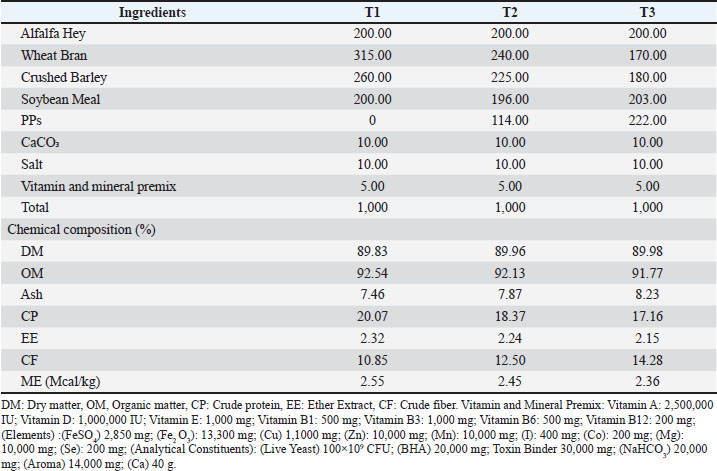
AbstractBackground: Ruminant animals are essential food resources, but they can lead to nutrient loss and greenhouse gas emissions. Feeding tannin-containing plants has been shown to increase digestion efficiency and affect rumen fermentation. The application of pomegranate peel (PP) feed supplements can provide suitable prebiotic substances that increase animal productivity and reduce its environmental consequences. Aim: This study combined in vivo feeding experiments and in situ rumen degradability of PP as a natural condensed tannin (CT) source on digestibility, rumen fermentation, nitrogen balance, microbial populations quantitative-PCR (qPCR), and methane (CH4)production. Methods: This study used three fistulated goats with an average weight of 28.2 ± 1.7 kg to investigate the influence of three different levels (0, 114 g PP equivalent to 30 g CT, and 222 g PP equivalent to 60 g CT) of PP in their diets as sources of CT. Treatments were formulated according to the measured concentration of CT in the peel and labeled T1, T2, and T3, respectively. The same diet treatments were used in the in situ trials. The experimental design used a repetitive 3 × 3 Latin square with 10-day phases, comprising 7 days for diet adaptation and 3 days for sample collection. Results: Feed intake (p < 0.009) was significantly higher in the CT-supplemented treatments (T2 and T3) than in the control (T1). Incubation time influenced the disappearance of dry matter and protein, indicating that CT decreased immediate loss while protecting protein against rumen overdegradation. CT improved rumen fermentation as shown by lower Ammonia-N concentration (p < 0.001) and higher volatile fatty acid contents. This decreases the acetate/propionate ratio in T2 and T3. Results showed an increase in CH4 emissions, with T3 showing the largest increase at 53.32% compared to the control. qPCR showed decreased protozoa and methanogen populations in the CT groups, whereas moderate levels of Ruminobacter amylophilus were stimulated. Conclusion: Overall, this study indicates that moderate CT inclusion improves rumen fermentation characteristics without affecting nutrient digestibility (except crude protein) and may represent a sustainable dietary intervention for goats. Keywords: Condensed tannins, Digestibility, Methane, Nitrogen balance, Rumen fermentation. IntroductionRuminants are essential as they transform lignocellulosic plant material into high-quality protein sources for human consumption. Methane (CH4), produced as a byproduct of enteric fermentation, accounts for 40% of the carbon footprint of worldwide agriculture and around 6% of global greenhouse gas (GHG) emissions (Ahmed, 2016; Smith et al., 2022; H. Essa et al., 2025). The transfer of greenhouse gases into and out of the atmosphere results in the warming and cooling of the Earth’s surface, respectively. While increased GHG production poses a threat to life, their absence can result in a decline of about 18°C in the average surface temperature of the Earth, underscoring their essential role in sustaining life on the planet (Vaghar Seyedin et al., 2022; Saeed et al., 2023a). Although CH4 is not the main cause of global warming, its influence on climate change requires solutions that balance environmental sustainability and animal production. In addition to CH₄ emissions, the efficiency of protein use in the rumen is an important feature of ruminant nutrition. Part of the dietary protein may be catabolized into ammonia nitrogen (NH₃-N), which is a substrate for microbial protein formation. Nevertheless, not all protein is broken down in the rumen as a portion of it survives microbial action and is released into the small intestine as dietary undegraded protein, which directly adds to metabolizable protein supply. Surplus NH₃-N that cannot be used for microbial protein synthesis enters the systemic circulation, where it is transported to the liver for conversion to urea, which is then excreted or recycled in the rumen (Abdan and Saeed, 2024; Thakur et al., 2024). Consequently, livestock farming must focus on more sustainable systems, employing management strategies and technologies to enhance ruminant nitrogen utilization, which is crucial for improving feed efficiency and minimizing the environmental impact of livestock production. Condensed tannins (CTs) are a polyphenolic group of compounds widely found in plants. They have a polymeric structure based on flavan-3-ol units and the capacity to bind and precipitate proteins, form complexes with metal ions, interact with carbohydrates, or affect microbial enzymes. They exhibit considerable binding capacity for dietary protein and can diminish protein degradability in the rumen, potentially benefiting animals that consume diets high in rumen-degradable protein (Makkar, 2003; Kelln et al., 2020). At modest concentrations (generally 2%–4% of DM), CTs interact with protein at near-neutral pH values (6.5–7.5) in the rumen, resulting in the formation of CT–protein complexes that significantly protect the associated protein from destruction (Poudel et al., 2023). Furthermore, CTs inhibit methanogenic archaea by deactivating the methyl-coenzyme M reductase enzyme, which is crucial for CH4 synthesis (Rashama et al., 2021). The influence of CT on rumen fermentation is dose-dependent, where moderate levels can improve protein utilization and decrease CH₄ generation, while high tannin consumption may result in diminished feed digestibility and compromised nutrient absorption (Tedeschi et al., 2021). Pomegranate by-products contain several bioactive chemical compounds. Pomegranate peel (PP) is a major source of phenolic compounds, particularly flavonoids, anthocyanidins, and tannins, and serves as a promising natural feed supplement for CH4 mitigation and enhanced nitrogen utilization in ruminants (Ahmed et al., 2025). The impact of different CT levels on physiological traits, nutritional digestibility, microorganisms, and emissions of CH4 in goats requires further study. Although previously reported studies have also examined different facets of the effects of tannin supplementation, none have yet combined results from in vivo feeding trials and in situ rumen degradability measurements, nitrogen balance assessment, and microbial quantification using quantitative-PCR (qPCR) to comprehensively assess both the influence on rumen function overall and its implications for mitigating CH₄ production via PP-derived CT in goats. This study attempts to assess the impact of including different quantities of PPs, a source of CT, into the basal diet of goats. This study aimed to evaluate nutritional digestibility, rumen microbial composition, and CH4 mitigation capacity. Understanding these consequences will aid in developing sustainable feeding strategies that enhance ruminant output while reducing environmental impact. Materials and MethodsThis experiment was conducted at the Agricultural College Campus of the University of Anbar, in Ramadi province (coordinates 33.427117N, 43.332602E), in strict compliance with the directives for the control of animal experimentation. Feed ingredients and total mixed rations were stored in a well-ventilated feed room with an average ambient temperature of 17.9°C (daily maximum and minimum air temperatures of 24.6°C and 11.5°C, respectively) and an average relative humidity of 37.8%. On average, the environment of the animal housing (average wind speed 2.5 km hr-1) ensured good air circulation, and humidity or heat was not maintained, so reduced around cleaning of the experimental house to maintain natural ventilation. These environmental factors were measured daily during the experiment, as they affect rumen fermentation and microbial function. The experiment utilized three crossbred male goats (bucks) with rumen-cannulated specimens that consisted of indigenous Iraqi goat breeds, including black local goat and mountain goat, with an average live body weight of 28.2 ± 1.7 kg. These local Iraqi goat breeds are typically simple but have been adapted to arid and semi-arid environments with high heat stress tolerance, efficient utilization of low-quality feed resources, and good resilience through extensive management systems. These crossbred indigenous animals are common in Iraqi husbandry and help make the findings more applicable to regional production systems. Animals were fed one of three dietary treatments, i.e., a control diet without PPs (T1) and experimental diets supplemented with 114 or 222 g/kg of PPs (T2 and T3, respectively). PPs source (equivalent of CT at 23.3% DM) correlates to inclusion levels in diet equivalent to CT delivery at 30 and 60 g/kg feed DM for T2 and T3, respectively. As a natural source of CT, the CT content of PP was measured using the dietary treatments formulated for PPs. The animals had free access to drinking water, and the diets were offered ad libitum at 8:00 am and 4:00 pm. The protein and energy requirements of the growing bucks were calculated based on the NRC (2007)and all diets were planned accordingly. The same three diets (T1, T2, and T3) were used to evaluate dry matter and protein degradability in the rumen for the in situ trial. Table 1 presents the nutritional contents of the three experimental diets. The phytochemical content of the PP investigated in this study was evaluated as used directly without any manipulation or preparation. Phenolic and bioactive compounds were analyzed by gas chromatography–mass spectrometry (Adams, 2001) and verified for PP analysis in earlier studies (Thitipramote et al., 2019; Marra et al., 2022) (Table 2). The experiment was conducted using a repeated 3 × 3 Latin square design with three rumen-cannulated male goats and three dietary treatments. This design allows each animal to receive all treatments across different periods, thereby controlling for animal and period effects and reducing individual variability. Such experimental designs are commonly used in mechanistic rumen fermentation studies involving cannulated animals. In each Latin square, two consecutive periods were used to enable each animal to receive all treatments twice. Each period consisted of 10 days (7 dietary adaptation days and 3 sample collection days). Other studies on in situ ruminal degradability and rumen fermentation have also applied such adaptation periods (Wang et al., 2008; Sosa-Pérez et al., 2023; Loregian et al., 2025). The animals were kept in single cages for 2 weeks before the start of the trial. In situ dry matter disappearance and protein degradation were assessed in cannulated goats. For this purpose, each sample was packed in three sub-bags for each animal, which were then incubated in the rumen of the three cannulated goats for different periods. This sample size (n=3) is similar to those in previous ruminant nutrition studies using a 3 × 3 Latin square design under comparable conditions, indicating that such designs successfully control for animal and period effects with a small number of animals (Huo et al., 2013; Li et al., 2014; Reynolds et al., 2014). Table 1. Ingredients and chemical composition of the experimental diets (g/kg DM).
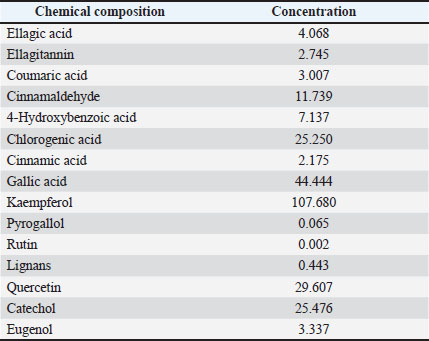
Table 2. Polyphenolic composition of PP (DM, mg/g).
Ground feed samples (2 g) were weighed into dacron bags (ANKOM, Macedon, NY, USA; 50 ± 15 μm pore size; 5 ×10 cm). Surface area to sample ratios (about 20 mg/cm²) were similar, based on the approach of Coblentz et al. (1999)to provide a sufficient footprint of feed particles to the rumen microbes. Duplicate bags were incubated in the rumen of each cannulated goat for 0, 3, 6, 9, 12, 24, and 48 hours. Duplicate nylon bags per diet for each incubation time were incubated in the rumen of each cannulated goat, resulting in a total of six bags per incubation time (3 diets × 2 bags), suspended with cable ties on 20 cm long pieces of nylon string recoverable tie. Upon extraction, the bags were placed in ice-cold water to stop the growth of microorganisms and rinsed under running tap water until no further effluent was observed. The 0-hour bags were introduced into the rumen and removed at 10 minutes to correct for loss of solubility. All recovered bags were then frozen, dried at 60°C in a forced air oven for 48 hours, and reweighed to determine the disappearance of dry matter. Daily feed amounts were given to the goats in two portions at 8:00 am and 4:00 pm, and feed intake was recorded daily. Total urine and feces were collected during the collection period. Urine was collected in tanks with sulfuric acid (20% vol/vol) to value of pH < 2·5 and prevent NH3-N losses. The daily weights of feces and urine were collected, and samplings of 20% and 10% of their total weight were performed, respectively, and pooled per goat according to each collection period. Ruminal fluid was collected at the conclusion of each experimental period. The rumen fluid was removed via the rumen cannula before feeding. Only one sample per animal per period was taken, but this time point was chosen to represent a common measure of rumen fermentation status at steady-state. Immediately after sampling, the pH was measured, and aliquots were kept at 20°C to conduct NH3-N, Volatile Fatty Acids (VFA), and microbial population analyses. NH3-N was measured according to the method described by (Parsons, 2013). A calibration curve was plotted to assess the concentration of standard ammonium sulphate related to the generated colorimetric intensity if the relationship was linear. The spectrophotometric absorbance at 420 nm was read 5–10 minutes after the reference absorbance was adjusted to zero with the blank solution (Secomam, Domont, France). Rumen fluid fatty acids were determined after lipid extraction according to (Folch et al., 1957) followed by methylation of the extracted fatty acids to fatty acid methyl esters (FAME) for gas chromatographic determination. The FAME were analyzed using Hewlett Packard 6,890 gas chromatograph (Agilent Technologies) equipped with a flame ionization detector and HP-88 capillary column (100 m × 0.25 mm i.d., 0.20 µm film). The oven was set at 120°C (2 minutes hold) to 220°C at a rate of 4°C/min. Injector and detector temperatures were maintained at 250°C, helium was the carrier gas (1.0 ml/min), and fatty acids were identified by matching retention times with those of a 37-component FAME standard (Supelco, Sigma-Aldrich). The determination of VFA was by using a gas chromatograph gas chromatograph (Hewlett Packard 6890 GC system) as described by Cottyn and Boucque (1968). Thawed rumen fluid samples were maintained at room temperature for 2 hours, and then mixed with 200 µl of 25% (w/v) meta-phosphoric acid and left for 30 minutes. The total volume was centrifuged (10 minutes at 3,000 g, 24°C), after which 500 µl of supernatant was introduced into a GC vial and mixed with 500 µl of 20 mM 4-Methyl-N-valeric acid (as internal standard). The CH4 produced during rumen fermentation was estimated using an equation based on VFA percentage (Moss et al., 2000). The equation is given by: CH4=0.45 × (A) - 0.275 × (P) + 0.4 × (B), where CH4=quantity(mmol) of CH4 generated, (A)=concentration (mmol) of acetate, (B)=the concentration (mmol) of butyrate, and (P)=propionate concentration (mmol). CH4 production and related indices were calculated from VFA profiles using standard stoichiometric relationships (Makkar and Vercoe, 2007; Jayanegara et al., 2013). CH4 production (mmol/d) was estimated as follows: CH4 (mmol/d)=(CH4 /100) total VFA CH4 in grams per day was derived as follows: CH4 (g/d)=CH4 (mmol/d) * 0.016 Additional indices were calculated as follows: CH4 index=(acetate + 2 butyrate)/propionate CH4 yield (% VFA)=(CH4 (mmol/d)/Total VFA (mmol) ×100 CH4-to-acetate ratio=CH4 (mmol/d)/acetic acid (mmol) CH4 per kg dry matter intake (DMI) (g)=CH4 production (g/d)/DMI (g/d) CH4 changes (%)=((CH4 in control × CH4 in treatment) / CH4 in control) ×100 A positive value indicates an increase, and a negative value indicates a reduction of CH₄ production compared to the control. Bacterial counts were performed 24 hours after the experiment. Microbial DNA was extracted from the samples using the QIAamp DNA Mini Stool Kit (Qiagen, Hilden, GmbH) with slight modifications, and DNA quality was assessed using a NanoDrop spectrophotometer (NanoDrop Technologies, Silverside, Wilmington, DE). The primers for amplification of 16S rRNA genes in rumen bacteria were as previously described (Saeed et al., 2023c) and pretested before use in animals. The 16S rRNA gene-based real-time qPCR for total bacteria (F: CGGCAACGAGCGCAACCC. R: CCATTGTAGCACGTGTGTAGCC), cellulolytic bacteria (F: TTCGGTGGATCDCARAGRGC. R: GBARGTCGWAWCCGTAGAATCC), and methanogenic archaea (F: ATGCAAGTCGAACGGTAACAGCAGG). R: GCACCCGTTTCCAGGTGTTGTCC) and protozoa (F: GCTTTCGWTGGTAGTGTATT). R: CTTGCCCTCYAATCGTWCT) were conducted on a species-specific basis using the CFX96 Real-Time PCR System (Bio-Rad Laboratories, Inc., Hercules, CA) with SYBR Green detection. All real-time 25 µl PCR reactions included SYBR Green Supermix, primers, DNA, and nuclease-free water. Reactions were performed in 0.2 mm PCR strips, and the cycling was as follows: At 5-minute: 94°C denaturation for 5 minutes, 94°C for 20 seconds, annealing for 30 seconds, and 72°C for 20 seconds for 40 cycles. The study used a 3 × 3 Latin square design, repeated in two phases, with three cannulated animals, three diets, and three periods. An adaptation and sampling phase was performed for each diet in each period, and each animal received all diets in that order. The data were analyzed using the MIXED procedure of SAS (SAS Institute Inc., Cary, NC). The diet was defined as fixed, and random effects were considered for the animal and period. For the in situ bag data, substrate type (fed diet vs. extract) was one of the fixed effects, and the interactive term with diet was included as a fixed effect; the bag was treated as a random effect. For repeated-incubation time analyses, both time and the interaction between diet and time were considered fixed effects, and correlations among repeated measures were accounted for using an autoregressive covariance structure. Duncan’s multiple range test was used to compare the least squares means, and differences were considered significant at p < 0.05. The statistical model used was as follows:
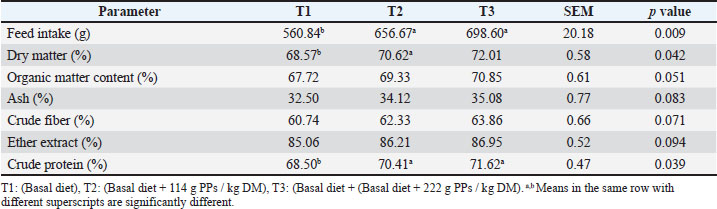
where Yijkl represents the observation (response variable), μ is the overall mean, Di is the fixed effect of treatment (fed diet), Rj is the fixed effect of period, Ak is the random effect of goat, Pl is the random effect of period, and eijkl is the residual error. Ethical approvalThe study was conducted in accordance with the Declaration of Helsinki and approved by the Ethics Committee of University of Anbar on January 15, 2025 (REF.26/2025). ResultsTable 3 presents the results of the dietary inclusion of PP as a source of CT on goat feed intake and nutrient digestibility. The daily feed intake increased significantly (p < 0.05), and the dry matter digestibility tended to increase along with the PP inclusion levels from 68.57% in T1 to 72.01% in T3. Treatments significantly increased crude protein digestibility (p < 0.05), increasing from 68.50% in T1 to 71.62% in T3. Table 3. DMI, g/day and nutrient digestibility of treatment diets.
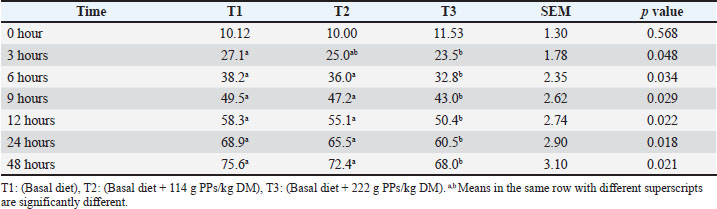
The ISDMD of diets containing CT differed (p < 0.001) at all incubation times except for the 0 hour time point (p=0.568) (Table 4). At 3 hours, both T2 and T3 had significantly lower disappearance rates than T1. This analysis showed that T1 and T2 had the most disappearance at 6 hours, followed by T3 with the lowest disappearance. T1 recorded higher values at 9 and 12 hours, whereas T3 recorded the lowest values. At 24 hours, T2 and T3 had higher disappearance, whereas T1 had the lowest. T1 showed the greatest disappearance at 48 hours compared to T3 and T2, which were significantly lower. Table 4. In situ dry matter disappearance (%) of CT in goat diets.
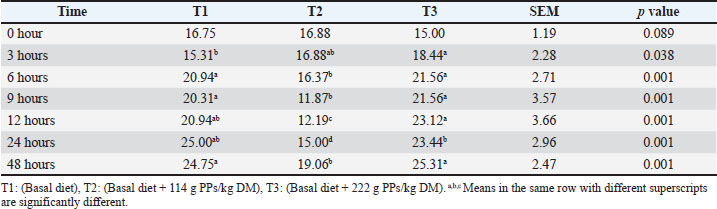
There were no significant differences in ISCPD among treatments at 0 hour (p > 0.05, p=0.089) (Table 5). However, T3 had a significantly greater disappearance rate than T1 at 3 hours, with T2 being intermediate (p < 0.05). The occurrence values of T1 and T3 were significantly higher than those of T2 at 6 hours (p < 0.001). The same trend continued at 9 and 12 hours, with T1 and T3 being higher and T2 being lower. The highest percentage of disappearance at 24 hours among the treatments was observed for T1, followed by T3, and the lowest was observed for T2 (p < 0.001). At 48 hours, T1 and T3 had the highest disappearance, whereas T2 had significantly lower (p < 0.001). Table 5. In situ crude protein disappearance (%) of inclusion of CT in goat diets.
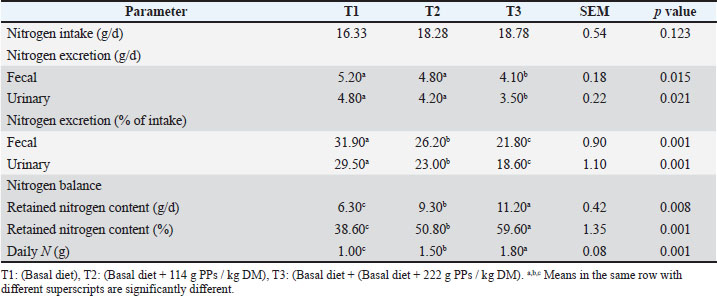
The nitrogen intake was not significantly different between the treatments (p=0.123 > 0.05) (Table 6). Fecal and urinary nitrogen excretion in absolute amounts and as a proportion of intake were highest in T1 and T2 and lowest in T3 (p < 0.001). Higher retained nitrogen (g/d or % intake) was detected in T2 and T3 compared with T1 (p < 0.007). Similarly, the daily nitrogen balance increased progressively from T1 to T3 (p < 0.001). Table 6. Urine excretion and nitrogen balance of the four experimental diet-fed goats.
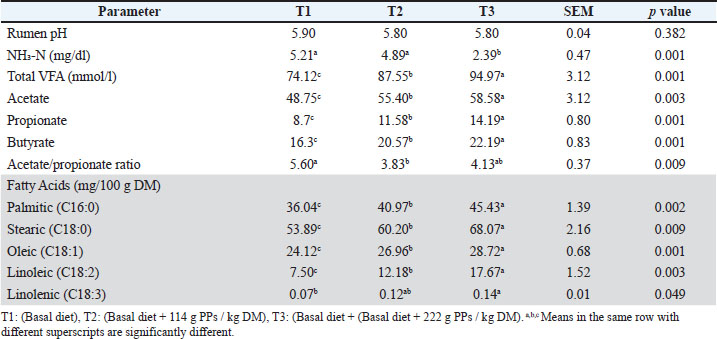
The treatments did not have a significant effect (p=0.382 > 0.05) on rumen pH (Table 7), suggesting that the inclusion of PP in the diets did not change the ruminal acid-base environment. The concentration of NH₃-N was significantly lower in T3 than in T1 (p < 0.001). There was an increase in the total VFA concentration between T2 and T3 (p < 0.001), and a similar increase in acetate, propionate, and butyrate proportions (p < 0.003). T1 showed the highest acetate/propionate ratio (p < 0.009), T2 had the lowest, and T3 had an intermediate ratio. Results for fatty acid profiles, palmitic (C16:0), stearic (C18:0), oleic (C18:1c9), linoleic (C18:2c9,12), and linolenic (C18:3c9,12,15) acids, were significantly greater in T3 than in T1 and T2, with T2 being intermediate for most fatty acids (p < 0.049). Table 7. Effect of CT on rumen fermentation parameters in experimentally fed goats.
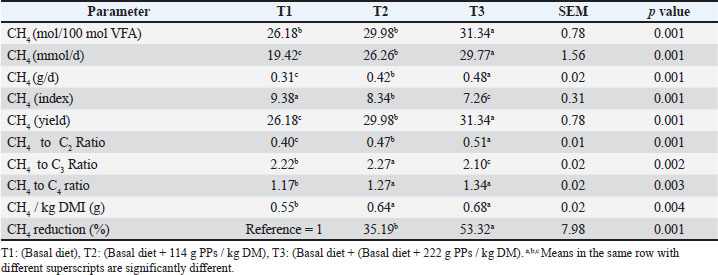
CT supplementation had a highly significant effect (p < 0.004) on CH4 production (Table 8). The highest values in milliliters and yield CH₄, CH₄:C₂ ratio were observed for T3, and the lowest for T1. The highest mmol CH₄/d and g CH₄/d production was observed in T3, whereas it was similar in T1 and T2 (p=0.001). The CH₄ index declined from T1 to T3, while both the CH₄:C₃ and CH₄:C₄ ratios varied over the same period, being usually higher at T2 and T3 than at T1. The CH₄ per kg DMI was greater in T2 and T3 than in T1. According to the standard approach of calculating percent CH₄ reduction compared with the encoded control, both T2 (35.19%) and T3 (53.32%) resulted in a negative reduction, i.e., an apparently higher rather than lower CH₄ production at high CT doses (p=0.001). Table 8. Effect of CT on total gas and CH4 production in experimentally fed goats.
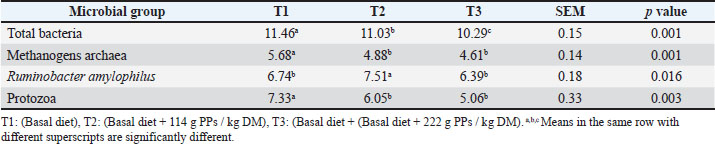
CT supplementation had a marked influence on the rumen microbial population (p < 0.016) (Table 9). T1 had the highest total bacterial counts, followed by T2 and T3, which had the lowest. The abundance of methanogens was statistically higher in T1 than in T2 and T3. The highest level of Ruminobacter amylophilus bacteria was observed in T2, but was lower and comparable in T1 and T3. The highest number of protozoans was found in T1 and decreased in T2 and T3, which had the lowest value. Table 9. Effect of CT on rumen microbial populations (log10 copies/ml rumen fluid) in goats fed experimental diets.
DiscussionThis experiment showed that CT supplementation altered intake, rumen fermentation, nitrogen balance, CH4 production, and microbial populations in goats without affecting nutrient digestibility. The higher feed intake in T2 and T3 than in T1 indicated that mild CT might increase feed palatability or promote feeding behavior. Moderate inclusion may improve intake (especially for high-quality legumes) due to the astringent properties of CT, but very high or high-level inclusion reduced palatability (Kelln et al., 2020; Mansoor et al., 2020; Saeed et al., 2023b). Similarly, dry matter, organic matter, ash, crude fiber, and ether extract digestibility were similar among treatments (p > 0.05), but the digestibility of crude protein increased significantly with increasing amounts of PP in diets (p < 0.05). Dry matter digestibility increased with the increase in CT (T1: 68.57%, T3: 72.01%), although no significant statistical difference was observed between treatments (p > 0.05, Table 3). This indicates that dried PP supplementation did not negatively affect overall dry matter digestibility in vitro. The results showed that PP supplementation did not negatively influence total nutrient digestibility and improved dietary protein use. This result is in agreement with that of Zhou et al. (2019)who reported that tannic acid (16.9 g/kg DM) supplementation had no significant influence on rumen fermentation characteristics and nutrient digestibility in cattle. Similarly, Besharati et al. (2022)and Gerlach et al. (2018)pointed out that moderate inclusion of tannins in ruminant diets did not considerably affect the digestibility of dry matter, organic matter, crude protein, and fiber fractions; this suggests that ruminants are capable of adapting to medium contents of tannin. The increase in crude protein digestibility in this study can be explained by the tendency of tannins to bind dietary protein and to avoid excessive ruminal degradation while allowing a greater portion of protein to be digested post-ruminal tract (Makkar, 2003). The data on disappearance in situ over time showed that the timing of differences in the degradability of dry matter and crude protein differed with treatment, with CT-containing diets typically characterized by less degradation during early incubation times but greater stability at later times. CTs may form reversible complexes with proteins and subsequently protect them from immediate ruminal degradation while increasing their post-ruminal availability, independent of the ratio of CT/protein mixture before incubation (Lashkari et al., 2019). The increased ISCPD noted at prolonged incubation periods in T1 and T3 may indicate variation in the rates of ruminal protein degradation, where the data for T1 indicates a normal ruminal degradation process without CT, whereas the presence of intermediate CT (T3) may have initially protected dietary protein from immediate soluble destruction, allowing it to be degraded more during later stages of incubation. In situ degradability may be underestimated due to the use of nylon bags (49 μm pore size), which restrict microbial access and overestimate the degradation effect of CT. This in vivo and in situ difference has also been reported (Katsande et al., 2019; Yang et al., 2022). Nitrogen balance results confirm the protective role of CT on dietary protein. Both T2 and T3 resulted in lower urinary nitrogen excretion and higher nitrogen retention compared with T1, indicating reduced ruminal protein degradation (less ammonia formation). In the rumen, such CT can form transient complexes with dietary proteins and thus inhibit their over-degradation by microbes, resulting in higher portions of dietary protein reaching the small intestine that is accessible for degradation after ruminal passage. This mechanism improves protein efficiency and reduces nitrogen wastage through urine, which may lead to better feed use and reduced nitrogen losses from ruminant production systems on the environment. This agrees with Waghorn and G (2008)who reported that CT reduces both the ruminal deamination process and the production of NH3-N by ruminal microorganisms, which decreases its excess in the rumen and systemic circulation, thereby improving the efficiency of nitrogen use. This is in agreement with the improved synchrony between rumen protein and energy availability (T3), as also implied by the reduced NH₃-N concentration (El-Katcha et al., 2025). CT supplementation favorably influenced the rheological profile of rumen fermentation. Dietary proteins in the rumen are divided into degradable and undegradable proteins. Rumen microorganisms degraded some parts of the degradable rumen protein to support the development and synthesis of microbial proteins. Any surplus can be excreted in the form of urea in the urine or propelled to the rumen epithelium as NH3-N. The decrease in rumen protein breakdown in T2 and T3 resulted in diminished NH3-N synthesis in the rumen. Consequently, urinary nitrogen decreases, whereas fecal nitrogen experiences a slight increase. This is the result of tannin-protein complexes being undegraded throughout the digestive tract (Mergeduš et al., 2018). CT supplementation increased the VFA concentrations, showing that rumen fermentative activity was stimulated with a constant fiber source (200 g/kg alfalfa). This indicated that this was an effect induced through changes in rumen fermentation dynamics rather than dietary fiber level. It may also help in synchronizing energy and nitrogen availability (by protecting dietary protein from excessive degradation), which is associated with improved microbial efficiency leading to higher VFA production. Moreover, a decrease in protozoa can reduce bacterial predation and promote microbial activity and fermentation. An increase in acetate concentration was also observed, which suggests a shift to hydrogen-producing fermentative pathways. These findings are consistent with previous studies demonstrating that moderate doses of CT can promote rumen fermentation and microbial efficiency (Makkar, 2003; Patra and Saxena, 2011; Jayanegara et al., 2012). The lower acetate/propionate ratio observed in T2 and T3 shows increased glycogenic fermentation, which could contribute to energy efficiency (Comer et al., 2020). In addition, the increased levels of unsaturated fatty acids in T3 are in agreement with earlier reports of CT limiting ruminal biohydrogenation, which promotes the passage of polyunsaturated fatty acids to the intestine (Toral et al., 2011; Makmur et al., 2022). Supplementation with CT significantly modified CH₄ emissions. The yield of CH₄ (g CH₄/kg DM intake) was only higher for T2 and T3, with T3 having the highest value. Tannin inclusion reduced methanogen and protozoal populations; however, CH₄ production was greater in T2 and T3, indicating an apparent disagreement. where the availability of metabolic hydrogen influences CH₄ production more strongly than methanogen abundance alone. The addition of CT increased the total VFA concentration, especially the exact proportions of hydrogen-producing pathways (acetate and butyrate). This increased availability of hydrogen probably maintained CH₄ biosynthesis, even though both the methanogen and protozoal populations decreased. Interactions between fermentation pathways and H2 balance have been reported (Jayanegara et al., 2012). This inhibition is supported by the decreasing levels of the CH4 index and abundance of methanogen seen in T2 and T3. CT influence the biochemistry of proteins by forming complexes with dietary proteins, thereby lowering ruminal degradation of associated proteins and directing nitrogen utilization to the post-ruminal tract (Min et al., 2003; Patra and Saxena, 2011). Decreased ruminal protein degradation may enhance the synchronization of nitrogen and energy availability in the rumen by using available carbohydrates more effectively for fermentation by microorganisms. Increased fermentation of carbohydrates can lead to the production of more VFAs, including acetate and butyrate, which are correlated with hydrogen production and may stimulate CH₄ production (Moss et al., 2000; Jayanegara et al., 2012). The CH₄:C₂ ratio was highest in T3, indicating a strong coupling between acetate production and CH4 because acetate fermentation pathways are hydrogenogenic (Moss et al., 2000). On the other hand, propionate is a hydrogen sink; thus, diets that promote propionate formation typically lower CH4 production (Ungerfeld, 2020). The relatively lower CH₄ production observed in T1 may be related to its lower total VFA concentration and decreased acetate and butyrate production compared with T2 and T3, leading to reduced hydrogen availability for methanogenesis. Another reason for an increased CH₄ production in spite of the lowered methanogen and protozoal populations could be the change in fermentation pathways observed for T2 and T3, as higher acetate and butyrate production generates more metabolic hydrogen available for methanogenesis. Note that we estimated CH₄ production in this study from VFA stoichiometry and thus reported this data as a fermentation profile rather than direct CH₄ measurements. The microbial population data provided the final corroboration, demonstrating that CT modulated the rumen ecosystem. The reduced protozoa count in T2 and T3 confirms the antiprotozoal effects of CT (Patra and Saxena, 2011). However, in these treatments, the decrease in protozoa and methanogen populations did not lead to a decrease in CH₄ production due to the shift in favoring hydrogen-producing fermentation pathways (increased acetate and butyrate concentrations), which can increase CH₄ formation. The results suggested that CT had a dose-dependent effect, and a moderate CT dose (T2) could promote the growth of some ruminal bacteria, whereas excessive CT doses (T3) might inhibit microbial proliferation. This finding is in line with a previous report (Min et al., 2003) that reported that CT indirectly affected ruminant microbial populations in a dose-dependent manner. The increase in R. amylophilus with moderate CT (T2) indicated that CT at this level may decrease protozoal challenge to bacteria and thus preferred starch-fermenting bacteria, leading to increased propionate production and better feed efficiency. With the highest CT (T3), its decrease demonstrates that high CT inhibit bacterial growth, revealing a dose-dependent relationship of rumen ecosystems. ConclusionThis study suggested the effects of dietary supplementation with CT on feed intake, ruminal fermentation, nitrogen metabolism, microbial populations, and CH₄ production in goats. Most parameters of nutrient digestibility evaluated were not different among treatments, except for crude protein digestibility, which increased significantly. CT inclusion (T2 and T3) led to improved feed utilization, a dose-dependent enhancement of N use associated with reduced NH₃-N concentrations in the rumen, and a clear shift toward more glucogenic fermentation patterns, as reflected in higher propionate and total VFA concentrations. These modifications were associated with better fatty acid profiles and decreased protozoal and methanogen counts. Increased nitrogen balance and more favorable in situ crude protein disappearance patterns supported the protective effect of CT on dietary protein. These results indicate that an intermediate CT level can increase nutrient use efficiency, reduce nitrogen losses, and optimize the ruminal fermentation environment in goats. In contrast, high CT levels decreased the activity of R. amylophilus, indicating a dose-dependent effect. Thus, CT constitutes an innovative dietary approach to enhance the productivity and sustainability of small ruminant production systems if carefully included. AcknowledgmentThe authors would like to thank the staff members of the College of Agriculture/University of Anbar for their full support during this study. The authors would like to express their appreciation to Dr. Salah Al-Kubaisi for constantly conducting animal health checks and to Mr. Kazim for his support in farm work. Conflict of interestWe have no conflicts of interest to declare. FundingNone. Authors' contributionsEsraa W. Muayouf: Conceptualization, methodology, data analysis, writing – original draft. Esraa W. Muayouf: Laboratory investigation, writing – review & editing. Osama A. Saeed: Supervision, project administration, funding acquisition. Anajs A. Samsudin: Conceptualization, validation, writing – review & editing, corresponding author. Data availabilityAll data were provided in the manuscript. ReferencesAbdan, A. and Saeed, O. 2024. Growth performance, rumen fermentation, and nutrient digestibility of awassi lambs fed different levels of organic copper in a basal diet. Anbar. J. Agric. Sci. 22, 1542–1556. Adams, R.P. 2001. Identification of essential oil components by gas chromatography/quadrupole mass spectroscopy. Carol Stream, IL: Allured Publishing Corporation. Ahmed, K.D. 2016. Effect of fibrolytic enzymes on serum testosterone level and some of carcass traits in Turkish Awassi male lambs. Indian. J. Anim. Res. 50, 919–921. Ahmed, M.G., El-Zarkouny, S.Z., Al-Sagheer, A.A. and Elwakeel, E.A. 2025. Co-ensiling pomegranate (Punica granatum L.) peels and molasses with berseem (Trifolium alexandrinum L.) alters in vitro fermentation quality, nutrient composition, ruminal fermentation, and methane production in buffalo bulls. Trop. Anim. Health. Prod. 57, 21. Besharati, M., Maggiolino, A., Palangi, V., Kaya, A., Jabbar, M., Eseceli, H., De Palo, P. and Lorenzo, J.M. 2022. Tannin in ruminant nutrition. Molecules 27, 8273. Bhatta, R., Saravanan, M., Baruah, L. and Prasad, C.S. 2015. Effects of graded levels of tannin‐containing tropical tree leaves on in vitro rumen fermentation, total protozoa and methane production. J. Appl. Microbiol. 118, 557–564. Coblentz, W.K., Abdelgadir, I.E.O., Cochran, R.C., Fritz, J.O., Fick, W.H., Olson, K.C. and Turner, J.E. 1999. Degradability of forage proteins by in situ and in vitro enzymatic methods. J. Dairy. Sci. 82, 343–354. Comer, A.D., Abraham, J.P., Steiner, A.J., Korosh, T.C., Markley, A.L. and Pfleger, B.F. 2020. Enhancing the photosynthetic production of glycogen-rich biomass for use as a fermentation feedstock. Front. Energy Res. 8, 93. Cottyn, B.G. and Boucque, C.V. 1968. Rapid method for the gas-chromatographic determination of volatile fatty acids in rumen fluid. J. Agric. Food. Chem. 16, 105–107. El-Katcha, M.I., Soltan, M.A.K., Farfour, H.T. and El-Shobokshy, S.A.S. 2025. Effect of different dietary buffer sources and roughage-to-concentrate ratios on growth performance, rumen fermentation, and health status of growing lambs. J. Appl. Vet. Sci. 10, 151–164. Essa, A., Mohammed, T. and Al-anbari, N. 2025. Polymorphisms and allele frequency of bmpr1b genes in local awassi sheep. Anbar J. Agric. Sci. 23, 64–76. Folch, J., Lees, M. and Stanley, G.H.S. 1957. A simple method for the isolation and purification of total lipides from animal tissues. J. Biol. Chem. 226, 497–509. Gerlach, K., Pries, M. and Südekum, K.-H. 2018. Effect of condensed tannin supplementation on in vivo nutrient digestibility and energy values of concentrates in sheep. Small Ruminant Res. 161, 57–62. Huo, W., Zhu, W. and Mao, S. 2013. Effects of feeding increasing proportions of corn grain on concentration of lipopolysaccharide in the rumen fluid and the subsequent alterations in immune responses in goats. Asian-Australas. J. Anim. Sci. 26, 1437; doi:10.1016/j.aaj.2013.09.007 Jayanegara, A., Ikhsan, I. and Toharmat, T. 2013. Assessment of methane estimation from volatile fatty acid stoichiometry in the rumen in vitro. J. Indones. Trop. Anim. Agric. 38, 103–108. Jayanegara, A., Leiber, F. and Kreuzer, M. 2012. Meta-analysis of the relationship between dietary tannin level and methane formation in ruminants from in vivo and in vitro experiments. J. Anim. Physiol. Anim. Nutr. 96, 365–375. Katsande, S., Baloyi, J.J., Nherera Chokuda, F.V., Ngongoni, N.T. and Gusha, J. 2019. Rumen degradability of selected forage legumes using the in sacco nylon bag technique. Anim. Nutr. Feed. Technol. 19, 57–63. Kelln, B.M., Penner, G.B., Acharya, S.N., Mcallister, T.A. and Lardner, H.A. 2020. Impact of condensed tannin-containing legumes on ruminal fermentation, nutrition, and performance in ruminants: a review. Can. J. Anim. Sci. 101, 210–223. Lashkari, S., Panah, F.M. and Weisbjerg, M.R. 2019. Effect of decortication of oat on chemical composition and in situ rumen and total tract disappearance of protein. Adv. Anim. Biosci. 10, 547. Li, F., Yang, X.J., Cao, Y.C., Li, S.X., Yao, J.H., Li, Z.J. and Sun, F.F. 2014. Effects of dietary effective fiber to rumen degradable starch ratios on the risk of sub-acute ruminal acidosis and rumen content fatty acids composition in dairy goat. Anim. Feed. Sci. Technol. 189, 54–62. Loregian, K., Silva, M., Dourado, S., Guimarães, J., Amâncio, B., Magnani, E., Silva, T., Branco, R., Benedeti, P.D.B. and Paula, E. 2025. Enhancing rumen-undegradable protein via dual-flow continuous culture system. Fermentation 11, 94. Makkar, H.P. and Vercoe, P. East 2007. Measuring methane production from ruminants. Dordrecht, The Netherlands: Springer. Makkar, H.P.S. 2003. Effects and fate of tannins in ruminant animals, adaptation to tannins, and strategies to overcome detrimental effects of feeding tannin-rich feeds. Small Ruminant Res. 49, 241–256. Makmur, M., Zain, M., Sholikin, M.M. and Jayanegara, A. 2022. Modulatory effects of dietary tannins on PUFA biohydrogenation in the rumen: a meta-analysis. Heliyon 8, e09828. Mansoor, A.R., Saleh, I.D., Dakheel, H.A. and Quarter, H. 2020. Effect of melatonin addition to intravaginal sponges on oxidative status and reproductive performance in Iraqi awassi ewes. Ann. Trop. Med. Public Health 23, 120–127. Marra, F., Petrovicova, B., Canino, F., Maffia, A., Mallamaci, C. and Muscolo, A. 2022. Pomegranate wastes are rich in bioactive compounds with potential benefit on human health. Molecules 27, 5555. Mergeduš, A., Pšenková, M., Brus, M. and Janžekovič, M. 2018. Tannins and their effect on production efficiency of ruminants. Acta Agric. Sci. 15, 1–11. Min, B.R., Barry, T.N., Attwood, G.T. and Mcnabb, W.C. 2003. The effect of condensed tannins on the nutrition and health of ruminants fed fresh temperate forages: a review. Anim. Feed Sci. Technol. 106, 3–19. Moss, A.R., Jouany, J.P. and Newbold, J. 2000. Methane production by ruminants: its contribution to global warming. Ann. Zootech. 49, 231–253. NRC. 2007. Nutrient requirements of small ruminants: sheep, goats, cervids, and new world camelids. Washington, DC: National Academy Press. Parsons, T.R. 2013. A manual of chemical & biological methods for seawater analysis. Amsterdam, The Netherlands: Elsevier. Patra, A.K. and Saxena, J. 2011. Exploitation of dietary tannins to improve rumen metabolism and ruminant nutrition. J. Sci. Food Agric. 91, 24–37. Poudel, S., Zeller, W.E., Fike, J. and Pent, G. 2023. Condensed tannins attributes: potential solution to fescue toxicosis?. Agriculture 13, 672. Rashama, C., Ijoma, G.N. and Matambo, T.S. 2021. The effects of phytochemicals on methanogenesis: insights from ruminant digestion and implications for industrial biogas digesters management. Phytochem. Rev. 20, 1245–1271. Reynolds, C.K., Humphries, D.J., Kirton, P., Kindermann, M., Duval, S. and Steinberg, W. 2014. Effects of 3-nitrooxypropanol on methane emission, digestion, and energy and nitrogen balance of lactating dairy cows. J. Dairy. Sci. 97, 3777–3789. Saeed, O.A., Abdulghafoor, R.T., Al-Salmany, S.S., Ali, F.M., Samsudin, A.A. and Mahmood, E.K. 2023a. Effect of temperature on the physiological characteristics of Awassi and crossbred sheep. J. Anim. Behav. Biometeorol. 11, 2023031. Saeed, O.A., Ahmed, N.K., Alnori, H.M. and Ali, F.M. 2023b. Effects of heat stress on ruminant physiological changes in dry arid regions: a review. Large Anim. Rev. 29, 271–278. Saeed, O.A., Sani, U.M., Sazili, A.Q., Akit, H., Alimon, A.R. and Samsudin, A.A. 2023c. Profiling of fatty acids and rumen ecosystem of sheep fed on a palm kernel cake–based diet with corn substituted. Agriculture 13, 643. Smith, P.E., Kelly, A.K., Kenny, D.A. and Waters, S.M. 2022. Research on enteric methane and mitigation strategies for pastoral-based beef cattle production systems. Front. Vet. Sci. 9, 958340. Sosa-Pérez, G., López-Ortiz, S., Pérez-Hernández, P., Vaquera-Huerta, H., Galván, M.M.C. and Gallegos-Sánchez, J. 2023. Dry matter and crude protein degradation of Chloroleucon mangense and Acacia cochliacantha fruits in sheep. Pesq. Agropecu. Bras. 58, e03026. Tedeschi, L.O., Muir, J.P., Naumann, H.D., Norris, A.B., Ramírez-Restrepo, C.A. and Mertens-Talcott, S.U. 2021. Nutritional aspects of ecologically relevant phytochemicals in ruminant production. Front. Vet. Sci. 8, 628445. Thakur, S., Dey, A. and Kumar, S. 2024. Rumen bypass protein: an effective technology for enhancing performance of ruminants. Indian J. Anim. Health 63, 43–52. Thitipramote, N., Maisakun, T., Chomchuen, C., Pradmeeteekul, P., Nimkamnerd, J., Vongnititorn, P., Chaiwut, P., Thitilertdecha, N. and Pintathong, P. 2019. Bioactive compounds and antioxidant activities from pomegranate peel and seed extracts. Food. Appl. Biosciences. J. 7, 152–161. Toral, P.G., Hervás, G., Bichi, E., Belenguer, A. and Frutos, P. 2011. Tannins as feed additives to modulate ruminal biohydrogenation: effects on animal performance, milk fatty acid composition, and ruminal fermentation in dairy ewes fed a diet containing sunflower oil. Anim. Feed. Sci. Technol. 164, 199–206. Ungerfeld, E.M. 2020. Metabolic hydrogen flow in rumen fermentation: principles and interventions. Front. Microbiol. 11, 589. Vaghar Seyedin, S.M., Zeidi, A., Chamanehpour, E., Nasri, M.H.F. and Vargas-Bello-Pérez, E. 2022. Methane emission: strategies to reduce global warming in relation to animal husbandry units with emphasis on ruminants. Sustainability 14, 16897. Waghorn. and G. 2008. Beneficial and harmful effects of dietary condensed tannins for sustainable sheep and goat production—progress and challenges. Anim. Feed Sci. Technol. 147, 116–139. Wang, M., Hu, Y., Tan, Z., Tang, S., Sun, Z. and Han, X. 2008. In situ ruminal phosphorus degradation of selected three classes of feedstuffs in goats. Livest. Sci. 117, 233–237. Yang, J.C., Guevara-Oquendo, V.H., Refat, B. and Yu, P. 2022. Effects of exogenous fibrolytic enzyme derived from Trichoderma reesei on rumen degradation characteristics and degradability of low-tannin whole plant faba bean silage in dairy cows. Dairy 3, 303–313. Zhou, K., Bao, Y. and Zhao, G. 2019. Effects of dietary crude protein and tannic acid on rumen fermentation, rumen microbiota and nutrient digestion in beef cattle. Arch. Anim. Nutr. 73, 30–43. | ||

| How to Cite this Article |
| Pubmed Style Muayouf EW, Saeed OA, Samsudin AA. Harnessing condensed tannins to improve rumen efficiency and reduce goat methane emissions. Open Vet. J.. 2026; 16(6): 3506-3517. doi:10.5455/OVJ.2026.v16.i6.21 Web Style Muayouf EW, Saeed OA, Samsudin AA. Harnessing condensed tannins to improve rumen efficiency and reduce goat methane emissions. https://www.openveterinaryjournal.com/?mno=308152 [Access: June 26, 2026]. doi:10.5455/OVJ.2026.v16.i6.21 AMA (American Medical Association) Style Muayouf EW, Saeed OA, Samsudin AA. Harnessing condensed tannins to improve rumen efficiency and reduce goat methane emissions. Open Vet. J.. 2026; 16(6): 3506-3517. doi:10.5455/OVJ.2026.v16.i6.21 Vancouver/ICMJE Style Muayouf EW, Saeed OA, Samsudin AA. Harnessing condensed tannins to improve rumen efficiency and reduce goat methane emissions. Open Vet. J.. (2026), [cited June 26, 2026]; 16(6): 3506-3517. doi:10.5455/OVJ.2026.v16.i6.21 Harvard Style Muayouf, E. W., Saeed, . O. A. & Samsudin, . A. A. (2026) Harnessing condensed tannins to improve rumen efficiency and reduce goat methane emissions. Open Vet. J., 16 (6), 3506-3517. doi:10.5455/OVJ.2026.v16.i6.21 Turabian Style Muayouf, Esraa W., Osama A. Saeed, and Anjas A. Samsudin. 2026. Harnessing condensed tannins to improve rumen efficiency and reduce goat methane emissions. Open Veterinary Journal, 16 (6), 3506-3517. doi:10.5455/OVJ.2026.v16.i6.21 Chicago Style Muayouf, Esraa W., Osama A. Saeed, and Anjas A. Samsudin. "Harnessing condensed tannins to improve rumen efficiency and reduce goat methane emissions." Open Veterinary Journal 16 (2026), 3506-3517. doi:10.5455/OVJ.2026.v16.i6.21 MLA (The Modern Language Association) Style Muayouf, Esraa W., Osama A. Saeed, and Anjas A. Samsudin. "Harnessing condensed tannins to improve rumen efficiency and reduce goat methane emissions." Open Veterinary Journal 16.6 (2026), 3506-3517. Print. doi:10.5455/OVJ.2026.v16.i6.21 APA (American Psychological Association) Style Muayouf, E. W., Saeed, . O. A. & Samsudin, . A. A. (2026) Harnessing condensed tannins to improve rumen efficiency and reduce goat methane emissions. Open Veterinary Journal, 16 (6), 3506-3517. doi:10.5455/OVJ.2026.v16.i6.21 |


