





| Review Article | ||
Open Vet. J.. 2026; 16(6): 3311-3319 Open Veterinary Journal, (2026), Vol. 16(6): 3311-3319 Review Article What makes mandatory digital animal health surveillance systems work? Lessons from global implementation experienceKunta Adnan Sahiman1, Siti Azizah1*, Muhammad Halim Natsir1, Kuswati Kuswati1 and Moh. Andi Iekram21Faculty of Animal Science, Universitas Brawijaya, Malang, Indonesia 2Faculty of Veterinary Medicine, Universitas Airlangga, Surabaya, Indonesia *Corresponding Author: Siti Azizah. Faculty of Animal Science, Universitas Brawijaya, Malang, Indonesia. Submitted: 28/01/2026 Revised: 25/04/2026 Accepted: 06/05/2026 Published: 05/06/2026 © 2025 Open Veterinary Journal
AbstractWhy do some mandatory digital surveillance systems in animal health succeed while others struggle? This question is important because veterinary authorities worldwide have invested heavily in electronic disease reporting; however, outcomes remain inconsistent. We reviewed published literature from 2005 to 2024 across Scopus, Web of Science, and PubMed to identify the factors that drive successful implementation in public veterinary services. Six key domains shape whether these systems work: structure of regulations and governance, readiness for change, available infrastructure, workforce capacity, coordination across agencies, and incentive mechanisms. Having a legal mandate helps but does not guarantee success. What matters more is alignment—when governance frameworks match organizational capabilities and when staff actually find the system useful. One Health coordination is especially challenging; without sustained effort, policy commitments rarely translate into operational reality. For veterinary authorities planning new deployments, it is important to assess organizational readiness beforehand, engage frontline staff, clarify data governance, and build feedback loops. Regulatory status alone tells us little about the effectiveness of surveillance. Keywords: Animal health, Digital surveillance, Implementation, One Health, Veterinary services. IntroductionAnimal health management has undergone a significant transformation with the adoption of digital technologies. Where paper forms once traveled slowly through bureaucratic channels, electronic platforms now promise real-time disease data, faster outbreak detection, and evidence for policy decisions (Hoinville et al., 2013; Dorea and Vial, 2016). Many countries have moved beyond voluntary reporting, and national veterinary legislation now mandates digital submission for notifiable diseases in numerous jurisdictions (Bellemain and V, 2013). These mandatory systems—operated by public veterinary services—have become a critical infrastructure that matters both domestically and for international disease notification under the Organization for International Animal Health obligations (Kluge et al., 2022). The shift toward digitalization reflects broader recognition that effective surveillance requires timely, standardized data flow across institutions. However, investment does not guarantee results, and implementation outcomes vary considerably across settings. Some mandatory systems work well, achieving sustained adoption, better timeliness, and improved coverage, whereas others struggle with incomplete submissions, questionable data quality, and fragmented institutional boundaries (Kimani et al., 2016; George et al., 2021a). The pattern is clear enough: legal requirements and technical capabilities alone cannot ensure effective surveillance. Previous evaluations have documented persistent gaps between system design and operational reality (Stark et al., 2015; Bordier et al., 2019). What distinguishes successes from failures? Veterinary authorities deploying new systems or trying to fix existing ones need practical answers, particularly as digital surveillance becomes essential for meeting both domestic disease control targets and international reporting commitments. The implementation of digital surveillance spans human public health and One Health initiatives, providing valuable cross-sectoral insights (Weiner, 2009; Gagnon et al., 2012). However, mandatory animal health systems present distinct challenges that warrant specific attention. Regulatory authority intersects with organizational realities, workforce constraints, and the need to coordinate across sectors in ways that differ from voluntary or human health contexts. Although published studies offer pieces of the puzzle—individual country experiences and specific system evaluations—synthesized evidence on implementation determinants across different mandatory surveillance contexts remains limited (Hoinville et al., 2013). Without this synthesis, veterinary authorities cannot adequately anticipate problems or design effective strategies for system deployment and strengthening. This review addresses this gap. We synthesize global evidence on the factors that determine the success of mandatory digital animal health surveillance systems in public veterinary services. The analysis is guided by three questions: What determinants shape implementation effectiveness? How do organizational, infrastructural, and human factors play out differently across settings? What do implementation experiences tell us more broadly about One Health coordination and disease control? MethodologyA structured narrative review of the peer-reviewed literature on the implementation of mandatory digital animal health surveillance was conducted. Searches covered Scopus, Web of Science, and PubMed for articles from 2005 to 2024. The search terms combined concepts around digital surveillance, animal health, veterinary services, regulatory or mandatory systems, and implementation. Inclusion required that studies either examine digital or electronic surveillance in animal health with public veterinary authorities or formal reporting structures, or that they report on implementation challenges, determinants, or operational outcomes. We also included voluntary initiatives that offered a valuable comparison to mandatory implementation. Studies that focused solely on technical system development without implementation analysis were excluded. Data extraction captured mandatory status, implementation context, key determinants, challenges, and outcomes in a structured matrix. We narratively synthesized the findings, looking for recurring patterns and contrasts between mandatory and voluntary systems. The reference lists of key articles yielded additional relevant studies. Thematic organization reflects the major domains that influence the implementation of the One Health strategy and its implications. Ethical approvalNot required. This study reviews previously published literature. ResultsThe following six domains shape whether mandatory digital animal health surveillance systems achieve their objectives: regulatory and governance architecture, organizational readiness, infrastructure capacity, workforce factors, coordination mechanisms, and incentive structures. We draw on voluntary and conceptual studies to contextualize the dynamics of mandatory implementation, not as primary evidence of the performance of the compulsory system. These domains interact dynamically; no single domain operates independently of the others. Regulatory and governance architecture Clear regulations are important for establishing the foundation of mandatory surveillance systems. Studies of European veterinary services found that explicit legal mandates are more effective when institutional authority is clearly delineated, providing unambiguous responsibility for data collection, analysis, and response (Bellemain and V, 2013). The establishment of a formal One Health coordination office in Kenya improved strategic alignment across sectors by creating an institutional home for cross-sectoral dialogue (Zinsstag et al., 2014). However, formal structures alone do not produce operational integration, as implementation requires ongoing attention beyond initial regulatory establishment. Fragmented regulation creates substantial problems for surveillance effectiveness. When multiple agencies hold overlapping surveillance responsibilities without precise coordination mechanisms, reporting becomes inconsistent, and data flow considerably slows down (Kimani et al., 2016; George et al., 2021a). Cross-country comparisons show that governance coherence—whether surveillance objectives, institutional mandates, and operational protocols are aligned—varies considerably and contributes to uneven detection performance across systems (Hoinville et al., 2013). Political commitment mediates the relationship between regulatory architecture and outcomes of implementation. Studies of integrated surveillance-response systems emphasize that sustained political endorsement moves cross-sector coordination from conceptual agreement toward operational reality (Zinsstag et al., 2014; Kluge et al., 2022). Without high-level political support, even well-designed regulatory frameworks may fail to achieve their intended coordination objectives. Political commitment also influences the allocation of resources that determine whether surveillance systems receive adequate funding for sustained operation. Organizational and institutional readiness Readiness determines adoption, making organizational capacity a critical factor in successful surveillance implementation. Institutions’ ability to absorb new surveillance requirements—including leadership commitment, resource allocation, and adaptive management—significantly influences whether digital systems achieve sustained use (Weiner, 2009). Organizations lacking these foundational capacities often struggle to move beyond the initial phases of deployment. Readiness encompasses technical preparedness and the softer dimensions of institutional culture and change management capacity. Weiner’s (2009) framework on organizational readiness for change explains why this pattern holds across health surveillance systems. Collective commitment and perceived efficacy among the staff are prerequisites for successful implementation of the program. Systems introduced in environments where these conditions are absent typically exhibit resistance or superficial compliance that fails to generate meaningful surveillance data. Institutional history is also important for implementation trajectories. Settings with established but fragmented surveillance traditions face a double challenge: technical upgrades and renegotiation of institutional roles and data ownership arrangements (Kimani et al., 2016; George et al., 2021b). Tanzanian studies have found that the potential for multi-source data integration exists even within fragmented systems; however, realizing this potential depends more on institutional alignment than on data availability itself (George et al., 2021a, 2021b). Infrastructure and technological capacityInfrastructure is necessary but not sufficient for effective surveillance. System interoperability—whether different platforms and data sources can seamlessly exchange information—proves more decisive than individual component sophistication (Stark et al., 2015). Many implementation failures can be traced to inadequate attention to interoperability requirements during system design phases. The technical architecture of surveillance systems must accommodate the heterogeneous data environments characteristic of veterinary services. European syndromic surveillance studies have reported that data heterogeneity and a lack of standardization constrain analytical capacity, even when the IT infrastructure is adequate (Dorea and Vial, 2016). Multi-country assessments highlight how inconsistent data formats and variable system designs impede cross-border coordination efforts (Hoinville et al., 2013; Stark et al., 2015). These findings underscore the importance of standardization efforts that extend beyond the boundaries of individual systems. Connectivity constraints hit resource-limited settings the hardest, creating particular challenges for surveillance coverage. Voluntary community-based initiatives often face acute sustainability challenges related to connectivity limitations (Mariner et al., 2011; Karimuribo et al., 2017). Mandatory systems with institutional backing sometimes demonstrate greater capacity to invest in infrastructure improvements, although this pattern is not universal across all implementation contexts. Data governance arrangements are important beyond technical interoperability considerations. Clarity about data ownership, access rights, and quality assurance protocols influences whether surveillance data flows efficiently from the field to the central analysis units (Racloz et al., 2012; George et al., 2021b). Without clear governance frameworks, data sharing between institutions often stalls despite technical feasibility. Human resources and workforce factors Human factors often dominate implementation outcomes, frequently outweighing technical design considerations in determining the success of surveillance. Workforce capacity—encompassing digital literacy, training adequacy, and workload perception—consistently shapes system adoption and data quality across diverse implementation contexts (Gagnon et al., 2012). The centrality of human factors reflects the reality that surveillance systems ultimately depend on individuals’ meaningful engagement with reporting requirements. Therefore, understanding user perspectives is essential for implementation planning. Studies on cross-sectoral adoption of Information and Communication Technology (ICT) have shown that perceived usefulness and ease of use strongly predict whether health professionals engage meaningfully with digital reporting tools (Gagnon et al., 2012). In cases where systems add administrative burden without clear benefit to users, resistance and incomplete adoption typically follow. User-centered design approaches that prioritize workflow integration show promise in addressing these challenges. Training helps but rarely suffices to ensure sustained competency. Although initial training is common across implementation contexts, one-time capacity-building efforts seldom sustain competency over extended periods. Continuous support, refresher training, and responsive feedback mechanisms contribute more substantially to sustained workforce engagement than initial training alone (Mariner et al., 2011; Karimuribo et al., 2017). Reporting fatigue is particularly challenging when surveillance requirements expand without corresponding workload adjustments. Voluntary initiatives can simply see a decline in participation when the burden increases. Instead of reporting fatigue, mandatory systems often show quality degradation—formally compliant but substantively incomplete submissions that undermine surveillance objectives (Mariner et al., 2011; George et al., 2021a). Coordination and integration mechanismsCross-sector coordination remains a central objective and a persistent challenge for surveillance systems operating within the One Health framework. Coordination mechanisms—formal structures enabling information sharing and joint action across institutional boundaries—are essential for translating surveillance data into effective disease response (Zinsstag et al., 2014; Bordier et al., 2019). The complexity of coordination requirements increases substantially when surveillance spans the human health, animal health, and environmental sectors. Effective coordination requires sustained attention to building relationships alongside formal structural arrangements. One Health surveillance integration consistently shows gaps between conceptual frameworks and operational practice. Although cross-sectoral collaboration principles are widely endorsed, translation into routine inter-agency coordination proves difficult to sustain over time (Stark et al., 2015; Bordier et al., 2019). Formal coordination bodies improve strategic alignment but do not automatically produce integrated operations at the field level (Zinsstag et al., 2014). Integration failures are more often traced to governance and coordination deficiencies than to technical or resource constraints (Kluge et al., 2022). The livestock-wildlife interface presents particular coordination challenges that exemplify broader integration difficulties. Studies in Africa indicate that unclear institutional ownership and weak data integration protocols between domestic animal and wildlife health sectors limit the capacity for early detection of diseases with cross-species transmission potential (Racloz et al., 2012). These interface challenges are compounded by different institutional cultures, funding streams, and professional networks operating in livestock versus wildlife health domains. Addressing interface challenges requires deliberate investment in bridging mechanisms that span institutional boundaries. Voluntary collaboration models often rely on interpersonal relationships and ad hoc arrangements rather than formal coordination structures (Bordier et al., 2019). Although these informal approaches can be effective, they are vulnerable to personnel changes and competing institutional priorities. Mandatory systems embed coordination requirements within regulatory frameworks, potentially providing greater durability. However, regulatory mandates alone do not resolve coordination challenges; sustained integration requires ongoing investment in relationship building, trust development, and operational refinement (Zinsstag et al., 2014; Kluge et al., 2022). Incentive structures and accountability systemsIncentives and accountability mechanisms shape compliance patterns and data quality across mandatory surveillance systems. Regulatory authority is necessary for mandate enforcement, but enforcement alone rarely produces high-quality surveillance data (Mariner et al., 2011). By creating intrinsic motivation for participation, positive incentives that align individual and institutional interests with surveillance objectives complement regulatory authority. The most effective incentive structures combine accountability requirements and tangible benefits for data contributors. Understanding the motivations of frontline reporters is essential for designing incentive systems that generate meaningful engagement rather than mere compliance. Feedback loops are particularly important as incentive mechanisms for sustained engagement. Systems that provide timely, helpful information back to data contributors—including epidemiological summaries, early warning alerts, and performance benchmarks—achieve higher sustained engagement than one-way data extraction systems (Mariner et al., 2011; Karimuribo et al., 2017). Feedback transforms surveillance from a burden into a resource that directly benefits reporters. Trust mediates compliance in important ways that shape surveillance effectiveness. Where historical relationships between field reporters and central authorities have featured punitive responses to disease notifications, underreporting persists despite mandatory requirements (George et al., 2021a). Building trust requires consistent, supportive responses to disease reports over extended periods. Summary of the key patternsSeveral overarching patterns stand out from the evidence synthesis across implementation contexts. Institutional mandates do not automatically produce integration; operational effectiveness requires simultaneous alignment across governance, organizational, infrastructural, and human factors. Mandatory status ensures baseline participation but does not guarantee meaningful engagement or high-quality data. One Health integration aspirations consistently exceed implementation readiness across the examined settings. Human factors—particularly perceived usefulness, workload alignment, and feedback mechanisms—consistently influence outcomes across diverse contexts. Figure 1 synthesizes the six implementation determinant domains in a spidergram, illustrating the relative strength of evidence, implementation impact, and current practice attention for each domain. The visualization highlights a notable gap: while organizational readiness and human resource factors show high implementation impact, they receive comparatively less attention in current practice, suggesting priority areas for veterinary authorities seeking to improve surveillance system performance.
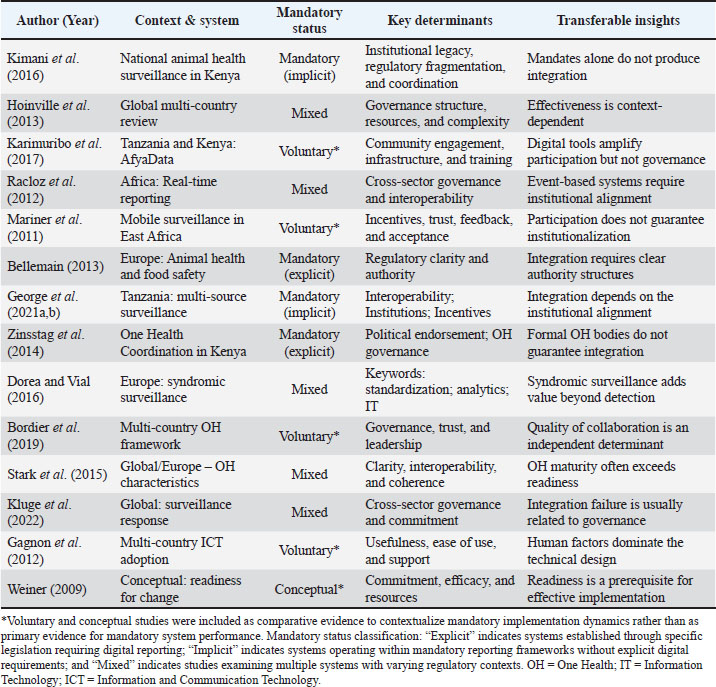
Fig. 1. Spidergram showing the synthesis of six implementation determinant domains for mandatory digital animal health surveillance systems. The radar chart illustrates three dimensions for each domain: evidence strength (blue) represents how strongly each domain is supported by the reviewed literature; implementation impact (pink) indicates how much each domain influences implementation success; and current practice attention (orange) shows how much attention each domain typically receives in current practice. Higher values indicate stronger evidence, greater impact, or more attention. The gap between implementation impact and current practice attention highlights areas requiring increased focus—particularly organizational readiness and human resource factors, which show high implementation impact but receive comparatively less attention in practice. DiscussionThis review demonstrates that the effectiveness of mandatory digital animal health surveillance depends less on regulatory status or technical design than on governance structure, organizational readiness, human factors, and coordination mechanisms. This analysis reveals consistent patterns that transcend individual country experiences or specific system designs by synthesizing evidence across diverse implementation contexts. Contrasting mandatory and voluntary contexts highlights why regulatory mandates alone cannot ensure meaningful surveillance performance and points toward the enabling conditions that distinguish successful implementations. Synthesis of the key findingsEffective implementation is less a purely technical challenge and more fundamentally a governance and organizational one. Infrastructure and technology provide the necessary foundations, but institutional alignment, workforce engagement, and coordination mechanisms more decisively shape whether mandatory systems achieve their surveillance objectives (Hoinville et al., 2013; Stark et al., 2015). This finding aligns with broader implementation science literature emphasizing that intervention success depends on contextual fit and adaptive capacity rather than technical sophistication alone (Weiner, 2009). Voluntary and conceptual studies help to contextualize these dynamics by illustrating how similar determinants operate across different regulatory contexts. A central finding of this review is that the mandatory status alone does not ensure implementation success. Regulatory requirements secure baseline participation but do not automatically yield high-quality data or meaningful integration across institutional boundaries (Kimani et al., 2016; George et al., 2021a). This finding challenges the assumptions that compliance-driven approaches inherently outperform voluntary models. The characteristics and transferable implementation insights of the included studies are summarized in Table 1. Rather, the evidence suggests that mandatory frameworks require equally careful attention to enabling conditions—organizational readiness, perceived usefulness, and feedback mechanisms—as voluntary initiatives (Gagnon et al., 2012; Karimuribo et al., 2017). Table 1. Characteristics and findings of the included studies.
The persistent gap between One Health policy endorsement and operational integration represents another significant pattern that warrants attention. Commitment to cross-sectoral coordination is widespread across the examined settings, yet translating it into routine interagency operations remains challenging (Zinsstag et al., 2014; Bordier et al., 2019). This gap reflects the substantial organizational and political investments required to move from policy rhetoric to operational reality. Sustaining integration requires ongoing attention to relationship maintenance and trust building that extends well beyond initial coordination agreements (Kluge et al., 2022). Implications for veterinary servicesThe findings have several practical implications for veterinary authorities responsible for implementing or strengthening mandatory digital surveillance systems. These implications derive from the consistent patterns observed across diverse implementation contexts and point toward actionable priorities for system deployment and improvement. Understanding these implications can help veterinary services avoid common implementation pitfalls and effectively allocate resources toward factors most likely to influence surveillance outcomes. An organizational readiness assessment before deployment warrants explicit attention in implementation planning. Introducing digital surveillance requirements into unprepared institutional environments tends to produce superficial compliance rather than genuine system adoption (Weiner, 2009). The readiness assessment should examine leadership commitment, resource availability, and staff attitudes toward the proposed changes. Where readiness gaps are identified, targeted interventions to build organizational capacity may be warranted before system deployment proceeds. The consistent influence of human factors places workforce engagement strategies at the center of implementation planning rather than the periphery. Training alone is insufficient for sustained engagement; effective implementation requires ongoing support, responsive feedback, and alignment between surveillance tasks and existing workflow patterns (Mariner et al., 2011; Gagnon et al., 2012). Engaging frontline staff in system design and refinement processes may enhance both perceived usefulness and actual fit with work routines. Investing in continuous professional development and user support structures yields returns in terms of data quality and reporting completeness. Interoperability challenges point to technical standardization as an area of potential high-return investment. Veterinary services operating fragmented surveillance systems might prioritize data governance arrangements—agreements on formats, exchange protocols, and quality standards—even before pursuing full system integration (Stark et al., 2015). Early attention to standardization can prevent the accumulation of technical debt that makes later integration increasingly difficult. Feedback mechanisms offer a high impact at a relatively low cost compared with other implementation investments. Systems that provide timely, helpful information to data contributors achieve higher sustained engagement than one-way data extraction systems (Karimuribo et al., 2017). Designing feedback loops should be a priority rather than an afterthought from the early implementation stages. Implications for One Health coordinationThe persistent integration challenges documented in this review indicate that operational One Health surveillance requires sustained investment that extends well beyond initial coordination agreements. Formal governance structures appear necessary but insufficient for achieving integrated operations across sectors (Zinsstag et al., 2014; Bordier et al., 2019). Sustained coordination requires ongoing relationship maintenance, trust building across institutional boundaries, and operational arrangements, iterative refinement over extended periods. Health coordination should be understood as a continuous process rather than a distinct achievement. For One Health practitioners, these findings underscore that the effectiveness of surveillance systems depends substantially on implementation quality, not merely on system design or regulatory status. If underlying implementation determinants remain unaddressed, cross-sectoral data platform investments may underperform (Kluge et al., 2022). Practitioners should advocate for adequate attention to organizational and human factors alongside the development of technical systems. The evidence suggests that implementation investments yield surveillance performance returns that technical investments alone cannot achieve. LimitationsThis review has several limitations that should be considered when interpreting the findings. We employed narrative synthesis without formal quality appraisal protocols, which may affect the rigor of evidence assessment. Although the search and selection processes were transparently documented, potential selection bias cannot be excluded from the review process. The narrative approach was selected as appropriate for the heterogeneous evidence base, but the synthesis’s interpretive nature should be recognized by readers. The reviewed literature exhibits substantial heterogeneity in implementation contexts, system types, and outcome measures. This heterogeneity reflects the diversity of global surveillance implementations but complicates direct comparison across studies (Hoinville et al., 2013). The identified implementation determinants may not transfer uniformly to all settings; contextual factors are likely to mediate their applicability in specific implementation environments. Future research employing more standardized outcome measures would strengthen the evidence base. Publication bias may influence the available evidence base in ways that affect the conclusions of the review. Studies reporting implementation challenges may be underrepresented relative to those documenting successful implementations. Additionally, focusing on peer-reviewed literature may exclude relevant implementation experiences documented in gray literature, government reports, or program evaluations that did not reach academic publication. Despite these limitations, the convergent patterns identified across diverse studies provide reasonable confidence that the identified determinant domains represent meaningful categories for understanding mandatory surveillance implementation. The consistency of findings across different geographic and institutional contexts strengthens confidence in the generalizability of core patterns. Future research directionsSeveral areas warrant additional research to strengthen the evidence base for surveillance implementation. Longitudinal studies examining implementation trajectories over extended periods could illuminate sustainability dynamics that cannot be captured by cross-sectional assessments. Comparative studies that explicitly examine mandatory versus voluntary implementation within similar contexts could provide more rigorous evidence on the effects of regulatory status. Research examining implementation from the perspective of frontline surveillance reporters could provide deeper insight into the human factors that influence reporting behavior. These gaps underscore the need to treat implementation as a central determinant of surveillance effectiveness and not as a secondary consideration following system design or regulatory adoption. ConclusionThe implementation of mandatory digital animal health surveillance remains a complex challenge that extends beyond technical design or regulatory adoption. This review clarifies why regulatory status alone does not determine surveillance effectiveness: implementation alignment is the decisive factor. Governance architecture, organizational readiness, infrastructure capacity, human factors, coordination mechanisms, and incentive structures must all be aligned for mandatory systems to achieve surveillance objectives. Before deployment, veterinary authorities should assess organizational readiness, engage workforces in ways that demonstrate tangible benefits to reporters, clarify data governance arrangements, and build feedback mechanisms that return useful information to data contributors. The persistent gap between One Health policy commitments and operational integration underscores the need for sustained investment well beyond initial agreements in cross-sectoral coordination. Further research should examine implementation trajectories over extended periods, compare mandatory and voluntary approaches within similar contexts, and explore implementation dynamics from the perspectives of frontline reporters. Making mandatory digital animal health surveillance work ultimately requires recognizing implementation as central to surveillance effectiveness—not a secondary phase following regulatory adoption or system design. AcknowledgmentsK.A.S. received scholarship support from the Indonesia Endowment Fund for Education (LPDP), Ministry of Finance of the Republic of Indonesia. Universitas Brawijaya provided institutional support. Conflict of interestThe authors have no conflicts of interest related to this work. FundingNo specific grant from any funding agency supported this study. Authors' contributionsKunta Adnan Sahiman: Conceptualization, methodology, investigation, and writing of the original draft. Siti Azizah: Supervision, writing, review, and editing. Muhammad Halim Natsir: Supervision, writing, review, and editing. Kuswati: Supervision. Moh. Andi Iekram: Investigation and validation. Data availabilityAll data supporting this study’s findings are included within the article. ReferencesBellemain, V. 2013. Coordinating surveillance policies in animal health and food safety from farm to fork: the European perspective. Vet. Ital. 49(1), 87–93. Bordier, M., Uea-Anuwong, T., Binot, A., Hendrikx, P. and Goutard, F.L. 2019. Characteristics of One Health surveillance systems: a systematic literature review. Prev. Vet. Med. 181, 104560. Dorea, F.C. and Vial, F. 2016. Animal health syndromic surveillance: a systematic literature review of the progress in the last 5 years (2011-2016). Vet. Med. Res. Rep. 7, 157–169. Gagnon, M.P., Desmartis, M., Labrecque, M., Car, J., Pagliari, C., Pluye, P., Frémont, P., Gagnon, J., Tremblay, N. and Légaré, F. 2012. Systematic review of factors influencing the adoption of information and communication technologies by healthcare professionals. J. Med. Syst. 36(1), 241–277. George, J., Hasler, B., Komba, E., Sindato, C., Rweyemamu, M. and Mlangwa, J. 2021a. A qualitative study exploring the potential for integration of animal health surveillance data in Tanzania. Prev. Vet. Med. 194, 105418. George, J., Hasler, B., Komba, E., Sindato, C., Rweyemamu, M. and Mlangwa, J. 2021b. Towards integrated animal health surveillance: characterizing data sources in Tanzania. Front. Vet. Sci. 8, 679396. Hoinville, L.J., Alban, L., Drewe, J.A., Gibbens, J.C., Gustafson, L., Häsler, B., Saegerman, C., Salman, M. and Stärk, K.D.C. 2013. Proposed terms and concepts for describing and evaluating animal-health surveillance systems. Prev. Vet. Med. 112(1-2), 1–12. Karimuribo, E.D., Mutagahywa, E., Sindato, C., Mboera, L., Mwabukusi, M., Kariuki Njenga, M., Teesdale, S., Olsen, J. and Rweyemamu, M. 2017. A smartphone app (AfyaData) for innovative One Health disease surveillance from community to national levels in Africa: intervention in disease surveillance. JMIR. Public. Health. Surveill. 3(4), e94. Kimani, T., Schelling, E., Bett, B., Ngigi, M., Randolph, T. and Fuhrimann, S. 2016. Public health benefits from livestock Rift Valley fever control: a simulation of two epidemics in Kenya. EcoHealth 13(4), 729–742. Kluge, H., Martín-Moreno, J.M., Emiroglu, N., Rodier, G., Kelley, E., Vujnovic, M. and Permanand, G. 2022. Strengthening global health security by embedding the International Health Regulations requirements into national health systems. BMJ. Glob. Health. 7(Suppl 1), e007883. Mariner, J.C., Jones, B.A., Hendrickx, S., El Masry, I., Jobre, Y. and Jost, C.C. 2011. Experiences in participatory surveillance and community-based reporting systems for H5N1 highly pathogenic avian influenza: a case study approach. EcoHealth 8(2), 151–166. Racloz, V., Griot, C. and Stärk, K.D.C. 2012. Sentinel surveillance systems with special focus on vector-borne diseases. Anim. Health. Res. Rev. 7(1-2), 71–79. Stark, K.D.C., Arber, L.B., Audige, L., Salman, M.D., Schulze-Horsel, T., Hasler, B., Horby, P.W. and Kellar, J.A. 2015. Compendium of the standard questionnaire on the efficiency of surveillance within the RISKSUR project. Front. Vet. Sci. 2, 20. Weiner, B.J. 2009. A theory of organizational readiness for change. Implement. Sci. 4, 67. Zinsstag, J., Schelling, E., Waltner-Toews, D., Whittaker, M. and Tanner, M. 2014. One Health: the theory and practice of integrated health approaches. Wallingford, UK: CABI Publishing. | ||

| How to Cite this Article |
| Pubmed Style Sahiman KA, Azizah S, Natsir MH, Kuswati K, Iekram MA. What makes mandatory digital animal health surveillance systems work? Lessons from global implementation experience. Open Vet. J.. 2026; 16(6): 3311-3319. doi:10.5455/OVJ.2026.v16.i6.3 Web Style Sahiman KA, Azizah S, Natsir MH, Kuswati K, Iekram MA. What makes mandatory digital animal health surveillance systems work? Lessons from global implementation experience. https://www.openveterinaryjournal.com/?mno=308394 [Access: June 26, 2026]. doi:10.5455/OVJ.2026.v16.i6.3 AMA (American Medical Association) Style Sahiman KA, Azizah S, Natsir MH, Kuswati K, Iekram MA. What makes mandatory digital animal health surveillance systems work? Lessons from global implementation experience. Open Vet. J.. 2026; 16(6): 3311-3319. doi:10.5455/OVJ.2026.v16.i6.3 Vancouver/ICMJE Style Sahiman KA, Azizah S, Natsir MH, Kuswati K, Iekram MA. What makes mandatory digital animal health surveillance systems work? Lessons from global implementation experience. Open Vet. J.. (2026), [cited June 26, 2026]; 16(6): 3311-3319. doi:10.5455/OVJ.2026.v16.i6.3 Harvard Style Sahiman, K. A., Azizah, . S., Natsir, . M. H., Kuswati, . K. & Iekram, . M. A. (2026) What makes mandatory digital animal health surveillance systems work? Lessons from global implementation experience. Open Vet. J., 16 (6), 3311-3319. doi:10.5455/OVJ.2026.v16.i6.3 Turabian Style Sahiman, Kunta Adnan, Siti Azizah, Muhammad Halim Natsir, Kuswati Kuswati, and Moh. Andi Iekram. 2026. What makes mandatory digital animal health surveillance systems work? Lessons from global implementation experience. Open Veterinary Journal, 16 (6), 3311-3319. doi:10.5455/OVJ.2026.v16.i6.3 Chicago Style Sahiman, Kunta Adnan, Siti Azizah, Muhammad Halim Natsir, Kuswati Kuswati, and Moh. Andi Iekram. "What makes mandatory digital animal health surveillance systems work? Lessons from global implementation experience." Open Veterinary Journal 16 (2026), 3311-3319. doi:10.5455/OVJ.2026.v16.i6.3 MLA (The Modern Language Association) Style Sahiman, Kunta Adnan, Siti Azizah, Muhammad Halim Natsir, Kuswati Kuswati, and Moh. Andi Iekram. "What makes mandatory digital animal health surveillance systems work? Lessons from global implementation experience." Open Veterinary Journal 16.6 (2026), 3311-3319. Print. doi:10.5455/OVJ.2026.v16.i6.3 APA (American Psychological Association) Style Sahiman, K. A., Azizah, . S., Natsir, . M. H., Kuswati, . K. & Iekram, . M. A. (2026) What makes mandatory digital animal health surveillance systems work? Lessons from global implementation experience. Open Veterinary Journal, 16 (6), 3311-3319. doi:10.5455/OVJ.2026.v16.i6.3 |


