




| Research Article | ||
Open Vet. J.. 2026; 16(6): 4001-4007 Open Veterinary Journal, (2026), Vol. 16(6): 4001-4007 Research Article Effects of Glycine in Combination with Carbamazepine in Pentylenetetrazol-Induced Convulsions in ChicksJian Salam Hasan1, Suleiman Dawood Suleiman1, Aziza Raof Haji1* and Ramadhan Ado Khanamir21Department of Anatomy and Physiology, College of Veterinary Medicine, University of Duhok, Duhok, Iraq 2Department of Veterinary Internal Medicine and Surgery, College of Veterinary Medicine, University of Duhok, Duhok, Iraq *Corresponding Author: Aziza Raof Haji. Department of Anatomy and Physiology, College of Veterinary Medicine, University of Duhok, Duhok, Iraq. Email: Aziza.haji [at] uod.ac Submitted: 02/02/2026 Revised: 30/05/2026 Accepted: 08/06/2026 Published: 30/06/2026 © 2025 Open Veterinary Journal
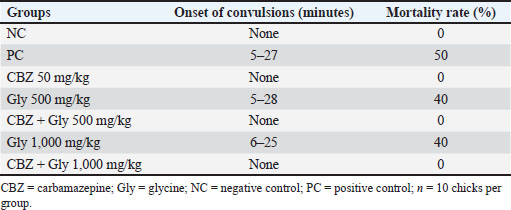
ABSTRACTBackground: Epileptic seizures are common neurological disorders, and the therapeutic use of antiepileptic drugs is often limited due to adverse effects or refractory epilepsy. Aim: The present investigation aimed to explore the anticonvulsant potential of glycine (Gly) and its interaction with carbamazepine (CBZ) in a pentylenetetrazol (PTZ)-elicited convulsive model in chicks by measuring neurotransmitters and inflammatory cytokines in brain tissue. Methods: In this experimental study, 70 broiler chicks were randomly assigned to seven groups. The negative control (NC) was given physiological saline, whereas the positive control (PC) was treated with PTZ (80 mg/kg). The remaining groups received oral administrations of CBZ (50 mg/kg), Gly (500 mg/kg), Gly (500 mg/kg) with CBZ, Gly (1,000 mg/kg), and Gly (1,000 mg/kg) with CBZ for 6 consecutive days. Two hours following the final treatment dose, convulsions were induced by PTZ, and the onset of convulsions was recorded for 30 minutes, and mortality was recorded 3 hours later. Results: CBZ alone and in combination with Gly completely prevented PTZ-induced convulsions and mortality in chicks. Gly (1,000 mg/kg) significantly decreased tumor necrosis factor-α levels, while Gly in combination with CBZ significantly increased gamma-aminobutyric acid (GABA) levels. Conclusion: Gly possesses anti-inflammatory properties, and when combined with CBZ, it enhances the anticonvulsant efficacy of CBZ, which is limited to GABA levels. Further studies are needed to clarify its pharmacological effects in convulsive disorders. Keywords: Anticonvulsant, Cytokines, Neuroinflammation. IntroductionEpileptic seizures are transient manifestations of excessive and synchronous neuronal activity and represent a major neurological disorder affecting both humans and animals (Löscher, 2022; Sumadewi et al., 2023). The pathophysiological mechanism of seizures is characterized by a disruption between excitatory neurotransmitters and inhibitory neurotransmitters (Nartsissov, 2022; Shokr et al., 2025). Glutamate and aspartate represent the main excitatory neurotransmitters of the central nervous system (CNS), which promote neuronal depolarization, hyperexcitation, and lowering of the seizure threshold (Nartsissov, 2022). Gamma-aminobutyric acid (GABA) is the principal inhibitory neurotransmitter in the CNS, acting to modulate neuronal excitability through the activation of GABA receptors; impairment or deficiency in GABAergic signaling can result in excessive neuronal firing and hyperexcitability (Sumadewi et al., 2023). Alongside neurotransmitter imbalance, neuroinflammation plays an essential role in epileptogenesis (Parsons et al., 2022). Seizure activity induces the overproduction of reactive oxygen species, which results in oxidative neuronal injury, neuroinflammation, and increases seizure susceptibility in chicks (Suleiman et al., 2025). Concurrently, raised levels of pro-inflammatory cytokines exacerbate excitotoxicity by enhancing glutamatergic transmission, impairing GABAergic signaling, and altering synaptic plasticity (Sumadewi et al., 2023). Pentylenetetrazol (PTZ) is a widely used convulsant agent in experimental animals such as mice and rats to investigate epileptogenesis, evaluate antiepileptic drugs, and investigate the contribution of neuroinflammation to seizure pathophysiology (Khan et al., 2024). In addition, chicks have been established as valid models for both maximal electroshock and PTZ-induced seizures, demonstrating disturbances in GABA and glutamate levels and elevated proinflammatory cytokines, which are similarly implicated in human epilepsy (Wada et al., 2023; Suleiman et al., 2025). Glycine (Gly) is a non-essential amino acid that performs diverse physiological functions, including acting as a fundamental building block for protein and collagen synthesis, supporting muscle development, tissue repair, and metabolic processes (Ramos-Jiménez et al., 2024; Petkova et al., 2025). It acts as both an inhibitory and excitatory neurotransmitter within the CNS (Nartsissov, 2022). It exerts its inhibitory function in the spinal cord and brainstem via activation of its receptors, which mediate chloride influx, a mechanism crucial for motor control and sensory processing in these regions (Bhumika et al., 2022; Raiteri, 2024). Conversely, in the hippocampus, Gly functions as a co-agonist at N-methyl-D-aspartate (NMDA) receptors, thereby enhancing glutamatergic neurotransmission and promoting synaptic plasticity and cognition (Idiculla et al., 2022; Raiteri, 2024). Gly deficiency impairs NMDA receptor activation, glutamatergic hyperactivity, and lowers the seizure threshold by disrupting the excitatory/inhibitory balance (Bhumika et al., 2022; Dong et al., 2023). Gly administration has been shown to improve characteristics of the nervous system by binding to NMDA receptors, especially decreasing fatigue and improving cognitive symptoms in schizophrenic patients (Soh et al., 2024). The effect of Gly on seizure modulation depends on the receptor subtype engaged; activation of inhibitory Gly receptors contributes to anticonvulsant activity, whereas co-activation of NMDA receptors is potentially proconvulsant (Breitinger and Breitinger, 2020; Gapińska et al., 2025). In addition, Gly has been shown to protect against inflammatory organ injury, including in the liver and brain, by attenuating the inflammatory responses (Elkot et al., 2025; Liu et al., 2026). It has been shown that Gly provides anti-inflammatory effects by reducing tumor necrosis factor–receptor 1, IL-6, IL-1β, interferon-gamma, and resistin (Aguayo-Cerón et al., 2023). Despite most investigations focusing on the isolated effects of Gly on neurochemical and anti-inflammatory properties, and limited attention to its interaction with conventional anticonvulsant therapies such as carbamazepine (CBZ). Therefore, the present study was designed to investigate the anticonvulsant potential of Gly, alone and in combination with CBZ, in a PTZ-induced seizure model in chicks by measuring GABA, glutamate, IL-1β, and tumor necrosis factor-α (TNF-α) levels in brain tissue. Materials and MethodsLaboratory animalsSeventy Ross broiler chicks (1 day old) were obtained from Jeen Hatchery, Duhok, for the experiment. The chicks were housed in the poultry hall under continuous lighting and provided with feed and water ad libitum for 2 weeks. The environmental temperature was maintained between 28°C and 32°C until the birds reached a body weight of 265–340 g, and they were used for the study. Experimental design and seizure inductionThe experimental study consisted of seven groups of chicks randomly assigned using a simple randomization method, with equal numbers in each group. The negative control (NC) group was injected with normal saline (1 ml/kg) subcutaneously, whereas the positive control (PC) group received PTZ (80 mg/kg; Sigma, USA) to induce seizures (Seedo and Hassan, 2016). The third group received CBZ (50 mg/kg; Novartis/Turkey) via oral gavage for 6 consecutive days (Pottoo et al., 2021). The fourth group received Gly (500 mg/kg; G41000-31, Serbia) via oral gavage (Shibui et al., 2013). The fifth group was administered a combination of CBZ (50 mg/kg) and Gly (500 mg/kg) using the same route and duration. Gly (1,000 mg/kg) was given to the sixth group, and the seventh group received Gly (1,000 mg/kg) in combination with CBZ (50 mg/kg) via oral gavage. Two hours after the final treatment dose, convulsions were induced in groups 3–7 by PTZ injection (80 mg/kg). Seizure onset was recorded for 30 minutes using a digital camera, and mortality was recorded three hours later (Suleiman and Hassan, 2022). Collection of brain samplesThree hours after PTZ administration and following an overnight fast, the animals were euthanized via decapitation. The brains were promptly excised and stored at −20°C in plastic containers until biochemical analysis. For homogenization, the frozen brain tissue (100 mg) was mixed with ice-cold PBS (0.9 ml) using an electric homogenizer (Coyote, China) and centrifuged at 5,000 rpm for 10 minutes at 4°C (DRAGONLAB, China). The supernatants were collected and stored at −20°C until biochemical measurements were performed. Measurement of GABA and glutamateGABA concentrations in brain homogenates were determined using a commercially available sandwich ELISA kit (BT LAB, China) in accordance with the manufacturer’s protocol. The assay involves specific antibody–antigen binding, detection with streptavidin-HRP, and the development of a chromogenic substrate. The absorbance was recorded at 450 nm using an ELISA reader (BioTek, USA), and the results were derived from a standard curve and reported as ng/g of brain tissue. Glutamate concentrations in homogenates were determined using a glutamate measurement kit (BT LAB, China) and UV-visible spectroscopy. The assay is based on the enzymatic conversion of glutamate to α-ketoglutarate, producing NADH from NAD+. The amount of NADH, measured at 340 nm, is proportional to the glutamate concentration and expressed as µmol/g of brain tissue (Melo et al., 2012). Measurement of IL-1β and TNF-αBrain levels of IL-1β and TNF-α were quantified using commercial competitive ELISA kits (BT LAB, China) according to the manufacturer’s instructions. The assay relied on competition between endogenous cytokines and biotinylated antigens for antibody binding, followed by avidin-HRP-based signal detection and chromogenic color development. The absorbance was read at 450 nm, and the cytokine concentrations were derived from standard curves and expressed in pg/g of brain tissue. Data analysisAll biochemical data were statistically analyzed using SPSS software (version 23). Differences between the experimental groups were evaluated using one-way analysis of variance, with data presented as mean ± SEM. Duncan’s multiple range test was used for post hoc comparisons, with differences considered statistically significant at p < 0.05. Ethical approvalAll experimental procedures involving animals were conducted in accordance with established ethical standards and were approved by the Local Ethics Committee. Research on animals was performed according to the ethics committee on animal use of the University of Duhok (Approval No. CVM2024/0215/UoD). ResultsThe results presented in Table 1 showed that convulsions were observed within 5–27 minutes in the PC group, 5–28 minutes in the Gly (500 mg/kg), and 5–25 minutes in the Gly (1,000 mg/kg). No signs of convulsion were recorded in the CBZ group and in the groups that received CBZ in combination with Gly. Regarding mortality, the study showed a mortality rate of 50% in the PC group and 40% in both groups treated with Gly at 500 mg/kg and 1,000 mg/kg. No mortality was recorded in the NC, CBZ, Gly 500 + CBZ, and Gly 1,000 + CBZ groups. Table 1. Effect of different treatments on convulsion onset and mortality in chicks following PTZ-induced seizures.
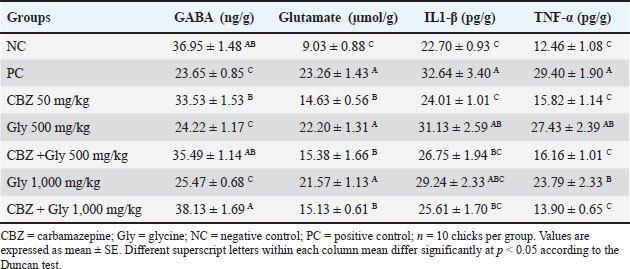
Table 2 presents the effects of CBZ and Gly, individually and in combination, on neurotransmitter and inflammatory markers in chicks with PTZ-induced convulsions. GABA concentration was significantly decreased, while glutamate concentration was increased in the PC group relative to the NC group (p < 0.001). CBZ alone and in combination with Gly groups showed significantly increased GABA levels (p < 0.001) compared to the PC group, with CBZ + Gly 1,000 showing a further increase over CBZ alone (p < 0.01). Gly alone did not alter GABA levels relative to the PC group. On the contrary, glutamate concentrations were significantly reduced in CBZ, CBZ + Gly500, and CBZ + Gly 1,000 groups (p < 0.001) relative to the PC group. No differences were noted between CBZ alone and CBZ + Gly combinations, or between Gly alone and the PC group. Table 2. Effect of Gly on brain tissue parameters in chicks with PTZ-induced convulsive seizures compared to the control groups.
The levels of IL-1β and TNF-α were significantly elevated in the PC group compared with the NC group (p < 0.01 and p < 0.001, respectively). CBZ, CBZ + Gly500, and CBZ + Gly 1,000 pretreatment significantly decreased both IL-1β (p < 0.01) and TNF-α levels (p < 0.001). The Gly 1,000 group alone also showed a significant decrease in TNF-α (p < 0.05) compared to the PC group. No differences were found in either IL-1β or TNF-α levels between the CBZ-only group and those receiving CBZ + Gly in combination. DiscussionEpilepsy is a chronic neurological condition characterized by recurrent seizures that arise from disrupted excitatory–inhibitory balance, and it represents a major challenge in clinical management. Approximately 20%–30% of patients with epilepsy do not achieve adequate seizure control despite treatment with antiepileptic drugs (AEDs) (Chen et al., 2025). Consequently, the adjunctive use of bioactive substances alongside AEDs has been explored to improve the therapeutic efficacy of the drugs through modulation of neurotransmission, attenuation of oxidative stress, and suppression of neuroinflammation (Chaachouay, 2025). PTZ is widely used as a chemoconvulsant to induce seizures in animal models, effectively replicating the pathological features of human epilepsy (Wang et al., 2022). PTZ acts by non-competitively antagonizing GABA receptors, reducing inhibitory signaling, and enhancing glutamatergic activity (Khan et al., 2024). Epileptic seizures are associated with oxidative stress, microglial activation, pro-inflammatory cytokine release, neuroinflammation, and neuronal injury (Monteiro et al., 2024). In the present study, PTZ-induced convulsive seizures significantly reduced GABA levels while increasing glutamate concentrations in chick brain tissue, leading to a pronounced excitatory–inhibitory imbalance that underlies seizure activity. The present findings align with previous rodent and avian models demonstrating impaired GABAergic transmission and elevated glutamate levels (Suleiman and Hassan, 2022; Aleshin et al., 2023). Elevated IL-1β and TNF-α further indicated a neuroinflammatory response that may aggravate excitotoxic neuronal damage (Kamali et al., 2021). PTZ has also been associated with oxidative damage, evidenced by reduced catalase and glutathione reductase and elevated MDA and 8-isoprostane (Suleiman and Hassan, 2022). CBZ is an antiepileptic drug commonly used to manage focal and generalized tonic–clonic seizures, as well as other neurological disorders (Soni and Sahu, 2025). The findings indicate that CBZ prevented the PTZ-induced seizures by increasing GABA levels, reducing glutamate, and decreasing IL-1β and TNF-α in the brain tissue. However, no additional functional anticonvulsant effects were observed when CBZ was combined with Gly, possibly because the selected CBZ dose (50 mg/kg) achieved complete protection against PTZ-induced convulsions and mortality. Consequently, any additional effect of Gly was limited to increased GABA levels rather than functional seizure outcomes. Accordingly, it indirectly supports GABAergic inhibition, helping to maintain the balance between excitatory–inhibitory signaling (Belete, 2023). These results are in line with findings from rodent models demonstrating that CBZ enhanced GABAergic signaling and reduced glutamate levels in PTZ-induced seizures in rats (Barzroodi Pour et al., 2021). Furthermore, the reduction in pro-inflammatory cytokines suggests that CBZ also exerts anti-inflammatory effects by limiting glial activation and neuroinflammatory signaling (Pottoo et al., 2021). Recent evidence suggested that pro-inflammatory cytokines might contribute to the pathogenesis of seizures, and their inhibition could help prevent seizure development (Kamali et al., 2021; Monteiro et al., 2024). Gly is endogenously synthesized in the body and exerts diverse biological effects such as anti-inflammatory and neuroprotective activities (Aguayo-Cerón et al., 2023). The recent poultry study has shown that Gly supplementation (up to 2%) is well tolerated and does not induce adverse effects in chicks, confirming its safety and physiological relevance in chickens (Deng et al., 2023). Although the levels of Gly in the CNS are largely maintained by local synthesis, peripheral Gly can enter the brain through GlyT1 and GlyT2 transporters and modulate neurotransmission (Salceda, 2022). The current results demonstrated that a higher dose of Gly reduced TNF-α levels and exerted neuroprotective effects, likely through suppression of neuroinflammation, activation of Gly inhibitory signaling, and modulation of NMDA receptor activity, and limiting the excitotoxic glutamatergic transmission (Monteiro et al., 2024). Gly could protect the brains of neonatal mice from lipopolysaccharide-induced neuroinflammation and apoptosis (Zubair et al., 2024). Gly triggers the opening of the Gly ion channels, hyperpolarization, and a decrease in intracellular calcium concentration, thereby reducing the synthesis of pro-inflammatory cytokines (Aguayo-Cerón et al., 2023). Studies have reported that Gly had anti-aging and antioxidant effects, and it exerted a protective effect against oxidative injury in rat spinal cord and skeletal muscle tissues after spinal cord trauma (Xu et al., 2024). Previous evidence suggests that combining antiepileptic drugs with agents that modulate inhibitory neurotransmission may enhance GABAergic activity and improve anticonvulsant efficacy (Tabassum et al., 2024). Consistently, pretreatment with CBZ combined with Gly (1,000 mg/kg) resulted in a significant increase in GABA levels. This effect may be attributed to the Gly that facilitates inhibitory neurotransmission and potentiates GABAergic signaling, along with CBZ in the brain (Raiteri, 2024). Gly exerts its function as an inhibitory neurotransmitter and enhances neuronal inhibitory activity, indirectly supporting GABA synthesis or release, thereby augmenting the anticonvulsant action of CBZ (Mizzi and Blundell, 2025). Although direct studies of Gly plus CBZ are scarce in the recent literature, related evidence shows that pairing AEDs with other inhibitory agents yields additive benefits. For instance, co-administration of ferulic acid with CBZ in mice significantly enhanced anticonvulsant efficacy by shortening seizure duration and preventing seizure-induced increases in hippocampal IL-1β (Taheri and Hassanpourezatti, 2025). ConclusionThe present study demonstrates that Gly administration exerts anti-inflammatory properties by reducing TNF-α. When combined with CBZ, Gly enhances anticonvulsant effect, which is limited to increased GABA levels. These findings highlight the potential of Gly not only to modulate inhibitory neurotransmission via Gly receptor activation but also to support GABAergic signaling and attenuate neuroinflammation in the brain tissue. Further research is necessary to clarify the precise cellular and molecular mechanisms responsible for these effects. In addition, histochemical and immunohistochemical studies can reveal how neurotransmitters and inflammatory markers are distributed and altered within specific brain regions. AcknowledgmentsWe gratefully thank the Duhok Research Center, College of Veterinary Medicine, University of Duhok, for their support and provision of research facilities. FundingThe authors did not receive any funding support for this study. Authors’ contributionsJSH designed and supervised the study, contributed to laboratory work, and interpreted the data. SDS conducted the experiments, analyzed the data, and drafted the manuscript. ARH contributed to laboratory work and manuscript drafting. RAK performed laboratory work and assisted with statistical analysis. All authors reviewed, revised, and approved the final manuscript. Conflict of interestThe authors confirm that no conflicts of interest are associated with this study. Data availabilityAll data supporting the findings of this study are available within the manuscript. ReferencesAguayo-Cerón, K.A., Sánchez-Muñoz, F., Gutierrez-Rojas, R.A., Acevedo-Villavicencio, L.N., Flores-Zarate, A.V., Huang, F., Giacoman-Martinez, A., Villafaña, S. and Romero-Nava, R. 2023. Glycine: the smallest anti-inflammatory micronutrient. Int. J. Mol. Sci. 24(14), 11236; doi:10.3390/ijms241411236 Aleshin, V.A., Graf, A.V., Artiukhov, A.V., Ksenofontov, A.L., Zavileyskiy, L.G., Maslova, M.V. and Bunik, V.I. 2023. Pentylenetetrazole-induced seizures are increased after kindling, exhibiting vitamin-responsive correlations to the post-seizures behavior, amino acids metabolism and key metabolic regulators in the rat brain. Int. J. Mol. Sci. 24(15), 12405; doi:10.3390/ijms241512405 Barzroodi Pour, M., Bayat, M., Navazesh, A., Soleimani, M. and Karimzadeh, F. 2021. Exercise improved the anti-epileptic effect of carbamazepine through GABA enhancement in epileptic rats. Neurochem. Res. 46(8), 2112–2130; doi:10.1007/s11064-021-03349-3 Belete, T.M. 2023. Recent progress in the development of new antiepileptic drugs with novel targets. Ann. Neurosci. 30(4), 262–276; doi:10.1177/09727531231185991 Bhumika, S., Basalingappa, K.M., Gopenath, T.S. and Basavaraju, S. 2022. Glycine encephalopathy. Egypt. J. Neurol. Psychiatr. Neurosurg. 58(1), 132; doi:10.1186/s41983-022-00567-6 Breitinger, U. and Breitinger, H.G. 2020. Modulators of the inhibitory glycine receptor. ACS. Chem. Neurosci. 11(12), 1706–1725; doi:10.1021/acschemneuro.0c00054 Chaachouay. 2025. Synergy, additive effects, and antagonism of drugs with plant bioactive compounds. Drugs. Drug. Candidates. 4(1), 4; doi:10.3390/ddc4010004 Chen, Y., Tang, R., Shao, Z., Li, W., Fei, G. and Wang, X. 2025. Risk factors and a nomogram model for drug-resistant epilepsy (DRE) in Asian population. Clin. Neurol. Neurosurg. 256, 109009; doi:10.1016/j.clineuro.2025.109009 Deng, C., Zheng, J., Zhou, H., You, J. and Li, G. 2023. Dietary glycine supplementation prevents heat stress-induced impairment of antioxidant status and intestinal barrier function in broilers. Poult. Sci. 102(3), 102408; doi:10.1016/j.psj.2022.102408 Dong, B., Yue, Y., Dong, H. and Wang, Y. 2023. N-methyl-D-aspartate receptor hypofunction as a potential contributor to the progression and manifestation of many neurological disorders. Front. Mol. Neurosci. 16, 1174738; doi:10.3389/fnmol.2023.1174738 Elkot, M.G., Nematalla, H.A., Abdel-Raheem, I.T. and Ghoneim, A.I. 2025. Protective effects of glycine against diclofenac-induced toxicity in isolated rat hepatocytes. Drug Chem. Toxicol. 48, 1–12; doi:10.1080/01480545.2025.2564433 Gapińska, N., Wlaź, P., Wyska, E., Świerczek, A., Kamiński, K., Jakubiec, M., Abram, M., Ciepiela, K., Latacz, G., Słowik, T., Krokowski, D., Jarosz, Ł., Ciszewski, A. and Socała, K. 2025. Effect of SSR504734, a selective glycine transporter type 1 inhibitor, on seizure thresholds, neurotransmitter levels, and inflammatory markers in mice. ACS Chem. Neurosci. 16(6), 1210–1226; doi:10.1021/acschemneuro.5c00039 Idiculla, P.S., Nagarajan, E., Murala, S. and Bollu, P.C. 2022. Glycine. In: Neurochemistry in clinical practice. Ed., Bollu, P.C. Cham, Switzerland: Springer International Publishing, Vol. 6, pp. 109–132; doi:10.1007/978-3-031-07897-2_6 Kamali, A.N., Zian, Z., Bautista, J.M., Hamedifar, H., Hossein-Khannazer, N., Hosseinzadeh, R., Yazdani, R. and Azizi, G. 2021. The potential role of pro-inflammatory and anti-inflammatory cytokines in epilepsy pathogenesis. Endocr. Metab. Immune. Disord. Drug. Targets. 21(10), 1760–1774; doi:10.2174/1871530320999201116200940 Khan, J.Z., Zainab, S.R., Rehman, M.U., Abid, M., Mazhar, M.U., Shah, F.A. and Tipu, M.K. 2024. Chronic stress intensifies PTZ-induced seizures by triggering neuroinflammation and oxidative stress. Biochem. Biophys. Res. Commun. 729, 150333; doi:10.1016/j.bbrc.2024.150333 Liu, J., Zhang, L., Feng, C., Li, Y., Wu, H., Wang, X. and Li, D. 2026. Glycine attenuates sepsis-induced white matter injury by modulating gut microbiota. Front. Mol. Biosci. 12, 1733207; doi:10.3389/fmolb.2025.1733207 Löscher, W. 2022. Dogs as a natural animal model of epilepsy. Front. Vet. Sci. 9, 928009; doi:10.3389/fvets.2022.928009 Melo, D., Mirandola, S., Assunção, N. and Castilho, R. 2012. Methylmalonate and mitochondrial respiration. J. Neurosci. Res. 90(6), 1190–1199; doi:10.1002/jnr.23020 Mizzi, N. and Blundell, R. 2025. Glycine receptors: structure, function, and therapeutic implications. Mol. Aspects Med. 103, 101360; doi:10.1016/j.mam.2025.101360 Monteiro, A.B., Alves, A.F., Ribeiro Portela, A.C., Oliveira Pires, H.F., Pessoa De Melo, M., Medeiros Vilar Barbosa, N.M. and Bezerra Felipe, C.F. 2024. Pentylenetetrazole: a review. Neurochem. Int. 180, 105841; doi:10.1016/j.neuint.2024.105841 Nartsissov, Y.R. 2022. Amino acids as neurotransmitters. The balance between excitation and inhibition as a background for future clinical applications. In: COVID-19, Neuroimmunology and Neural Function. Eds., Heinbockel, T. and Weissert, R. London, UK: IntechOpen, pp. 1–18; doi:10.5772/intechopen.103760 Parsons, A.L., Bucknor, E.M., Castroflorio, E., Soares, T.R., Oliver, P.L. and Rial, D. 2022. The interconnected mechanisms of oxidative stress and neuroinflammation in epilepsy. Antioxidants 11(1), 157; doi:10.3390/antiox11010157 Petkova, D., Stoyanova, S., Dinkov, G. and Bogdanov, M.G. 2025. Beyond protein building blocks: a review of biological roles and therapeutic potential of free amino acids. Int. J. Mol. Sci. 26(23), 11264; doi:10.3390/ijms262311264 Pottoo, F.H., Salahuddin, M., Khan, F.A., Al Dhamen, M.A., Alsaeed, W.J., Gomaa, M.S., Vatte, C. and Alomary, M.N. 2021. Combinatorial regimen of carbamazepine and imipramine exhibits synergism against grandmal epilepsy in rats: inhibition of pro-inflammatory cytokines and PI3K/Akt/mTOR signaling pathway. Pharmaceuticals 14(11), 1204; doi:10.3390/ph14111204 Raiteri, L. 2024. Interactions involving glycine and other amino acid neurotransmitters: focus on transporter-mediated regulation of release and glycine–glutamate crosstalk. Biomedicines 12(7), 1518; doi:10.3390/biomedicines12071518 Ramos-Jiménez, A., Hernández-Torres, R.P., Hernández-Ontiveros, D.A., Ortiz-Ortiz, M., López-Fregoso, R.J., Martínez-Sanz, J.M., Rodríguez-Uribe, G. and Hernández-Lepe, M.A. 2024. An update of the promise of glycine supplementation for enhancing physical performance and recovery. Sports 12(10), 265; doi:10.3390/sports12100265 Salceda, R. 2022. Glycine neurotransmission: its role in development. Front. Neurosci. 16, 947563; doi:10.3389/fnins.2022.947563 Seedo, S.K. and Hassan, J.S. 2016. Phytochemical analysis and evaluation of anticonvulsant effect of chamomile (Matricaria chamomilla L.) flower extract in chicks. J. Z S 19(1), 35–50; doi:10.17656/jzs.10583 Shibui, Y., Miwa, T., Yamashita, M., Chin, K. and Kodama, T. 2013. A 4-week repeated dose toxicity study of glycine in rats by gavage administration. J. Toxicol. Pathol. 26(4), 405–412; doi:10.1293/tox.2013-0026 Shokr, M., Abdelaziz, A., Nasser, M. and El-Adaway, R. 2025. The possible pathophysiological alterations of epilepsy and its relation with other neurological disorders. SINAI. Int. Sci. J. 1(4), 46–58; doi:10.21608/sisj.2024.303962.1000 Soh, J., Raventhiran, S., Lee, J.H., Lim, Z.X., Goh, J., Kennedy, B.K. and Maier, A.B. 2024. The effect of glycine administration on the characteristics of physiological systems in human adults: a systematic review. Geroscience 46(1), 219–239; doi:10.1007/s11357-023-00970-8 Soni, V.K. and Sahu, T. 2025. A review on carbamazepine in the treatment of epilepsy. WJBPHS 21(2), 432–440; doi:10.30574/wjbphs.2025.21.2.0183 Suleiman, S.D. and Hassan, J.S. 2022. Anticonvulsant and antioxidant activities of crude flavonoid extract of Matricaria chamomilla L. against convulsions induced by pentylenetetrazole in chicks. Iraqi. J. Vet. Sci. 36(4), 1089–1095; doi:10.33899/ijvs.2022.133120.2176 Suleiman, S.D., Hasan, J.S., Jarjees, K.I. and Haji, A.R. 2025. Quercetin attenuates pentylenetetrazol-induced seizures in chicks through antioxidant and anti-inflammatory pathways. J. Adv. Vet. Anim. Res. 12(3), 1037–1044; doi:10.5455/javar.2025.l963 Sumadewi, K.T., Harkitasari, S. and Tjandra, D.C. 2023. Biomolecular mechanisms of epileptic seizures and epilepsy: a review. Acta. Epileptol. 5(1), 28; doi:10.1186/s42494-023-00137-0 Tabassum, S., Shorter, S. and Ovsepian, S.V. 2024. Analysis of the action mechanisms and targets of herbal anticonvulsants highlights opportunities for therapeutic engagement with refractory epilepsy. J. Mol. Med. 102(6), 761–771; doi:10.1007/s00109-024-02445-5 Taheri, E. and Hassanpourezatti, M. 2025. Ferulic acid attenuates seizure severity and enhances valproate and carbamazepine seizure preventing efficacy by regulating hippocampal interleukin-1β level and antioxidant capacity in mice. Oxid. Med. Cell Longev. 2025, 8832818; doi: 10.1155/omcl/8832818 Wada, A.S., Shuaibu, A.B., Abubakar, A.B., Huguma, M.A., Ahmad, A., Sani, I.H., Abdussalam, U.S., Nazifi, A.B., Umar, S., Malami, S. and Yaro, A.H. 2023. Preliminary anticonvulsant activity of some medicinal plants in animal models of seizures. Bayero J. Pure Appl. Sci. 14(1), 196–201; doi:10.4314/bajopas.v14i1.31S Wang, Y., Wei, P., Yan, F., Luo, Y. and Zhao, G. 2022. Animal models of epilepsy: a phenotype-oriented review. Aging. Dis. 13(1), 215–231; doi:10.14336/AD.2021.0723 Xu, X., Zhang, C.J., Talifu, Z., Liu, W.B., Li, Z.H., Wang, X.X., Du, H.Y., Ke, H., Yang, D.G., Gao, F., Du, L.J., Yu, Y., Jing, Y.L. and Li, J.J. 2024. The effect of glycine and N-acetylcysteine on oxidative stress in the spinal cord and skeletal muscle after spinal cord injury. Inflammation 47(2), 557–571; doi:10.1007/s10753-023-01929-9 Zubair, S., Jahan, R., Jan, A., Zeb, S. and Shah, S.A. 2024. Glycine mitigates lipopolysaccharide induced neurotoxicity via inhibition of TLR-4 signaling pathway in developing mice brain. J. Saidu. Med. Coll. 14(4), 367–373; doi:10.52206/jsmc.2024.14.4.870 | ||
| How to Cite this Article |
| Pubmed Style Hasan JS, Suleiman SD, Haji AR, Khanamir RA. Effects of Glycine in Combination with Carbamazepine in Pentylenetetrazol-Induced Convulsions in Chicks. doi:10.5455/OVJ.2026.v16.i6.67 Web Style Hasan JS, Suleiman SD, Haji AR, Khanamir RA. Effects of Glycine in Combination with Carbamazepine in Pentylenetetrazol-Induced Convulsions in Chicks. https://www.openveterinaryjournal.com/?mno=308949 [Access: June 28, 2026]. doi:10.5455/OVJ.2026.v16.i6.67 AMA (American Medical Association) Style Hasan JS, Suleiman SD, Haji AR, Khanamir RA. Effects of Glycine in Combination with Carbamazepine in Pentylenetetrazol-Induced Convulsions in Chicks. doi:10.5455/OVJ.2026.v16.i6.67 Vancouver/ICMJE Style Hasan JS, Suleiman SD, Haji AR, Khanamir RA. Effects of Glycine in Combination with Carbamazepine in Pentylenetetrazol-Induced Convulsions in Chicks. doi:10.5455/OVJ.2026.v16.i6.67 Harvard Style Hasan, J. S., Suleiman, . S. D., Haji, . A. R. & Khanamir, . R. A. (2026) Effects of Glycine in Combination with Carbamazepine in Pentylenetetrazol-Induced Convulsions in Chicks. doi:10.5455/OVJ.2026.v16.i6.67 Turabian Style Hasan, Jian Salam, Suleiman Dawood Suleiman, Aziza Raof Haji, and Ramadhan Ado Khanamir. 2026. Effects of Glycine in Combination with Carbamazepine in Pentylenetetrazol-Induced Convulsions in Chicks. doi:10.5455/OVJ.2026.v16.i6.67 Chicago Style Hasan, Jian Salam, Suleiman Dawood Suleiman, Aziza Raof Haji, and Ramadhan Ado Khanamir. "Effects of Glycine in Combination with Carbamazepine in Pentylenetetrazol-Induced Convulsions in Chicks." doi:10.5455/OVJ.2026.v16.i6.67 MLA (The Modern Language Association) Style Hasan, Jian Salam, Suleiman Dawood Suleiman, Aziza Raof Haji, and Ramadhan Ado Khanamir. "Effects of Glycine in Combination with Carbamazepine in Pentylenetetrazol-Induced Convulsions in Chicks." doi:10.5455/OVJ.2026.v16.i6.67 APA (American Psychological Association) Style Hasan, J. S., Suleiman, . S. D., Haji, . A. R. & Khanamir, . R. A. (2026) Effects of Glycine in Combination with Carbamazepine in Pentylenetetrazol-Induced Convulsions in Chicks. doi:10.5455/OVJ.2026.v16.i6.67 |


